


Like a sailboat lying broadside to a supertanker’s wake, the Enterprise IT market is experiencing turbulence in the wash of massive AI infrastructure spending. With prices escalating, the LAN (Local Area Network) equipment market is already beginning to heel, and as the wake of the AI revolution spreads, more upheaval is on its way.
The first consequence of the trillions being spent on data center infrastructure is the shortage of available components left over for everyone else. Enterprise IT equipment, such as Wireless LAN (WLAN) Access Points and Campus Switches, is built using components that are not nearly as cutting edge and high performance as the ones that go into data center infrastructure for AI training. The IT market is facing shortages, nonetheless.
AI Infrastructure Spending Is Driving DDR4 Memory Shortages
Memory, in particular, has been front and center of collateral damage (see: The Growing Memory Tax on AI Infrastructure). IT networking equipment uses an older generation memory (DDR4), but when the handful of memory producers shifted focus to the insatiable demand for High Bandwidth Memory for AI, DDR4 became hard to obtain, and therefore more expensive.
And “more expensive” seems like an understatement.
Over the past year, the spot price of DDR 8 Gbps memory chips has grown 788%. Vendors don’t usually pay spot prices, but this escalation demonstrates the kind of contract price pressures that systems vendors are facing.
WLAN and Campus Switch Prices are Growing as Memory Costs Escalate
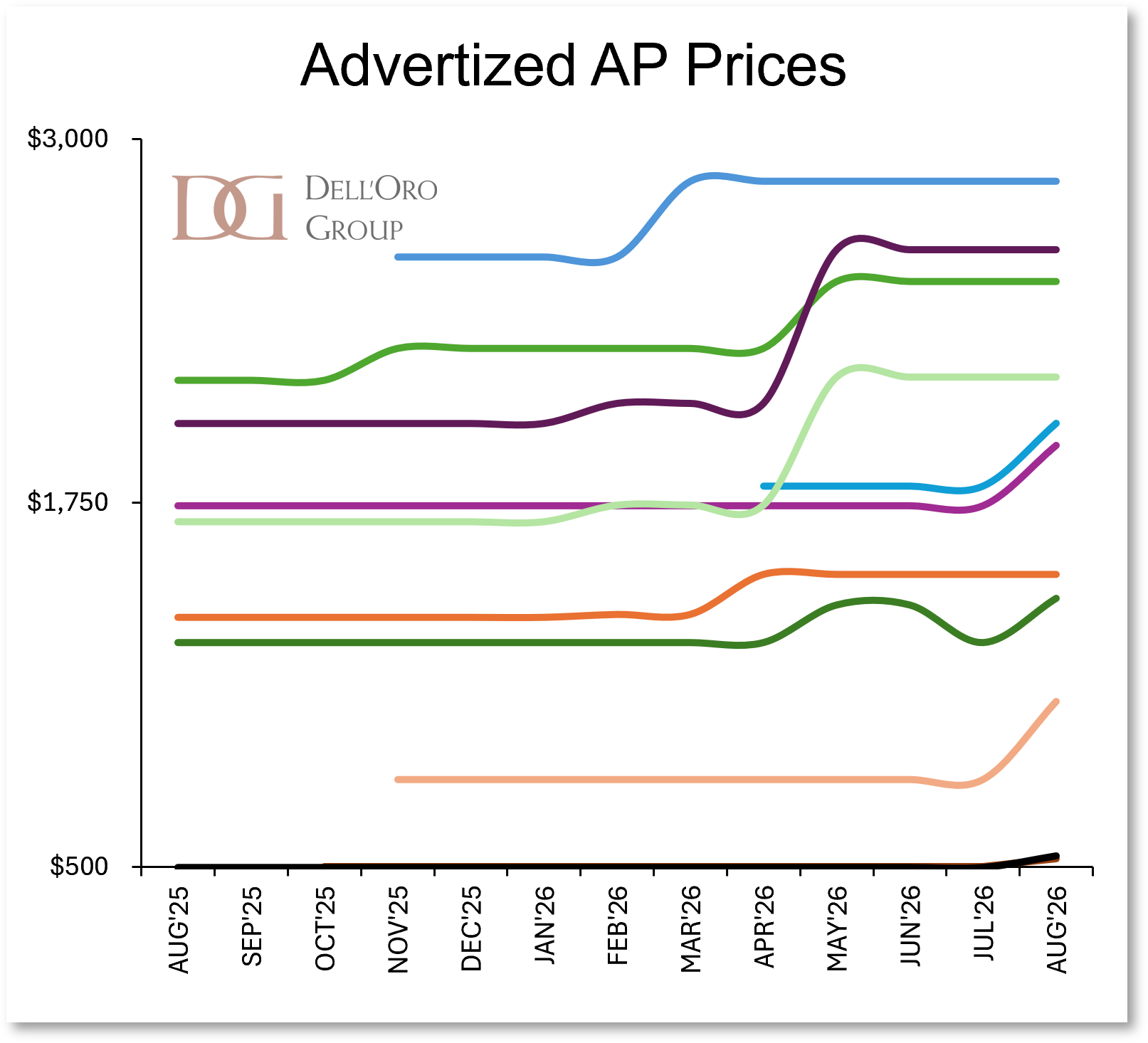
Historically, memory was a small piece of IT equipment’s total cost to produce. For Campus Switches and WLAN, it was in the range of low-to-mid single digits of the total bill of materials. But a component that represents 5% of the cost of a piece of equipment, and then grows in cost by 8 times, will increase the total cost of the equipment by 30%.
It is no wonder that nearly all WLAN and Campus switch vendors have increased prices at least once in the past year (some several times), as shown in a price graph of some of the most popular WLAN APs on the market.
Two years ago, WLAN or Campus Switch designs considered memory as a minor detail in the total cost equation, such that the equipment was not originally designed with memory efficiency in mind. Even worse, in some cases, equipment was deliberately designed with more memory than required, to help make it future-proof and able to support yet-unknown applications.
Unfortunately, a simple swapping of one memory chip for a cheaper one inside a Campus Switch or WLAN AP is not as easy as it sounds. A new chip may involve a different board layout or power design; it may trigger firmware changes that would require regression testing. A design change may necessitate new certifications in each market, adding costs and delays before a new product can be released.
This has left vendors scrambling to secure sources of memory in order to ensure a continued supply of APs and Campus Switches to the market. Lead times on some products have been variable, and vendors have shortened validity times for the quotes they issue, leaving them room to react to uncertain component pricing and availability.
Memory Shortages Are Expected to Shape the Enterprise LAN Market Until 2028
By 2Q26, most equipment vendors had reassured investors that sufficient memory supply has been secured for the next year or two. However, supply shortages may still cause industry leaders some seasickness, and are likely to play out as follows:
- Switch and AP prices are expected to rise even higher, although price growth should slow. With high levels of inflation affecting both DDR4 and DDR5, equipment prices are likely to remain elevated for several years.
- Market demand could be suppressed. Although we have not witnessed any drastic downturns yet, it is common for enterprises to choose to wait to upgrade equipment or choose to take on smaller projects in order to avoid exceeding pre-established budgets.
- Equipment lead times may continue to be uneven. Vendor terms and conditions (on returns, order cancellations, and quote price validity) are expected to remain tight.
- Vendors may look for redesign opportunities, taking advantage of natural transition points (such as the introduction of Wi-Fi 8, or accelerated end-of-life dates) in order to deliver new, more memory efficient designs.
The return to some kind of memory supply-demand equilibrium is likely to occur as more memory-efficient equipment is released, and as more memory producers ramp up production. These conditions are unlikely to be met before 2028.
Memory shortages are just one of the ways the LAN equipment market will be rocked by AI. AI models are heightening cyber risks in the LAN, causing enterprises to perform security audits and focus on equipment patching and renewal. Looking further ahead, once AI use cases are widely disseminated, there’s the possibility that LAN traffic patterns will change, leading to network redesigns. Under the pitch and roll of AI impacts, the IT industry will need to hold tight and focus on the horizon.
