


In previous blogs, I’ve argued that the vCMTS was just the first application on a broader edge compute cluster. This perspective wasn’t new, as it evolved from discussions with operators and vCMTS suppliers who saw the potential of converging applications and functions into a common platform. Throughout all of those discussions, it became clear that, once the MAC runs in software on commodity servers, the same cluster can take on vBNG (Virtual Broadband Network Gateway) functions for fiber subscribers, vWAG (Virtual Wi-Fi Access Gateway) functions to manage residential and public Wi-Fi, and potentially even the AGF (Access Gateway Function) of the mobile core for operators with FWA (Fixed Wireless Access) subscribers.
More immediately, the initial vCMTS cluster can also carry the telemetry and AI/ML that cable operators deploying DOCSIS 4.0 with a network of smart amplifiers are now demanding. Further, the initial cluster can also evolve to support PNM and PMA functions, ultimately providing core service assurance functions of traditional OSS platforms.
In the last few months, two of the leading vCMTS vendors have either launched expanded capabilities or acquired key functions that move them closer to this idea of the original vCMTS expanding into what we are tentatively calling a “Converged Broadband Edge.” Vecima acquired PNM specialist Akleza and its CableDiag platform on September 21st, while Harmonic launched its sensAI solution on September 8th, followed by its fiber-focused Recon on September 30th.
From vCMTS to Converged Broadband Edge Architecture
Converged, in this context, doesn’t just imply the combination of virtualized access network functions, such as the vCMTS and vBNG. It also implies the convergence of AI and network analytics tools, as well as edge compute resources to support localized and distributed AI agents using small language models (SLMs) and CDN elements to support caching and network security services, for example (Figure 1).
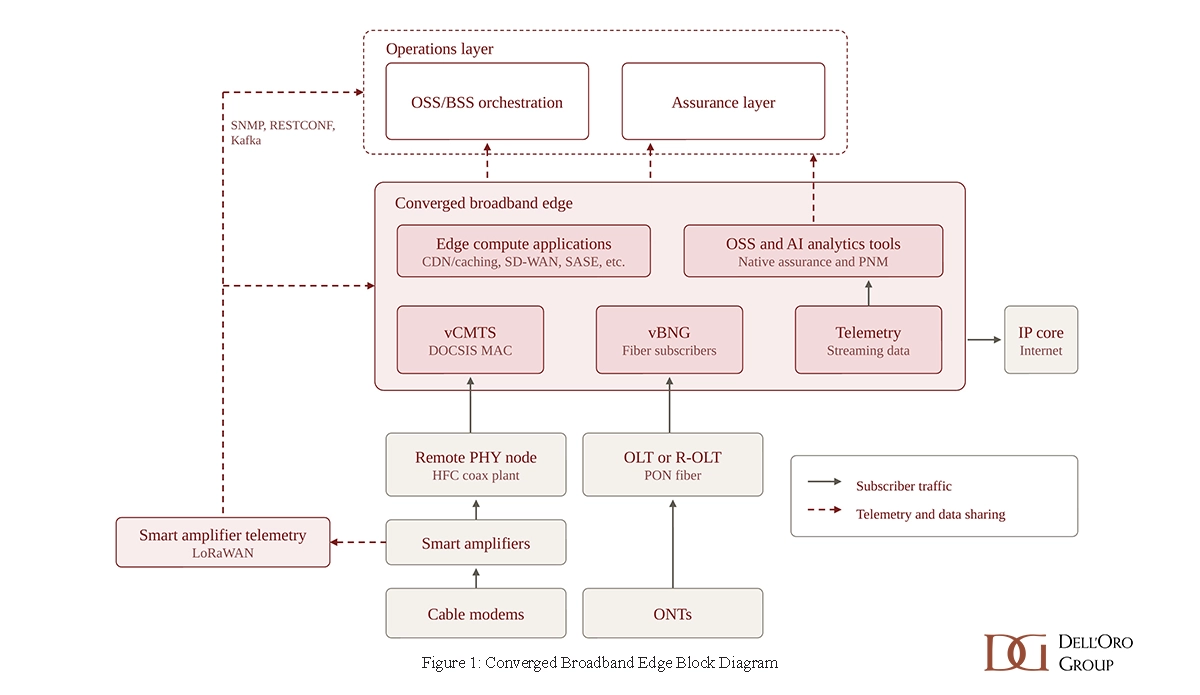
For operators, this Converged Broadband Edge essentially functions as a control plane across their entire access network, initially extending the traditional function of the CMTS as the operator’s window into their HFC plant via the cable modems and extending it to nodes, RPDs, and even smart amplifiers. Inside the Converged Broadband Edge, OSS and AI analytics tools run on the same compute resources, gather enhanced telemetry from the plant, and correlate it with fiber, Wi-Fi, and amplifier signals traditional CMTS platforms never saw. The vCMTS continues to generate the MAC-layer telemetry, but now the analysis of that telemetry and event triage and troubleshooting decisions can be made on the same compute resources.
Long-Term Growth from Recurring Revenue
Consolidating network functions at the edge obviously has benefits for cable operators. But for the platform vendors, it also introduces the opportunity for recurring revenue well beyond traditional capacity- or subscriber-based licensing. Within the next couple of years, additional vCMTS cluster deployments will slow. New server deployments and licenses will continue to be purchased as subscriber growth returns and as capacity requirements by service group continue to expand. But that additional revenue won’t be equal to the current combination of initial cluster deployments and capacity expansions.
So, supplementing that revenue with some combination of subscription or consumption-based revenue from the additional telemetry, AI, and service assurance capabilities makes a lot of sense for these vendors. Because the Converged Broadband Edge platforms can scale up or down easily based on the size and requirements of the operator, they can either offer a bundled service assurance software stack based on the size of the existing server cluster, or provide a subscription-based service priced per subscriber, node, or service group.
Is This What Operators Want?
From an architectural standpoint, the consolidation of network functions, telemetry, PNM, and service assurance at the edge makes a lot of sense. The end-to-end visibility that is provided can be incredibly valuable, especially as broadband providers look to differentiate their networks as much on reliability as speed.
But there is also something to be said for continued specialization and separation of functions, especially in cases where many of these functions already exist in larger operator networks. For decades, cable operators had highly centralized CMTS platforms that delivered subscriber services, but also polled cable modems to determine if there were any network performance issues. Over time, CMTS platforms were able to expand the amount of telemetry they could ingest, peaking with today’s vCMTS platforms. The telemetry that today’s vCMTS platforms can take in and provide to existing OSS platforms is exponentially greater than before.
But for some operators, that functional separation between the vCMTS and OSS platform is what they are used to and what they would prefer to stick with—particularly in an environment where the cost of new physical servers continues to skyrocket. Also, they may already have long-term maintenance and support contracts in place for their OSS platforms, so an expansion of the vCMTS into the realm of service assurance might be viewed as redundant.
Edge AI and CDN Services: The Next Growth Opportunity?
Long-term, it could turn out that Converged Broadband Edge platform revenue will rely less on the incorporation of service assurance and OSS engine functions and more on the integration of edge AI inferencing functions, offering AI application providers a balance between performance and cost. These platforms could serve as distributed edge nodes for CDN software, similar to how Comcast and Fastly are collaborating to improve live streaming content for Comcast’s subscribers. Supporting and expanding those edge processing functions could take priority over the expansion of service assurance functions, particularly if cable operators need to demonstrate growth opportunities beyond traditional broadband services.
