


Liquid cooling and high-density power dominated the data center physical infrastructure agenda at a sold-out summit. In a week when credit markets fretted, the show floor shrugged.
Standing Room Only
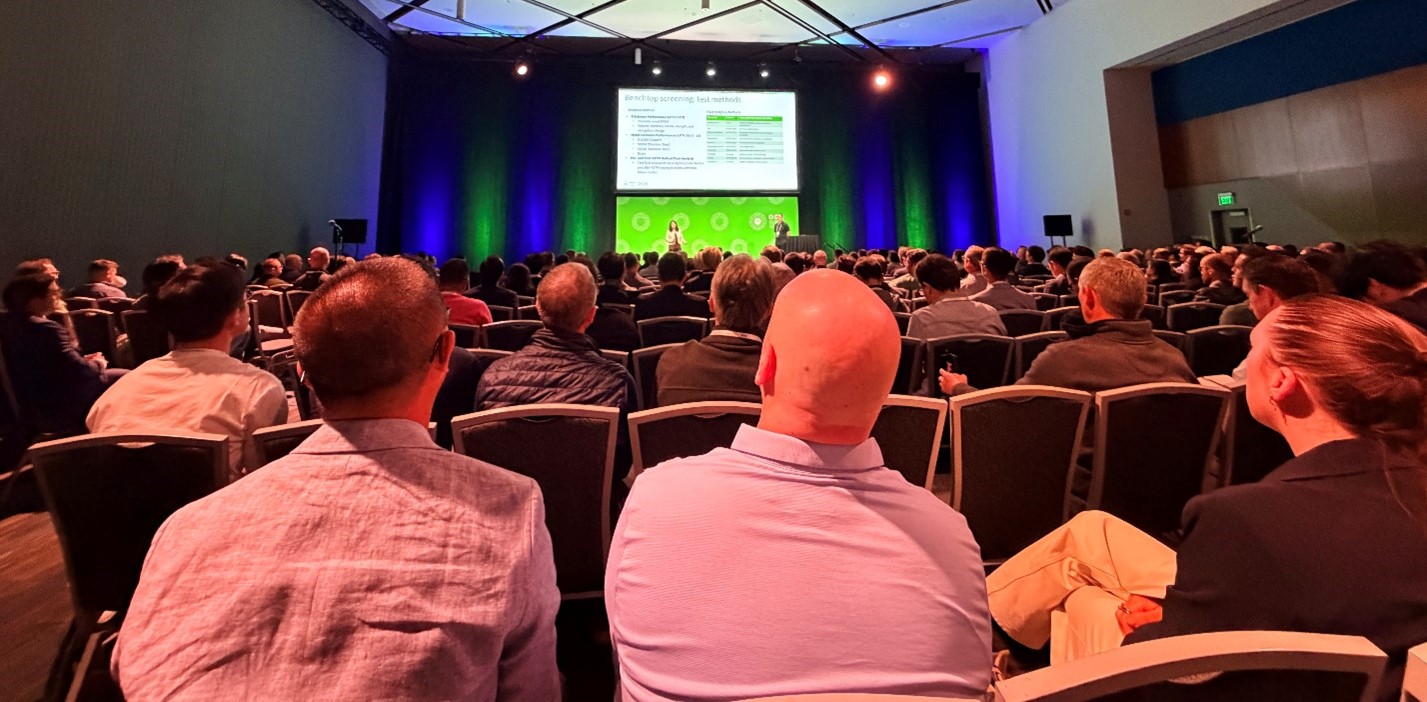
The 2026 Open Compute Project (OCP) Global Summit closed on Thursday, October 15, as the largest edition yet. The event sold out, drawing roughly 15,000 attendees to the San Jose McEnery Convention Center, with about 3,000 more left on a waitlist. A year earlier, the count was less than 11,000. Many sessions were packed to capacity, starting with AMD CEO Lisa Su’s opening keynote on Monday. Shut out of packed rooms, attendees followed along on their phones from the hallways.
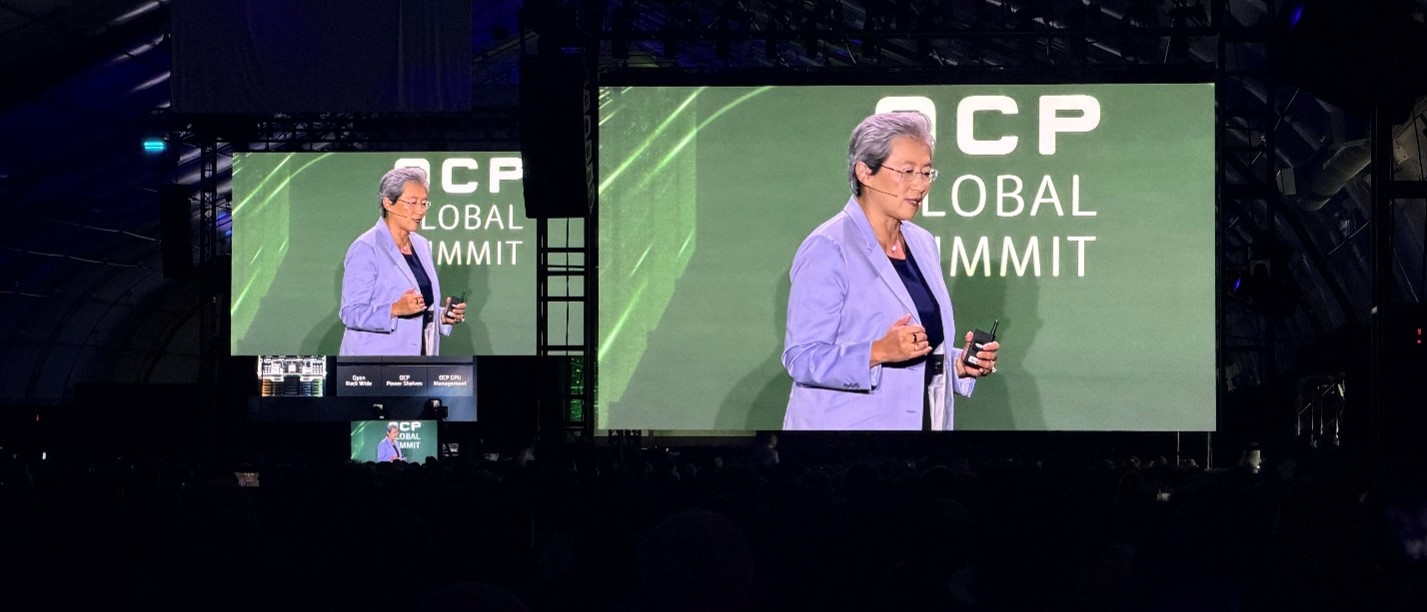
Relief is on the way. Next year, the summit moves to the Moscone Center in San Francisco, a substantially larger venue more in keeping with the stature OCP has gained in the AI economy. San Jose has been outgrown.
Pacing the Frontier, Racing the Buildout
On the floor, the mood matched the attendance. From concrete pourers to electrical engineers and thermal specialists, the people who build AI data centers have been working at breakneck speed for the past three years. Nothing on their order books suggests that is about to change.
Beyond the convention center, the backdrop was more uncertain. In September, Anthropic CEO Dario Amodei argued in “We Must Pace the Frontier” that AI developers should deliberately slow the advance of model capabilities, while stressing that pacing does not mean halting training. The frontier may be paced. The buildout is running at full throttle.
Credit markets fired a warning shot of their own. As the summit wrapped up, CoreWeave’s credit default swaps hit a record, pricing in more than 60% odds of default within five years. The topic came up in conversations, yet the crowd seemed unfazed. Sheer optimism prevailed, even if laced with a blasé disbelief at current growth rates.
Jensen’s Maths, Revised
On the IT side, optics stole the show. NVIDIA and Cisco introduced USFP, an optical module that fits four times the bandwidth into roughly the same space. Broadcom brought co-packaged optics, which sit right beside the switch chip to save power, and Wiwynn, Ayar Labs, and GUC showed the same approach on compute. Optical links are moving from the edge of the network toward the heart of the compute domain.
That migration changes what NVL576 means. At GTC 2025, NVIDIA unveiled Kyber as NVL576 by counting dies instead of GPUs: 144 GPUs with four dies each. Call it Jensen’s maths. NVIDIA has since dropped the die count, so Kyber got renamed NVL144. NVL576 has been repurposed. It now describes eight MGX racks of 72 Rubin Ultra GPUs each, joined into a single NVLink domain with copper inside each rack and optics between them. NVIDIA previewed the 576-GPU fabric again in San Jose—with NVL1152 expected to follow.
For physical infrastructure, this is a subtle but consequential shift. Copper NVLink reaches only a few feet, which is why the scale-up domain has grown by packing more GPUs into a single cabinet. Optics loosen that constraint, blurring the line between scale-up and scale-out. If the domain can stretch across racks, the pressure to cram ever more silicon into one enclosure eases. Adding the migration of AI workloads from training to inference may cause the rack density trend to lose momentum.
But density is not going backward. NVIDIA’s MGX 1.2 specification supports racks up to 250 kW. Meanwhile, the OCP community sees a clear path to 1 MW racks—even if they arrive later and prove rarer than earlier roadmaps implied.
Plate Expectations
For the physical infrastructure community, the headline topics came as no surprise: liquid cooling and high-density power, the two pillars that make dense accelerated compute racks possible. Three shifts stood out on the floor. The cold plate took the spotlight from the coolant distribution unit (CDU). The 800 Vdc sidecar arrived in force. And solid-state transformers drew crowds well ahead of volume deployments.
At previous shows, the CDU took center stage. This year, it was all about the cold plate, the heart of direct-to-chip liquid cooling. This is not to suggest that CDUs were missing. CoolIT previewed its 3 MW CHx3000, integrated with Ecolab’s fluid monitoring suite, a sign that the acquisition is already bearing fruit. Cooler Master unveiled a 2.5 MW floor-mount unit, while Delta showed one of equal capacity running on 800 Vdc power. Rittal introduced an in-house CDU delivering more than a megawatt as part of its RiMatrix HPC architecture. Nidec, making its OCP debut, brought a 3.2 MW in-row prototype. Multi-megawatt is now table stakes.
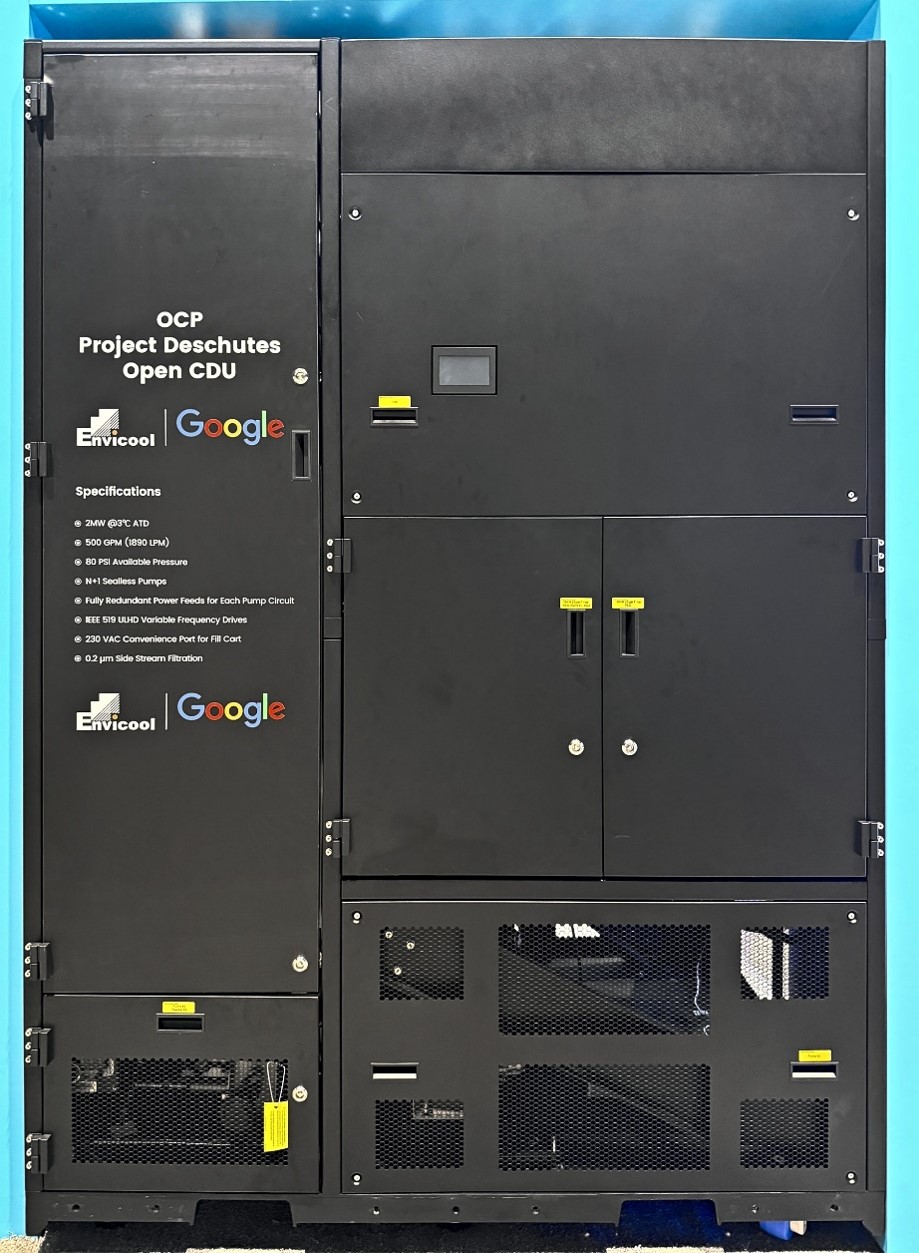
The Project Deschutes design was also present, notably at the Envicool and Delta booths, the latter gearing up to mass-produce its Deschutes model in 1Q 2027. Yet it was eclipsed by the latest merchant designs. With the open specification at version 1.0 and a version 2.0 expected soon, some vendors may be holding fire. Others may see a design built around a single customer as not meriting the hefty investment of prime real estate on the show floor.
The real attention went to cold plates, where participation grew considerably. Established specialists such as Cooler Master and Auras continued to push the extension of direct liquid cooling beyond processors to memory, high-speed interfaces, and power delivery, while CoolIT unveiled its partnership with Stäubli on cold plates for pluggable optics. Jabil showcased the microchannel expertise it acquired with Mikros Technologies to handle more extreme heat fluxes. Start-up Frore Systems and IP specialist Adeia brought their own approaches, and xFusion presented diamond-copper composite cold plates. In the hallways and sessions, newcomers from adjacent industries, such as Conflux, were scouting their way into the data center.
As we detailed in our Data Center Liquid Cooling Advanced Research Report, every new silicon generation tests whether single-phase cold plates can keep up, turning a small component into a strategic asset. Large thermal management players have taken note. Earlier this year, Johnson Controls acquired Alloy Enterprises, whose stack forging process produces aluminum and copper cold plates, while Vertiv bought Strategic Thermal Labs, adding cold plate design and server-side validation. The show floor confirmed what the deal flow implied: value in liquid cooling is expanding beyond the CDU.
Phase Two: Two-Phase
If every new silicon generation puts single-phase to the test, two-phase direct-to-chip cooling is the contender waiting in the wings. The technology drew more interest in hallway conversations than in previous years, and both leading specialists came to make their case. ZutaCore demonstrated direct-to-die two-phase cooling on a running Blackwell GPU while MiTAC showed ZutaCore’s technology on its own servers. Accelsius answered with scale, expanding its Austin lab to multi-megawatt capacity for two-phase testing and teasing a 375 kW multi-rack unit. Beyond the specialists, Cooler Master previewed refrigerant-based cold plate loops still in development.
The OCP Foundation itself describes the transition to two-phase as looming, and a new OCP paper on thermal boundaries sets a threshold for single-phase cold plates that chip roadmaps may reach sooner rather than later. The interest likely reflects a growing sense of inevitability. Each year brings the two-phase era a little closer, but each year single-phase extends its runway a little further. Where one runway ends and the other takes off will constitute the battleground of the next few years.
Riding Sidecar
On the power side, the industry is coalescing around 800 Vdc, even if parts of the ecosystem, especially safety, protection, and insulation, still have ground to cover. OCP’s updated LVDC white paper now spans DC distribution up to 1,500 Vdc. Microsoft contributed new versions of its Mt Diablo power sidecar specification, which began life at ±400 Vdc. NVIDIA dedicated a session to protection and fault management, ABB and Eaton shared a keynote on the shift to DC distribution, and Vertiv explored how OCP could standardize the way solid-state circuit breakers behave and report faults.
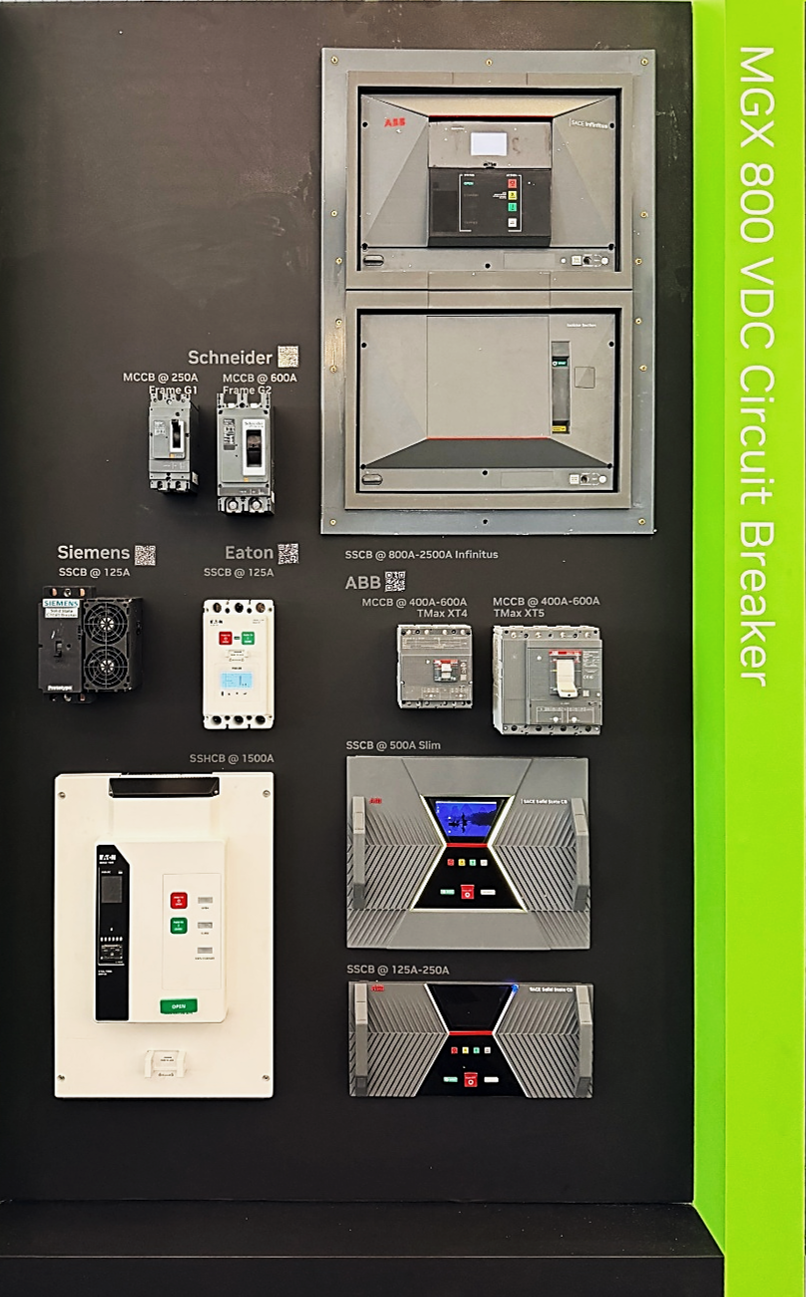
Solid-state circuit breakers, designed to clear faults within microseconds, are getting closer to market, with SolarEdge and Infineon deepening their collaboration on a silicon carbide-based design. Electrical heavyweights ABB, Schneider Electric, Siemens, and Eaton also brought their own 800 Vdc protection and power hardware to NVIDIA’s MGX wall. The full chain still needs work. The industry has yet to determine the appropriate balance between solid-state and thermal-magnetic breakers, the design of DC PDUs, and how much battery and capacitance to install across the system—and where. Operating at these voltages also raises questions about arc-flash mitigation and controlling fault currents shaped by system inductance.
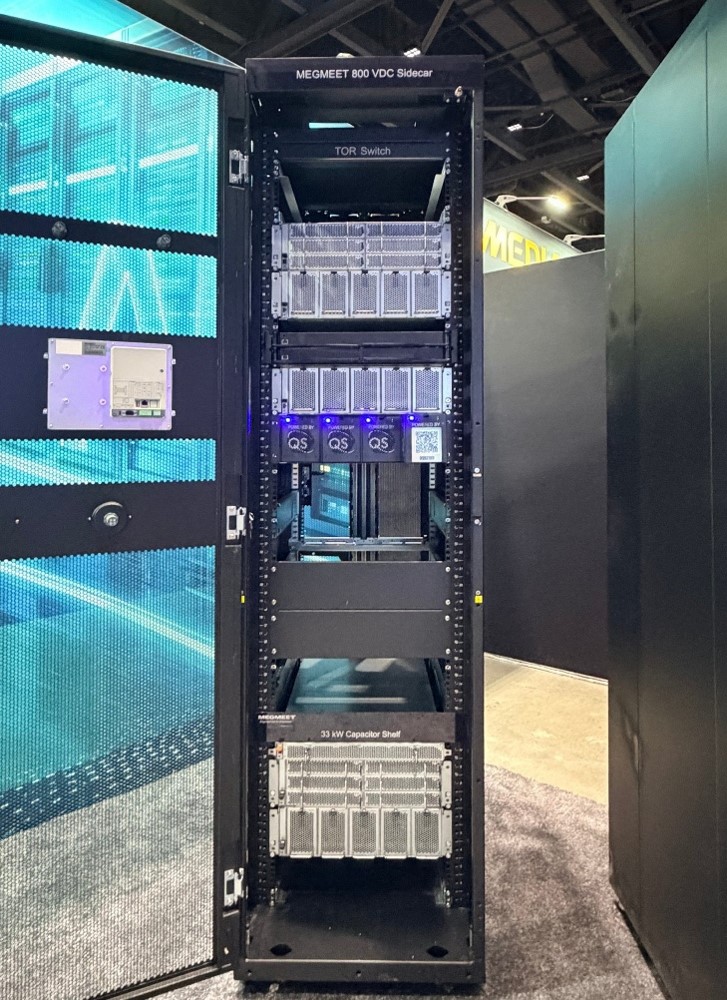
Even so, while the upstream 800 Vdc architecture remains an object of engineering ambition and speculation, the sidecar is here. Sitting beside the IT rack, it converts AC power to 800 Vdc, while taking the power shelves and battery backup out of the server rack. It was the star of the show—no, make that a constellation.
Traditional power shelf suppliers came out in full force. Delta displayed a 660 kW in-row power rack with 480 kW of integrated battery backup, Lite-On brought 800 Vdc racks and supercapacitor backup units, and AcBel, Advanced Energy, Murata, and Flex (soon to be spun off as Axiom Solutions) all staked out 800 V roadmaps. Facility power leaders Eaton and Vertiv were in the mix, too.
Then came the new entrants. Shenzhen-based Megmeet put 800 Vdc front and center, xFusion showed a sidecar prototype scaling from 300 kW to 1.2 MW, and white-label UPS manufacturer Voltronic Power joined the race. Perhaps most telling, auto parts giant Bosch is supplying its EV-derived 800 V power electronics for a Rittal sidecar demonstrator designed to scale to 2 MW. When the automotive supply chain shows up, a market has arrived.
Solid-State of Play
Solid-state transformers (SSTs), meanwhile, remain the darlings of the industry. Specialists DG Matrix and Heron Power exhibited at the show for the first time, both flush with capital after raising $60 million and $140 million respectively earlier this year. DG Matrix launched Interport 360 Flex, a skid-mounted system built on its SST cell that takes up to 34.5 kV AC and delivers native 800 Vdc. Solar power companies joined them on the MGX wall. SolarEdge displayed an SST cell while its full system undergoes validation, Sungrow showed components of its EnerNeo SST, and Delta demonstrated direct conversion from medium-voltage AC to 800 Vdc.
The hype is understandable. By folding the transformer, rectifier, and much of the switchgear into power electronics, the SST promises a leaner path from grid to rack. OCP’s draft SST design specification already targets units of up to 10 MW, with at least 98% efficiency from half to full load. Yet volumes remain modest, field reliability is unproven at scale, and protection and grounding practices are still being written. The real test will come as 800 Vdc moves upstream, from the sidecar to the facility.
Good Grid Citizens
Energy extended well beyond the rack. Google, Meta, Microsoft, and NVIDIA jointly published an OCP Grid Resilience Specification that targets restoring near-full load within two seconds of a grid disturbance. OCP launched a new Energy Project covering generation and storage, issued requirements for energy storage systems, and formed an alliance with EPRI and Current/OS on how data centers interact with the grid. On the floor, battery backup units, supercapacitor shelves, and fuel-cell microgrids sat alongside the racks they serve. The data center is learning to behave like a grid asset rather than just a grid load.
Quieter on the Newswire
Physical infrastructure giants were notably quieter on the newswire than a year ago. At OCP 2025, Vertiv, Eaton, Schneider Electric, ABB, and others rallied around NVIDIA’s 800 Vdc architecture with a wave of product previews and reference designs. This year, the majors spoke from the stage and the booth rather than through product launches. With so many vendors closely tied to NVIDIA, the bigger names may be saving their news for GTC Berlin, which opens on October 20. Industrial AI tops the agenda, befitting the heart of Europe’s manufacturing economy, and Siemens, Schneider Electric, ABB, and Vertiv are expected to arrive in force, announcements in hand.
Next Stop, Non-Stop to Moscone
Disruption is no stranger to the data center, and the ecosystem continues to evolve at speed. Across the products showcased in San Jose, OCP is pointing to what comes next. Energy is the topic at hand: from 800 Vdc distribution and solid-state conversion to storage and grid interaction. All in all, a great show. We look forward to seeing it in even greater scale at Moscone in 2027. In the meantime, you’re invited to connect with us at Dell’Oro Group to discuss these trends.
Off the Wire
