


Last week, I attended Cisco Live 2026 in Vegas. In a blog published last week, I discussed how Cisco Live 2026 framed AI as a catalyst for enterprise-wide infrastructure modernization, beyond just the data center. In this blog, I would like to double click on Cisco’ AI data center strategy as framed and communicated by Tom Gillis, Kevin Wollenweber, Will Eatherton and Murali Grandluru.
At Cisco Live 2026, the AI infrastructure story continued to move beyond the simple question of who can attach the most GPUs to the fastest network. The more interesting question, especially for non-hyperscale customers is now operational: how do customers design, deploy, secure, validate, and manage AI data centers at a pace that matches the market?
The strategy session with Kevin Wollenweber and Will Eatherton made clear that Cisco sees AI data center infrastructure as a multi-layered opportunity. The company is not only building faster switches or partnering around GPU platforms. It is assembling validated reference architectures, GPU vendor ecosystems, front-end and back-end fabrics, orchestration, observability, and segment-specific engagement models for neoclouds, and enterprises, driving the next wave of the AI adoption.
AI Network Cycles Are Compressing
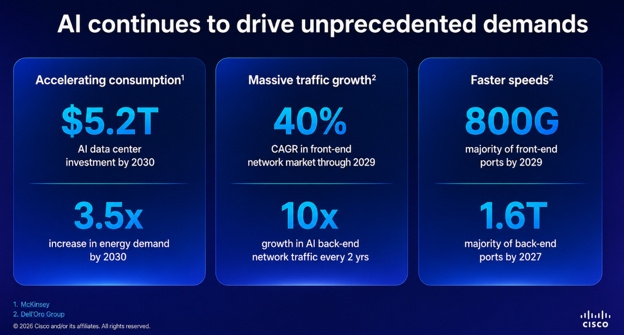
Traditional network refresh cycles that once stretched three to four years are now compressing toward 12 to 18 months. That is a major shift for data center planning, procurement, and architecture teams.
In front-end networks, the market is moving toward 800 Gbps connectivity over the next few years. In the back-end, fabrics are advancing toward 1.6 Tbps and 3.2 Tbps speeds at an unprecedented pace. These are not incremental changes. They reflect the pressure AI workloads are putting on every part of the network fabric.
The reason is straightforward: AI workloads are changing faster than traditional enterprise applications. Training clusters, inference systems, retrieval-augmented generation, and agentic workflows each stress the infrastructure differently. The network must adapt as workload patterns evolve, and customers want architectures that can absorb those shifts without forcing constant redesign.
Different Customers Need Different AI Data Center Models
At Cisco Live 2026, it was clear that Cisco is not treating the AI data center market as one homogeneous segment. Hyperscalers, neoclouds, and enterprises are moving at different speeds and making different tradeoffs.
Hyperscalers are engaging through deep technical partnerships across multiple future generations. They want flexibility in silicon, software, accelerator choice, and custom algorithm development. Their architectures are becoming more nuanced than a simple scale-up versus scale-out distinction, and many are experimenting across multiple accelerator types.
Neocloud providers are different. They tend to move fast and put heavy emphasis on benchmarking, congestion handling, load balancing, and failure scenarios. They also need multi-tenancy, resource isolation, and shared infrastructure security using mechanisms such as network tags. Their deployment cycles are so compressed that the next cluster may be in planning before the current one is fully deployed.
Enterprises are different again. They generally want simplicity, vendor consolidation, integrated support, and familiar tools. Many are less interested in learning new controllers or stitching together bespoke systems. They want intent-driven automation from day 0 through day 1 operations, and they want AI infrastructure that can fit into existing data center operating models.
This segmentation is important because it suggests the AI data center market will not standardize around one universal architecture. The winning strategy will need to combine opinionated reference designs with enough flexibility to meet different customer operating models.
Inference and Agentic AI Are Rewriting Data Center Assumptions
The first wave of AI infrastructure demand was dominated by large training environments. The next wave is increasingly about inference and agentic workflows. That shift changes the network conversation.
Historically, many AI designs assumed a much smaller front-end network relative to the scale-out back-end fabric. At Cisco Live, senior executives highlighted that the old 10-to-1 scale-out to front-end ratio no longer holds in all deployments. Some environments are moving closer to 1-to-1 ratios, driven by front-end traffic growth, cache initialization, offline processing, multi-tenant workloads, and new accelerator handoff patterns.
This is an important architectural signal. As AI becomes more distributed and application-facing, the front-end network becomes more strategic. It must handle high-bandwidth server-to-server traffic, connect users and applications to inference services, support multi-tenancy, enforce security policies, and deliver consistent performance under congestion and failure scenarios.
Agentic AI will likely intensify this trend. Agents introduce more workflow steps, more system-to-system communication, and more cut points across the architecture.
GPU Partnerships Are Becoming Architecture Partnerships
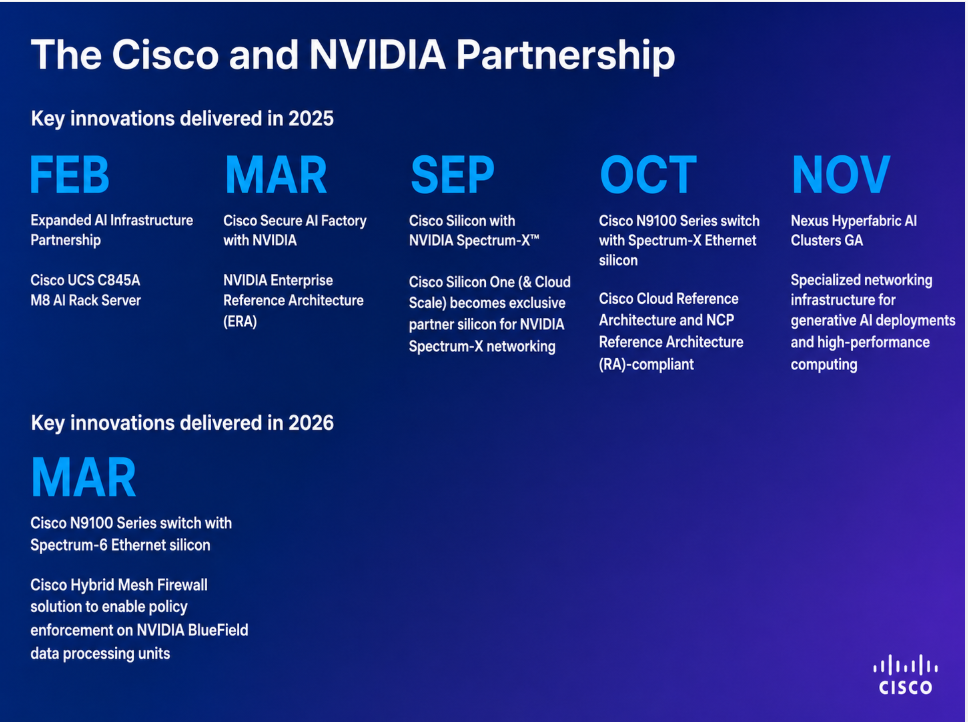
Cisco’s AI data center strategy is also increasingly defined by GPU vendor partnerships. The NVIDIA relationship has moved through several stages: enterprise reference architectures, Spectrum-X technology integration, Nexus 9100 platforms with Spectrum-X silicon, Nvidia certification, Nexus Dashboard management, and development work around BlueField NIC services for firewalling, micro-segmentation, and load balancing.
The significance is not only that Cisco is partnering with Nvidia. It is that the partnership is moving deeper into architecture, management, and services integration. AI data centers are becoming tightly coordinated systems, and the boundaries between accelerator, NIC, switch, controller, and security service are becoming more important.
Cisco is also validating AMD MI300 GPUs with Cisco networking infrastructure. The AMD ecosystem and benchmarking base may still be earlier than NVIDIA’s, but the direction matters. Customers want optionality, especially as AI infrastructure costs grow and accelerator roadmaps diversify.
Token Economics Are Pulling Some Workloads Back On-Premises
The session also touched on a practical driver that may become more important over time: token economics (or tokenomics). As customers gain experience with cloud-based AI services, they are starting to analyze the cost of token generation across model tiers and deployment options.
For some customers, especially those with large proprietary data sets and repeatable workloads, on-premises infrastructure can offer better cost control. Once customers understand their data, usage patterns, and model economics, they may choose to build dedicated infrastructure rather than consume everything through cloud APIs.
This does not mean the market is moving away from cloud. It means AI deployment decisions are becoming more workload-specific. Customers will evaluate performance, cost, data locality, governance, and operational control. That creates room for hybrid AI architectures and makes the data center relevant again for workloads that justify dedicated infrastructure.
Net-Net
The most important takeaway from Cisco Live 2026 is that AI data center infrastructure is becoming a systems problem. Faster silicon and faster switches are necessary, but they are not sufficient. Non-hyperscale customers increasingly need validated architectures that bring together compute, storage, networking, security, observability, orchestration, and operational tooling.
