


Very little is written about Huawei’s optical DWDM technology, but that doesn’t mean the company hasn’t made some big waves in the industry. We had the chance to sit down with the Huawei optical team, led by Gavin Gu, at MWC 2026 to learn about their latest coherent DWDM technology. This is what we learned.
Huawei has started shipping its next-generation high-performance coherent DSP in the first quarter of 2026 as an embedded assembly in a muxponder with two ports of 2.0 Tbps coherent wavelengths. The client ports in the module include a mix of 100 Gbps, 400 Gbps, and 800 Gbps. These muxponders are housed in the company’s DWDM systems, namely the OSN 9800 K12 and K36. And of course, Huawei’s new module delivers wavelengths across the entire Super C-band and Super L-band, which is increasingly important as wavelength channels get wider.
As is the situation in the industry, the highest wavelength speed used to identify the coherent technology is just that, the highest speed capable. One of the benefits of modern coherent line cards is that the symbol rate and modulation can be adjusted to deliver different wavelength speeds and performance. Huawei presented a few of those options in a chart (Figure 1) showing the unregenerated signal distance at different wavelength speeds. Maybe the most important speeds to look at are the 2.0 Tbps and 800 Gbps. We say this because the maximum distance at 2.0 Tbps gives us a good sense of the technology, and the maximum distance at 800 Gbps tells us if the muxponder will meet current customer requirements for unregenerated span lengths when they upgrade networks to 800 Gbps over the next few years.
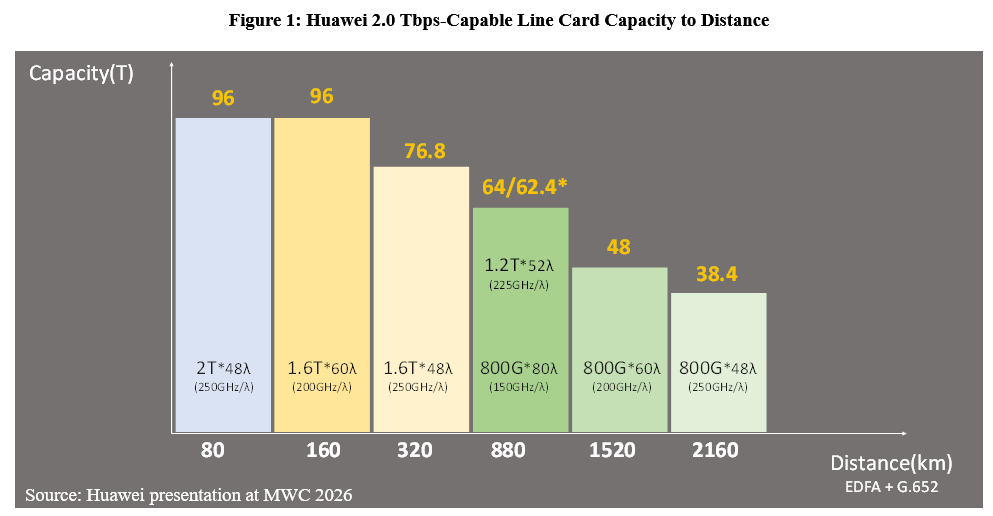
How does Huawei’s new coherent wavelength technology compare to the rest of the industry? We did a simple comparison between the industry and Huawei (Figure 2). Specifically, we looked at high-performance coherent muxponders that are generally available as of 1Q 2026. Of course, this doesn’t give a deep assessment of Huawei’s technology or even that of the industry. But at a high level, we think it gives a good sense of where the company is at.
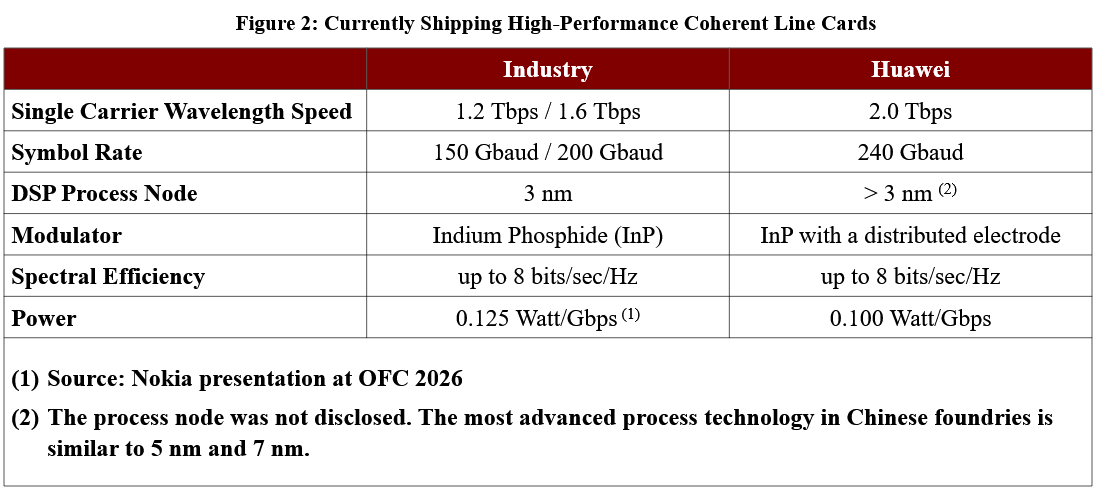
Two key differences show up in this comparison. The first is that Huawei DSP uses a larger semiconductor process node, while the industry is at 3 nanometers (nm). This difference puts Huawei at a slight disadvantage at the ASIC level, but the company can still deliver 2.0 Tbps at 80 km, which was proven in a live demonstration. Usually, a DSP using a larger process node would also consume more power. However, in Huawei’s newest muxponder, power consumption is lower at 0.1 Watts/Gbps, compared to the industry average of 0.125 Watts/Gbps. We believe this power advantage is created by Huawei’s extensive in-house development of every component inside a coherent optical module (tunable laser, receiver, TIA, driver, modulator, and DSP), along with its expertise in photonic packaging and manufacturing processes (Huawei has its own state-of-the-art manufacturing, assembly, and test facility for optical modules that we once visited).
Also, using an advanced InP-based modulator with a distributed electrode, internally designed and developed to achieve 30% lower parasitic capacitance, could give the company a power-consumption advantage at the module level, compensating for the DSP’s higher power consumption. Then, at the system level, Huawei also internally develops and manufactures the major components of its optical line systems, including its pump lasers and WSS modules, giving the company greater control over technology performance and time-to-market. As a result, Huawei is constantly innovating its optical system design, from the chip level to the system level.
The 2 Tbps technology is now ready, with the first wave of deployments underway. During MWC 2026, Huawei highlighted six successful trials of its 2 Tbps-capable muxponders across Europe, Asia Pacific, the Middle East, and Latin America. The company also proudly announced that the first commercial deployment with a major European Tier-1 communication service provider (CSP) is currently in progress.
