


A year ago, we questioned whether the recovery in Enterprise Networking could sustain itself after several years of extraordinary market swings. The first half of 2026 has provided an encouraging answer. Worldwide Enterprise Networking revenue grew 15% year over year (Y/Y), with all five major segments—Network Security, Branch Routing, WLAN, Campus Switching, and Enterprise Data Center Switching—posting double-digit gains. Growth accelerated further in the second quarter.
Yet the headline figures conceal increasingly different market dynamics. Some segments are benefiting from rising equipment shipments, others from higher prices, and still others from changes in how enterprises connect and secure their infrastructure. Artificial intelligence (AI) is complicating the picture, generating new infrastructure requirements while also driving up the cost of traditional networking equipment. As the industry looks toward 2027, the central question is how much of the current expansion reflects durable investment demand and how much reflects pricing and purchase timing.
From Recovery to Expansion
The Enterprise Networking market has traveled a rocky road since the pandemic. Supply shortages and accumulated backlogs drove exceptional revenue growth in 2023, followed by a sharp correction as shipments normalized and enterprises worked through excess inventory. The market contracted in 2024 before returning to growth in 2025 (Figure 1). With the inventory digestion behind us, enterprise spending has entered a new investment cycle shaped by technology refreshes, security modernization, rising prices, and shifting infrastructure economics.
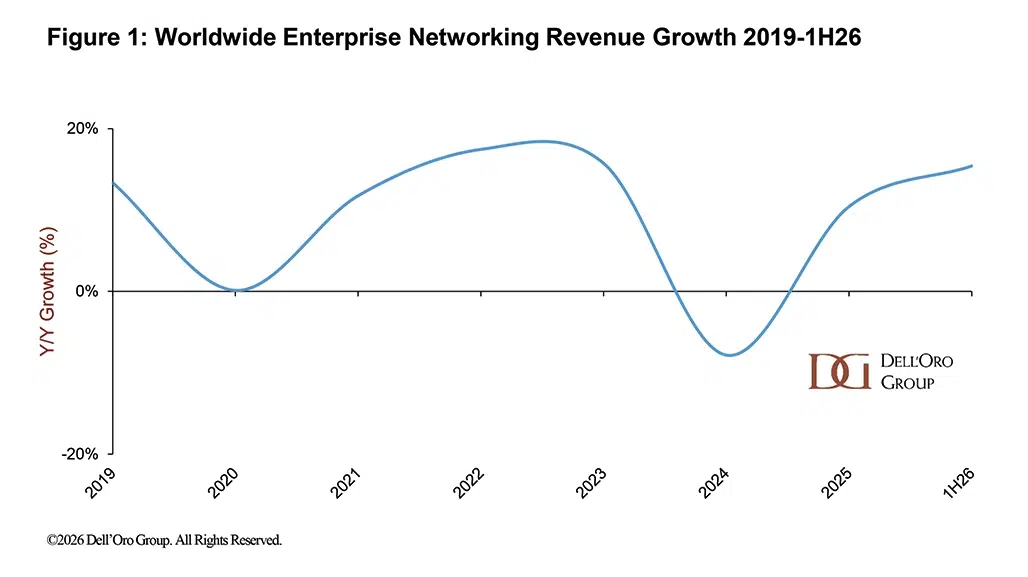
WLAN led the five markets in growth during 1H26, while Network Security contributed the most incremental revenue. Campus Switching, Branch Routing, and Enterprise Data Center Switching also expanded at double-digit rates, but their underlying drivers were far from uniform. In 2026, renewed supply shortages and rising prices are intersecting with genuine deployment growth and technology migration. Those forces will not necessarily persist on the same timetable.
When Revenue Growth Outpaces Underlying Demand
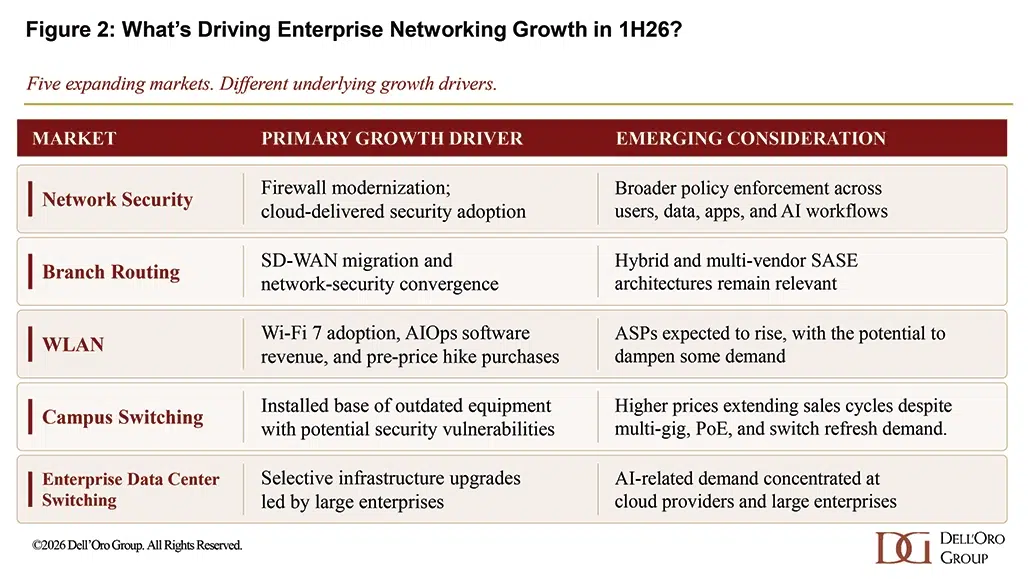
Campus Switching and WLAN illustrate the difference between stronger spending and stronger equipment demand (Figure 2). Campus Switching revenue grew at a double-digit rate in 1H26 even though port shipments were nearly flat following elevated shipment growth in 2025. Higher campus switch prices are now flowing through to vendor revenues; in 2Q26, port shipments fell 5% while ASPs surged 19%. Despite the large volume of end-of-support campus switches in the field, higher spending did not translate into a comparable increase in switch port shipments.
DDR4 memory shortages are a major source of pricing pressure, with memory costs escalating as AI infrastructure buildouts have tightened component supply. Enterprise IT vendors have raised prices, redesigned products, and sought alternative sources. Since enterprise equipment is often quoted well before delivery, these increases take time to appear in reported revenue. The latest Campus Switch results suggest that earlier price actions may be squeezing IT budgets and making some refresh projects harder to justify.
In 1H26, WLAN followed a different trajectory from Campus Switching, with revenue growth supported by higher access point shipments as Wi-Fi 7 adoption accelerated and enterprises ordered ahead of anticipated price increases. Wi-Fi 7 now accounts for most indoor access point revenue. Vendors are also contending with DDR4 memory shortages, which we expect will push WLAN equipment prices higher in 2H26. Meanwhile, recurring software licenses and advanced AIOps capabilities are becoming increasingly important revenue sources in a market historically dominated by hardware sales. Together, these developments are changing both the economics of WLAN deployments and how vendors monetize their installed bases.
AI Is Both a Tailwind and a Headwind
AI infrastructure investment has been a strong catalyst for the broader Data Center Switching market, particularly among hyperscalers and specialized cloud providers building networks for training, inference, and agentic workloads. Enterprise demand is more measured. Growth in enterprise front-end Data Center Switching has been concentrated among large organizations, often as part of upgrades to networks supporting general-purpose servers rather than dedicated AI deployments. Smaller enterprise customers have continued to pull back on purchases.
Many enterprises are still deciding where AI workloads should run and whether the expected benefits justify new on-premises infrastructure. Public cloud services offer an alternative to owning compute and networking equipment. Meanwhile, the AI buildout is tightening supplies of components also used in campus and wireless networks. It can therefore lift traditional networking revenue through price increases even where AI is not generating incremental equipment demand. Higher costs could, in turn, encourage customers to extend product lifecycles or redirect budgets.
AI is also expanding security and operations requirements, from protecting sensitive data and governing AI applications to managing non-human access and defending against more capable attackers. Much of the near-term commercial opportunity is being captured through capabilities added to established platforms rather than entirely new product categories. For now, network modernization, risk reduction, and operational efficiency remain more tangible purchasing drivers than broad AI-led replacement cycles.
Cybersecurity Becomes a Modernization Catalyst
Network Security was the largest contributor to Enterprise Networking revenue growth in the first half, supported by targeted Firewall refreshes and continued adoption of cloud-delivered security. Within Security Service Edge (SSE), separately monetized Data Security and Digital Experience Management capabilities are expanding faster than foundational access and inspection. Enterprises are extending security policy across users, applications, data, and workloads, with AI introducing additional requirements rather than replacing existing ones.
Cybersecurity concerns are increasingly influencing spending beyond security products. Aging switches, routers, and wireless access points have always needed replacement as performance requirements rise or vendor support expires. Now, vulnerability exposure and concerns about AI-assisted cyberattacks are making those refresh decisions more urgent. Channel discussions suggest that security audits are identifying unsupported equipment and initiating replacement projects. Infrastructure modernization is becoming as much a resilience decision as a capacity decision.
The shift is especially visible in Branch Routing, where SD-WAN continues growing while traditional Access Router revenue contracts. Enterprises are using router refreshes to adopt software-defined connectivity and integrate networking with cloud-delivered security through Secure Access Service Edge (SASE). The result is not necessarily a single-vendor architecture: operational maturity, existing investments, and sovereignty requirements still favor hybrid or multi-vendor approaches in many environments. Network management is evolving similarly. Cloud-managed Campus Switching is outpacing the broader market, but premises-based and private-cloud WLANs remain important, reflecting the trade-offs among automation, recurring fees, and control.
Which Way Are We Headed?
We remain optimistic about Enterprise Networking, although growth is likely to moderate from the first-half pace. Wi-Fi 7, installed-base refreshes, security requirements, and SD-WAN adoption provide durable support. Countering those tailwinds are component shortages, higher equipment prices, and purchasing pull-forwards that may dampen subsequent shipments even if modernization plans remain intact.
As 2027 approaches, we will be watching whether equipment demand can withstand higher prices, whether AI investment spreads beyond cloud providers and the largest enterprises, and whether automation and cybersecurity investments deliver the operational benefits buyers expect. Sustaining market expansion will increasingly depend on the underlying need to modernize rather than on higher prices or shifts in purchase timing.
