[wp_tech_share]

For many years now, the evolution of WiFi has been focused on improving two key technical attributes: speed and range. WiFi 6, however, is the first iteration to take a more holistic view of wireless technology that encompasses not only improvements in speed and range, but also network intelligence, analytics, and power efficiency. It is the first WiFi standard developed specifically for a world defined by the IoT and the consistent proliferation of connected devices.

WiFi 6 also comes at a critical time for global service providers looking to extend their broadband service portfolios into the home while facing increasing competition from other ISPs and consumer electronics providers also seeking to dominate that service space. WiFi 6 will undoubtedly boost the connected home service offerings of those service providers willing to embrace the technology, and make it available across their CPE and home networking equipment. It will quickly become a technology that subscribers will expect as a standard part of their in-home broadband experience. In fact, Dell’Oro Group expects that total WiFi 6 CPE shipments, including retail WiFi routers for residential and SOHO applications, will grow from just over 5 million units in 2019 to more than 23 million units in 2020, with further expansion expected through 2023.

WiFi 6 also has the capacity to dramatically improve how service providers will be able to provision, manage, troubleshoot, and analyze their in-home networking services. It provides options for the remote, zero-touch provisioning of devices and services, as well as the automatic adjustment of WiFi channels to ensure peak performance. As subscribers become savvier about broadband and WiFi, and as they become more reliant on broadband to enable multiple services in their home, they will demand uninterrupted service. With WiFi 6, service providers will finally have the power to deliver on those expectations.

New Features Deliver Speed Intelligently and Efficiently

Speed boosts are an essential feature of any new WiFi standard. Given its many key technical upgrades, WiFi 6 is quickly emerging as the first standard that is designed for the gigabit age and beyond, with a focus on providing a theoretical maximum of 10Gbps of throughput. The goal of this standard is to ensure that a customer’s WiFi network will not impede the delivery of high-bandwidth, latency-sensitive services such as cloud gaming, 8k video, and cloud VR services. These feature additions are especially critical for service providers that offer managed home networking services because subscribers have proven quite willing to use speed tests to verify the performance and value of their end-to-end broadband service.

But beyond increased speed and range, taken together, all of the features described above are designed to deliver stable, consistent performance not just to a handful of devices in the home, but potentially to hundreds of connected devices.

Perhaps the most important feature of WiFi 6 is OFDMA (Orthogonal Frequency Division Multiple Access). OFDMA allows WiFi routers and access points to divide multiple channels—on either the 2.4GHz or 5GHz frequency band—into smaller allocations called resource units (RUs). Each RU can then be divided into yet smaller channels, with that traffic earmarked simultaneously for multiple devices. Each of those devices can have dramatically different traffic profiles (e.g., a TV that is streaming an 8k movie and a connected thermostat communicating with a cloud-based analytics engine).

The net result is a reduction in latency for connected devices and an increase in the aggregate throughput across the wireless network. WiFi 6 adds both uplink and downlink OFDMA, meaning that routers and CPE can intelligently allocate different levels of transmit and receive power per connected device, depending on variables such as distance, noise, and other signal impediments.

OFDMA complements another feature that has been enhanced in WiFi 6: MU-MIMO (Multi-User, Multiple Input, Multiple Output). MU-MIMO was included as part of the WiFi 5 (802.11ac) standard, but it was limited to downlink signals from the router to end devices. WiFi 6 includes uplink signals from multiple devices, and it doubles the number of devices that can be supported from four to eight. While OFDMA divides channels into resource units to be allocated across multiple devices, MU-MIMO multiplexes transmit and receive traffic from multiple devices based on their proximity to the router and to each other. This streamlines traffic patterns and reduces latency by more intelligently allocating spectrum across multiple devices, as opposed to serving devices sequentially.

In addition, WiFi 6 adds the ability to support up to eight separate spatial streams using beamforming, which allows the router to allocate additional throughput to particular devices at a given range.

WiFi 6’s final major upgrade that improves overall speed and throughput is the increase in QAM (Quadrature Amplitude Modulation) from 256-QAM to 1024-QAM. This allows devices to send ten digits of binary code with each transmission to the router. According to the WiFi Alliance, this will increase throughput by 25-30% versus WiFi 5. This upgrade is critical for supporting today’s very high-bandwidth, latency-insensitive applications and services, as well as those anticipated in the next five years.

Smarter Management of Connected Devices

Of course, speed improvements are expected. Video streaming, online gaming, and other applications that continue to grow immensely in popularity and capability demand consistent speed and performance upgrades.

But home and connectivity requirements are changing. Just as the use of high-end applications is increasing, so is consumer reliance on myriad connected devices, including smart speakers, sensors, thermostats, and home security systems. Indeed, these devices are quickly becoming the ones we interact with most often on a daily basis. Though our interactions with such devices are short in duration, we expect that they will work perfectly every single time we interact with them.

Poor battery life is one of the main culprits that causes connected devices to underperform or flat out the malfunction. To ensure that these devices draw as little power as possible, thus improving battery life, WiFi 6 incorporates a feature called target wake time (TWT). TWT allows the router to set a schedule for connected devices to ping it to report their status; thus, devices do not have to fight for the channel spectrum to complete their communication. Each device can be guaranteed an optimal slot to ping the router, and it can remain in battery-saving sleep mode for a longer time.

How Service Providers can use WiFi 6 to their Advantage

According to Dell’Oro Group, as of the first half of 2019, approximately 85% of all broadband CPE (Cable, DSL, and PON) includes embedded WLAN capabilities. That is up from 63% in 2015. As these percentages have increased, so has the number of operators providing managed home WiFi services to their customers to increase broadband service revenue while also reducing churn by anticipating and reducing WiFi outages.

Within that same time frame, broadband and WiFi have become essential applications and experience enablers. From social networking to cloud gaming, telemedicine, and VR, broadband and WiFi are viewed as critical offerings. Because of its enhanced throughput, range, and overall performance, WiFi 6 will open up a whole new world of applications and services formerly unavailable at consistent levels. Obviously, true gigabit broadband services throughout the home will serve as the backbone service for network operators and consumers. From there, cloud gaming across multiple devices and with simultaneous usage become available, followed by true virtual and augmented reality services. WiFi 6 is a necessary precursor for these advanced services.

Service providers can start with the rollout of WiFi 6-enabled CPE to demonstrate their commitment to delivering the best wireless networking experience for their subscribers. Once WiFi 6-enabled devices are in the home, additional services that take advantage of the technology’s enhancements are sure to follow. Providers can bundle smart home devices alongside their upgraded CPE, marketing those devices as ‘optimized for WiFi 6.’

In addition, service providers can offer a range of CPE that is customized to the unique needs of their subscribers’ homes. For example, mesh routers can be used to enhance coverage in larger homes, homes with a significant number of dead spots, or homes with 4k and 8k TVs and displays in multiple rooms. The goal, of course, is to deliver sustained and consistent gigabit access to every device that requires it.

The industry is already seeing tremendous growth in mesh routers, both in retail outlets and directly from service providers. Operators are becoming smarter about identifying when mesh routers are required through delivering apps that allow new subscribers to describe their homes, the placement of their routers, and the types of devices throughout the home that might require closer proximity to a mesh base station or satellite.

By providing this type of indirect network consulting, a service provider ensures that it is a trusted partner for its subscribers, instead of simply being a company that turns on broadband service and then sends a bill.

Beyond improving connectivity and WiFi performance through the deployment of new networking terminals, service providers must also layer in remote provisioning, troubleshooting, and advanced analytics to enable the zero-touch installation and management of WiFi services. As service providers expand their presence in the home, they want to avoid having to respond to a phone call or roll a truck every time network performance is impacted by weather, the addition of a new device, or channel contention with a neighbor’s access point.

WiFi 6 eliminates a number of these issues and allows operators to constantly monitor the performance of their CPE, including mesh base stations and satellites, and to verify a customer’s service level remotely. New broadband subscribers can request service, be sent the appropriate devices, and have service turned on in their homes, all with a simple phone call to their service provider. The service provider can offer a range of additional managed WiFi services, depending on the needs of each subscriber.

Service providers continue to invest in upgrades to their access network infrastructure to support gigabit speeds and services, and WiFi 6 home networking technology is ideal for extending this investment in-home service capabilities with reliability. The network no longer stops just outside the subscriber’s door. Instead, the service provider’s network extends into the home, creating and defining the subscriber’s daily interactions with that network operator. Thus, operators must treat their gigabit WiFi offerings just as they would any other network service. If a service provider’s throughput, reliability, and overall performance are underwhelming, subscribers will quickly cancel the service in favor of a competitor’s.

[wp_tech_share]

Amazon’s latest acquisition in its ever-growing WiFi technology platform is the mesh networking pioneer eero systems. The deal was announced on February 11, 2019.

Eero, along with Luma, was among the first home networking suppliers to optimize enterprise-grade mesh networking technologies for residential CPE. This innovation meets two goals: improving WiFi coverage by using a series of mesh-connected access points and providing an improved level of network control when compared to the clunky user interfaces typically found on WiFi routers.

Eero’s products and platforms address a growing set of problems with home WiFi. One common problem is that traditional home routers, while powerful enough to generate a signal for most of a home, often have limited and clunky user interfaces. This makes it challenging for users to set specific network parameters or preferences. A second problem in larger or older homes is that brick and cinder block walls can quickly dampen a WiFi signal, creating dead spots. Historically, these dead spots have been addressed through the use of WiFi extenders, which simply repeat the signal generated by the central access point.

However, the problem with traditional WiFi extenders is two-fold:

  • The extender can only do its job when it can detect the original WiFi signal.
  • Each time the signal is repeated or extended, signal loss occurs to the tune of a 30% to 60% reduction in throughput.

Mesh networking capabilities from Plume, eero, Luma, Google, NetGear, D-Link, and similar companies do a far better job of maintaining a clean wireless signal though they still rely on signal repetition. By spacing multiple units throughout a home, these systems effectively create multi-hop communications for wireless devices. Essentially, when a wireless device receives or transmits data, it is either the first leg or anchor in a WiFi relay race. The data transfer then hops from one access point to another until it reaches the primary access point, which is connected to the DSL, cable, or fiber gateway. The multi-hop attributes of a mesh network reduce the distance the wireless signal must hop from one point to the next.

Just as important as strengthening the home WiFi signal is the increased control users will have over their home WiFi experience. Eero’s access points and smart home manager app will allow users to control their WiFi networks, passwords, and devices. Control over the home network experience is being fought over by consumer electronics companies and broadband service providers alike.

Tying together the Amazon home experience

Eero adds a major puzzle piece to Amazon’s long-term plan to own the in-home IoT experience. Between Fire Sticks, Fire TVs, Ring video doorbells, Echo devices, and a growing list of appliances and consumer electronics with Alexa voice capabilities, pre-integrated, eero access points can ensure that these devices stay connected all the time.

Early on, eero differentiated itself from other mesh networking suppliers by including 802.15.4 radios on each of its access points. The 802.15.4 is an IEEE standard, designed for low-data rate and low-power consumption wireless communications. It is part of the 802.15 group of standards for what are called wireless personal access networks (WPANs). For example, 802.15.1 is for Bluetooth.

The 802.15.4 standard defines the MAC and PHY layers of the OSI model and provides a basis for other protocols and features to be added in layers 3 through 7. ZigBee, Z-Wave, WeMo, and Thread are common protocol stacks relying on the 802.15.4 standard. The eero devices currently use Thread, but nothing is stopping Amazon from incorporating its favored Z-Wave protocol on these devices. Z-Wave is Amazon’s home automation protocol of choice, as it is used in its Echo Show and Echo Plus home hub devices. Also, a much larger ecosystem of sensors, light bulbs, and other home automation devices relies on Z-Wave.

In fact, I fully expect Amazon to quickly provide eero mesh units using the Z-Wave protocol stack, so that the units could act as distributed home hubs. This would allow users to place smart devices throughout their home, rather than limiting them to areas near a home hub unit. Keep in mind that Z-Wave has a functional distance limit of 300 feet. In larger homes, for which eero access points are ideal, eero can eliminate WiFi dead spots, while also connecting bedroom light bulbs, window sensors, and other Z-Wave devices.

I don’t believe Amazon will integrate an eero-style access point into any of its Echo series of devices, as some have suggested. Amazon wouldn’t have bought eero if that was its strategy. Besides, the Echo devices already pump out their own limited WiFi signal. There is no need to raise its bill of materials (BOM) cost by adding a more complex WiFi chip and series of antenna arrays. After all, the purpose of Echo devices is to provide a voice-based connection to Amazon-hosted services and content, not to become expensive, all-in-one devices.

Eero gives Amazon a way to ensure always-on WiFi connectivity at home. This, in itself, is critical to the performance of Amazon services. More importantly, eero gives Amazon insight into how broadband customers use their home Internet service, which devices they use to access the Internet, and when and how the devices are used. Eero is invasive, for certain. As with any service, users will have to weigh the convenience offered against their privacy concerns.

But you can imagine a scenario where Amazon uses the data collected from eero access points to recommend smart light bulbs, DIY home security systems, window sensors, connected TVs, and other devices based on your data consumption habits and current network setup, among other parameters.

Beyond that, Amazon primarily wants to ensure that the content and services you rely on–including Amazon Video, Music, and Audible–all are performing at their peak. By providing home connectivity, Amazon can also more accurately identify the source of issues delivering 4K UHD video content. Is the problem at home, within the Amazon Web Services CDN, or in the broadband provider’s network? When you don’t own the pipe into the home but own everything else, being able to eliminate your network as the locus of the problem is absolutely critical.

Related Posts:

About the Broadband Access Market Research Report:

The Dell’Oro Group Broadband Access Report provides a complete overview of the Broadband Access market with tables covering manufacturers’ revenue, average selling prices, and port/unit shipments for Cable, DSL, and PON equipment.  Covered equipment includes Converged Cable Access Platforms (CCAP) and Distributed Access Architectures (DAA), Digital Subscriber Line Access Multiplexers ([DSLAMs] by technology ADSL/ADSL2+, G.SHDSL, VDSL, G.FAST), and PON Optical Line Terminals (OLTs), as well as all Cable, DSL, and PON CPE (Customer Premises Equipment.)

[wp_tech_share]

2019 Broadband Access Market Outlook: Part 4 of 4

The introduction of more artificial intelligence (AI) and network automation services will allow operators to continue their push to become more than providers of broadband access services. These innovations will allow them to provide in-home network monitoring, troubleshooting, and maintenance issues. Comcast and AT&T have already begun to offer in-home WiFi management platforms, while Adtran, Calix, and other equipment vendors are also expanding their product portfolios to include intelligent, software-based control of CPE.

Just as broadband has become an essential service for most individuals, WiFi has also become a critical service. Like broadband, WiFi is also fraught with customer experience challenges. Broadband service providers are seeking to reduce these difficulties, while also reducing service calls. Introducing AI and network automation services presents a potential revenue opportunity though most operators would be satisfied with a reduction in WiFi-related service calls.

For a growing number of broadband providers, the picture is clear: To counter the economic and mindshare threat posed by OTT providers and consumer electronics players, broadband providers must become better at defining, controlling, and protecting the home-user experience because the home is where service providers most frequently interact with customers.

Operators are using a combination of software-based network managers along with intelligent, mesh-based WiFi extenders and routers to address a growing set of problems with home WiFi. One common problem is that traditional home routers, while powerful enough to generate a signal for most of a home, often have limited and clunky user interfaces. This makes it challenging for users to set specific network parameters or preferences. A second problem in larger or older homes is that brick and cinder block walls can quickly dampen a WiFi signal, creating dead spots. Historically, these dead spots have been addressed through the use of WiFi extenders, which simply repeat the signal generated by the central access point.

However, the problem with traditional WiFi extenders is two-fold:

  • The extender can only do its job when it can detect the original WiFi signal.
  • Each time the signal is repeated or extended, signal loss occurs to the tune of a 30% to 60% reduction in throughput.

Mesh networking capabilities from Plume, eero, Luma, Google, NetGear, D-Link, and similar companies do a far better job of maintaining a clean wireless signal though they still rely on signal repetition. By spacing multiple units throughout a home, these systems effectively create multi-hop communications for wireless devices. Essentially, when a wireless device receives or transmits data, it is either the first leg or anchor in a WiFi relay race. The data transfer then hops from one access point to another until it reaches the primary access point, which is connected to the DSL, cable, or fiber gateway. The multi-hop attributes of a mesh network reduce the distance the wireless signal must hop from one point to the next.

Just as important as improvement of the home WiFi signal is the increase in control users will be offered over their WiFi networks, passwords, and devices on networks with AI and network automation services. Operators will continue to expand their in-home network management apps as a means to retain broadband customers and also to expand into new services, including home automation and security. A centralized dashboard for controlling a customer’s total online experience is an important tool in the fight with Amazon, Google, Apple, Roku, and others to maintain control over the home experience.

To learn more about highlights on Broadband Access market in the next five years (2018-2023), please click here

Related blogs:

[wp_tech_share]

2019 Broadband Access Market Outlook: Part 3 of 4

Very few subscribers will ever praise their service provider’s customer service. Improving customer service has always been a challenge for major operators, regardless of the service. But with advances in AI and tools for network automation, operators can fundamentally change the customer experience. Major operators–including AT&T Inc., Comcast, and Bell Canada–will implement a combination of AI and network automation as part of their overall network virtualization efforts.

2019 will see the roll out of AI capabilities for the express purpose of providing proactive data management as operators move toward full network automation. For operators, the following use cases and applications will see the light of day this year:

  • Machine learning and proactive network maintenance, or PNM, to regularly poll active electronics and detect and troubleshoot issues before they impact end subscribers.
  • Software-defined networking (SDN) and network functions virtualization (NFV) will provide far more visibility into individual and collective network elements. They will proactively alert network operations centers (NOCs), about potential hiccups.
  • Virtualization of customer premises equipment (CPE) to allow for customer self-installation and management without contacting customer service to initiate a new service.
  • Monitoring of traffic flows and data usage combined with algorithms to automate speed boosts when customers increase their data consumption.

Comcast, via its X1 service and platforms, is beginning to roll out a number of these capabilities in its effort to reduce truck rolls and improve the overall customer experience. 2019 will see the expansion of these efforts across a much broader range of network operators, including AT&T, Verizon Communications Inc., NTT DOCOMO, British Telecom, and others.

In Part 4, I will examine the ways that operators continue to push further into the home.

Related blogs:

[wp_tech_share]

2019 Broadband Access Market Outlook: Part 2 of 4

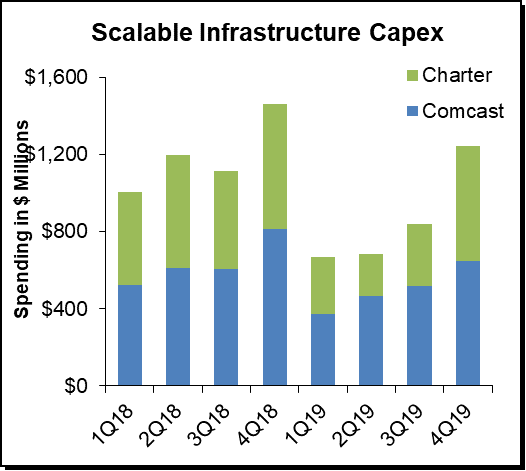
2019 is expected to be the year that Comcast, Mediacom, and others in the North American market move from lab and field trials of their remote PHY and remote MACPHY or RPD and RMD platforms to general availability. Equipment vendors are ramping up production of their node units to meet what is expected to be a major year of deployments in 2019. We expect Comcast to pursue its goal of using distributed access architecture, or DAA, to dramatically reduce service group sizes from an average of 300 to 400 homes to less than 100. Other operators, including Cox and Spectrum, will quickly follow suit.

We’ve already seen a number of deployments in Europe, particularly at Com Hem and Stofa, designed to help these cable operators roll out DOCSIS 3.1 services, while simultaneously moving away from their traditional, integrated CCAP platforms. Both operators face significant competition from fiber providers, so they view R-PHY as a stepping stone to either full duplex DOCSIS 3.1 or FTTH.

The move to DAAs sets the stage for cable operators not only to expand the bandwidth they can offer end customers by reducing service group sizes, but also to push more edge computing capabilities closer to subscribers. Current optical nodes are nothing more than layer 1 and layer 2 platforms focused primarily on converting radio frequency signals to optical and vice versa. RPD and RMD nodes introduce layer 3 capabilities, as well as a road map to edge computing for more localized media processing and decision-making for applications beyond high-speed internet. With these more intelligent nodes, cable operators can better deliver IoT and wireless services.

Managing an expanded network of intelligent nodes, however, will introduce new challenges, which cable operators hope to address by virtualizing their existing cable modem termination system, or CMTS, functions. By centralizing service orchestration and control, cable operators can potentially reduce the time to deployment for their new distributed infrastructure, as well as the operational costs associated with these new architectures.

For cable operators, virtualization brings scale. By virtualizing and distributing the data and control planes from previously centralized and self-contained hardware platforms, operators can ultimately rely on more generic equipment, while also preparing their networks for the anticipated deluge of traffic from IoT and 5G services.

In Part 3, I discuss operators’ implementation of early use cases for artificial intelligence and network automation.

Related blog: