[wp_tech_share]


At this year’s virtual Cable-Tec Expo, four prominent themes have emerged throughout the online panels and technical presentations:

    1. Cable broadband networks have performed incredibly well during the COVID-19 pandemic, with minimal outages and minimal complaints from customers.
    2. Despite the reliability, there is a clear and pressing need to dramatically improve upstream bandwidth.
    3. Cable operators’ future is one of business, infrastructure, and service convergence, with their DOCSIS networks serving as the platform for fixed-mobile convergence on a large scale.
    4. Convergence at all levels will be driven in part by the evolution of a common control and management plane across all networks and services.

I’ve dealt with the first two topics earlier this year in multiple blog posts and articles. Those two themes will certainly continue to evolve and have an impact on cable operator spending and strategic priorities for their access networks for the next year.

With this blog, I do want to spend some time considering the overall impact of convergence on cable operators’ long-term strategic plans, especially when it comes to their desire to become both fixed and mobile network operators.

The FCC’s auction of 3.5GHz CBRS licenses, which concluded in August, yielded few surprises when it came to the leading purchasers of the spectrum. Verizon and Dish Network led all bidders in terms of money spent, with Comcast, Charter, and Cox rounding out the top 5. Other major cable bidders included Mediacom, Midcontinent Communications, Shentel, and Cable One.

Comcast and Charter have been signaling for some time that they intend to build CBRS-based mobile networks in their existing cable footprints in an effort to reduce the amount of money they pay Verizon and other MVNO partners to use their networks. Their MVNO operations were always intended as a way to build a subscriber base and a brand in advance of owning their own wireless networks, even if that meant consistent EBITDA losses.

Cox, which had entered the wireless space a decade ago, only to exit after disappointing results, has signaled its intention to re-enter the wireless market through the purchase of a significant number of CBRS licenses across its cable footprint.

Finally, Cable One has taken an interesting approach, acquiring CBRS licenses but also making investments in two fixed wireless ISPs (WISPs) to provide coverage in rural and less dense areas surrounding its cable footprint.

Though they have no intention, at this point, of becoming national carriers, cable operators can certainly become competitive in their current markets, offering bundles of fixed and mobile services with the goal of reducing churn and stealing away some market share from their telco rivals.

Let’s not forget that the largest cable operators already have a very dense network of millions of Wi-Fi hotspots either through their own doing (Comcast’s Xfinity) or through their CableWiFi Alliance. Additionally, most cable operators have been deploying advanced Wi-Fi gateways in residential and small enterprise locations that typically reserve a single SSID for either open CableWiFi or Xfinity Wi-Fi subscriber access. These hotspots can very easily be turned into 5G small cells, expanding and amplifying mobile network access for their subscribers.

The dense network of hotspots and access points that the largest MSOs already have in place combined with the licensed CBRS spectrum that they have acquired should give them access to 150MHz of spectrum that they can reuse across a larger number of subscribers per individual access point.

But that type of spectrum reuse will only be possible with a vast and far-reaching deployment of CBRS small cells. In fact, according to a fascinating paper by Cisco’s John Chapman presented at Cable-Tec Expo, it “can take 200 CBRS small cells to cover an area equivalent to the area covered by one LTE macrocell.”[1]

Though the deployment of such a huge number of small cells seems daunting and costly at first, Chapman goes on in his paper to show that existing and future DOCSIS networks are completely up to the task. Firstly, a large percentage of small cells deployed by cable operators will be strand-mounted, drawing power from the existing HFC plant. Those strand-mount small cells will be deployed in conjunction with small cells located in residences to expand coverage and capacity, such that cable operators could expect to see a small cell count of anywhere from 1 to 80 per optical node, depending on the density of the area being covered, the average span length, and the number of mobile subscribers being served.

Cable operators are very accustomed to thinking about their networks as a shared resource among households and subscribers and then adding capacity when utilization rates remain consistently above 70% for any particular service group. As MSOs have been pushing fiber deeper into their networks, reducing the average number of amplifiers per node, and deploying DAA nodes in an effort to improve MER (Modulation Error Ratios,) they have prepared themselves for an access network that can handle the variable requirements of both fixed and mobile traffic.

Chapman points out in his paper, DAA nodes and CBRS small cells are essentially performing the same function: They are both RF gateways that convert RF traffic to IP over Ethernet. As cable operators continue to add capacity to their networks by pushing fiber deeper and reclaiming spectrum used for broadcast video (which they have been actively doing during the COVID-19 pandemic,) there is more than enough bandwidth to backhaul fixed and mobile broadband traffic over their existing DOCSIS infrastructure. Furthermore, with the introduction of low latency DOCSIS and the new LLX (Low Latency Xhaul) protocol, the overall DOCSIS network can deliver the 2ms of latency mandated by today’s 5g services.

Finally, today’s virtual CCAP platforms are already evolving to provide flexible data and control plane functions across cable operators’ converging fixed and mobile networks. Services like DOCSIS, 1588 and SyncE, BNG, as well as PON, can all be containerized and isolated either physically or logically, depending on the operator’s preference. The virtual CCAP becomes the centerpiece for the control and management of a diverse collection of media gateways located in the outside plant, including DAA nodes, CBRS small cells, PON OLTs, Wi-Fi access points, and cable modems.

Cable’s path to convergence is clearer now than it ever has been, from a business and service perspective to an infrastructure perspective. Chapman summarizes his paper with two (of a number) of points:

  • Today’s cable operators are tomorrow’s mobile operators
  • Behind every great wireless network is a great wireline network

I am in complete agreement with him and would add that the efforts being made by vendors to realize this at the control and management planes suggest that they agree, as well.

[1] John T. Chapman, “Small Cell Traffic Engineering: How Many Small Cells are Needed for Proper Coverage,” SCTE Cable-Tec Expo, October 2020.

[wp_tech_share]

During the Huawei AirPON Commercial Release Conference last week, Huawei formally introduced its AirPON solution, a combination of a blade OLT (Optical Line Terminal) and Digital Quick ODN (Optical Distribution Network) equipment designed specifically to be deployed at existing cell sites. Though Huawei is first out of the gate with a blade-based OLT designed to deliver FTTH from distributed, non-cabinet locations, we fully expect to see other vendors address this space in the near future. The target market for the AirPON solution and those expected from competing vendors is existing mobile carriers looking to expand their service portfolio by adding FTTH (Fiber-to-the-Home) access by taking advantage of their existing cell sites and fiber infrastructure.

These distributed solutions aim to capitalize on the trend towards fixed-mobile convergence among global operators that have only recently been accelerated by the COVID-19 pandemic. The pandemic has shown that universal access to premium broadband services is absolutely critical, and operators are responding by ensuring they can provide premium broadband services across both their fixed and mobile networks. Additionally, the proliferation of national broadband plans or subsidized broadband expansion efforts include both fixed and mobile network options to speed the availability of broadband throughout entire countries.

AirPON Specifics

At the heart of the AirPON solution is an OLT on a blade that can be deployed either on a pole or the wall of a building. The unit can be installed alongside an existing cellular BBU (Baseband Unit) and either draw from an existing DC or AC power source or be deployed with a new power source. The blade OLT is environmentally hardened to withstand extreme temperatures and wind. The unit itself weighs less and is smaller than current strand- or pole-mount OLT nodes, because typical antenna installations on building rooftops are quite a bit smaller in diameter when compared with traditional utility poles.

The blade OLT a maximum of 1,024 subscriber connections, depending on the split ratio the operator selects and how much bandwidth they want to deliver. For mobile operators beginning to offer fixed broadband services, this range is ideal for addressing buildings where either cable, DSL, or 3G/4G fixed wireless connections were only available or where no fixed connections existed previously.

During the online event, Peter Lam of Hong Kong Telecom (HKT) noted that the AirPON solution allows them to deliver fiber services to over 700 villages in remote islands and rural areas of Hong Kong. For HKT, the AirPON solutions solve two significant issues: limited access to existing fiber and the typically high costs associated with delivering FTTH access. The vast majority of HKT’s FTTH offerings are via OLTs located in central offices. However, in remote areas, those central offices are often limited in their reach and limited in their ability to deliver FTTH connectivity.

In a similar presentation, Joel Agustin of the Philippines’ Globe Telecom, which is the country’s largest mobile network operator, noted that the AirPON solution allows the company to deliver residential broadband services, where it is estimated that the penetration rate remains near 20%. Some of the challenges that have hindered operators’ ability to deliver universal fixed broadband services in the Philippines include extremely long fiber spans, owing to an insufficient number of central office locations, particularly in suburban and rural areas, and extremely long times for civil works projects to be completed.

The historically long lead times to complete fiber deployment projects pushed Globe to consider using its existing base station locations as distributed central offices where they could co-locate the AirPON OLTs to reduce the time and cost required to roll out FTTH services. In the Philippines, the typical ODN distance for a CO-based OLT was 7km. By moving to a more distributed architecture using the AirPON solution, Globe was able to increase the number of distributed OLTs and reduce the ODN distance to 1-2km. The reduction in the distance reduces the total fiber infrastructure while also making it easier to secure right-of-way access to add in additional fiber strands to the individual OLT locations. Finally, the approvals and construction process is reduced significantly because Globe doesn’t need to set up additional cabinets to deploy the OLT. Instead, the blade OLT can be placed on the existing rooftop site, taking advantage of existing power supplies and optical backhaul cables.

From the OLT, the feed fiber connection can be dropped directly to an optical distribution point located either on a utility pole or in the MDU to then distribute fiber connections to individual subscriber homes. Globe is taking advantage of advances in ODN equipment and connections to be able to quickly turn up new subscribers while also identifying and isolating faults, such as fiber impairments. The new ODN equipment eliminates the need for fiber splicing using pre-connectorized cable, while also eliminating the need for the technician to open up the optical distribution point unit when connecting a new feeder cable.

Distributed solutions for FMC will continue to grow

The AirPON solution and other vendors expected to enter the market are targeted initially at mobile operators in the Asia-Pacific region who face similar network or geographic constraints as HKT and Globe Telecom, where the re-use of existing rooftop antenna sites for the blade OLT makes economic sense. Countries in Southeast Asia are particularly ideal candidates for the solution, assuming they have determined that the competitive environment and ROI make it feasible to begin rolling out an FTTH service.

Beyond Southeast Asia, these solutions can be applied to operators in Central and South America, as well as parts of Europe, the Middle East, and Africa. Again, with operator consolidation occurring more frequently and with mobile and fixed technologies and architectures beginning to merge, solutions that distribute traditional CO-based platforms are certainly viable technology options. In many cases, there is simply no cost-effective way to deliver FTTH services to rural areas without a distributed platform that allows the operator to build out an FTTH service incrementally. The additional benefit of the AirPON solution and others that will enter the market is that operators can also re-use their existing investments in rooftop antenna locations to help further improve the ROI and overall business case of deploying FTTH.

[wp_tech_share]

Dell'Oro Broadband Access and Home Networking 5-Year Forecast ReportBalancing Broadband Subscriber Growth with Supply Chain Constraints

Global home networking unit shipments are only expected to decline by 1% in 2020, dipping from 193.9 M worldwide to 192.1 M. Included devices are residential access points, residential WiFi routers, including mesh routers, as well as broadband CPE with integrated WiFi capabilities. Supply chain constraints and reductions in manufacturing capacity seen in the first quarter of the year, due to plant closings in China, Taiwan, Malaysia, and the Philippines, will quickly give way to shipments increases to support growth in new broadband subscribers as well as consumers upgrading their in-home WiFi devices to better handle telework and remote education requirements.

WiFi 6 unit shipments across all product categories are expected to increase to 1.5 M units this year, and then skyrocket in 2021 and beyond, as broadband service providers begin taking shipments of cable, fiber, and DSL gateways with integrated WiFi 6 capabilities. Until then, the bulk of WiFi 6 units will be premium WiFi routers and mesh systems sold via retail outlets.

WiFi 6 adoption combined with the increased rollout of higher-end broadband CPE, including GPON and XGS-PON ONTs, along with DOCSIS 3.1, VDSL, and G.fast units will result in an increase in overall home networking unit shipments through 2022. The adoption of mesh router systems in the North American and Western European markets will also help to drive overall growth, before a period of market saturation sets in beginning in 2023 and 2024. 802.11ac (WiFi 5) units will continue to hold the largest share of overall units through 2022. Beginning in 2023, WiFi 6 will dominate overall shipments. Transitions to new WiFI technologies take time, especially when considered on a global basis. Specifically, high-ARPU regions, such as North America and select markets of Western Europe and APAC make these transitions much faster than other regions, including China and CALA, where operators generally wait until volume shipments have ushered in unit price reductions that better match their ARPU profiles.

Mesh and WiFi 6 Ushering In a New Era of Home Networking

For many years now, the evolution of WiFi has been focused on improving two key technical attributes: speed and range. WiFi 6, however, is the first iteration to take a more holistic view of wireless technology that encompasses not only improvements in speed and range, but also network intelligence, analytics, and power efficiency. It is the first WiFI standard developed specifically for a world defined by the IoT and the consistent proliferation of connected devices.
WiFi 6 also can dramatically improve how service providers will be able to provision, manage, troubleshoot, and analyze their in-home networking services. It provides options for the remote, zero-touch provisioning of devices and services, as well as the automatic adjustment of WiFi channels to ensure peak performance. As subscribers become savvier about broadband and WiFi, and as they become more reliant on broadband to enable multiple services in their home, they will demand uninterrupted service. With WiFi 6, service providers will finally have the power to deliver on those expectations.

Perhaps the most important feature of WiFi 6 is OFDMA (Orthogonal Frequency Division Multiple Access.) OFDMA allows WiFi routers and access points to divide multiple channels—on either the 2.4GHz or 5GHz frequency band—into smaller allocations called resource units (RUs.) Each RU can then be divided into yet smaller channels, with that traffic earmarked simultaneously for multiple devices. Each of those devices can have dramatically different traffic profiles (e.g., a TV that is streaming an 8k movie and a connected thermostat communicating with a cloud-based analytics engine).

The net result is a reduction in latency for connected devices and an increase in the aggregate throughput across the wireless network. WiFi 6 adds both uplink and downlink OFDMA, meaning that routers and CPE can intelligently allocate different levels of transmitting and receiving power per connected device, depending on variables such as distance, noise, and other signal impediments.

As for mesh capabilities, consumer mesh routers have been growing at a fast pace over the last year, with total units expected 23 M this year. Operators are becoming smarter about identifying when mesh routers are required by means of delivering apps that allow new subscribers to describe their homes, the placement of their routers, and the types of devices throughout the home that might require closer proximity to a mesh base station or satellite. As such, they are either re-selling mesh routers or integrating mesh capabilities directly into their higher-end gateways.

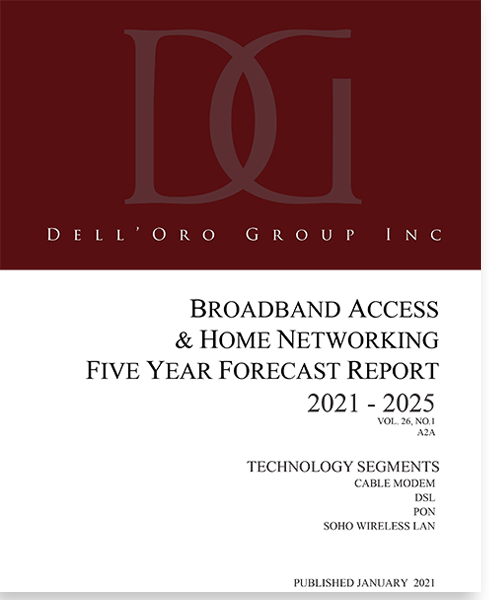
To get a copy of  the Broadband Access and Home Networking Market July 2020 5-Year Forecast Report, please email us at dgsales@delloro.com.
About the Broadband Access and Home Networking 5-Year Forecast Report:

The Dell’Oro Group Broadband Access 5-Year Forecast Report provides a complete overview of the Broadband Access market with tables covering manufacturers’ revenue, average selling prices, and port/unit shipments for Cable, DSL, and PON equipment. Covered equipment includes Converged Cable Access Platforms (CCAP), Distributed Access Architectures (DAA), DSL Access Multiplexers ([DSLAMs] by technology ADSL/ADSL2+, G.SHDSL, VDSL, VDSL Profile 35b, G.FAST), PON Optical Line Terminals (OLTs), Customer Premises Equipment ([CPE] for Cable, DSL, and PON), along with SOHO WLAN Equipment, including Mesh Routers.

[wp_tech_share]


In yet another sign of a re-shuffling of the deck among cable equipment vendors, Vecima Networks announced an agreement to acquire the Nokia DOCSIS DAA and EPON/DPoE product portfolio. The agreement comes on the heels of ATX Networks’ acquisition of Cisco’s cable amplifier business and continues the trend we have seen of larger equipment vendors divesting business units to smaller companies focused squarely on global cable operators.

For the original Gainspeed team, this also marks their second transaction, after Nokia acquired the start-up back in 2016 with the hope of extending market share gains made in the routing segment to cable access networks. Likely, the return to a smaller, exclusively cable-focused business will pay dividends for the group that was—and remains—at the forefront of remote MACPHY and flexible MAC architectures.

Meanwhile, for Nokia, this puts an end to the pursuit of DOCSIS access business, though the company is likely to continue selling its own GPON and XGS-PON platforms into the cable vertical, as some operators have expressed an interest in these options, as opposed to deploying 10G EPON or DPoE (DOCSIS Provisioning over EPON).

Though the Nokia/Gainspeed combination had netted some customer wins and trials, there was obvious concern about just how long it would take for the business unit to generate meaningful and sustained revenue. As we have noted before, 2019 was a difficult year for cable access equipment vendors, with total revenue dropping 36% from the year before. A glut of DOCSIS channel capacity, the lack of significant competitive threats, and indecision around DAA technologies and timing all contributed to the spending slowdown in 2019.

2020 isn’t expected to fare much better, with operators focused in the short-term on expanding capacity via existing CCAP platforms and node splits. Some new DAA projects have been shelved for the time being, though R-PHY deployments at Comcast, Cox, and others will continue. The uncertainty around when cable operators would return to their DAA projects, combined with general uncertainty around the macroeconomic environment, were likely the reasons behind Nokia’s divestment.

Vecima’s Gain

For Vecima, the acquisition of Nokia’s cable unit fills a few key product gaps. The company was already finding success with its Entra R-PHY node, having deployed with ANsome North American operators and interoperating with MAC cores from Harmonic, Cisco, and ARRIS. But the company did not have an R-MACPHY solution in its portfolio, though the company had been extremely active in the standards working groups for both R-MACPHY and FMA. It’s likely the company was working on an R-MACPHY solution in-house. Either way, the addition of the Gainspeed platforms certainly accelerates the general availability of a proven platform. That availability is critical for potential large customers such as Charter, J:COM, and Australia’s NBN, which are known to favor R-MACPHY as their DAA solution of choice.

Beyond R-MACPHY, the acquisition also gives Vecima a revenue stream from Nokia’s 10G EPON and DPoE deployments. Comcast, Charter, BrightHouse, J:COM, and others have all deployed this platform, either in a standard OLT form factor or as a hardened, remote OLT in a node. With Charter’s recent announcement that it would apply for RDOF (Rural Digital Opportunity Fund) grants, likely to expand its serving areas in rural areas of Nebraska, Utah, Iowa, and other states, there is a strong possibility that it will expand using the 10G EPON platform from either Vecima or Adtran, the only other vendor supporting complete DPoE OLT platforms and ongoing development.

With the addition of the Gainspeed platforms, Vecima can now offer customers a range of access technology options and architectures which, for operators such as Charter and J:COM, is critical as they look to redesign their access network architectures.

Vecima Brings IP Video Expertise to the Table

One of the recognized challenges for both DAA options is how to handle legacy, QAM-based video. Although major cable operators continue to lose multichannel video subscribers, there remains a significant installed base of subscribers who will maintain their subscriptions and will expect to receive service without interruption.

To maximize the signal quality and bandwidth improvements delivered by DAA, operators will deploy video platforms that allow them to convert existing QAM-based video to IP for transport purposes between the headend or hub site and optical nodes. Gainspeed had developed a video engine for specifically this purpose. But Vecima has already been guiding operators through the QAM-to-IP conversion process via its Entra Video QAM Manager and Legacy QAM Adapter products. The Entra video products have been designed to support RPDs and RMDs from multiple vendors, giving operators a way to onboard new nodes and shelves without having to be concerned that legacy video service would be disrupted. These products will be critical for potential customers as they look to deploy either R-PHY or R-MACPHY architectures.

[wp_tech_share]

During an online event last week, Huawei and a select group of 20 chipset, module, and terminal suppliers formally introduced the 4G/5G Fixed Wireless Access (FWA) Technology Forum 2020. The group’s mission is to help service providers adopt and deploy fixed wireless access by ensuring interoperability, sharing business case successes, and providing best practices for deploying and managing fixed wireless services and subscribers.

Although FWA has been a viable technology option for decades, the proliferation of 4G networks and rapid growth of 5G networks makes it an even more promising tool to connect rural, underserved, and emerging markets where copper and fiber infrastructure has never existed. Already, according to the GSA, over 400 mobile operators and WISPs (Wireless ISPs) globally deliver some type of 4G FWA service, while over 35 5G operators have launched FWA service. Additionally, more national broadband plans or broadband expansion efforts include FWA as an important complement to fiber buildouts, especially for rural and underserved areas.

As the COVID-19 pandemic has shown, broadband access is an absolutely critical service, as much of the world continues to work and educate from home. Being connected with a service that can deliver videoconferencing and other high bandwidth applications consistently is just as important. As we have seen in some countries, including Italy, the zero-touch provisioning afforded by FWA can help to deliver broadband connectivity quickly and safely.

FWA Technology Options Abound

One of the primary goals of the newly-created FWA Technology Forum is to help service providers sift through the myriad technology options in front of them to help put together services that match their available spectrum bands, serving areas, data consumption, and subscriber growth expectations.

To be successful and reliable, FWA demand higher throughput and higher spectral efficiency, as well as dedicated QoS and subscriber/device management. To meet those demands, equipment vendors and component suppliers are integrating MIMO (Multiple Input, Multiple Output), carrier aggregation TDD and FDD spectrum, as well as QoS, subscriber, and service provisioning software tools.

The antenna and spectral efficiency tools, including MIMO, beamforming, and carrier aggregation are critical components of both the FWA access networks and CPE to ensure subscribers get as much sustained throughput as possible.

Vendors have shown that providing massive MIMO throughout the RAN (Radio Access Network) can deliver a 3x-5x capacity gain for operators. Coupling this with CPE that can support 4×4 MIMO can also increase an individual user’s throughput by 1.5x-2x.

Chipset and module suppliers are accommodating the various technology options by delivering multi-mode reference designs that support 5G, 4G, and 3G spectrum bands, as well as supporting both standalone and non-standalone 5G architectures in the sub-6GHz band. These chips also deliver 2×2 MIMO in the uplink and 4×4 MIMO in the downlink, with roadmaps to increase the MIMO capabilities in the near future.

Besides, these integrated chipsets also support WiFi 6. The combination of FWA for broadband access to the home, using WiFi 6 to distribute the signal within the home is an ideal combination for operators. Both technologies support very high bandwidth and high concurrency rates, while also delivering the low latency and low power consumption required in today’s homes that are heavy consumers of videoconferencing, online gaming, and cloud VR services, but also have a growing number of IoT sensors and devices that require features such as TWT (Target Wake Time) to preserve their battery life.

Finally, these chipsets and the CPE in which they are integrated can include AI and machine learning capabilities to help them anticipate network or signal quality issues, anticipate increases in consumption based on time of day or user profiles, and even help subscribers identify the best location for the terminal to optimize the FWA signal from the network. These capabilities are critical in helping service providers reduce their operational costs, while also delivering on the promise of zero-touch installation and provisioning. They are also critical in giving service providers the flexibility to provide both indoor and outdoor CPE, depending on their subscriber’s geographic location and dwelling type.

The FWA Technology Forum hopes to streamline the interoperability process and provide a template for FWA providers based on their requirements, matching all the technology options available to their budgets and ROI expectations. Part of the Forum’s efforts is the creation of a catalog of vendor members and their products to make it easier for service providers to piece together FWA solutions based specifically on their needs.

FWA Delivers New Business and Revenue Models

With a wide range of new technology options comes the opportunity for FWA to deliver multiple business cases and help service providers expand their revenue-generating opportunities. First and foremost, FWA is the easiest and most cost-effective method for providing basic broadband access to rural and underserved areas, as well as those areas where fixed infrastructure never existed. From there, service providers can use some of the technologies listed above to deliver broadband on par with today’s DOCSIS and higher-end DSL offerings. Finally, as service providers deploy 5G networks, they can use FWA to deliver services and experiences similar to today’s fiber networks.

Combining the bandwidth and range improvements with emerging edge computing and virtualization efforts also enable FWA providers to move into areas beyond residential broadband into small-to-medium enterprise connectivity, telemedicine, industrial control, remote education and work, and full-fledged VR. Again, the FWA Technology Forum aims to be helpful to service providers here as they work with their vendor partners to deliver FWA services today with an eye to future service revenue growth. The 4G/5G FWA Technology Forum members plan to expand collaboration with service providers by sharing successful business cases of operators, the equipment and architectures they used to deliver multiple types of FWA, and how technology evolutions will give service providers a healthy roadmap for the growth of subscribers, overall connectivity, and revenue.