[wp_tech_share]

Reflecting on my recent attendance at the 2024 Tencent Global Industry Analyst Conference held on September 5th in Shenzhen, China, I’m struck by Tencent Cloud’s ambitious plans to expand beyond its home market. The conference provided a comprehensive look at Tencent’s technological advancements, its strategy for global expansion, and the challenges it faces in an increasingly complex geopolitical landscape. Using the “glass half full or half empty” metaphor, we’ll explore the promising aspects and the obstacles of Tencent Cloud’s global expansion efforts.

The Glass Half Full: Tencent Cloud’s Strengths and Opportunities

Tencent Cloud’s executives, led by SVP and CTO Wang Huixing, emphasized their focus on business continuity and next-generation infrastructure. This push for technological advancement extends to Tencent’s AI offerings, with the company claiming to have one of the best Chinese-language Large Language Models (LLMs).

However, what sets Tencent Cloud apart is not just its technology but its experience. As Poshu Yeung, SVP of Tencent Cloud International, emphasized, “We don’t just sell the products. We sell our experience.”

Tencent’s background in running successful apps like WeChat, which boasts over 1.3 billion monthly active users, gives it unique insights to share with clients. WeChat combines messaging, social media, mobile payments, e-commerce, and a vast mini-program ecosystem, making it a “super app” with few equals in the global digital landscape.

Tencent Cloud’s globalization efforts were a key theme throughout the conference. While the company has data centers on almost every continent, its natural expansion focuses on the Asia Pacific region, particularly countries like Indonesia, Malaysia, Thailand, and the Philippines. The Middle East and Africa, specifically Saudi Arabia, UAE, and South Africa were also mentioned as areas of interest.

A significant development in Tencent Cloud’s strategy is its focus on building a robust partner ecosystem. After having just a handful of partners three years ago, Yeung revealed that Tencent Cloud now boasts close to 1,000 active partners worldwide. These include Managed Service Providers (MSPs), Application Service Providers (ASPs), and Cloud Service Providers (CSPs). The contribution of these partners to Tencent Cloud’s revenue has grown from less than 10% to an expected 35% by the end of the year, with aims to cross 50% soon.

Tencent Cloud is positioning itself as more than just a technology provider. Yeung emphasized their approach of being a strategic partner to clients, helping them grow by leveraging Tencent’s experience in building and running successful digital products. This consultative approach, combined with their technical expertise, is how Tencent aims to differentiate itself in the market. In an interesting analogy, Yeung compared Tencent Cloud’s approach to the famous “Pepsi Challenge” from the Cola Wars, encouraging potential clients to try Tencent Cloud alongside other providers and judge for themselves.


The Glass Half Empty: Challenges and Hurdles

While the one-day Global Industry Analyst Summit didn’t focus on cybersecurity, I previously had been briefed late last year on Tencent Cloud’s security portfolio, which includes cloud and application security tooling. At first, I was disappointed that security wasn’t discussed during the industry summit, given its critical importance in cloud services. However, I later learned that security was given a dedicated session during the subsequent Tencent Digital Ecosystem Summit, a customer-focused event held the following day. Unfortunately, due to scheduling conflicts, I wasn’t able to attend the second day’s summit and hear about progress firsthand.

As Tencent Cloud continues its global expansion, security remains an important consideration for potential clients. Like all cloud providers, Tencent Cloud’s ability to meet various security needs and regulatory requirements will be a factor as companies evaluate their cloud options. The company’s experience in managing large-scale applications like WeChat could potentially offer unique insights in this area. However, as with any global technology provider, Tencent Cloud’s expansion efforts will need to navigate the complex landscape of international markets and varying regional requirements.

Indeed, the geopolitical landscape remains a significant factor in Tencent Cloud’s global ambitions. For many enterprises, particularly those in Western countries, Chinese cloud providers may be viewed cautiously due to data security concerns and regulatory pressures. This hesitancy extends beyond security features to encompass broader data governance and sovereignty issues. On the other hand, there are markets where Chinese technology might be actively preferred or seen as a viable alternative to US-dominated options, presenting both challenges and opportunities for Tencent’s expansion strategy.

Tencent’s current global cloud market position also presents challenges. According to the Dell’Oro 1Q24 Data Center IT Capex Quarterly Report, Tencent’s share of worldwide cloud revenue stands at about 2% as of Q1 2024, significantly behind the top U.S. cloud providers who collectively hold over 80% of the market. These figures underscore the uphill competition Tencent faces in challenging the Western giants but also highlight the substantial room for growth in the global market.


Conclusion: A Promising Future with Challenges to Overcome

As the cloud computing landscape continues to evolve, it’s clear that Tencent is determined to be more than just a regional player. Whether you see Tencent Cloud’s glass as half full or half empty, one thing is certain — the competition in the cloud market is heating up, which could be good news for enterprises worldwide.

Tencent Cloud’s rise promises increased choice and potentially more tailored solutions, particularly for businesses in Asia and emerging markets. However, the path to global cloud dominance is far from straightforward. To succeed in this highly competitive landscape, Tencent will need to navigate complex international relationships, address security concerns head-on, and continue to innovate at a rapid pace.

Despite the challenges, Tencent Cloud’s unique experience, growing partner ecosystem, and focus on underserved regions provide a strong foundation for growth. By leveraging its strengths and addressing its weaknesses, Tencent Cloud has the potential to reshape the global cloud landscape and offer compelling alternatives to established players.

Ultimately, Tencent’s global expansion might be the “Pepsi Challenge” the cloud industry needs. Just as that famous marketing campaign encouraged consumers to look beyond brand names and judge based on taste, Tencent invites global enterprises to look past preconceptions and judge cloud providers on their merits. Whether Tencent can convince the world to take a sip of its cloud offerings remains to be seen, but one thing is clear: the cloud competition is far from over, and Tencent’s bid to shake up the market is a development worth watching closely in the coming years.

As Tencent Cloud steps onto the global stage, the team here at Dell’Oro will meticulously track every percentage point of market share gained or lost. So, will you take the Tencent Cloud challenge? Dell’Oro and the rest of us will eagerly watch to see who does.
[wp_tech_share]

After attending Cisco Live in Vegas just two weeks ago, I returned to Las Vegas this week for HPE’s Industry Analyst Summit at HPE Discover 2024. It was HPE’s showcase to catch the AI lightning in a bottle, highlighting their ambitions and innovations in the rapidly evolving AI landscape. Below are three things that stuck out to me: HPE’s ambitious AI vision, cautious networking strategies, and the balance between Atmosphere and Discover. 

HPE’s Ambition: Becoming the Enterprise AI Hardware Provider of Choice

Like many other vendors, HPE has overpivoted on AI. Labeling everything as AI dilutes genuine AI advancements. However, HPE’s effort to be the go-to enterprise hardware vendor for AI server hardware and solutions is noteworthy.

The newly announced NVIDIA AI Computing by HPE aims to accelerate the generative AI industrial revolution. This collaboration includes NVIDIA’s powerful GPUs, DGX systems, and software, combined with HPE’s advanced water-cooling from the high-performance computing world. The stack leverages NVIDIA’s Ethernet and InfiniBand solutions for internal networking. While HPE played it safe by using NVIDIA’s networking, it must sting the HPE networking folks to be sidelined in favor of NVIDIA’s components. This approach contrasts sharply with Cisco’s, where they ensured Cisco networking had a prominent role in their joint hardware stack with NVIDIA. Nonetheless, Jensen Huang, NVIDIA’s CEO, showing up at HPE Discover but not Cisco Live might signify stronger backing for HPE.

Playing It Safe in Networking Amidst Strategic Shifts

HPE Aruba Networking played it relatively safe at Discover 2024, likely influenced by the ongoing Juniper acquisition. When Juniper arrives, strategy and tactics will undoubtedly be up for grabs again. Earlier this year, I wrote a blog about what the acquisition means for HPE’s network security aspirations, and my colleague Sian Morgan wrote a great blog about how the acquisition will change the enterprise market.

Although I anticipated updates on the Juniper acquisition, the timeline remains unchanged, targeting the end of the year or early 2025. Competitors are capitalizing on this uncertainty, generating FUD to steer business away from HPE and Juniper.

Despite no groundbreaking networking announcements, HPE Aruba showcased a broad spectrum of enhancements across its portfolio. During David Hughes’ keynote, Chief Product Officer of HPE Networking, he discussed several key advancements. A highlight was the push into “universal ZTNA” to bridge SSE’s wide-area ZTNA down into the campus with the new Aruba Local Edge. This solution identifies and enforces ZTNA on local traffic. While HPE is not the first in this area, it is far from the last; universal ZTNA is an area of active development in the industry.

Additionally, Hughes demonstrated various AI-ops demos and use cases, including AI-powered network management tools that enhance visibility, anomaly detection, and automated troubleshooting. Networking hardware also received attention with new campus switching, data center switches, SD-WAN hardware, Wi-Fi 7 access points, and even private 5G solutions. Although there were no earth-shattering networking announcements, the range of enhancements underscores that HPE Networking is not standing still or paralyzed by the ongoing acquisition of Juniper.

Balancing Atmosphere and Discover: Networking’s Place in HPE’s Vision

This year marked the first time Atmosphere, HPE Aruba’s dedicated conference, was integrated into HPE Discover. Previously, Atmosphere had a distinct identity, fostering a strong networking-focused culture. However, at HPE Discover, networking seemed to play second fiddle to the larger server and storage businesses. Many attendees lamented the loss of focus on networking and the unique culture that Atmosphere cultivated. The orange shirts of “Airheads” (Aruba’s affectionate term for its customers) were present but overshadowed by the more conservative attire of the broader HPE audience, whose only flare was a pin of HPE’s green rectangle logo.

I hope the Juniper acquisition will restore balance, bringing networking back to the forefront at future conferences. Atmosphere’s unique culture and focus should be preserved and better integrated into HPE Discover, ensuring networking and its innovations receive the attention they deserve.

Conclusion: A Glimpse into the Future

HPE Discover 2024 showcased HPE’s ambitions to lead in AI while navigating strategic shifts in networking. The partnership with NVIDIA highlights HPE’s commitment to delivering cutting-edge AI solutions, even if it means sidelining its networking components. The cautious approach in networking reflects the ongoing Juniper acquisition, with competitors eagerly watching and spreading FUD.

As HPE moves forward with the Juniper acquisition and continues to innovate, there’s hope that the unique culture of Atmosphere and the focus on networking will find a balanced place within the broader HPE and the HPE Discover show. The future promises exciting developments, and I look forward to seeing how HPE navigates these changes, driving innovation and growth in AI and networking.

[wp_tech_share]

I just returned from Cisco’s Press and Analyst Conference at Cisco Live 2024 in Las Vegas, and it was quite the spectacle. The event was a grand showcase of Cisco’s attempts to reinvent itself amidst a saturated market. While there were some genuinely impressive innovations, it was hard not to feel a bit skeptical about some of the grandiose claims. Here are my key takeaways, organized into three major themes: AI Integration, Security Innovations, and The Future of Observability.

AI Integration: A Strategic Embrace

Cisco made it clear at Cisco Live 2024 that AI is central to its future. The event was filled with AI-focused sessions, panels, and keynotes, all highlighting how AI will drive the next wave of innovation at Cisco. In fact, the term “AI” was used over 300 times across 11 presentations, or on average about 27 times per 45-minute presentation. There was no doubt that Cisco wanted to impress the importance of AI, but was it really necessary to use it so often?

Chuck Robbins, Cisco’s CEO, emphasized that while Cisco remains a networking company at its core, embracing AI is essential for staying at the forefront of technology. One of the standout announcements was the AI-powered HyperFabric, developed in collaboration with NVIDIA. This new hardware is designed to support AI clusters, ensuring that Cisco remains a critical player in the infrastructure needed for AI workloads. The practical applications of AI in automating network management and optimizing performance are genuinely beneficial, promising to reduce complexity and improve outcomes.

However, it’s important to temper expectations. While AI holds great promise, the real test will be its implementation and whether it can deliver consistent, tangible improvements. Cisco’s AI strategy is ambitious, but it’s a necessary step to ensure they stay competitive in a rapidly evolving market.

Security Innovations: Promising but Future-Focused

Security was another primary focus at Cisco Live, taking second billing to AI. Cisco is committed to enhancing its security offerings, though many innovations were announcements for future products expected over the next six months.

One of the significant security announcements was related to the upcoming Hypershield, set to launch in August. This initiative, now expanded with AMD DPU integration, aims to provide advanced AI-driven micro-segmentation and threat detection for distributed workloads. Additionally, a new Cisco low-end firewall (1200) is expected in October, reinforcing Cisco’s dedication to the firewall market, where it once was the dominant market share leader but now stands far behind Palo Alto Networks.

A significant part of Cisco’s security strategy involves integrating Splunk, which was acquired earlier this year. Splunk’s capabilities in providing visibility into the internet and cloud are crucial for understanding how external factors impact network performance. While Splunk is still finding its home within Cisco, the integration process is underway and will be pivotal for future security innovations.

Cisco’s security announcements also included the new Cisco Security Cloud Control, the unified management for Cisco Security Cloud, its AI-driven, cross-domain security platform, and partnerships with Microsoft and Google. These partnerships are noteworthy, demonstrating Cisco’s strategy of collaboration to enhance its security offerings without having to build out missing capabilities themselves. However, the true impact of these innovations will be seen once the products are fully rolled out and integrated.

The Future of Observability: Integrating Splunk

Observability and digital experience management were also prominent themes at Cisco Live. These areas are critical as they represent the evolution of traditional network management into more holistic, software-centric solutions. Cisco is positioning itself as a leader in this space, recognizing that as networks become more complex, the need for comprehensive observability tools becomes paramount.

A significant part of this strategy is the integration of Splunk and cross-pollination with standing Cisco products, such as Thousand Eyes. At Cisco Live, integrating Splunk with other Cisco products was a significant highlight, showcasing how observability can lead to better decision-making and improved operational efficiency. However, Splunk feels somewhat separated from the Cisco mothership. Given that the acquisition closed only a couple of months ago, this is understandable. The integration process will take time, and it will be interesting to see how Cisco fully incorporates Splunk’s capabilities into its broader portfolio.

A Networking Giant’s Evolution

Cisco, the blue-blood networking company, had a surprisingly limited number of CEO-caliber network infrastructure announcements. Other than the HyperFabric, there were no major hardware or networking revelations directly from Chuck Robbins or his staff. On the one hand, it’s refreshing to see Cisco focus on innovative technologies beyond the traditional “speeds and feeds.” On the other hand, isn’t that precisely what made Cisco the powerhouse it is today? The lack of significant networking announcements might leave some long-time Cisco followers questioning if the company is straying too far from its routing and switching roots.

Final Thoughts: A Bold Step into the Future

Cisco Live 2024 showcased a company making bold moves to stay relevant and competitive. The emphasis on AI, the continued focus on security, and the integration of observability tools like Splunk are all part of Cisco’s strategy to expand its market reach. While there are valid reasons to be cautiously optimistic, the real challenge will be turning these ambitious plans into concrete results.

The AI initiatives, while promising, need to prove their value in real-world applications. Security improvements, though many are future-focused, show a commitment to staying ahead of threats. Observability, particularly with the integration of Splunk, represents a significant step forward, though it will require time to realize its full potential.

Cisco Live 2024 left me with a sense of cautious optimism. The company is clearly making strategic moves to adapt and innovate. Whether these efforts will pay off remains to be seen, but one thing is sure: Cisco is not standing still. They are actively shaping their future, and it will be fascinating to see how these initiatives unfold in the coming year and beyond.

A correction was made on June 14, 2024: An earlier version of this blog incorrectly referred to Cisco Security Cloud Control as ”an AI-driven platform for unified security management.” Cisco Security Cloud Control is the unified management interface for Cisco Security Cloud, which is Cisco’s unified, AI-driven, cross-domain security platform.

[wp_tech_share]

Like many in the security world, I, too, made the pilgrimage to Moscone Center last week to attend the RSA Conference 2024. The conference was a melting pot of ideas, innovations, and insights, with cybersecurity professionals from around the globe converging to discuss the industry’s future. Among the myriad announcements and presentations, three key themes emerged: AI-Powered securityUnified Security Architectures, and Zero Trust Adoption.

  1. AI-Powered Security: The New Frontier

Artificial Intelligence (AI) has been a buzzword in the tech industry for years, but its application in cybersecurity has now moved from hype to reality. AI is being used to automate threat detection and response, reducing the time it takes to identify and mitigate potential attacks. It’s also being used to automatically analyze anomalies and correlations to prevent threats. This shift towards AI-powered security signifies a new era in cybersecurity, where intelligent, automated systems are replacing manual processes. However, as AI evolves rapidly, so does the sophistication of AI-powered threats, necessitating continuous innovation and adaptation in our defensive strategies.

  1. Unified Security Platforms: Simplifying Complexity

The second theme that stood out was the move towards unified security platforms. Managing multiple, disparate security solutions can be daunting with the increasing complexity of today’s digital environments. There’s a trend toward offering comprehensive, integrated security platforms to address this issue. These unified platforms aim to provide end-to-end security, covering everything from cloud security to endpoint protection and everything in between. By consolidating various security functions into a single platform, these solutions aim to simplify security management and enhance visibility and control across the entire digital landscape. Industry momentum has gone as far as turning the word “platform” into a verb (“platformization”)!

While it would be ideal to have a single platform to rule them all, it’s unlikely an enterprise would or could put all its security eggs into a single vendor’s basket, whether due to political (“I don’t want to be beholden to a single vendor”), economic (“How can I get the best price if standardized on single vendor?”), or technological (“I need best-of-breed and no single vendor is best-of-breed across all security fronts”) reasons. Fortunately, vendors may be talking platforms, but they are also creating connective tissue between disparate systems and other vendors’ products, which ultimately benefits everyone.

  1. Zero-Trust Adoption: A Paradigm Shift in Security

The third theme that emerged was the widespread adoption of Zero-Trust security models. In a Zero-Trust model, every user, device, application, and piece of data is treated as potentially compromised and verified before being granted access. This shift from the traditional ‘trust but verify’ approach to a ‘never trust, always verify’ model signifies a paradigm shift in security that has been around for numerous years but is finally catching fire.

However, it’s important to note that Zero-Trust isn’t one product or solution. It’s a comprehensive approach to security that can be applied across users, devices, applications, data, and network traffic. While in an ideal world, a single solution from a single vendor would span the entire spectrum, the reality is far more complex. There will always be multiple solutions and vendors, each with strengths and weaknesses. The challenge lies in integrating these diverse solutions into a cohesive security strategy that aligns with the principles of Zero Trust. Despite these challenges, the widespread adoption of Zero Trust is a positive step forward, helping organizations stay one step ahead of attackers and ensuring they are prepared for future challenges.

Conclusion

The RSA Conference 2024 provided a glimpse into the future of cybersecurity, highlighting the industry’s shift towards AI-powered security, unified architectures, and Zero-Trust models.

Lastly, I want to thank all the companies I had the pleasure of meeting at the conference. The companies, listed in alphabetical order, included Akamai, Aryaka, Aviatrix, Broadcom/Symantec, Cato Networks, Cisco, Cloudbrink, Cloudflare, Corelight, Ericsson/Cradlepoint, F5, Fastly, Fortinet, Hillstone Networks, HPE Aruba, Juniper Networks, Lookout, Netskope, OpenText, Orca Security, Palo Alto Networks, Skyhigh Security, Sophos, Trellix, Wiz, and Zscaler. If you’re reading this and from one of these companies, thank you for your insights and contributions to the cybersecurity industry.

If you have additional questions about my conversations at the conference, please reach out (mauricio@delloro.com).

[wp_tech_share]

About three years ago, Zscaler’s CEO Jay Chaudhry expressed a viewpoint in an SDxCentral article that distanced the company from the SD-WAN market. Chaudhry stated, “Network security is not really very meaningful. We decouple network access and application access with zero trust. We don’t put people on the network, we connect a person to a particular application or service. If you believe that network and security should be decoupled, there’s no reason for Zscaler to get into the SD-WAN space.” This stance highlighted a philosophy focused on securing direct application connections rather than managing the broader network layer.

Fast forward to last week’s Zscaler Zero Trust (ZT) SD-WAN announcement. Zscaler unveiled a strategic pivot that places them squarely into the SD-WAN space, indicating a significant expansion of their focus towards networking. By introducing new hardware appliances, the Z connector series, Zscaler targets small to medium-sized branches, aiming to blend zero trust security with SD-WAN capabilities. This move positions Zscaler as a competitor against existing SD-WAN behemoths like Cisco, departing from Chaudhry’s earlier assertions.

I had the opportunity to sit down with Zscaler this week for a briefing on the new Z connector appliance family encompassing three models: the ZT 400, ZT600, and ZT 800. The hardware appliances range in performance from 200Mbps to 1Gbps, which Zscaler stated was sufficient for small to medium branches. Zscaler admitted the need for higher throughput hardware and is actively investigating. Until faster hardware arrives, customers must rely on the VM-based software appliance (Zscaler Branch Connector) that can scale horizontally with 3rd-party load balancers.

A critical application of Zscaler’s strategy is enhancing IoT environments, with the appliances featuring IoT device discovery, yet, notably, they do not include Wi-Fi capabilities. Distinctively, Zscaler adopts a subscription-based model for its Z connector appliances, marking a departure from most of the industry’s standard practice of selling hardware solely through a capital expenditure (Capex) model. Details on the pricing remain confidential, with an announcement scheduled for this month (February) alongside the release of the Z connector software.

Zscaler’s SD-WAN strategy presents a streamlined, cloud-based alternative to complex traditional networking frameworks, emphasizing ease of management. The conversation underscored Zscaler’s potential to enhance or supplant current SD-WAN infrastructures. Yet, Zscaler recognizes its significant challenges in evolving into a hardware-centric enterprise. These challenges span the spectrum from regulatory compliance and establishing efficient distribution networks to ensuring next-day hardware replacement capabilities and bolstering support services. Additionally, Zscaler is focused on refining its SD-WAN solutions to enhance competitiveness and expand its offerings to support larger branch networks, necessitating integration with campus and Network Access Control (NAC) systems (in the vein of “Universal ZTNA”).

Adopting Zscaler Z-connector appliances positions Zscaler as a central network provider, managing secure application access via its Zero Trust Exchange and linking an enterprise’s operational integrity to its performance. This shift towards consuming a secure network as a service, akin to how cloud services for servers and storage are utilized, marks a significant change in enterprise networking that may feel foreign to some. Networking goes from hardware with blinking lights to an ephemeral service from the cloud. Despite this, it’s part of an industry-wide transformation, with other progressive vendors like Aryaka, Cato Networks, Cloudflare, and Versa Networks offering some or all their network services in a similar fashion.

This trend toward network as a service, the SASE framework, and multi-cloud networking are key pillars of my Distributed Cloud Network concept, which I discussed in my op-ed on SDxCentral. Collectively, these elements represent the future of enterprise networking, integrating new technology and consumption models into the broader, evolving landscape of enterprise IT strategies.

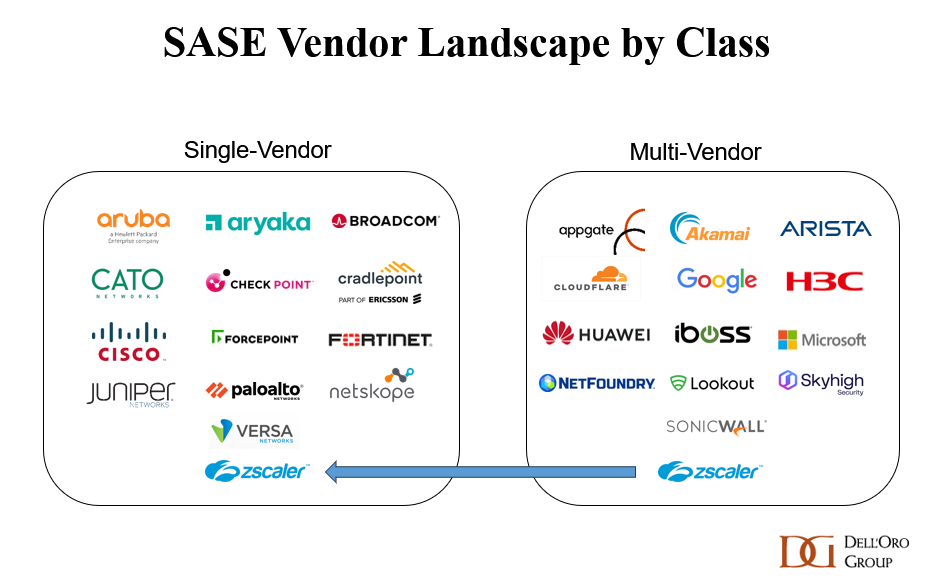
Zscaler’s evolution from sidestepping SD-WAN by exclusively relying on integrations with third-party SD-WAN vendors to now offering SD-WAN capabilities natively underscores the company’s adaptability and strategic growth. This shift highlights Zscaler’s responsiveness to changing market dynamics and marks a significant new chapter in its journey as a single-vendor SASE provider.

My SWOT analysis follows:

Strengths

  • Market-leading SSE with a strong security focus with zero trust architecture.
  • Simplified cloud management and deployment.
  • Targeted solutions for small to medium-sized branches.
  • Adoption of a modern subscription-based business model.

Weaknesses:

  • New entrant in the hardware-focused networking market.
  • Limited hardware portfolio breadth.
  • Pricing strategy not clearly defined.
  • Convincing established customers to switch from traditional vendors and approaches may pose challenges.
  • ZIA and ZPA are built on separate technology stacks and operate as distinct networks, unlike some newer SASE vendors that utilize a single network with a common technology stack. Having separate technology stacks/networks increases the risk of subpar networking performance and reliability.

Opportunities:

  • Rising demand for integrated security and networking solutions.
  • Shift towards service-oriented and cloud-based network management.
  • Opportunity to capture a niche market looking for simplified SD-WAN solutions.

Threats:

  • Competition from better-established SD-WAN vendors like Cisco, Fortinet, and Palo Alto Networks.
  • Resistance from customers loyal to traditional networking methods that rely on more of the security and networking smarts embedded in each SD-WAN device.
  • Need for continuous innovation in a rapidly changing SD-WAN and security landscape.
  • Newer SASE vendors offering a unified technology stack across functions may appeal to customers seeking streamlined solutions, posing a competitive threat to Zscaler’s dual-product approach.