[wp_tech_share]

I attended the Comcast Business Analyst Conference in Philadelphia last week, and the most important message was that Comcast Business is trying to expand its role in the enterprise market from just a connectivity provider to a higher layer defined by secure networking, distributed operations, and managed accountability. In my research at Dell’Oro Group, focused on the technology vendors behind enterprise networking, SD-WAN, and SASE, more of the strategic value is moving there. The important question is not whether Comcast Business sees that shift. It does. The real question is whether it can turn that vision into a repeatable operating model at scale. Four takeaways from the conference stand out and are discussed below.


Comcast Business is trying to move the conversation above transport.

The conference made clear that Comcast Business no longer wants to be evaluated primarily as a connectivity provider. The company repeatedly framed its business around managed SD-WAN, managed SASE, data center interconnection, digital experience, and a broader portfolio of lifecycle services layered on top of transport. That positioning matters because it aligns with a broader market reality: enterprise buyers increasingly want fewer integration burdens, clearer accountability, and more policy consistency across networking and security domains.

Strategically, that is the right direction. Value in the enterprise market is shifting from access and bandwidth to orchestration, policy, operations, and service assurance. That does not make connectivity unimportant. It makes connectivity less sufficient on its own. Comcast Business understands that, and the company’s message was notably more mature than a simple “we have more products now” narrative. It was really an argument that enterprises increasingly want a single operator who can stitch together connectivity, security, compute, and support into something that feels coherent.

Still, there is an important caution here. From a technology vendor’s perspective, the more interesting question is not whether Comcast Business can list many partners. It is whether the business ultimately concentrates on a smaller set of platforms that carry most of the operational and commercial weight. Portfolio breadth can help address heterogeneous customer demand. It can also create operational drag if too much of the business stays spread across a long tail of platforms. That is one of the central issues to watch from here.


AI matters more as an accelerant than as a standalone market story.

The conference’s AI narrative was most credible when it treated AI as an accelerant of existing trends rather than as a separate category that suddenly resets the market. Comcast Business repeatedly came back to the same core idea: the enterprise challenge is still managing everything, everywhere, all at once, but now at far greater speed. The security discussion reinforced that point by focusing on practical concerns, such as data leakage, shadow AI, governance, and AI-enabled threats, rather than on generic enthusiasm.

That framing fits what I am seeing across enterprise networking and security. AI does not reduce the need for secure connectivity, policy enforcement, observability, or lifecycle orchestration. It raises the value of those functions. More dynamic workloads, more automation, and more distributed compute create more dependency on the underlying networking and security control points that can connect, inspect, route, and operationalize those flows. In that sense, AI is not displacing existing enterprise infrastructure categories. It is increasing the strategic importance of those who can handle more change and complexity.

That distinction matters because it separates strategic importance from near-term revenue impact. AI clearly matters to Comcast Business’s story. But the near-term effect is more likely to show up in readiness, automation, policy, and selective architecture shifts than in immediate step-function revenue from new AI-specific products. That is a more disciplined way to interpret the opportunity.


The edge-compute thesis is logical, but it is still early.

Comcast Business also used the conference to make a broader case for edge computing. The logic is understandable. The company has a large access footprint, enterprise proximity, field operations, and a managed-services wrapper that can bring compute closer to customer sites. The examples discussed, especially around localized inference and application performance, were directionally sensible. They suggest Comcast is trying to position Edge not as a generic cloud alternative, but as a practical extension of its networking and managed-services relationship.

That is a different starting point than edge models built around hyperscale cloud infrastructure or developer-centric CDN platforms. Comcast Business’s version of edge is more operations-led, more premises-aware, and more tightly linked to access and lifecycle management. That could prove meaningful in enterprise environments where the problem is not only where compute sits, but who installs it, supports it, patches it, and makes it usable at a distributed scale.

At the same time, this remains more strategically interesting than commercially proven. The key open questions are straightforward. Which workloads move first into scaled production? How much near-term demand is really AI inference versus broader application localization, resiliency, or security-driven use cases? And how differentiated is Comcast Business’s model once the discussion moves from pilots and architecture diagrams to repeatable deployments? The conference pointed in the right direction, but the market still needs harder evidence.


Execution discipline is the strongest part of the Comcast Business story.

The most convincing part of the conference was not the architectural language. It was the operational one. Comcast Business’s operations and customer-experience sessions repeatedly emphasized simplification, industrialized delivery, operational accountability, and customer-first execution. That mattered because it shifted the conversation from vision to operating discipline. In managed services, that is where the real differentiation often lives.

The customer discussions made that point tangible. The City of Philadelphia session highlighted why large organizations value integrated execution and modernization discipline, not just product breadth. The manufacturing discussion reinforced the importance of standardization, uptime, and reliability in operationally sensitive environments. The most useful read-through was simple: enterprises are not only buying technology; they are buying confidence that the provider can absorb complexity on their behalf.

That is also where Comcast Business’s biggest opportunity and biggest risk intersect. If the company can translate multi-vendor breadth into a more standardized and scalable operating model, it becomes more relevant to larger enterprise buying centers. If it cannot, breadth starts to look more like catalog size than competitive advantage. In that sense, execution is not just part of the story. It is the story.

The Comcast Business conference mattered because it showed a company trying to reposition itself for the layer above connectivity. That is a credible strategic move, and it fits several market dynamics already reshaping enterprise networking and security. The next litmus tests are clear: whether the partner ecosystem narrows into a more defined set of scaled platforms, whether edge use cases move into measurable production, and whether Comcast Business’s managed-services narrative shows up in broader enterprise relevance rather than just broader messaging.

[wp_tech_share]

As mobile networks evolve to support more bandwidth, multiple technologies/frequencies, and increasingly diverse use cases—from eMBB to FWA, private wireless, and IoT—the complexity of operating the Radio Access Network (RAN) continues to rise. At the same time, revenue growth remains constrained, limiting operators’ ability to scale opex alongside this complexity.

Intelligent RAN Automation—combining automation, AI/ML, and advanced analytics—is emerging as a critical enabler for managing network complexity, enhancing network performance, curtailing energy consumption,  supporting new service models, and managing efficiencies/reducing opex. Most operators still remain between the Level 1 and 2 categories per the TM Forum; however, some of the early adopters are now slowly moving beyond basic automation toward Level 3 and 4 autonomous networks, where systems can reason, decide, and act with minimal human intervention. In this blog, we will review progress and expectations with autonomous networks.


The Autonomy Journey

RAN automation and intelligence are not new concepts. Existing 4G and early 5G networks already relied heavily on automation, but the role of automation has steadily evolved. Initial efforts focused on task-level efficiency, such as provisioning, configuration management, software upgrades, and alarm handling. With the first wave of 5G deployments, automation expanded into more advanced optimization use cases—building on 4G SON foundations—with closed-loop control for mobility management, load balancing, energy efficiency, and performance tuning using policy engines and domain analytics. Now, the industry is entering a new phase—AI-driven autonomy—where systems are no longer limited to predefined rules but can dynamically adapt to changing network conditions.

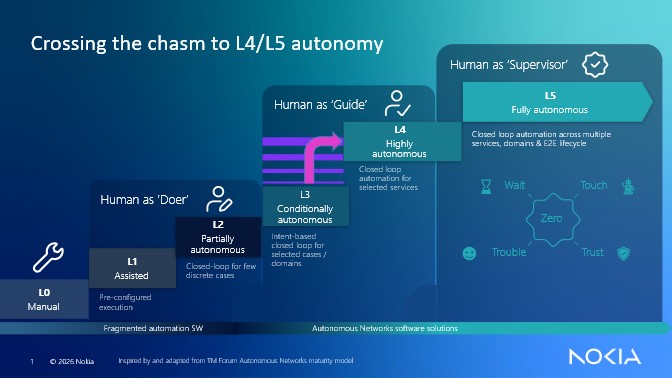
This evolution is captured in the TM Forum Autonomous Network framework:

  • L0 – Manual operations: Everything is driven by humans
  • L1 – Assisted operations: Manual and assisted human-based operations
  • L2 – Partial automation: Some automation but humans still address the lion’s share
  • L3 – Conditional automation: More AI, closed-loop operations and maintenance for select scenarios
  • L4 – High autonomy: Nearly full automation for many scenarios
  • L5 – Full autonomy: All AI, 100% automation, no human intervention – this is the end goal

Each transition brings the operators one step closer to the end goal of full autonomy without human intervention. The transition toward Level 4 represents a fundamental shift—from automating tasks to automating decisions. Vendors and operators broadly align on this transition. But the level of automation and pace of adoption will vary significantly depending on a confluence of factors. Still, the objective is clear: reduce human intervention while improving network performance/reducing opex.

Source: Nokia


Why Automation Matters

Mobile data traffic is still growing at a double-digit rate, though the pace is clearly slowing (up 16% in 2025 per Ericsson Mobility Report). At the same time, operator revenue growth increased at a 1% CAGR over the past ten years (Dell’Oro Capex Report).  This implies that the operators have minimal wiggle room to expand capex and opex to manage the increased complexity required to deliver the appropriate network performance while supporting more demanding and diverse end-user requirements.

Operators believe RAN automation is essential and can help to deliver several key benefits:

  • Maximize ROI on network investment
  • Improve performance and experience
  • Boost network quality
  • Accelerate time to market
  • Reduce complexity
  • Reduce energy consumption
  • Bring down CO2 emissions

Performance gains underpinned by Intelligent RAN will vary. Ericsson estimates that Intelligent RAN Automation solutions can improve spectral efficiency by 15%, while Huawei has demonstrated that its Intelligent RAN multi-band/multi-site 3D coordination feature can improve the user experience by up to 50% in some settings. Nokia has reported up to 80% efficiency gains with zero-touch radio network optimization. Meanwhile, ZTE has demonstrated tangible benefits from large-scale L2/L3 automation, including around a 30% reduction in fault recovery times and roughly 20%+ improvements in resource utilization. Samsung has incorporated AI and automation into its 5G RAN portfolio, although publicly disclosed large-scale L4 deployments remain more limited than those of larger RAN suppliers.

RAN Automation Achievements

Source: Ericsson

Level 4 takes it a step further. While Level 3 involves AI-driven closed-loop automation in defined scenarios, often with human oversight, L4 networks increasingly leverage multi-agent and AI-driven systems that can independently analyze, decide, and act within defined parameters with minimal approval. L4 is key to realizing zero-touch networks that detect and fix problems before they become major issues.

At L4, networks can:

  • Execute closed-loop automation across domains
  • Predict and resolve issues before they impact users.
  • Continuously optimize performance with real-time decisions
  • Improve spectral efficiency, user experience, and network reliability
  • Reduce energy consumption
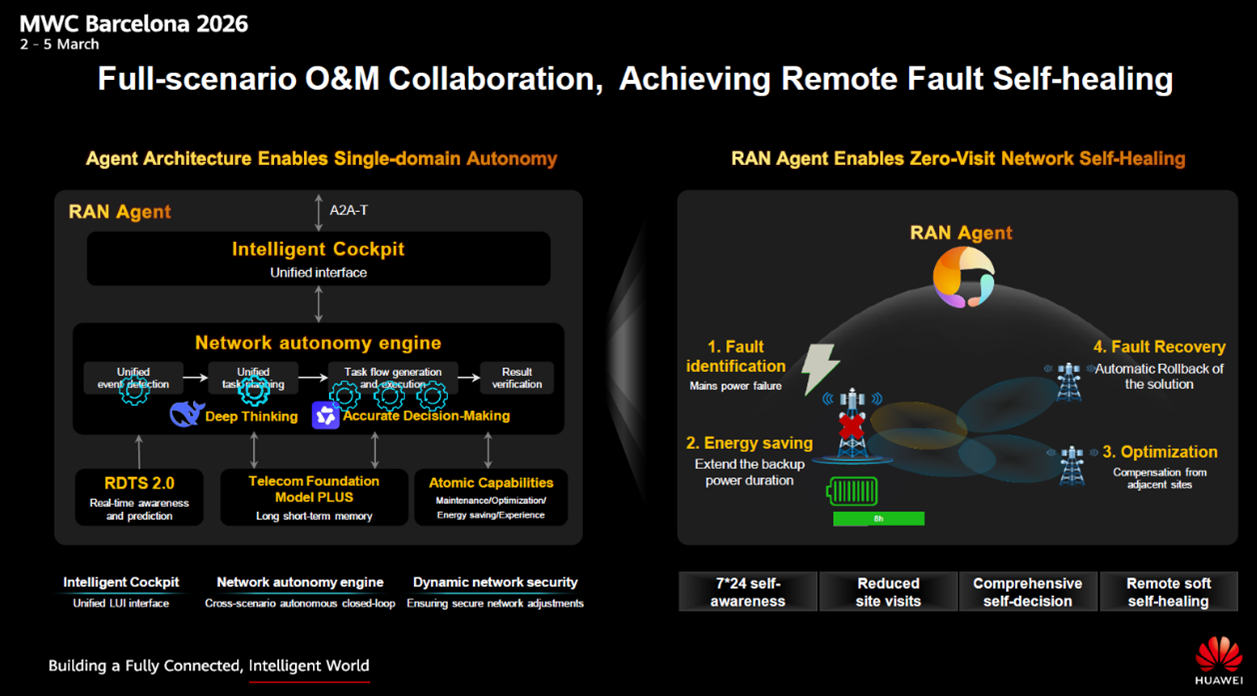
  • Full-scenario O&M collaboration
Source: Huawei


L4 Market Status: Early Days, but Real

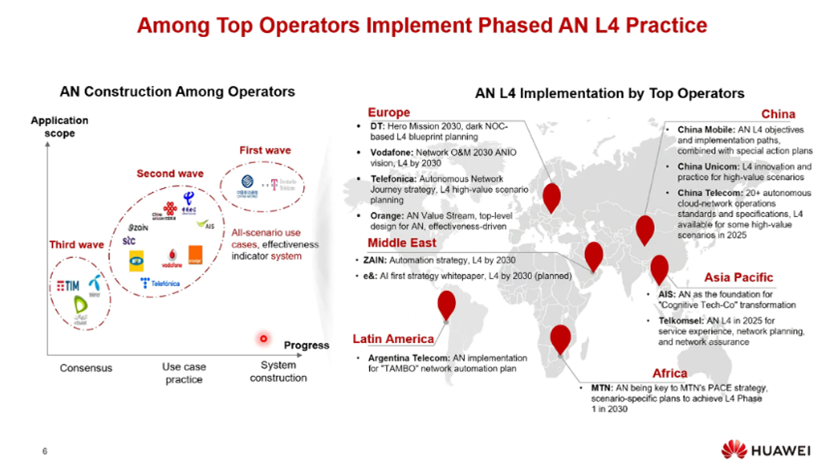
While some advanced domains like RAN optimization are approaching Level 3, the overall industry remains in the Level 1-2 range (TM Forum), where automation is still largely domain-specific and rule-based. Most deployments today are still limited to specific use cases rather than full network-wide autonomy. At the same time, Level 4 is no longer theoretical. Implementations remain limited to a small group of leading operators, but real progress is now visible.

Rakuten Mobile has already proven L4 at scale in a live RAN network, with TM Forum validation for RAN energy efficiency. Based on production traffic, Rakuten is able to realize 20% RAN energy savings using AI-driven closed-loop control with no impact on customer experience.

In June 2025, TDC NET and Ericsson achieved TM Forum Level 4 autonomy certifications for a live RAN deployment. The Level 4 validation focused on Ericsson’s PCEM software, which reduced the energy required to transmit 1 GB of data by approximately 5% under live network conditions.

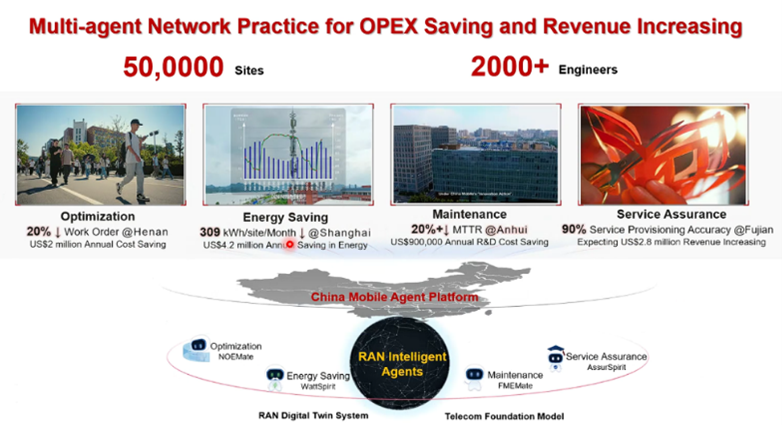
China Mobile reported Level 4 progress through TM Forum ANLAV assessments at Innovate Asia 2025, receiving TM Forum certifications across multiple use cases including service assurance, wireless energy optimization, and IP fault management. While scenario-based results do not imply network-wide Level 4 autonomy, they reflect meaningful operational progress in selected high-value domains.

China Telecom is an emerging L4 RAN adopter, applying automation in high-value domains such as optimization, assurance, and energy savings, with selected AI initiatives delivering double-digit efficiency improvements.

China Unicom is demonstrating targeted L4 RAN automation in areas such as traffic optimization, automated assurance, and energy efficiency, with broader deployment still maturing.

Huawei is also working with operators globally on large-scale L4 trials. In addition to the Chinese carriers, Huawei has indicated engagements with 10+ international operators implementing L4 autonomous networking in live production environments.

Nokia and STC have demonstrated Level 4 autonomy in live RAN operations, moving beyond traditional SON toward AI-driven closed-loop operations. During the Hajj period, despite traffic increasing by 40%, the network executed 10K autonomous operations per hour, helping improve DL throughput by approximately 10%.

Source: Huawei

Although newer entrants/smaller RAN suppliers are contributing to SMO, rApps/xApps, and cloud automation, most scaled L4 RAN deployments today remain associated with the largest established RAN suppliers.


Level 4 Roadmap

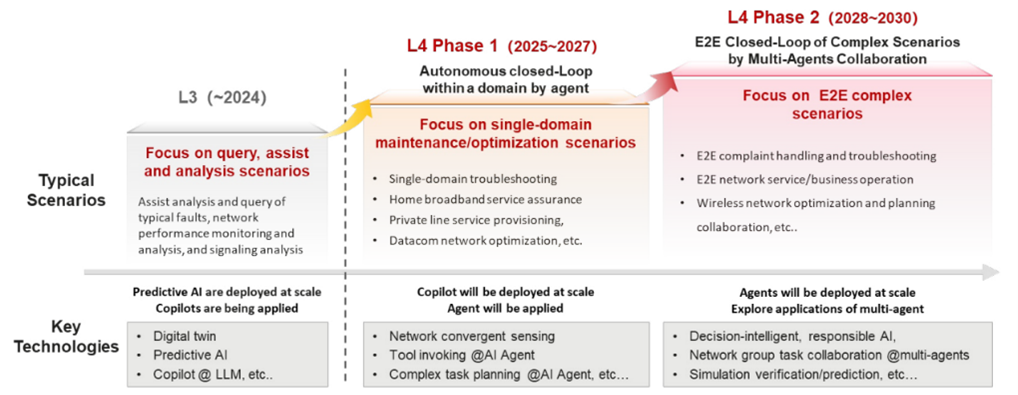
Most L4 deployments today are scenario-based rather than network-wide, with autonomy achieved in specific domains such as energy optimization or traffic management. And it will still take time before even the leading operators implement L4 across the broader network. Although the TM Forum envisions that the next couple of years will be critical for the autonomous closed-loop of L4 single-domain maintenance, optimization, and operation, the path to L4 will likely be slow and gradual and can at a high level be divided into two phases.

Phase 1: Single Domain-Level Automation Scenarios (Near-Term)

This phase focuses on high-value, low-risk use cases within individual domains:

  • Closed-loop automation within RAN
  • AI-assisted decision-making with human-defined guardrails
  • Limited cross-domain coordination
  • Energy optimization, automated fault detection, traffic and load optimization

Phase 2: Cross-Domain Autonomy (Medium-Term)

This phase extends autonomy across domains, enabling end-to-end service orchestration:

  • Multi-domain coordination (RAN, transport, core)
  • Intent-driven automation
  • Minimal human intervention
  • E2E assurance, cross-domain root cause analysis, mobile network optimization
Source: TM Forum


RAN agents are emerging as a key enabler in accelerating the transition to Level 4 autonomy by shifting networks away from rule-based automation toward a more adaptive, goal-driven model. Unlike traditional systems that depend on predefined scenarios, these agents can interpret intent, assess real-time conditions, and take action while continuously learning from new data. This allows networks to move beyond static workflows into context-aware decision-making, real-time adaptation, and ongoing optimization.

In the near term, RAN agents enhance domain-level automation by making operations more scalable and efficient—for instance, by dynamically adjusting energy usage based on traffic patterns or continuously tuning network parameters. The real step change is expected to come from cross-domain collaboration, where distributed agents coordinate across RAN, transport, and core to address issues such as congestion and enforce end-to-end service-level objectives. While this multi-agent approach should unlock greater scalability, faster innovation, and continuous improvement, it also introduces new challenges around coordination, interoperability, and building trust in autonomous decision-making.

Source: Huawei


In summary, the shift towards RAN Automation is happening. The journey is taking longer than expected (many operators promised large-scale L4 by 2025). In most cases, autonomy today is achieved within well-defined guardrails, with humans still setting policies and objectives. Still, there is no question that this is a key pillar in all future RAN and telecom roadmaps. The transition to Level 4 marks a pivotal shift—from automating tasks to automating decisions—enabling networks that are more adaptive, efficient, and resilient. While most operators remain in the early stages, the trajectory is clear. Early deployments demonstrate that L4 is achievable today, particularly in targeted domains.

The pace of this next phase remains highly uncertain. The transition to L4 autonomous networks is as much a human challenge as a technical one. It is natural to fear losing control and giving it up to machines. At the same time, networks will become more complicated, and the revenue upside remains limited, meaning operators who can accelerate this transition towards cross-domain autonomy and RAN agents will likely be in a better position. Ultimately, RAN automation will play a growing role in the second half of 5G and likely from the start with 6G.

[wp_tech_share]

Below are some of the MWC takeaways related to end-user drivers, AI RAN, 6G, and Open RAN.


It is all about the 0.06%

With mobile data traffic slowing and multiple data points suggesting the mobile network has significant excess capacity, the focus is shifting toward uplink (UL) traffic growth (Ericsson estimates it could grow by 3x every five years), network differentiation, and the RAN investment requirements needed to dimension networks for the AI era.

Impressive demos featuring robots serving drinks, busy concerts, or the ability to look up information using smart glasses were less interesting than the 0.06%—a number that every investor, financial analyst, and 6G skeptic now seems to have memorized. Against a backdrop of low network utilization, this figure became one of the key focal points of the show.

For those who did not read Ericsson’s June 2025 Mobility Report, 0.06% is the share of total network traffic originating from GenAI. The concern is that while AI is proliferating rapidly, its impact on the mobile network—for now—is negligible.


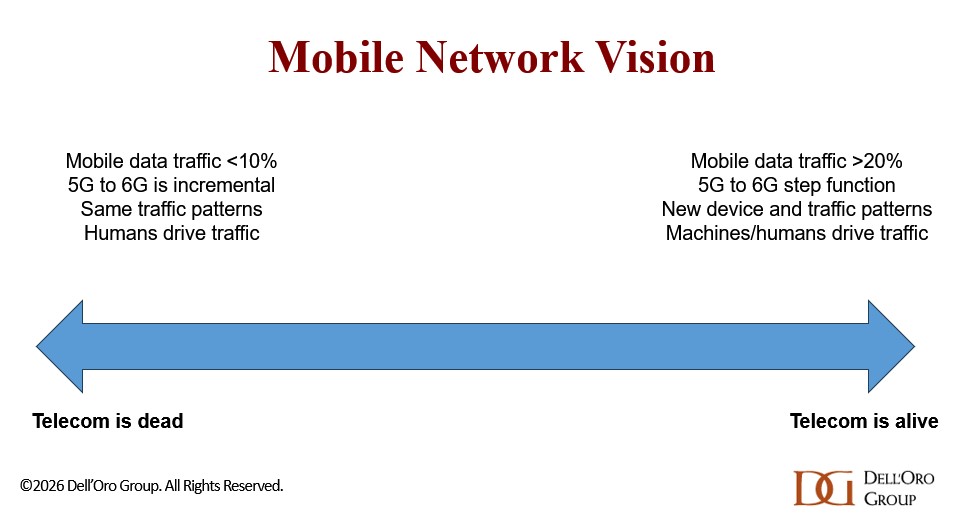
Two different mobile network visions

As we have discussed in various reports and blogs, we believe there are, at a high level, two very different mobile network visions evolving.

The “telecom is dead” narrative is largely driven by the mobile data traffic growth trajectory. The key argument is that humans can only consume so much smartphone video in a day; therefore, mobile data traffic growth will soon plateau, reducing the need for new 6G spectrum.

The “telecom is alive” vision is built on the assumption that it is still early days in the AI era. Even with GenAI accounting for just 0.06% of total traffic, this camp is more optimistic about both human-driven and machine-driven traffic. On the human side, the expectation is that new devices—better suited for environments where data is continuously recorded, analyzed, and uploaded—will emerge and significantly change mobile traffic patterns. Smart glasses are a strong contender, though they are not ready yet.

Machines and Physical AI are also expected to have a profound impact on everyday life for both consumers and enterprises. Fixed networks/Wi-Fi will play an important role, but they will need to be complemented by high-performance cellular connectivity.

These two very different visions are important, as they will shape how operators approach capex, architectural shifts, the timing of 6G, and the need for AI RAN, among other things.

All roads lead to AI RAN

MWC reinforced what we have already communicated:

  1. AI RAN is happening (across all RAN layers)
  2. It will play a major role in the second half of 5G and from the outset with 6G
  3. The base case is that AI-for-RAN will dominate over the forecast period
  4. The GPU RAN conversation is evolving

Operators are no longer asking why GPUs might be relevant, but rather where and when they make sense. Expectations for GPU RAN are still modest, but the topic has clearly moved out of the noise.

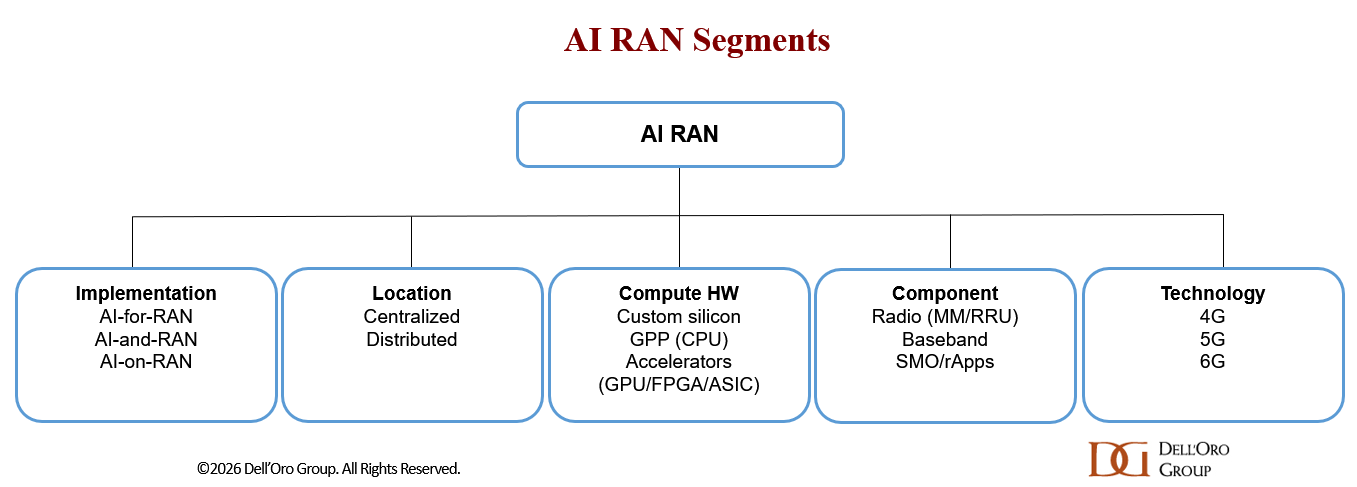
AI RAN Segments - Dell'Oro

Please see the recently published AI RAN blog for more details.


Open RAN/vRAN takes a backseat, but remains important

AI RAN has moved into the passenger seat, while Open RAN/vRAN/Cloud RAN was clearly pushed to the backseat at this year’s MWC. Still, even with reduced Open RAN marketing, most conversations and demos support our broader message:

  1. Open FH is increasingly being specified as a baseline capability for next-generation RAN platforms. Ericsson plans to have 160 Open-RAN-proven radios by the end of 2026. Similarly, Nokia’s recently introduced AI-RAN-ready Doksuri radios include compatibility with Open FH standards. Samsung, 1Finity, and NEC are already strong proponents of Open RAN/vRAN.
  2. Supplier diversity is not improving. RAN market concentration continues to increase, and Open RAN is most often deployed in single-vendor configurations.
  3. Multi-vendor Open RAN remains rare, although one European Tier-1 operator believes our forecast may be too pessimistic.
  4. Vendor strategies are shifting. Both Mavenir and NEC have recently revised their RAN strategies. Mavenir is focusing more on small cells and non-terrestrial networks (NTN), while NEC is prioritizing vRAN and Massive MIMO.
  5. The long-term outlook remains positive, though forecasts were revised downward in the January update.
  6. It is still not guaranteed that Open RAN will become part of the 3GPP standards.

Please see the recently published Open RAN blog for more details.


Massive MIMO – upside with 6G and FDD

Massive MIMO has been a major success. In addition to capacity gains, operators have used Massive MIMO to improve range and minimize incremental cell-site investments. We estimate that these higher-MIMO configurations accounted for roughly half of 5G RAN revenues between 2018 and 2025.

With upper mid-band now covering more than 55% of the global population (per the Ericsson Mobility Report), growth will become more challenging. So far, the focus has been on upper mid-band TDD, while FDD and 6.4 GHz+ remain largely untapped.

FDD Massive MIMO is gaining attention because:

  1. UL traffic is now growing faster than DL
  2. Technology improvements are helping reduce size and improve form factors

Because of the lower carrier frequencies, size remains a challenge in FDD spectrum. Huawei marketed its 28 kg 1.8+2.1 GHz FDD Massive MIMO unit as the industry’s lightest.


6G – no change to consensus outlook
  1. 6G was not as prominent as AI RAN, but the discussions and demos we saw reinforce our existing view:
  2. 6G is now inevitable—focus has shifted from if to how and when
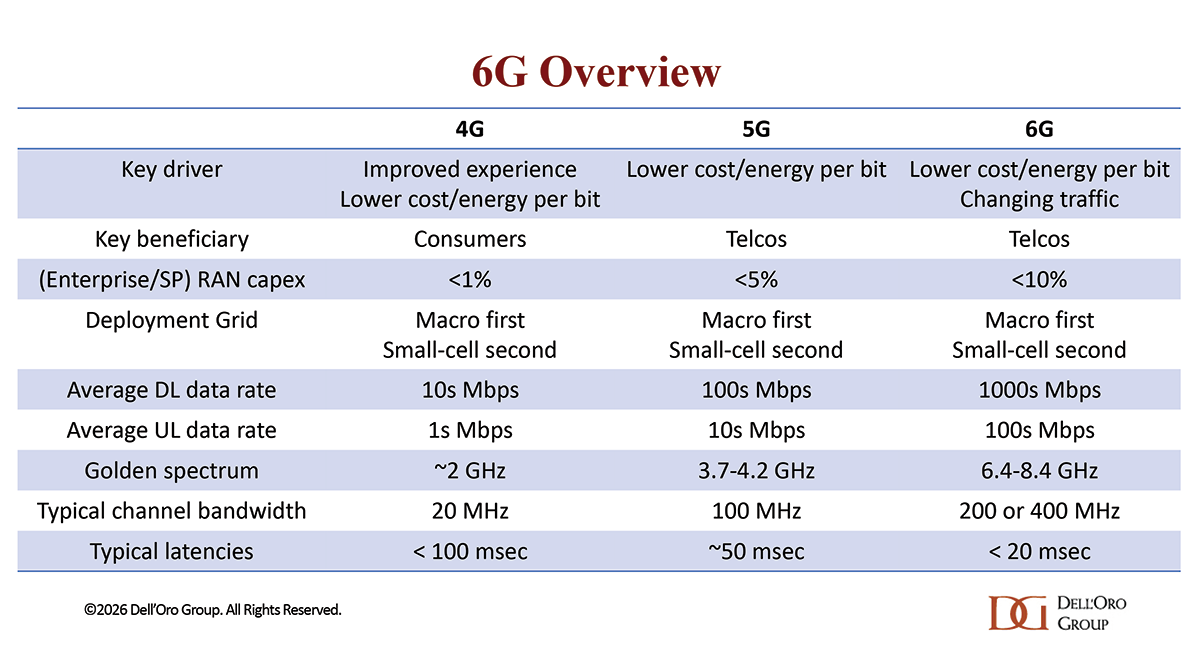
  3. Technology ramp is expected around 2029/2030
  4. 4–8.4 GHz is emerging as the “golden spectrum”
  5. The existing macro grid will provide the foundation, with Massive MIMO playing a key role
  6. A more optimistic network vision is improving sentiment—6G is not just about capacity, but also about changing traffic patterns as machines account for a larger share of total traffic
  7. AI-native architecture will be central

[wp_tech_share]

OFC 2026 was held a couple of weeks ago, and since then, I have had a chance to reflect on what was shown and what I saw from the perspective of an Optical Transport industry analyst. The simple conclusion is that the next direction for optical networking is to scale up in density.

100 Gbps ZR/ZR+ is officially a market

I should clarify this headline. 100 Gbps ZR/ZR+ QSFP28 pluggable optics have been shipping for revenue since 4Q 2023, and shipments have ramped nicely. However, the only supplier of the DSP (Digital Signal Processor) was a co-developed product from Coherent Corp and Adtran. So, technically, it was only one supplier. This changed during OFC when two additional suppliers—Cisco Acacia and Arycs Technologies—announced plans to begin shipping their 100 Gbps ZR/ZR+ pluggable with in-house DSPs in mid-2026. Now there are three DSP suppliers, introducing competition and giving customers a choice. It “feels” more like a market. I should add that in the IPoDWDM and Disaggregated WDM report, we forecast that 100 Gbps ZR/ZR+ optical pluggable modules will grow steadily for many years to come.


1.6 Tbps ZR/ZR+ pluggable optics were announced… before 800 ZR/ZR+ volume shipments started

This is the environment we are in right now—things are moving fast, and development cycles are shortening. The good news is that Cisco Acacia announced it has ramped 800 Gbps ZR/ZR+ DSP production, shipping 25,000 DSPs to date, which is a lot compared to other 800 Gbps ZR/ZR+ suppliers. But to put this in perspective, the cumulative shipments for 400 Gbps ZR/ZR+ pluggable optics to date for the industry, per our ZR/ZR+ optical pluggable shipment tracker, are closer to 1.7 million (FYI Cisco Acacia has stated they shipped 750 thousand 400 Gbps DSPs to date, where most were used for ZR/ZR+ optics). So, 800 Gbps ZR/ZR+ is just starting to ramp in production.

The vendors that announced plans to sell 1.6 Tbps ZR/ZR+ optical plugs in an OSFP form factor based on DSPs using a 2 nm foundry process were 1Finity, Ciena, Marvell, and Nokia. The timeline was a little vague, but I believe 1.6 Tbps ZR/ZR+ plugs will be generally available before the end of 2027, with samples as early as 4Q 2026. A couple of items to point out: 1) 1Finity will use a 3rd party DSP, and 2) Cisco Acacia did not make any announcements about 1.6 Tbps optics at OFC. So, I am guessing the company is waiting until ECOC in September.


Nokia laid out its anywhere, anyplace, and anybody product strategy

“Anywhere, anyplace, and anybody” is my own interpretation of Nokia’s optical product strategy after listening to the company’s announcements. Nokia held an analyst event at OFC where the company presented all the new products it has in the pipeline. Personally, I liked seeing all the products it has in development, but it could be overwhelming to hear it all at once in under 60 minutes. Luckily, for me, the OFC analyst event was the fourth Nokia meeting I had with them, where they presented these product ideas, so I understood more of the details that the company executives didn’t have time to explain during the event. In summary, Nokia presented the following new products:

  • Four new coherent DSPs (Huron, Superior, Ontario, and Pacific) are planned. Not one or two, but four! The key here is that three of the four are being developed simultaneously, using the same 2 nm base structure and logic. In other words, the cost to develop two of them (Superior and Ontario) is a fraction of the cost to develop Huron. Nokia’s objective is to create cost and performance-optimized DSPs for applications that include 3.2 Tbps coherent-lite for campus, 1.6 Tbps ZR/ZR+ pluggable for metro and DCI, and 2.4 Tbps high-performance for long-haul and subsea. And while not explicitly stated, to meet the differing needs of their wide customer base (CSPs, cloud providers, enterprises/public). So, basically, DSPs for anywhere, anyplace, and anybody. There wasn’t much said about Pacific, but I believe it will be a high-performance, 3.2 Tbps-capable DSP operating at 400 Gbaud and will likely be productized later than the first three.
  • All the pluggable optics (QSFP and OSFP) and embedded line cards needed to house the new DSPs in different shapes and forms.
  • Double-sided pluggable transponder. The idea is simple: combine the client optical transceiver and the coherent optical transceiver into a single pluggable module. One use case for this is to convert CPO grey light to colored light.
  • Multi-rail in-line amplifier (ILA). It wasn’t clear what variations the company would offer, but they stated that the highest-density configuration would be 160 rails per rack. The system will begin sampling mid-2026.
  • A Full Band Transponder (also called a full spectrum transponder) that encloses all the client ports, coherent transponder components, and mux/demux into one line card module that fits in an existing GX chassis, delivering a single fiber output with multiple wavelengths. Nokia plans to offer variations of this module with different options and optical engines.


Ciena kept things at the system level

Ciena announced several products under development but kept much of the coherent DSP activity under wraps (probably to spread its announcements out between OFC and ECOC). The products included:

  • 1.6 Tbps ZR/ZR+ OSFP pluggable module for IPoDWDM. No comment was made on the DSP to enable it other than that it is a 2 nm DSP.
  • 3.2 Tbps coherent-lite plug for campus. This may leverage the same DSP developed for 1.6 Tbps ZR/ZR+ as Ciena did for its 1.6 Tbps coherent-lite plug.
  • RLS Hyper-Rail, which is a multi-rail ILA. The company plans to offer 300 mm and 600 mm versions, as well as a 5 RU size to fit in existing ILA huts.
  • Full Spectrum Transponder to house all the client ports, coherent transponder components, and mux/demux in a single unit that outputs all the wavelengths through a single fiber connector, enabling a rapid delivery for a full-fiber deployment.
  • Early work on xPO modules was shown. I was surprised since the MSA was just announced, but I guess the advantage of xPO is that companies can use existing components to fill in the xPO form factor, but in a tighter configuration, since the xPO has liquid cooling.


Optical line systems are REALLY important

As transponder technology approaches Shannon’s Limit, spectral efficiency improvements do little to increase fiber capacity. The realization is that to add more capacity, more fibers will be needed, and each fiber pair requires an ILA every 80 km. In addition, cloud providers are building massive AI data centers that now need to scale-across hundreds of kilometers between data centers to form a larger virtualized AI factory. My discussion at OFC with some folks pointed to a need for 20 Pbps of capacity to connect the back-end of a GPU data center to another. This would convert to 390 fiber pairs when connecting 800 ZR+ optics at each end. The answer to this is a multi-rail system. If a rack unit supports 128 rails, three racks of multi-rail ILAs will be needed at each site.

During OFC, four companies announced multi-rail products: Coherent Corp., Ciena, Cisco, and Nokia. Three other companies (Molex, Ribbon, and Smartoptics) plan to look into developing a multi-rail system. Based on the timing of availability, I think commercial shipments of multi-rail products could begin in 2027.


Density is the Next Dimension

For decades, the method for scaling optical transport networks was to increase wavelength speeds (Mbps to Tbps) and the usable spectrum in a fiber (C-band to Super C and L-band). However, as we saw at OFC 2026, the next dimension is density—increasing the number of transponders and ILAs that fit in a cubic meter of space. This is the reason for some of the new product announcements:

  • 1.6 Tbps ZR/ZR+ optics
  • xPO form factor pluggable module
  • Full Spectrum Transponder
  • Multi-rail ILA

You can imagine. Combining all four product features into an optical network will increase the density by around 4 times.

  • Put multiple 1.6 Tbps coherent optics inside a full-band/spectrum transponder unit. Use xPO modules for the client interface instead of 1.6 Tbps OSFP plugs, saving 75% of the front panel density.
  • Connect the fiber coming out of the full-band/spectrum transponder to a multi-rail ILA that is 75% smaller than a traditional ILA unit.

Following OFC 2026, I think the new metric for an optical transport system’s efficiency will be volumetric density (Gbps-per-cubic meter) rather than spectral efficiency (Gbps-per-hertz).