[wp_tech_share]

AI RAN is moving to the center court. While operators have not fundamentally changed how they think about their RAN roadmaps—openness, intelligence, automation, and virtualization remain the core pillars of next-generation RAN platforms—the visibility and adoption of these technologies vary significantly. In the early phase of 5G, Open RAN and vRAN dominated the conversation. Today, AI RAN is the shiny object.

Events such as MWC2026 Barcelona and Nvidia GTC reinforced the message we have communicated for some time, namely that AI RAN is already happening. At the same time, the GPU conversation is shifting. Looking ahead, AI RAN is expected to see broad adoption across the RAN in the latter half of the 5G cycle and from the outset of 6G.

All roads lead to increased adoption of AI RAN. Differences will emerge across deployment models, compute architectures, hardware choices, functional splits, and underlying technologies.
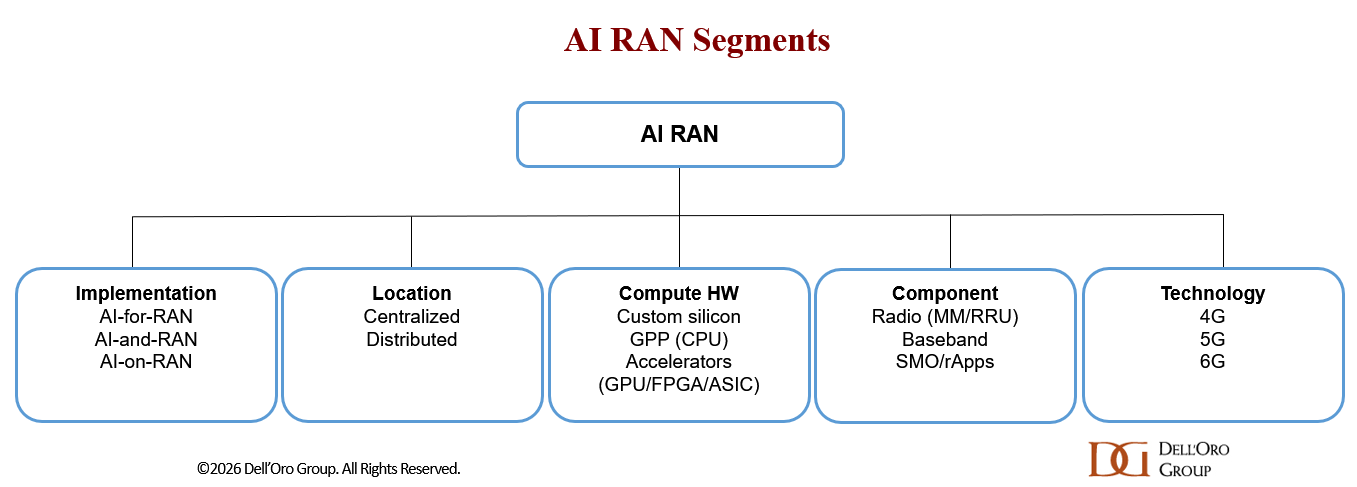
AI RAN Segments - Dell'Oro

At present, the majority of the AI RAN market is driven by distributed AI-for-RAN solutions focused on improving performance and efficiency, often leveraging existing 5G infrastructure. Vendors such as Huawei and ZTE have collectively shipped more than 0.6 M AI-enabled boards/plug-ins, underscoring that AI RAN is already happening at scale.

One of the key takeaways from MWC Barcelona is that nearly all RAN roadmaps—across both large and smaller vendors—now incorporate AI RAN capabilities across the full RAN stack, with a focus on AI-for-RAN. And it is not just the baseband—suppliers are now bringing intelligence into every RAN layer, including the radios. Ericsson’s launch of ten AI-ready radios featuring in-house silicon with neural network accelerators is a case in point. The question is no longer if AI RAN and AI-RAN will happen, but rather how, what, where, and when.
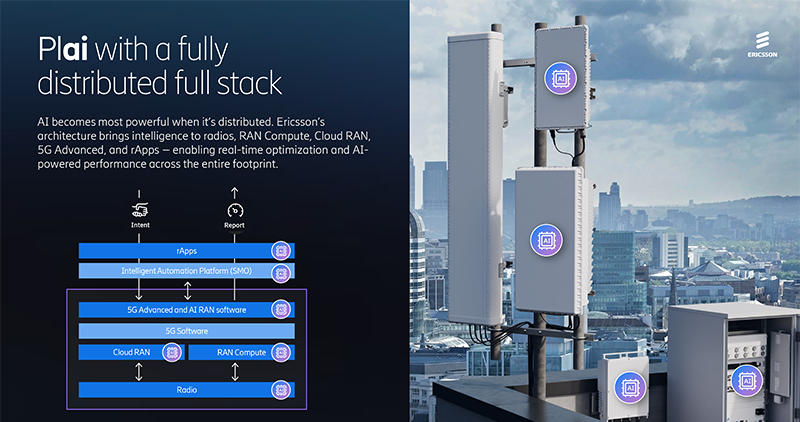
Ericsson AI RAN
Source: Ericsson


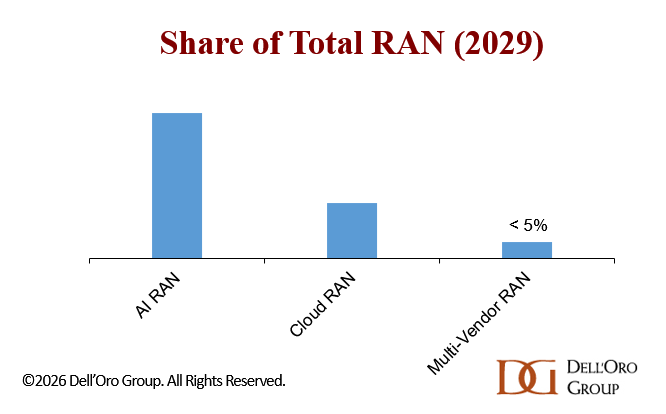
Dell’Oro’s long-term view of next-generation RAN has remained broadly intact. Events like MWC 2026 and NVIDIA GTC have done little to alter the underlying trajectory. The likelihood that AI RAN, Cloud RAN, and multi-vendor RAN will play major roles in the second half of 5G and the early 6G era remains high, moderate, and low, respectively. According to our latest forecast update, AI RAN is expected to surpass $10 B and account for roughly one-third of the total RAN market by 2029 (this is not new revenue).
Within the AI RAN domain, the prospects for GPU-RAN (and AI-and-RAN) are improving—still small, but no longer negligible. This shift reflects both low starting expectations and a gradual change in sentiment. The conversation is moving from outright skepticism to cautious curiosity. Much of this momentum is being driven by NVIDIA’s continued push and its vision that the world’s ~10 million macro sites could evolve into more than just base stations. As Jensen Huang put it during his GTC keynote: “That base station…is going to become an AI infrastructure platform.”

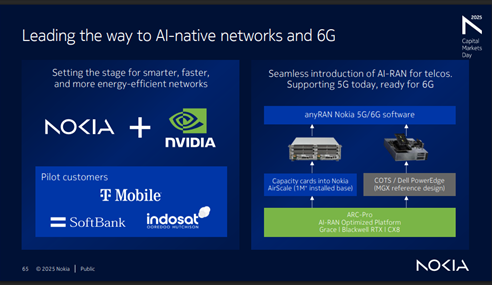
Early operator progress—from T-Mobile, SoftBank, and Indosat—combined with Nokia’s recent reiteration of its AI-RAN roadmap, is reinforcing this shift. Samsung and 1Finity, meanwhile, are exploring whether GPUs could make sense to diversify their computing platforms.

Source: Nokia


Part of the renewed interest in AI RAN—and GPU RAN specifically—stems from a broader realization: technological change is accelerating at a much faster pace than during the 4G-to-5G transition. This shift is reshaping how the industry views the role of mobile networks, the distribution of AI inference, and the trade-offs between hardware-based and software-defined architectures.

At the same time, “physical AI” is becoming more tangible. Concepts that once felt like science fiction—such as robots assisting with cooking or walking children to school—are now increasingly plausible in the near term.

That said, operators remain cautious for now about GPU RAN and broad-base AI inference distribution, even as skepticism gradually eases as the ecosystem matures. The constraints are structural. RAN deployments operate under tight power budgets, strict cost controls, and massive scale requirements. These factors make it challenging to justify deploying power-intensive compute at every cell site.

So, concerns persist about the performance-per-watt gap between GPUs and custom silicon, as well as the practicality and need to support non-telco workloads at both D-RAN and C-RAN sites—particularly in D-RAN deployments. For example, the SoftBank/Ericsson robot assistance demo at MWC operated with latency requirements of around 100 ms, which allows for centralized AI inference, with compute resources located in a data center using the User Plane Function.

In other words, AI RAN is moving from hype toward reality. While trade-offs across AI inference distribution needs, flexibility, performance, energy efficiency, TCO, and TTM will shape adoption paths over the near-term and long-term, the overall direction is clear: AI will become an integral part of every layer of the RAN.

Base-case projections suggest that non-GPU RAN will dominate AI RAN over the forecast period, reflecting both the ability to upgrade existing infrastructure, the constraints at the cell site, and the need for multi-purpose tenancy. This suggests NVIDIA still faces a meaningful challenge if it aims to position itself not only as the “inference king,” but also as the “AI RAN king.”

At the same time, the conversation is clearly evolving. Operators are no longer asking why GPUs might be relevant, but rather where and when they make sense. If NVIDIA succeeds in expanding the role of the RAN—from a single-purpose connectivity layer into a distributed AI platform—the long-term opportunity could be significantly larger than what is currently reflected in our base-case assumptions. As Amara’s Law suggests, the risk may not be overestimating the short-term impact of AI RAN, but underestimating the demand for more distributed intelligence over the long-term.
 

[wp_tech_share]

Open RAN has made significant progress since the O-RAN Alliance was formed in 2018 to “re-shape the RAN industry and ecosystem towards more intelligent, open, virtualized, and interoperable networks.” However, the results to date have been mixed. Open fronthaul (Open FH) is increasingly being specified as a baseline capability for next-generation RAN platforms. At the same time, supplier diversity has not improved. In fact, RAN market concentration is higher today than it was before the alliance was established. Also, uneven adoption across greenfield, early-adopting, and early-majority operators contributed to a sharp capex deceleration following the Open RAN peak in 2022. That slowdown fueled concerns about the movement’s momentum, even with single-vendor Open RAN.

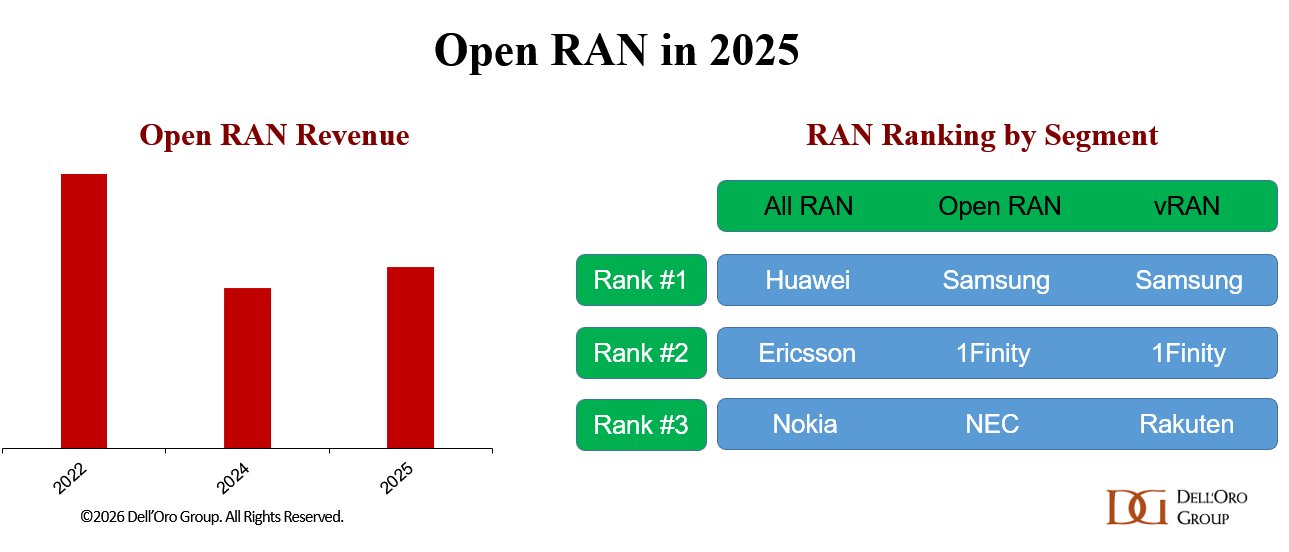
Market conditions improved in 2025. Following the roughly 40 percent decline between 2022 and 2024, preliminary findings suggest worldwide Open RAN revenue grew at a double-digit rate in 2025. Virtualized RAN (vRAN) revenue also stabilized, although at a more modest pace. Several factors help explain this reversal, including easier year-over-year comparisons, more favorable RAN spending trends in regions with strong Open RAN exposure, and, to a lesser extent, increased activity among early-majority adopters.

Vendor rankings did not change significantly, but the broader RAN landscape evolved in ways that also affected the Open RAN and Cloud RAN ecosystems. Both Mavenir and NEC revised their RAN strategies. Mavenir is now focusing more on small cells and non-terrestrial networks (NTN), while NEC is prioritizing vRAN and Massive MIMO. Meanwhile, 1Finity moved up one spot in the Open RAN ranking.

The incumbent Western suppliers are fully hedged. Ericsson and Nokia continue to support Open RAN while maintaining integrated portfolios. According to Ericsson’s latest update, 160 radio models will be Open-RAN-proven by the end of 2026. Likewise, Nokia’s recently introduced AI-RAN-ready Doksuri radios include compatibility with Open fronthaul standards.

Looking ahead, the positive momentum is expected to continue into 2026, with both Open RAN and vRAN projected to grow this year. The longer-term outlook for Open RAN and Cloud RAN also remains favorable. We have not changed the long-term assumptions communicated in the most recent forecast update. To recap, near-term Open RAN revenue projections were revised downward, while long-term growth expectations strengthened.

Virtualization remains a key pillar of next-generation RAN platforms. At the same time, Cloud RAN projections were lowered in the most recent five-year forecast. Still, Cloud RAN is expected to account for roughly 15 to 20 percent of the total RAN market by 2030.

Although the narrative around Open RAN improving supplier diversity has clearly cooled, the emerging GPU-RAN and software RAN wave is reopening the conversation about non-traditional suppliers playing a larger role in the RAN ecosystem. That said, the base case outlook for mixing and matching vendors remains limited. Multi-vendor RAN is still expected to account for less than 5 percent of total RAN deployments by 2030.

For more information about our RAN and Open RAN coverage, please see https://www.delloro.com/advanced-research-report/openran/

[wp_tech_share]

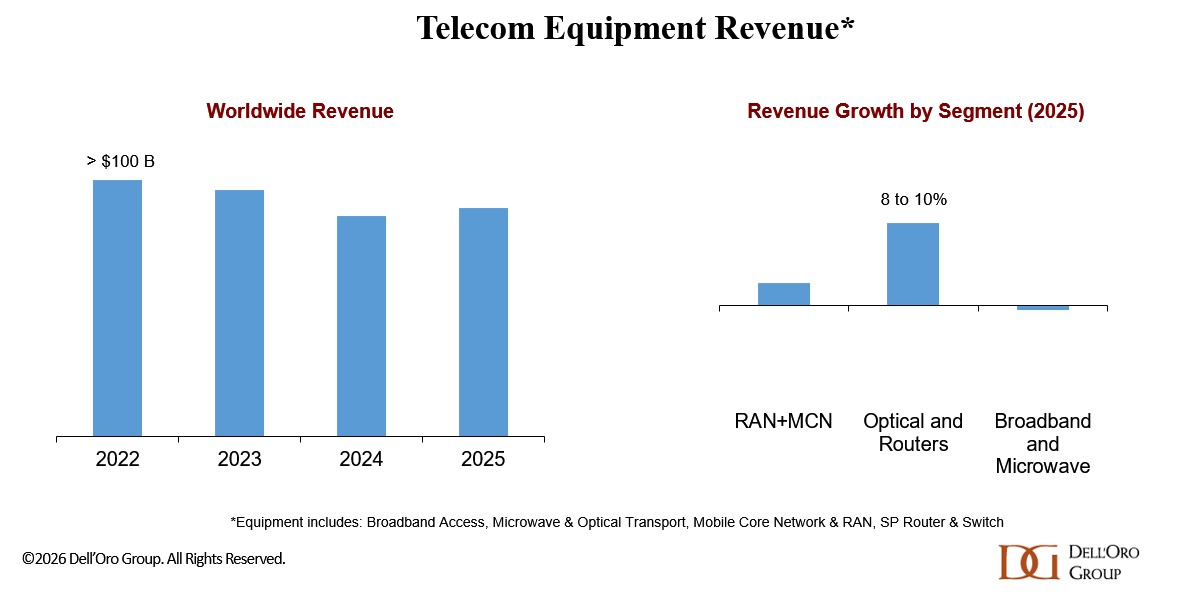
Following the 14% revenue decline between 2022 and 2024, telecom equipment investment conditions improved in 2025. Preliminary findings indicate that aggregate worldwide telecom equipment revenues across the six programs tracked by Dell’Oro Group—Broadband Access, Microwave & Optical Transport, Mobile Core Network (MCN), Radio Access Network (RAN), and Service Provider Router & Switch—increased 4% year over year (Y/Y) in 2025, supported by an exceptionally strong fourth quarter (accounting for 29% of full-year revenue).

Improved market conditions were supported by easier year-over-year comparisons, inventory stabilization, favorable currency movements, healthy demand for both wireless and wireline equipment, and robust investment from cloud providers, which contributed meaningfully to the overall growth of the telecom equipment market.

From a regional perspective, double-digit growth in North America and EMEA (Europe plus the Middle East and Africa) more than offset the more challenging conditions in the Asia Pacific. North America and China together accounted for slightly more than half of the overall market in 2025.

While growth was supported by both wireless and wireline segments, Optical Transport and SP Router & Switch stood out, partly reflecting their exposure to data center infrastructure investments.

Relative to our expectations heading into 2025, market performance was slightly stronger than the flat outlook initially outlined, supported by better-than-expected growth in MCN, Optical Transport, and SP Routers. Per the MCN report, the 5G MCN market reached an inflection point in 2025.

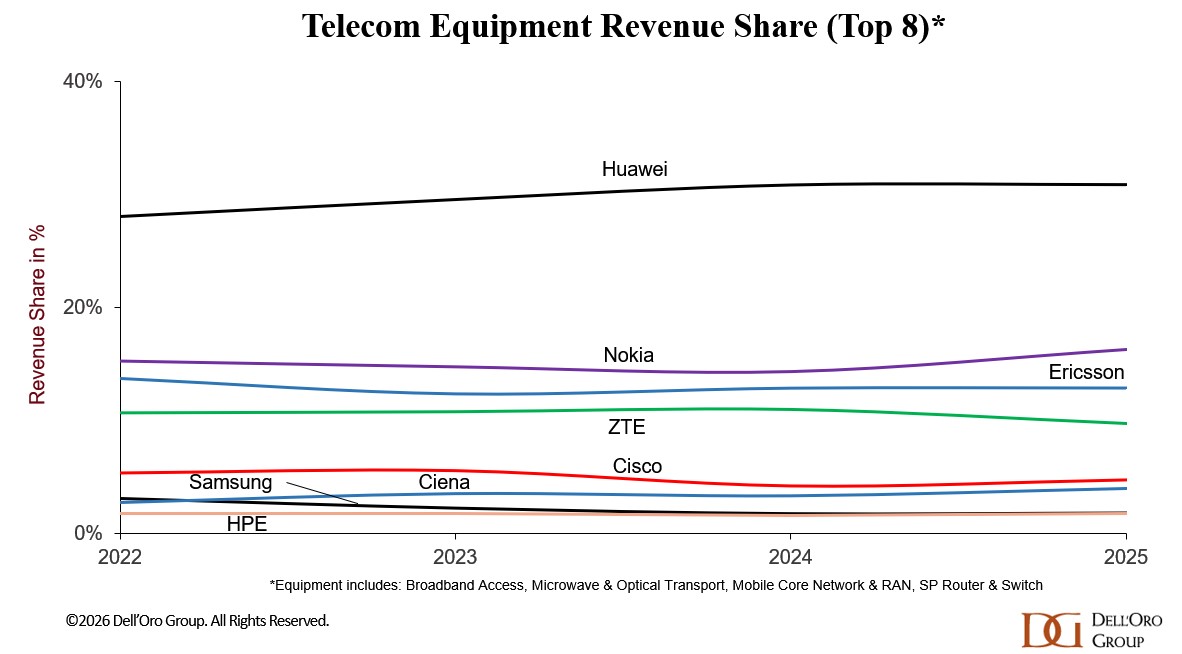
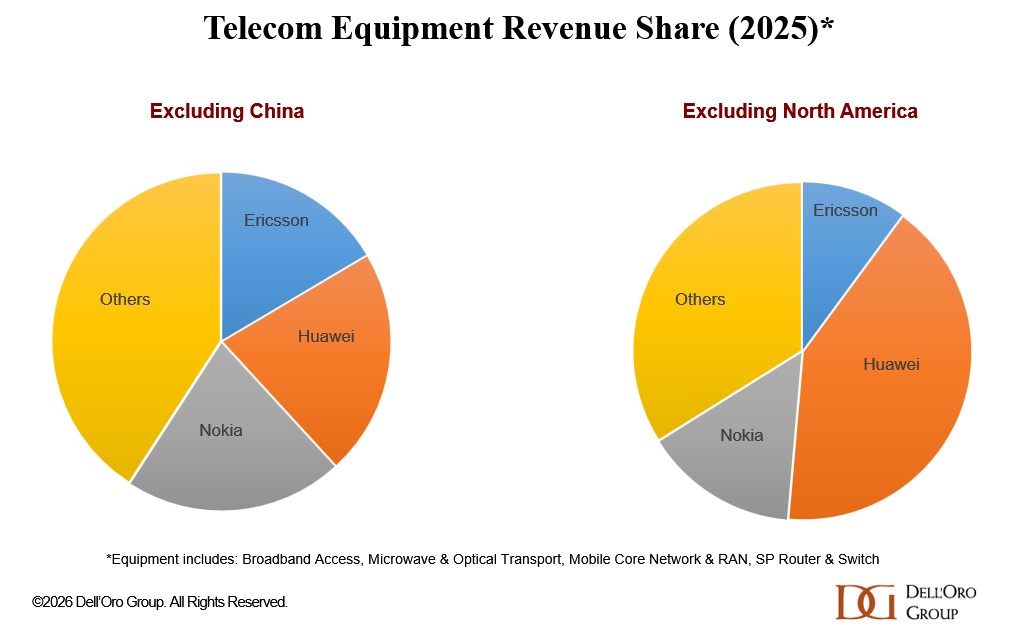
Global supplier rankings remained largely unchanged, although revenue shares shifted modestly. Nokia gained share, while Huawei and Ericsson remained broadly stable. Nokia’s share gains were partly driven by its acquisition of Infinera.

Regional dynamics vary significantly. Excluding China, the revenue distribution among the top three suppliers is more balanced. In contrast, excluding North America, Huawei’s overall revenue share reached a new high of 41% in 2025.

We attribute Huawei’s strong performance in markets where it is permitted to compete to three key factors:

  • First, a comprehensive telco strategy, with Huawei ranking as the #1 supplier by revenue across all six telco programs.
  • Second, technology leadership, supported by R&D investments that continue to exceed those of its competitors.
  • Third, footprint expansion, as Huawei has adapted to geopolitical constraints limiting its total TAM by focusing on share gains in markets where it can operate.

Looking ahead, the analyst team expects the positive momentum to extend into 2026. Global telecom equipment revenue across the six programs is projected to grow 2% to 4% in 2026, though the outlook for wireless infrastructure remains more muted.

[wp_tech_share]

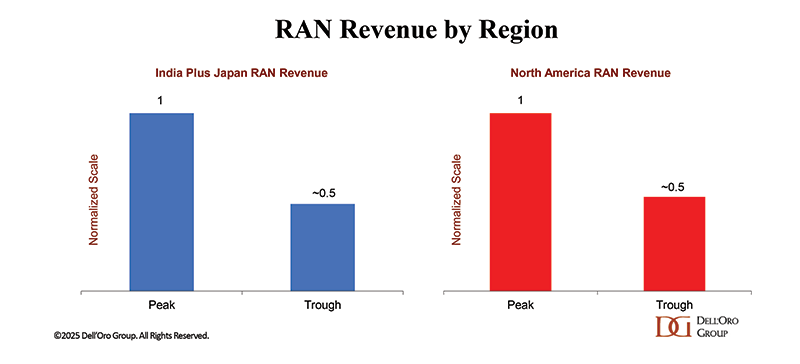
More stability is expected in 2026. After two steep years of declines that erased roughly $8–9 B of RAN revenue between 2021 and 2024, preliminary findings indicate that market conditions continued to stabilize in the third quarter. This supports the flat-growth thesis we have been communicating for some time and reflects both the maturation of the 5G network and the limited RAN upside beyond traditional consumer-driven MBB, including FWA, private wireless, and premium MBB.

Reflecting on the year and the expectations outlined for 2025, it appears that the high-level message that RAN conditions are improving is mostly correct, though with some regional caveats. Europe, the Middle East, and Africa (EMEA) is performing better than initially expected, in part due to currency exchange rate fluctuations. At the same time, 5G activity in India is coming in below expectations, partly due to coverage delays with the smaller carriers.

The results are mixed across the emerging RAN segments. Private wireless growth is in line with expectations. Preliminary findings from the recently updated Private Wireless report suggest that the positive momentum driving the roughly 40% increase in 2024 extended into 1H25, with worldwide private wireless RAN revenue accelerating rapidly in the first half. And even though Open RAN is stabilizing, growth is still landing at the low end of the 5% to 10% target for the year, in line with market conditions in the U.S. and Japan and the pace of adoption in Europe.

Looking ahead to 2026, we expect more of the same with stable overall investments dominated by regional MBB variations. At the same time, growth prospects will remain favorable with select RAN segments, including 5G, AI RAN, Open RAN, Cloud RAN, and Private Wireless.


Stable RAN in 2026

We have not made any material changes to the short-term outlook and continue to expect both wireless capex and RAN to remain mostly stable in 2026. Although the underlying drivers shaping the RAN market—slower 5G coverage expansion and mobile data traffic growth/capacity investments, ongoing monetization challenges, and limited upside from growth vehicles—are unlikely to change, regional variations should even out next year as growth in North America and APAC outside of China helps to offset weaker investments in China. While there is still uncertainty around the optimal steady-state capital intensity levels in the post-peak 5G phase, we remain cautiously optimistic that growth prospects in markets with steep peak-to-trough setbacks will remain more favorable in 2026.

Stable RAN in 2026

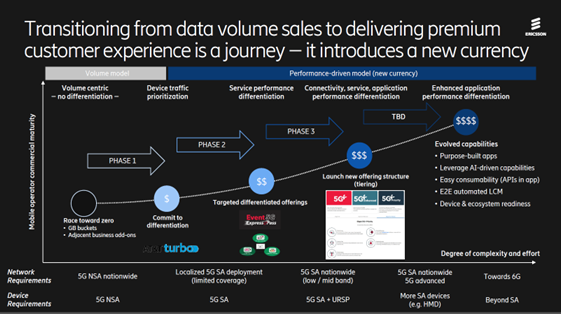
Suppliers are cautiously optimistic that the improved momentum around 5G SA and premium MBB could improve RAN growth prospects as operators move beyond the coverage/capacity-driven capex and focus more on performance improvements to enable differentiated services while also addressing different UL/DL ratios.

While the networks need to evolve to support changing end-user trends and evolving performance-driven models, we are not forecasting any performance differentiation-driven capex boost in 2026.

Source: Ericsson 3Q25 Network Update


5G is still growing

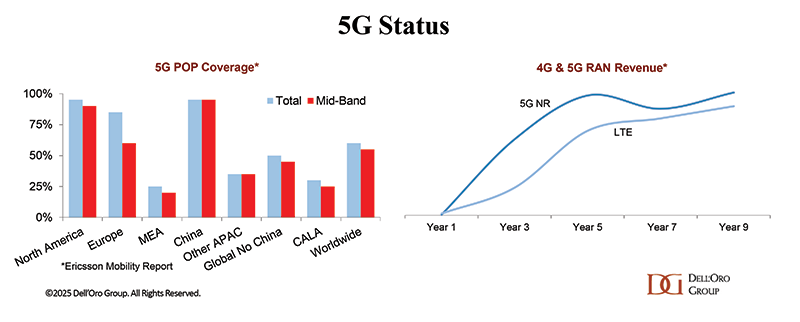
5G has made significant progress, but further investment is needed to improve coverage, capacity, and overall performance. According to Ericsson’s latest Mobility Report, 5G now reaches roughly 60% of the global population. We estimate that the installed base of 5G macro gNBs represents only about half of the eventual end-state target when accounting for all frequency variants. At the same time, year-over-year comparisons are becoming more challenging, which will weigh on growth prospects. Even so, global 5G RAN growth is expected to remain healthy in 2026, expanding at a modest pace across both macro and small-cell deployments. The overall RAN market, however, is expected to remain stable, as sharply declining 4G investments offset the gains in 5G.

5G is Still Growing


Private Wireless Campus Network to top $1 B

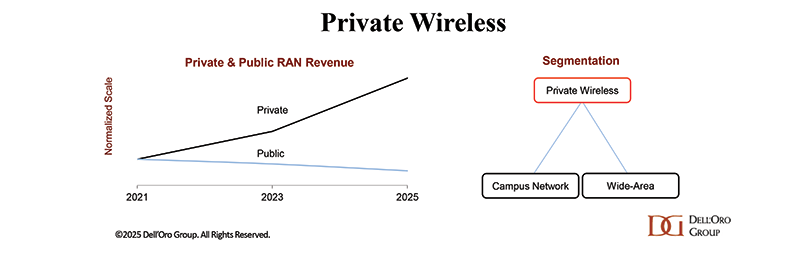
The overall private wireless market remains on track to outpace public RAN growth, increasing by roughly 20% in 2025, supported by both wide-area and local deployments. Looking ahead, private wireless adoption is expected to continue advancing at a healthy pace. Although the overall private wireless RAN growth rate is projected to moderate slightly in 2026—rising 10% to 20%—private wireless campus network RAN revenue is forecast to surpass $1 B. This outlook is underpinned by 1) increased availability of local and shared spectrum, 2) growing enterprise awareness of private cellular benefits, and 3) improved TCO and simplified solutions.

RAN in 2026 - Private Wireless Campus Network to top $1B


RAN Concentration to remain stable/increase

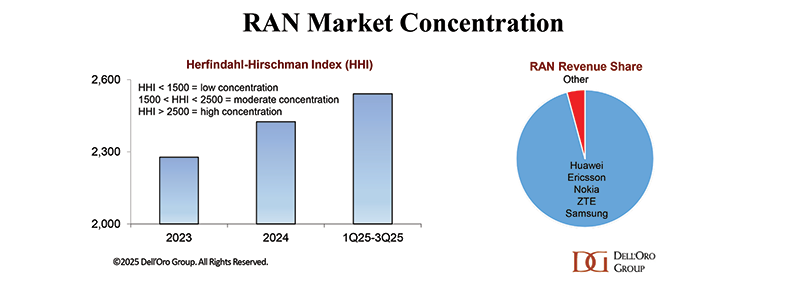
RAN is becoming more concentrated and divided. Preliminary findings suggest the top five RAN suppliers accounted for 96% of the 1Q25-3Q25 RAN market, up from 95% in 2024. The rise in concentration reflects the status of the smaller suppliers and the share developments among the top suppliers. Given current contract swap visibility and the lack of progress with the smaller suppliers to change the status quo in greenfield settings, the base case is for RAN concentration to remain stable, with a possible increase in 2026.

RAN 0n 2026 - RAN Concentration to remain stable or increase


In summary, the RAN market is adjusting to a post–5G peak-rollout environment characterized by slower data traffic growth and few catalysts likely to alter the flat-growth outlook. Global RAN projections remain essentially unchanged, with the market expected to hold steady in 2026. Beneath the flat topline, however, several segments—including private wireless, 5G, Open RAN, Cloud RAN, AI RAN, and small cells—are still poised for growth. In other words, while overall revenue growth will be muted, 2026 should nevertheless be an eventful year.

[wp_tech_share]

Nokia has a plan to reverse its declining RAN revenue share trajectory—and NVIDIA is now a significant part of that plan. What does this mean for the RAN market? After an intense month of updates from GTC and Nokia’s CMD, this is an opportune moment to review the scope of the Nokia–NVIDIA announcements, the potential RAN implications of their partnership, and Nokia’s broader RAN strategy.

A quick recap of NVIDIA’s entry into RAN: Based on the announcement and subsequent discussions, our understanding is that NVIDIA will invest $1 B in Nokia and that NVIDIA-powered AI-RAN products will be incorporated into Nokia’s RAN portfolio starting in 2027 (with trials beginning in 2026). While RAN compute—which represents less than half of the $30 B+ RAN market—is immaterial relative to NVIDIA’s $4+ T market cap, the potential upside becomes more meaningful when viewed in the context of NVIDIA’s broader telecom ambitions and its $165 B in trailing-twelve-month revenue.

Source: Nokia

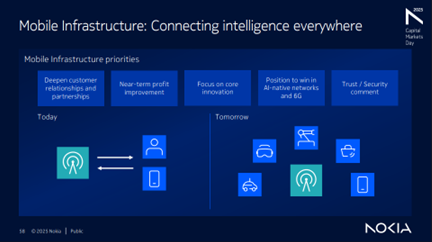
Perhaps more importantly, both Nokia and NVIDIA appear aligned on the role that telecom networks and assets will play as we move deeper into the AI era. Both companies broadly believe that AI will transform society—enabling robots, self-driving cars, humanoids, and digital twins for manufacturing, among other use cases. NVIDIA envisions a future in which everything that moves will be autonomous. But achieving this requires transforming the network from a simple connectivity pipe into a distributed computing platform that functions as an AI grid.

Since this is not NVIDIA’s first attempt to enter the RAN market, it is worth noting that a key difference from prior efforts is a more pragmatic approach. Nokia is acutely aware of its customers’ risk profiles—operators cannot justify ROI based on unknowns. This time, the target is parity with its existing RAN in terms of performance, power, and TCO. Multi-tenancy and potential new revenue streams are certainly attractive, but they are not prerequisites—the ROI must stand on its own on a RAN-only basis.

Source: Nokia


Given the size of Nokia’s 1 M+ BTS installed base, there are currently three high-level paths to transition towards NVIDIA’s GPU/AI-RAN, listed here in order of importance/projected shares: 1) Purpose-built D-RAN (add card into existing AirScale slots), 2) D-RAN vRAN (COTS at cell site), 3) C-RAN vRAN (centralized COTS).

Considering that the macro-RAN market—including both baseband and radio—totals around $30 B annually and suppliers ship 1–2 M macros per year, it is clear that carriers have limited appetite to spend $10+ K on a GPU, even if the software model could yield additional benefits over time. NVIDIA and Nokia will likely provide more details on performance and hopefully pricing soon. For now, NVIDIA has indicated that the GPU optimized for D-RAN will be priced similarly to the ARC-Compact, while delivering roughly twice the capacity. Nokia, meanwhile, is targeting further margin improvement; during its CMD, the company stated that the new Mobile Infrastructure BU is aiming for a 48%–50% gross margin by 2028, up from 48% for the 4Q24–3Q25 period.

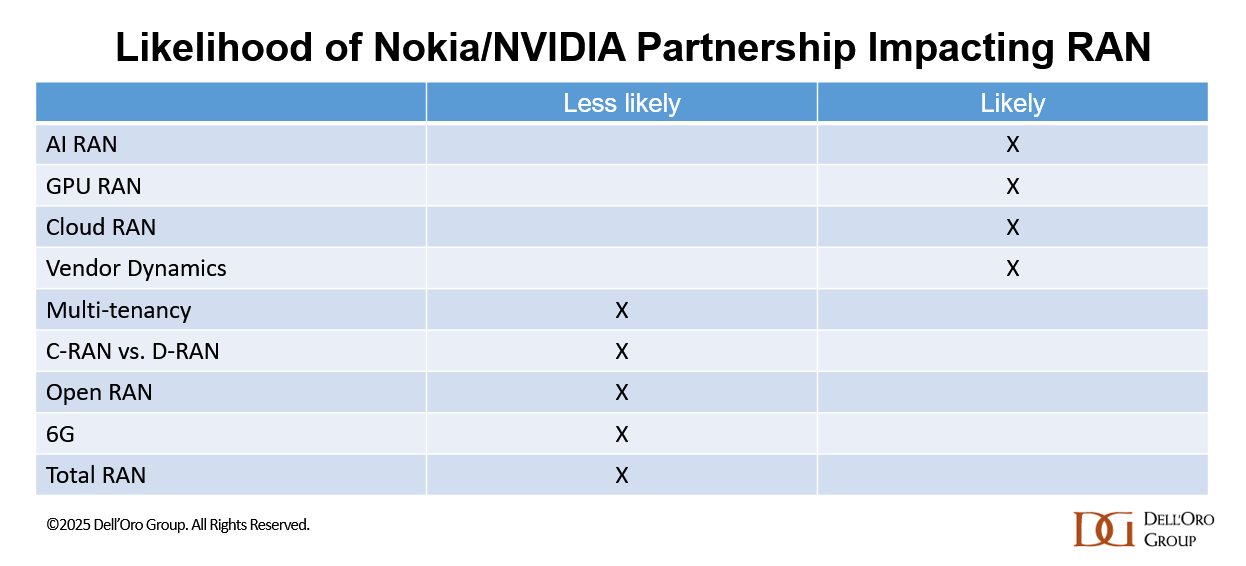
If the TCO and performance-per-watt gap with custom silicon continues to narrow, this partnership could have meaningful implications across multiple RAN domains. Beyond strengthening Nokia’s financial position, it also provides momentum for both the AI-RAN and Cloud-RAN movements. While the AI-RAN train had already left the station—and was expected to scale significantly in the second half of the 5G cycle, propelling AI-RAN to account for around a third of RAN by 2029, even before this announcement—Nokia’s decision to lean further into GPUs will only reinforce this trend.

Since Nokia’s customers want to leverage their existing AirScale investments, the D-RAN option using empty AirScale slots is expected to dominate in the near term. At the same time, this partnership is unlikely to materially affect the C-RAN vs. D-RAN mix, Open RAN adoption, or the growth prospects for multi-tenancy RAN. The shift toward GPUs is also unlikely to alter the broader 6G trajectory.

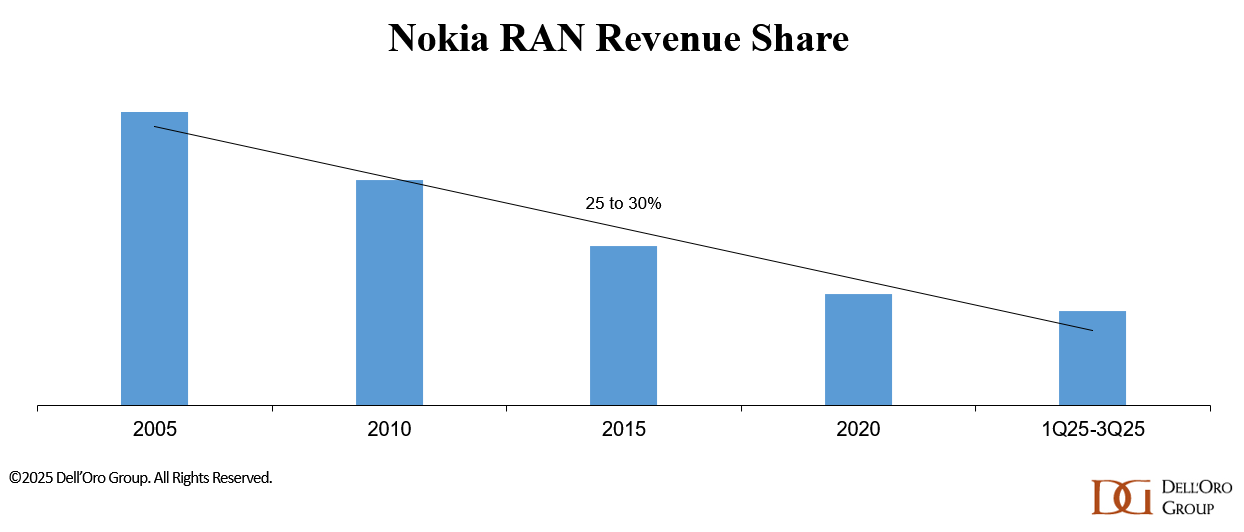
However, it could influence vendor dynamics. Nokia remains optimistic that it can reverse its RAN share trajectory, which had been trending downward over an extended period until recently. During its November 2025 CMD, the company outlined plans to stabilize its RAN business in the near term and position itself for long-term growth. As we have highlighted in our quarterly RAN coverage, the market is becoming increasingly concentrated and polarized, and vendors must determine how best to maximize their chances of winning while navigating the inherent trade-offs (the top five suppliers accounted for 96% of the 1Q25-3Q25 RAN market).

Rather than chasing volume in markets that are open to all suppliers, Nokia plans to remain disciplined and focus on areas where it can differentiate and unlock value—particularly through software/faster innovation cycles via its recently announced partnership with NVIDIA. The company sees meaningful opportunities to capture incremental share in North America, Europe, India, and select APAC markets. And it is already off to a solid start— we estimate that Nokia’s 1Q25–3Q25 RAN revenue share outside North America improved slightly relative to 2024. Following this stabilization phase, Nokia is betting that its investments will pay off and that it will be well-positioned to lead with AI-native networks and 6G.

Source: Nokia


In other words, the objective is stability in the near term and growth over the long term. It is now up to Nokia and NVIDIA to execute.