[wp_tech_share]

As I look to the future of the Wireless LAN (WLAN) market there are a few key trends that I’ll be watching for 2020:

  • Wi-Fi 6 is racing ahead. We expect Wi-Fi 6 will rise significantly, particularly as vendors bring to market lower-priced 2×2 Wi-Fi 6 access points. Concurrently, we’ll pay close attention to Wi-Fi 6 access points driving the Campus adoption of NBASE-T (Ethernet 2.5 Gbps and 5.0 Gbps).
  • Macroeconomic uncertainties impact near-term corporate spending. We expect 2020 to be a soft market for wireless LAN as short-term economic deterioration unfolds in many regions in the world. For example, in Europe Brexit is disrupting the general flow of business. Economists from the leading world banks have pulled down their GDP growth forecasts from 1.5% to 1.1% in 2020—a significant reduction. The good news is they predict a rebound in 2021. In the USA, according to the senior executives of wireless LAN manufacturers, large companies are delaying purchases as trade tensions create economic uncertainty. Economists forecast USA GDP growth to slow in 2020 to 1.8%, down from 2.3%.
  • More Wi-Fi 6 deployment in China. Although government incentives for 5G in large public venues has dampened wireless LAN sales in China, we learned that in 2020 Wi-Fi 6 will be big, particularly with the manufacturing vertical industry. We’ll be watching for innovation and use cases of Wi-Fi 6 deployments within the manufacturing sector.
  • 6 GHz turbo charging Wi-Fi 6. The availability of new unlicensed 6 GHz spectrum will increase the performance of Wi-Fi significantly. This will be the first time in over 20 years that additional mid-band spectrum has been made available to Wi-Fi, yet the use of Wi-Fi technology has increased on a massive scale. This is rocking the Wi-Fi market. The additional capacity would enable faster data throughput and lower latency—essentially turbo-charging Wi-Fi 6 and fortifying its competitiveness with cellular in the enterprise.

    The next hurdle to making 6 GHz available is managing the spectrum. The incumbents currently using the spectrum are asking that all Wi-Fi devices connect to an Automated Frequency Control System, whereas the Wi-Fi manufacturers are asking for all indoor and very low power devices not be required to connect. We will be watching with keen interest what rules the FCC structures for managing the 6 GHz spectrum, which may be in the March / April time frame.
[wp_tech_share]

An increasing amount of publicity is shifting to user applications, and away from the network. Enabling the user to extract more value out of the network is the topic of acquisitions and new product launches. For example, Arista recently acquired Mojo Networks not for its wireless LAN technology, but for its ability to deploy network intelligence; Cisco launched greater levels of security and troubleshooting enabled by its new DNA licenses; Juniper acquired Mist Systems which boasts its cutting-edge location Wi-Fi services. Yet, a closer look at companies such as Alcatel-Lucent Enterprise (ALE) and Extreme Networks, we observe these folks have been laser-focused on user applications all along. Let’s first discuss ALE.

ALE recently celebrated its centennial with a conference including some 1,000 partners, as well as 100 industry members of the press and analysts. Enthusiasm and energy levels were high.

Here’s what I think is important:

ALE has a long-running subscription-based business. As the networking industry incorporates applications and network intelligence via subscription-based services, this experience on ALE’s part will be a definite asset. In 1919, ALE founder Aaron Weil launched a subscription-based private telephone business, “Téléphone Privé,” as a productivity enhancement tool targeting enterprises.

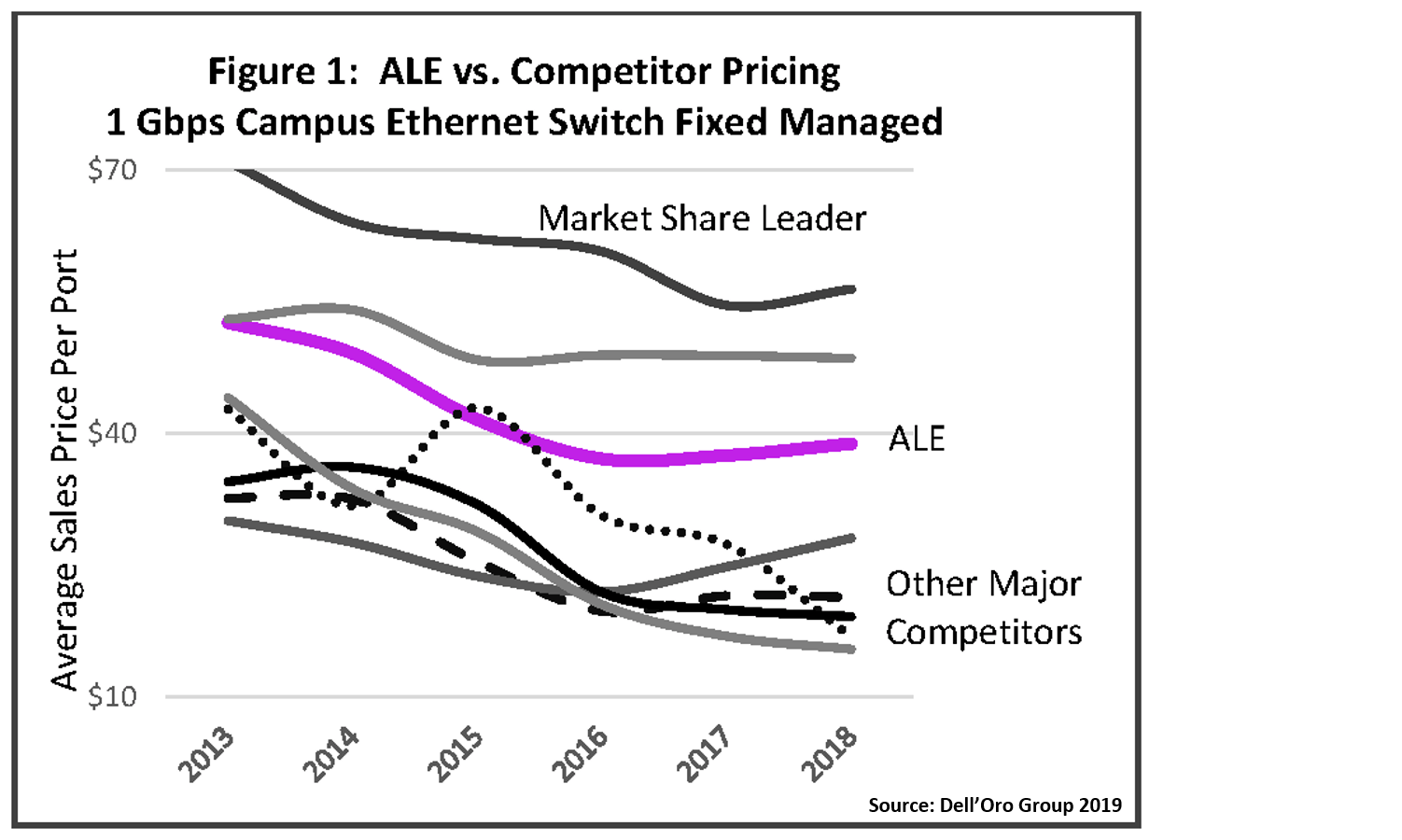
ALE’s near-term strategy will be to target select vertical industries focusing on applications specific to customer operations.  ALE’s focus on customer applications is the likely explanation as to why its customers place a high value on ALE’s products. For example, in Campus Ethernet Switching, we observed that ALE’s average prices for the past few years have been the third highest, well above many other larger vendors.  Figure 1 shows how ALE’s average sales price per port compares with that of the largest vendors in the most popular segment of the Campus Ethernet Switch market (Fixed Managed 1 Gbps switches). ALE senior management explained that the customer interaction process has included building custom applications by vertical industry. Whenever ALE could not on its own deliver the application, it brought in a partner that specialized in the operations of businesses in that particular vertical industry. This high-touch approach to service helps explain ALE’s ability to maintain high perceived value as reflected in its average prices.

1 Gbps Campus Ethernet Switch Fixed Managed

ALE’s networking business (Campus Ethernet LAN in particular) was challenged in 2017 and 2018, which we attribute largely to Huawei’s expansion in Europe, the Middle East and Africa (EMEA), the region representing ALE’s stronghold. During the past two years, Huawei has run aggressive promotions with new channel partners it added in 2016.  As the honeymoon period for these engagements comes to a close, we suspect the longer-term relationships with its new partners will change. Looking at the Campus Ethernet market on worldwide units (port shipments) basis, the performance was flat during the past two years, with the exception of China-based vendors, as well as vendors such as Ubiquiti that are targeting the low end of the market. The challenges ALE experienced on a unit basis was similar to the experience of other Western vendors focusing on the high-end and midrange segments of the market.

Dell’Oro Group believes that enterprise campus networks are entering a refresh cycle that will enable users to run new applications (click here to learn more about Dell’Oro Group Ethernet Switch Campus Network market report). This refresh of the installed networks, which will unfold over the next several years, will be the most significant upgrade during the past two decades—and many will be seeking high value from their networks, not the cheapest price.

[wp_tech_share]

Last week, I attended Extreme NOW Forum 2018, Extreme Networks’ customer and partner conference in San Jose California, the first in a series of events to be held around the world—more than 50. What impressed me was how familiar the senior staff were with individual customers. This clearly was not the first time interacting.

A few items caught my attention:

  • Senior staff knew many of the customers by name and there was a joviality and friendliness indicative of familiar relationships. Clearly the priority is on tight customer relationships, and this is coming from the top.
  • Software application development consumes over 95% of research and development spend—led by customer requests and use cases.
  • Two use cases amused me:
    • The first one was a large retail customer which deployed security cameras throughout its stores—monitoring theft was not its primary purpose! Instead the shop managers used technology to identify facial patterns—sadness or happiness. If a shopper was sad, an assistant would be immediately dispatched to offer help.
    • The second use case was a firm in the education sector which used security cameras in the classroom—not to just monitor cheating, but whether or not students were falling asleep during lectures. This monitoring allowed management to evaluate professor performance.

Certainly Extreme has its work cut out to harmonize the technologies and operations of its recent acquisitions, but its steadfast connection with its customers creates a lasting loyalty.

[wp_tech_share]

Last week, Dell’Oro Group hosted a webinar with the NBASE-T Alliance about recent Campus Network updates.  Spearheaded by users’ need for mobile connectivity everywhere, wireless LAN deployments are heralding in NBASE-T, particularly with the availability of the newest 802.11ax access points. Yet early indicators reveal that 802.11ax adoption is not following historic patterns.

Three disruptions are unfolding:

  • 802.11ax access points will have an amplified impact on the Ethernet network as they connect into the Ethernet network with two ports rather than the traditional one port. One of the Ethernet ports will be either 2.5 Gbps or 5.0 Gbps. This will have a cascading effect through the network.
  • The price premium for 802.11ax will be significantly lower than previous technologies. This suggests that adoption may be faster.
  • China may not lag adoption.

Enterprise class 802.11ax access points with NBASE-T shift wireless LAN from being cannibalistic to Ethernet Switch market sales

The rate of migration of enterprise users away from desktop PCs to laptop and/or tablets has slowed. Some applications and functions, such as CADCAM, and laboratory work are most efficient on desktop PCs. Annual desktop PC shipments appear to be stabilizing.

Most Wireless LAN deployments now expand, rather than replace, the Ethernet network. Through our end-user interviews, Dell’Oro Group learned that the majority of wireless LAN deployments are in areas where Ethernet never existed, such as common areas in the Education sector, public areas in government buildings, museums, and shopping malls.

Wireless LAN access points have reached a significant level—annual shipments worldwide are in the tens of thousands of units—and they all need to connect to the Ethernet network.  This has driven Ethernet switch port shipments. Previews of 802.11ax access-point configurations indicate that a single port of NBASE-T will be incorporated at all price points, from the highest end to the lower-mid-range products with one port 5.0 Gbps at the high end and 2.5 Gbps into the lower-mid-range products.  We estimate that these segments capture approximately 50% of the market volume.  1 Gbps Ethernet will be the secondary port on high- and-mid-range product, and will dominate the low-end access points.

Wireless LAN will become an accelerator

As wireless LAN access points connect into the network at 2.5-and-5.0 Gbps, switches in the next layer of aggregation will likely need to be replaced with higher speeds.  This will cause a cascade effect through the network.  NBASE-T currently commands a price premium over 1 Gbps, which will have an accelerating effect on switch sales.

The penetration rate of 802.11ax will be much faster than previous technologies

Manufacturers are launching mid-range to lower-range 802.11ax products in addition to high-end.  This contrasts with the product launch plans of previous technologies such as 802.11ac and 802.11n.  The implications are much wider range of products will be available and price sensitive users will enter the market sooner.  The price premium will be lower on the 802.11ax technology vs. 802.11ac.  As a result, we predict 802.11ax will have a faster market penetration.

In our next blog, we’ll continue to explore another disruption – China may not lag adoption.

Related links: