[wp_tech_share]


Dell’Oro published an update to the Data Center Capex 5-Year Forecast report in July 2021. Server spending is forecast to grow at a compound annual growth rate of 11 percent over five-year, comprising nearly half the data center capex by 2025.

The pandemic resulted in strong demand for computing and digital technologies due to a shift in enterprise and consumer behaviors. Current semiconductor foundry capacity is not adequate to meet the recent surge in global demand. The cost of servers and other data center equipment is projected to rise sharply in the near term partly due to the global semiconductor shortages. An increase of server average selling prices (ASPs) could approach the double-digit level that was observed in 2018, which was another period of tight supply and high demand. However, in the longer term, we anticipate that supply and demand dynamics could reach equilibrium and that technology transitions could drive market growth. We identify the following technology trends that shape our five-year forecast:

  • CPU Refresh Cycles: Intel and AMD both have an aggressive roadmap to introduce new platform refreshes as the processor race heats up. Both the Intel Sapphire Rapids and AMD EPYC Genoa, expected in 2022, will pack more processor cores and memory channels, and support the latest interfaces such as CXL, DDR5, and PCIe Gen 5 that could enable denser server form-factors and new architectures.
  • Accelerated Computing: A new class of accelerated servers densely packed with co-processors that are optimized for application-specific workloads, such as artificial intelligence and machine learning, is emerging. Some Cloud service providers such as Amazon and Google, have deployed accelerated servers using internally developed AI chips, while other Cloud service providers and enterprises have commonly deployed solutions based on GPUs and FPGAs. We estimate that attach rate of servers with accelerators to grow to 13 percent by 2025
  • Edge Computing: Certain applications—such as cloud gaming, autonomous driving, and industrial automation—are latency-sensitive, requiring Multi-Access Edge Compute, or MEC, nodes to be situated at the network edge, where sensors are located. Unlike cloud computing, which has been replacing enterprise data centers, edge computing creates new market opportunities for novel use cases.

With the evolution of CPU platforms along with and proliferation of accelerated computing, we anticipate data centers will be better optimized to process application-specific workloads with fewer, but more powerful and denser servers, increasing the total available market through higher server ASPs. Edge computing, on the other hand, will increase the available market with greenfield deployment of servers distributed edge locations. To access the full Data Center Capex report, please contact us at dgsales@delloro.com.

About the Report

Dell’Oro Group’s Data Center Capex 5-Year Forecast Report details the data center infrastructure capital expenditures of each of the ten largest Cloud service providers, as well as the Rest-of-Cloud, Telco, and Enterprise customer segments. Allocation of the data center infrastructure capex for servers, storage systems, and other auxiliary data center equipment is provided. The report also discusses the market and technology trends that can shape the forecast.

[wp_tech_share]

In our latest Data Center Capex report published in June 2021, server spending, which accounts for more than 40% of the data center capex, is forecast to grow 8% in 2021. We anticipate growth to come mostly from an increase of server average selling price (ASP), as vendors pass on higher commodity pricing and supply chain costs to customers amid recent global semiconductor shortages. We predict demand on servers to strengthen in 2H 2021, as the major Cloud service providers ease out of a digestion cycle, and as enterprise spending unfreezes for certain sectors, which could further strain the supply chain.

We identify the following effects due to these ongoing supply chain constraints:

  • Data center equipment—such as servers, storage systems, and Ethernet switches—contain critical components that may be supply constrained due to the recent shortages. Examples of such components include CPUs and GPUs, network processors, storage and Ethernet controllers, and DRAM and NAND chips. Passive components on the motherboard, such as capacitors and resistors, have longer lead times. While it is unclear how long the current component shortages will persist, there is an expectation in the industry that the backlog for components could be relieved by late 2021. Therefore, we have weighted capex towards the second half of this year and some of that capex rolling over into next year.
  • As system vendors scramble to increase component purchases to meet immediate and future demand, the supply chain will continue to tighten, resulting in higher component and logistics costs that will eventually be passed to end-users in the form of higher system ASPs. For 2021, we forecast server ASP to approach double-digit growth. While server ASP grew by an unprecedented rate of 15% in 2018, also due to a high-demand and tight supply environment, we do not expect 2021 ASP increases to approach those of 2018. Consequently, system vendors could see a lift in their topline revenue from these ASP increases.
  • Higher server ASPs could have several implications. First, given that the Cloud SPs purchase servers based on unit demand, higher server ASP could directly result in higher server capex. Second, given that enterprise IT budgets are usually fixed for the year, higher server ASP could translate to lower server unit purchases for the year. Thus, even though our 2021 server revenue forecast is relatively unchanged compared to our prior forecast, we have curtailed our projections for server unit growth.

In addition, we will watch out for other developments that could impact data center spending this year, such as, the Intel Ice Lake CPU ramp and delays to Sapphire Rapids, Cloud demand and enterprise recovery, the proliferation of AI, and more. To access the full Data Center Capex report, please contact us at dgsales@delloro.com.

[wp_tech_share]

In our latest forecast published in January 2021, revenue for the worldwide Ethernet controller and adapter market is projected to increase at a 3% compound annual growth rate (CAGR) from 2020 to 2025 to $2.7 billion.

This market is characterized by speed transitions. We project during our forecast horizon, the majority of the Cloud and Enterprise server market will upgrade port speeds from 10 Gbps to 25 Gbps, with a growth of 25 Gbps leveling by 2025. Newer technologies, Smart NICs and 100 Gbps Ethernet, and to a lesser extent, 50 Gbps, with CAGR growing strong double-digits by 2025, fueling market growth opportunities.

  • As the Tier 1 Cloud service providers refresh their networks, we anticipate an upgrade in server connectivity to 100 Gbps, based on PAM-4 SerDes, for general-purpose workloads. High-end workloads such as high-performance computing, accelerated computing, and all-flash arrays, will also benefit with 100 Gbps connectivity across all customer types.
  • Smart NICs, also referred to as data processing units (DPU), are also gaining traction, with numerous product introductions in 2020. Smart NICs are generally equipped with a programmable processor, such as an ARM-based SoC or FPGA; onboard memory and storage; operating system; and high-speed I/O, and offer various offload and security benefits. In 2020, the Top 4 US Cloud SPs comprised the vast majority share of the Smart NIC port shipments. By 2025, however, we expect Smart NICs to expand in customer segments outside of the Top 4 US Cloud, reaching a third of the Smart NIC port shipments. Due to the higher price premium of Smart NICs over that of traditional NICs, we anticipate that the impacts of Smart NICs on market revenue could be significant. We also predict that 100 Gbps will be the connectivity of choice for Smart NICs.
  • While the growth of 25 Gbps will continue to moderate and reach maturity during our forecast horizon, 25 Gbps will likely be widely adopted and become the primary revenue contributor. We forecast 25 Gbps to comprise 38% of the cumulative market revenue by 2025.

We believe that these advances in server network connectivity will enable the major Cloud service providers to continue to scale their networks, and drive the adoption of bandwidth-hungry AI applications.

To learn more about the Ethernet Controller and Adapter market, or if you need to access the full report, please contact us at dgsales@delloro.com.


Dell'Oro Group Ethernet Controller and Adapter 5-Year Forecast ReportAbout the Report:

The Dell’Oro Group Controller and Adapter 5-Year Forecast Report provides complete, in-depth analysis of the market with tables covering manufacturers’ revenue; average selling prices; and unit and port shipments by speed (1 Gbps, 10 Gbps, 25 Gbps, 40 Gbps, 50 Gbps, and 100 Gbps) for Ethernet and Fibre Channel Over Ethernet (FCoE) controllers and adapters. The report also covers Smart NIC and InfiniBand controllers and adapters. To purchase this report, please contact us at dgsales@delloro.com.

[wp_tech_share]

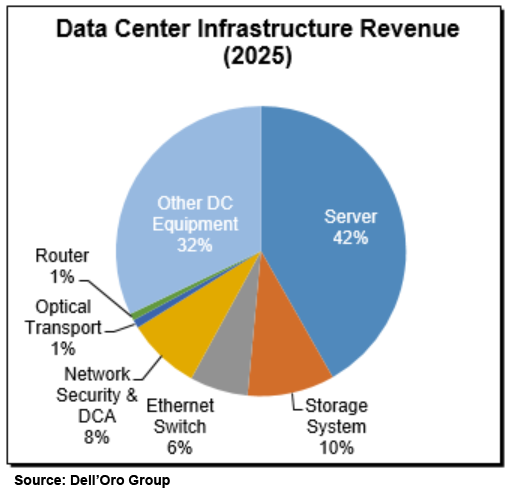
In our latest forecast published in January 2021, the worldwide capex on data center infrastructure is projected to increase at a 7% compound annual growth rate (CAGR) from 2020 to 2025 to $278 billion.

We anticipate the growth of data center capex to vary depending on the customer segment. The Cloud will continue to gain share over enterprise/on-premise data center deployments, with COVID-19 accelerating Cloud adoption to some extent. Edge computing deployed over Telco networks could emerge near the tail end of the forecast period.

Among all the technology areas that we track, we forecast the cumulative revenue growth of servers to surpass that of other technology areas such as Ethernet switch, network security, optical transport, and router. Higher capex on servers will be driven by a combination of higher server unit demand from the Cloud and increasing server average selling prices (ASP). We identify some notable trends in server architecture that could have the effect of lifting server ASP for our forecast horizon.

Dell'Oro Group Data Center Infrastructure Revenue 2025


The followings are some additional highlights from the Data Center Capex 5-Year Forecast January 2021 Report:

  • CPU Refresh: New generation of servers are typically equipped with more memory, cores, storage, and faster I/O than the preceding generation. In 2018, server ASPs increased by 15%, partly due to the refresh of the Intel Xeon Scalable platform. We anticipate an uplift in ASP with Intel’s ramp of the Whitley server platform based on the 10 nm microarchitecture.
  • Accelerated Computing: As the deployment of accelerated servers continues to grow, we expect that data centers will be better optimized to process AI and ML workloads with more powerful, denser, and costlier accelerated servers equipped with AI accelerator chips such as GPUs and FPGAs. Some of the Tier 1 Cloud service providers have deployed accelerated servers using internally developed AI chips. We estimate that the attach rate of servers with AI accelerators will reach double-digits by 2025.
  • Smart NICs: These specialized network cards typically have an on-board programmable processor, and can be configured to offload the CPU of a specific network, storage, and security services and to provide flexibility for software-defined and converged networks. Smart NICs, which carry a 3 to 5X price premium compared to standard NICs, could further inflate server ASP if deployed at scale.

These advances to server architecture will correspondingly drive innovations in the data center, such as the need for more advanced cooling solutions, additional network capacity, etc. To learn more about Data Center Infrastructure and Server spending, or if you need to access the full report, please contact us at dgsales@delloro.com.


About the Report:Dell'Oro Group Data Center Infrastructure Revenue 2025

Dell’Oro Group’s Data Center Capex 5-Year Forecast Report details the data center infrastructure capital expenditures of each of the ten largest Cloud service providers, as well as the Rest-of-Cloud, Telco, and Enterprise customer segments. Allocation of the data center infrastructure capex for servers, storage systems, and other auxiliary data center equipment is provided. The report also discusses the market and technology trends that can shape the forecast.

[wp_tech_share]

2020 has been a tumultuous year in which the industry has to reevaluate its data center deployment strategy. While COVID-19 and the ensuing recession did weigh down on projected 2020 data center capex growth to just 2%, the slowdown in spending was not as much as originally feared. Some Cloud service providers have continued to expand their infrastructure to support increased internet usage and work-from-home dynamics, while a great deal of uncertainty persists in other industry sectors. Our 2021 outlook is more optimistic, with a data center capex projection of 10%. We identify the following key trends that could shape the dynamics of the data center capex in 2021.

Cloud spending to return to higher growth:

This may not be a surprise given the surge in demand for Cloud services throughout the pandemic. But we project that all of the Top 10 Cloud service providers will increase their data center capex in 2021 by double-digit growth as they revert to an expansion cycle. Data center suppliers such as processor, memory, storage, and optics vendors have positive sentiment going into 2021 and have been proactively expanding capacity.

Soft Enterprise IT spending will persist:

Overall enterprise growth is forecast for tepid growth in 2021. While high-end enterprises are likely to invest in a hybrid Cloud strategy, small and medium enterprises have been making a secular shift to Cloud computing. This trend has materialized, simply because it is less expensive for smaller enterprises to rely on Public Cloud, as opposed to building and operating their own data centers. We expect this trend to accelerate in light of the macroeconomic uncertainties created by the pandemic.

System pricing expected to be higher, creating upside revenue growth for vendors:

While we may see some deflationary commodity pricing in 1H21, inflationary commodity pricing could return in 2H21 as global demand increases, driving system average selling prices higher. Furthermore, Intel’s new processor platform, Ice Lake, which will ramp in 2021, will enable deeper memory, more storage, and faster interconnects, and could drive up server cost. Accelerated compute servers, which can be many times the cost of a general-purpose server, should see greater adoption as well.

Accelerated computing further materializes:

As the number of artificial computing (AI) applications and use-cases increases, so will the deployment of accelerated compute servers with specialized processors, such GPUs, FPGAs, and custom ASICs, along with enhanced cooling designs such as liquid cooling. These specialized processors are designed to handle AI inference and training workloads much more efficiently than general-purpose processors such as CPUs. Smart NICs and data processing units (DPUs) are innovations that will nicely complement CPUs in increasing the efficiency and flexibility of the data center.

Intel will continue to dominate the data center CPU market, despite new entrants:

While AMD has made share gains and Intel’s data center business slipped 2020, we project Intel to retain a strong leadership position going into 2021. Intel still has a commanding share among the Top 10 Cloud service providers, and this is a market that will undergo an expansion in 2021 with the ramp of the new Intel Ice Lake processor platform. Nevertheless, we expect all the major vendors to increase their offerings of Intel and AMD x86 for enterprise servers. Furthermore, we believe that there are opportunities for ARM as well in niche markets and applications.