[wp_tech_share]

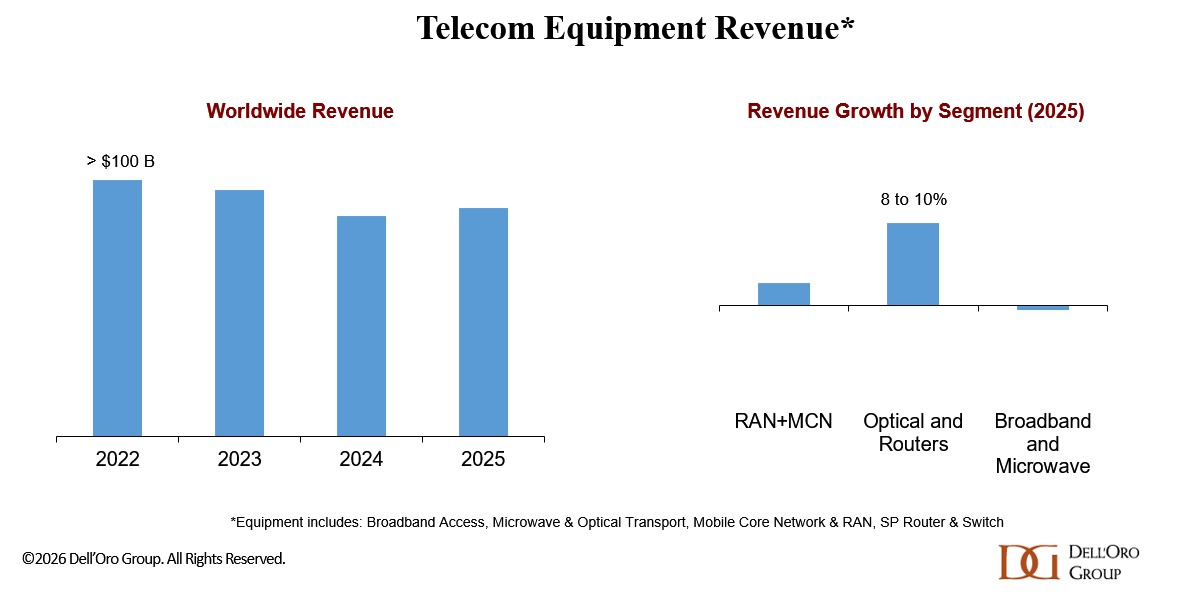
Following the 14% revenue decline between 2022 and 2024, telecom equipment investment conditions improved in 2025. Preliminary findings indicate that aggregate worldwide telecom equipment revenues across the six programs tracked by Dell’Oro Group—Broadband Access, Microwave & Optical Transport, Mobile Core Network (MCN), Radio Access Network (RAN), and Service Provider Router & Switch—increased 4% year over year (Y/Y) in 2025, supported by an exceptionally strong fourth quarter (accounting for 29% of full-year revenue).

Improved market conditions were supported by easier year-over-year comparisons, inventory stabilization, favorable currency movements, healthy demand for both wireless and wireline equipment, and robust investment from cloud providers, which contributed meaningfully to the overall growth of the telecom equipment market.

From a regional perspective, double-digit growth in North America and EMEA (Europe plus the Middle East and Africa) more than offset the more challenging conditions in the Asia Pacific. North America and China together accounted for slightly more than half of the overall market in 2025.

While growth was supported by both wireless and wireline segments, Optical Transport and SP Router & Switch stood out, partly reflecting their exposure to data center infrastructure investments.

Relative to our expectations heading into 2025, market performance was slightly stronger than the flat outlook initially outlined, supported by better-than-expected growth in MCN, Optical Transport, and SP Routers. Per the MCN report, the 5G MCN market reached an inflection point in 2025.

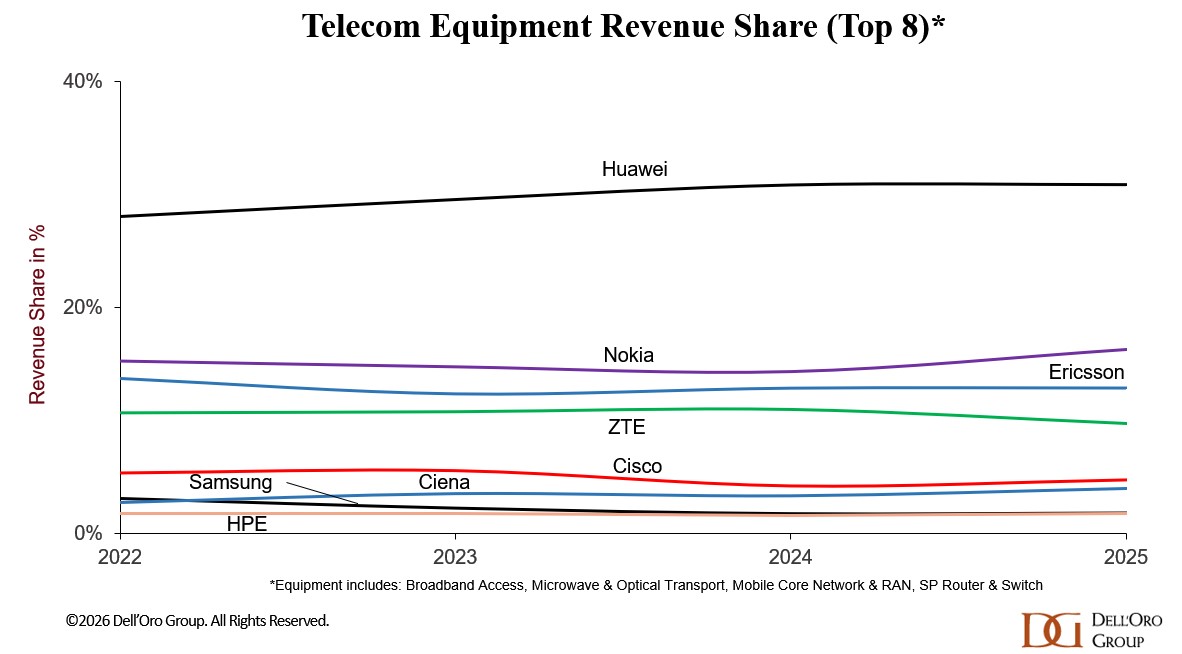
Global supplier rankings remained largely unchanged, although revenue shares shifted modestly. Nokia gained share, while Huawei and Ericsson remained broadly stable. Nokia’s share gains were partly driven by its acquisition of Infinera.

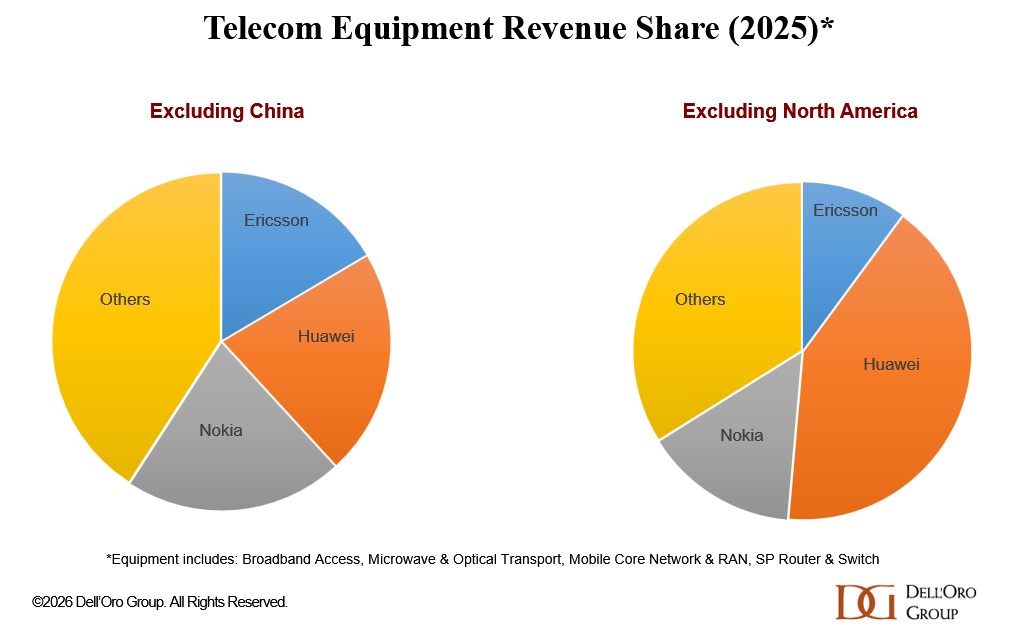
Regional dynamics vary significantly. Excluding China, the revenue distribution among the top three suppliers is more balanced. In contrast, excluding North America, Huawei’s overall revenue share reached a new high of 41% in 2025.

We attribute Huawei’s strong performance in markets where it is permitted to compete to three key factors:

  • First, a comprehensive telco strategy, with Huawei ranking as the #1 supplier by revenue across all six telco programs.
  • Second, technology leadership, supported by R&D investments that continue to exceed those of its competitors.
  • Third, footprint expansion, as Huawei has adapted to geopolitical constraints limiting its total TAM by focusing on share gains in markets where it can operate.

Looking ahead, the analyst team expects the positive momentum to extend into 2026. Global telecom equipment revenue across the six programs is projected to grow 2% to 4% in 2026, though the outlook for wireless infrastructure remains more muted.

[wp_tech_share]

A few months after Upscale AI introduced SkyHammer—its clean-slate, open-standards scale-up platform designed to make XPUs “behave like a single coherent machine”—the firm is now extending its vision for open AI networking infrastructure into the scale-out domain, where clusters expand horizontally across multiple racks and, increasingly, across multiple data centers. To that end, Upscale AI is announcing a strategic partnership with NVIDIA aimed at accelerating the deployment of open, scale-out AI networking infrastructure for next-generation data centers.

The collaboration brings together NVIDIA’s Spectrum-X Ethernet switch silicon and Upscale AI’s AI-optimized, SONiC-based networking software to deliver interoperable, high-performance Ethernet fabrics designed for large-scale AI workloads.

As enterprises and neocloud providers expand AI clusters, networking has emerged as a critical bottleneck. The partnership focuses on enabling these customers to deploy scalable, low-latency networking systems that support heterogeneous environments spanning compute, accelerators, memory, and storage.

Open Infrastructure for Heterogeneous AI Environments

As part of the initiative, Upscale AI has joined the NVIDIA Partner Network. The partnership is intended to give customers greater flexibility in how they design and procure AI infrastructure, including deploying Ethernet switching powered by NVIDIA Spectrum silicon in heterogeneous, multi-vendor environments. This collaboration reflects a step toward more interoperable Ethernet infrastructure for AI deployments, while maintaining operational consistency at scale.

Focus on AI-Optimized SONiC

A core element of Upscale AI’s approach is its AI-optimized implementation of SONiC, the open-source network operating system widely used in hyperscale environments.

At Dell’Oro Group, we expect SONiC adoption in AI back-end networks to accelerate much faster than what we have historically observed in front-end networks. This faster uptake will be driven by several tailwinds on both the demand as well as supply sides.

On the demand side, a growing number of fast-growing AI model builders and neocloud providers are evaluating SONiC to diversify vendors, reduce platform lock-in, and gain greater control over their network infrastructure. Vendor diversification also helps mitigate risk especially as supply availability tightens.

On the supply side, an expanding ecosystem of established vendors and new entrants is supporting the SONiC ecosystem. We expect SONiC-based switch sales in AI scale-out networks to grow at more than 50 % CAGR (2025-2030), exceeding $10 B by 2030.


Addressing a Critical Gap with Fully Integrated AI Infrastructure for Enterprise and Neocloud Customers

Historically, SONiC adoption has been spearheaded by hyperscalers. However, deploying and operating an open-source network operating system like SONiC demands substantial in-house engineering expertise and integration effort—capabilities many smaller cloud providers and enterprises lack. In addition, SONiC broader ecosystem support—such as turnkey distributions, enterprise-grade tooling, and vendor-backed support—has lagged proprietary network operating systems offerings, limiting SONiC adoption beyond hyperscale environments.

Upscale AI plans to bridge this gap by delivering fully integrated solutions that combine hardware, software, and lifecycle services targeted at organizations building medium and large-scale AI environments.

While the first wave of AI has been driven primarily by large AI model builders—namely hyperscalers—the second wave is expected to be led by other cloud providers, including neocloud providers, as well as large enterprises. Together, these customer segments are projected to account for the majority of the Ethernet data center switch sales in scale-out networks by 2030.

Stitching Together an Open Fabric for AI

SkyHammer was step one. Scale-out is step two. Upscale AI is stitching together an open networking story—from the scale-up interconnect that makes XPUs act like one system, to the Ethernet fabric that lets AI environments grow horizontally while preserving multi-vendor flexibility. The NVIDIA partnership helps validate that direction and accelerates the scale-out side of the roadmap, reinforcing Upscale AI’s broader goal: open, interoperable AI networking infrastructure from pod to cluster.

[wp_tech_share]
The Broadband Battleground Is Moving Beyond Speed

In our previous blog titled “The 2026 Broadband Pivot: Why ‘Better’ Beats ‘Bigger,” we argued that the broadband industry’s competitive battleground is shifting from headline speeds to experiential quality — that the operators who win the next decade won’t be the ones who lit up the most fiber wavelengths or pushed the highest downstream speeds, but the ones who invested in intelligence, automation, and the operational architecture to actually deliver on their performance promises.

Obviously, the vendors who supply the equipment and components for their operator customers to make this shift must make adjustments themselves. We are beginning to see a consistent stream of product releases and partnership announcements highlighting this shift in focus away from faster speeds toward reliability and automation.


DOCSIS 4.0 Is Triggering a New Outside-Plant Investment Cycle

One such announcement hit the wires last week. ATX Networks and Harmonic announced an integration between ATX’s GigaXtend GMC Series 1.8GHz Amplifiers and Harmonic’s cOS Virtualized Broadband Platform. The timing is not surprising. As operators prepare their networks for DOCSIS 4.0, outside plant upgrades are entering a multi-year investment cycle. Dell’Oro Group previously projected that amplifier, node, and passive equipment upgrades will drive roughly $10 billion in cable outside plant spending through 2030.

On the surface, the release highlighted the companies’ partnership. But diving deeper, the focus is on the challenges operators are facing when rolling out DOCSIS 4.0 and how the two companies are working to solve those issues.

Specifically, as operators begin to upgrade their headend and outside plant systems with platforms that offer a much higher degree of intelligence, control, and automation, the management architecture required to take advantage of these network components becomes substantially more demanding than what operators have historically required.

Extended Spectrum DOCSIS and Full Duplex both require tighter, more precise control of the RF environment. Noise ingress that was tolerable —or at least manageable— in a DOCSIS 3.1 upstream becomes a hard impairment when you’re pushing FDX traffic into overlapping spectrum. Operators need faster detection, faster diagnosis, and faster resolution—and they need these capabilities at a scale and frequency that makes traditional manual troubleshooting workflows economically unsustainable.


The Limits of Legacy HFC Management Architectures

The inconvenient reality for most MSOs today is that their HFC management architecture was not designed for that operational model. Amplifier telemetry lives in one system. Node performance lives in another. The CCAP platform sits somewhere else. NOC technicians are left triangulating across multiple tools to assemble a picture of what’s happening in the plant —and by the time they have assembled it, a truck is already rolling to the amplifier or node believed to be the source of the ingress noise.

But that might not be the only source of trouble in the outside plant. Often, when is truck is rolled to address the specific ticket that has been generated, any other issues along the cascade can get missed. That is just one of the problems ATX and Harmonic are attempting to solve through their partnership.


Integrating Amplifier Telemetry Into the Virtualized Broadband Platform

ATX’s GigaXtend amplifiers now communicate natively with Harmonic’s cOS platform through embedded transponders. That means amplifier performance data —spectrum capture, ingress analysis, real-time diagnostics—flows directly into the same platform managing the vCMTS, RPDs, and cable modems, rather than feeding into a siloed element management system that operators have to query separately. Technicians can access amplifier settings and troubleshoot impairments through Harmonic’s Sonar cloud tool without context-switching between platforms.

The potential benefits include fewer truck rolls, faster root-cause identification, reduced mean time to repair, and an overall improvement in operational efficiency. In essence, the operator gets a better, more reliable network, but also a network that costs less to run.

Further, there is also an architectural benefit that is gained. When amplifier telemetry becomes a native data stream inside the vCMTS and its management plane, an operator is now one step closer to the network automation that many vendors and operators are talking about. Ingress noise can be detected, correlated to a node segment, and then isolated to a specific amplifier. From there, a resolution workflow can be created and applied without forcing technicians to connect the dots manually. More importantly, technicians can also ensure that a visit to repair the node segment or amplifier includes adjacent amplifiers along the cascade, so that one truck roll can take care of all possible sources of noise.

Though amplifiers with transponders and controller platforms designed to aggregate performance data from an entire system of amps—have been available and deployed for many years, the difference here is the use of the vCMTS container of the Virtualized Broadband Platform and its expanded telemetry capabilities to directly correlate amplifier and node performance with cable modem traffic in a single pane. This insight allows operators to detect, diagnose, and resolve ingress noise issues far faster than before. Also, the integration and correlation of these data streams will allow for more efficient and automated plant operations.


Intelligence and Automation Become the Competitive Advantage

We have argued before that the operators who recognize the shift from raw speed to experiential quality early —and invest in intelligence and automation accordingly— will build competitive advantages that are much harder to replicate than simply deploying more infrastructure. This partnership, as well as those expected to follow, is a concrete example of how operators and their vendor partners are working to improve the perceived quality and reliability of their broadband networks and services.