[wp_tech_share]

Open RAN has made significant progress since the O-RAN Alliance was formed in 2018 to “re-shape the RAN industry and ecosystem towards more intelligent, open, virtualized, and interoperable networks.” However, the results to date have been mixed. Open fronthaul (Open FH) is increasingly being specified as a baseline capability for next-generation RAN platforms. At the same time, supplier diversity has not improved. In fact, RAN market concentration is higher today than it was before the alliance was established. Also, uneven adoption across greenfield, early-adopting, and early-majority operators contributed to a sharp capex deceleration following the Open RAN peak in 2022. That slowdown fueled concerns about the movement’s momentum, even with single-vendor Open RAN.
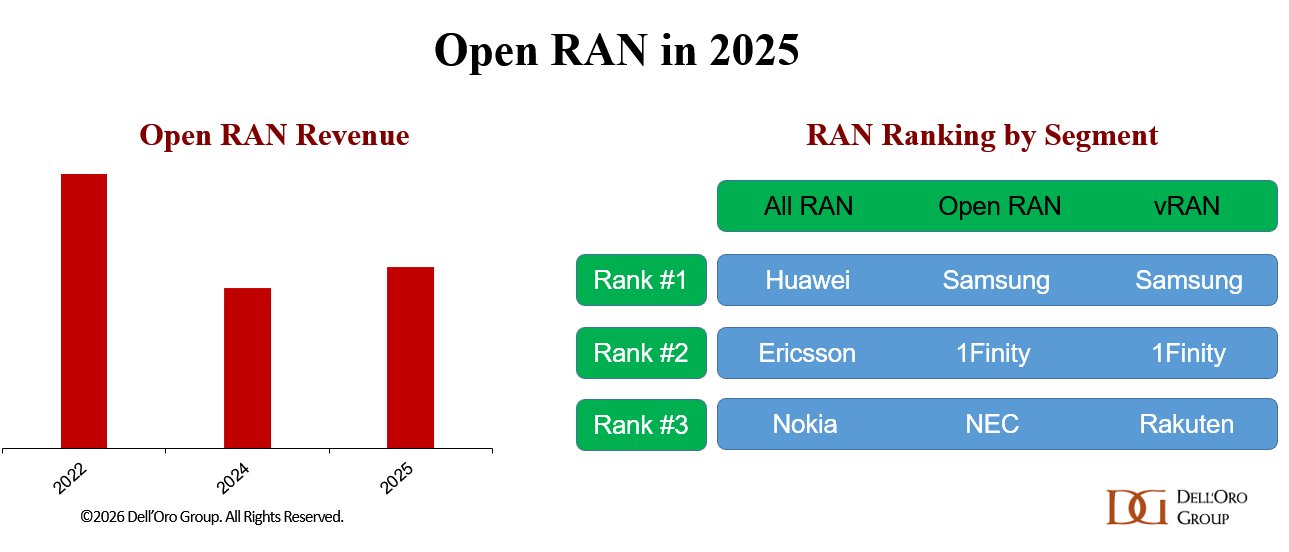
Market conditions improved in 2025. Following the roughly 40 percent decline between 2022 and 2024, preliminary findings suggest worldwide Open RAN revenue grew at a double-digit rate in 2025. Virtualized RAN (vRAN) revenue also stabilized, although at a more modest pace. Several factors help explain this reversal, including easier year-over-year comparisons, more favorable RAN spending trends in regions with strong Open RAN exposure, and, to a lesser extent, increased activity among early-majority adopters.

Vendor rankings did not change significantly, but the broader RAN landscape evolved in ways that also affected the Open RAN and Cloud RAN ecosystems. Both Mavenir and NEC revised their RAN strategies. Mavenir is now focusing more on small cells and non-terrestrial networks (NTN), while NEC is prioritizing vRAN and Massive MIMO. Meanwhile, 1Finity moved up one spot in the Open RAN ranking.

The incumbent Western suppliers are fully hedged. Ericsson and Nokia continue to support Open RAN while maintaining integrated portfolios. According to Ericsson’s latest update, 160 radio models will be Open-RAN-proven by the end of 2026. Likewise, Nokia’s recently introduced AI-RAN-ready Doksuri radios include compatibility with Open fronthaul standards.

Looking ahead, the positive momentum is expected to continue into 2026, with both Open RAN and vRAN projected to grow this year. The longer-term outlook for Open RAN and Cloud RAN also remains favorable. We have not changed the long-term assumptions communicated in the most recent forecast update. To recap, near-term Open RAN revenue projections were revised downward, while long-term growth expectations strengthened.

Virtualization remains a key pillar of next-generation RAN platforms. At the same time, Cloud RAN projections were lowered in the most recent five-year forecast. Still, Cloud RAN is expected to account for roughly 15 to 20 percent of the total RAN market by 2030.

Although the narrative around Open RAN improving supplier diversity has clearly cooled, the emerging GPU-RAN and software RAN wave is reopening the conversation about non-traditional suppliers playing a larger role in the RAN ecosystem. That said, the base case outlook for mixing and matching vendors remains limited. Multi-vendor RAN is still expected to account for less than 5 percent of total RAN deployments by 2030.

For more information about our RAN and Open RAN coverage, please see https://www.delloro.com/advanced-research-report/openran/
[wp_tech_share]

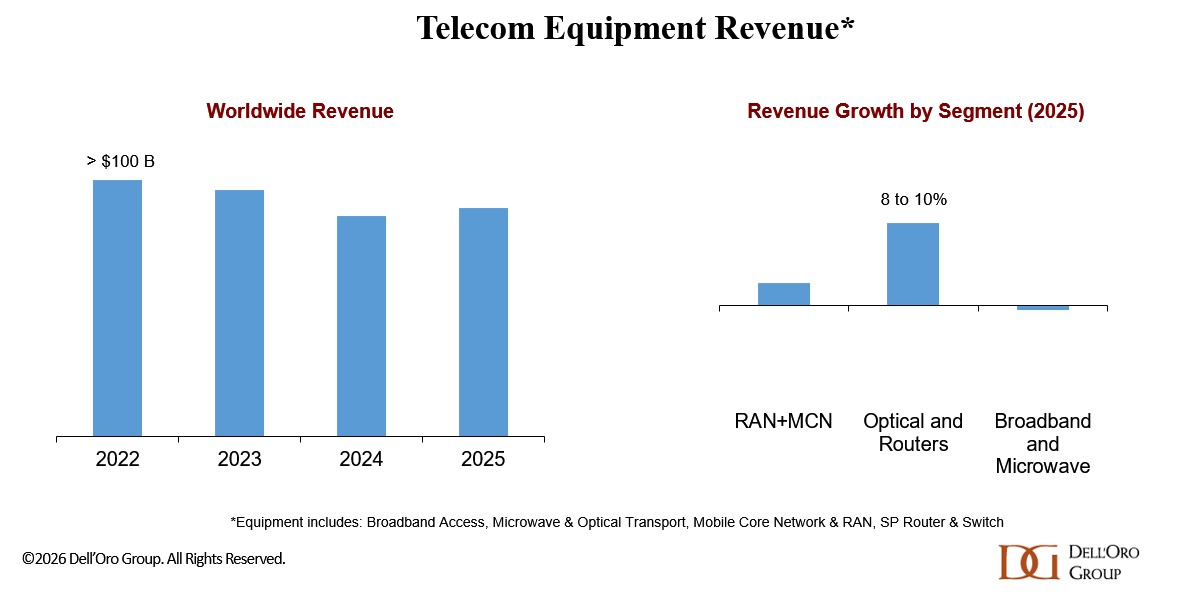
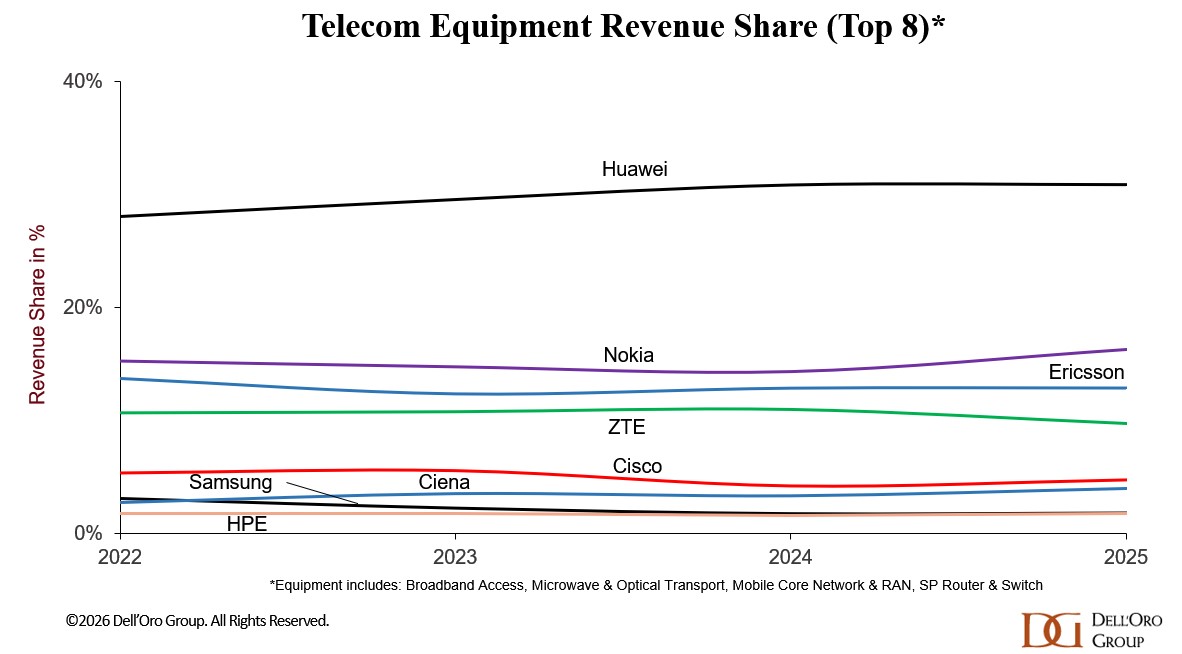
Following the 14% revenue decline between 2022 and 2024, telecom equipment investment conditions improved in 2025. Preliminary findings indicate that aggregate worldwide telecom equipment revenues across the six programs tracked by Dell’Oro Group—Broadband Access, Microwave & Optical Transport, Mobile Core Network (MCN), Radio Access Network (RAN), and Service Provider Router & Switch—increased 4% year over year (Y/Y) in 2025, supported by an exceptionally strong fourth quarter (accounting for 29% of full-year revenue).

Improved market conditions were supported by easier year-over-year comparisons, inventory stabilization, favorable currency movements, healthy demand for both wireless and wireline equipment, and robust investment from cloud providers, which contributed meaningfully to the overall growth of the telecom equipment market.

From a regional perspective, double-digit growth in North America and EMEA (Europe plus the Middle East and Africa) more than offset the more challenging conditions in the Asia Pacific. North America and China together accounted for slightly more than half of the overall market in 2025.

While growth was supported by both wireless and wireline segments, Optical Transport and SP Router & Switch stood out, partly reflecting their exposure to data center infrastructure investments.

Relative to our expectations heading into 2025, market performance was slightly stronger than the flat outlook initially outlined, supported by better-than-expected growth in MCN, Optical Transport, and SP Routers. Per the MCN report, the 5G MCN market reached an inflection point in 2025.

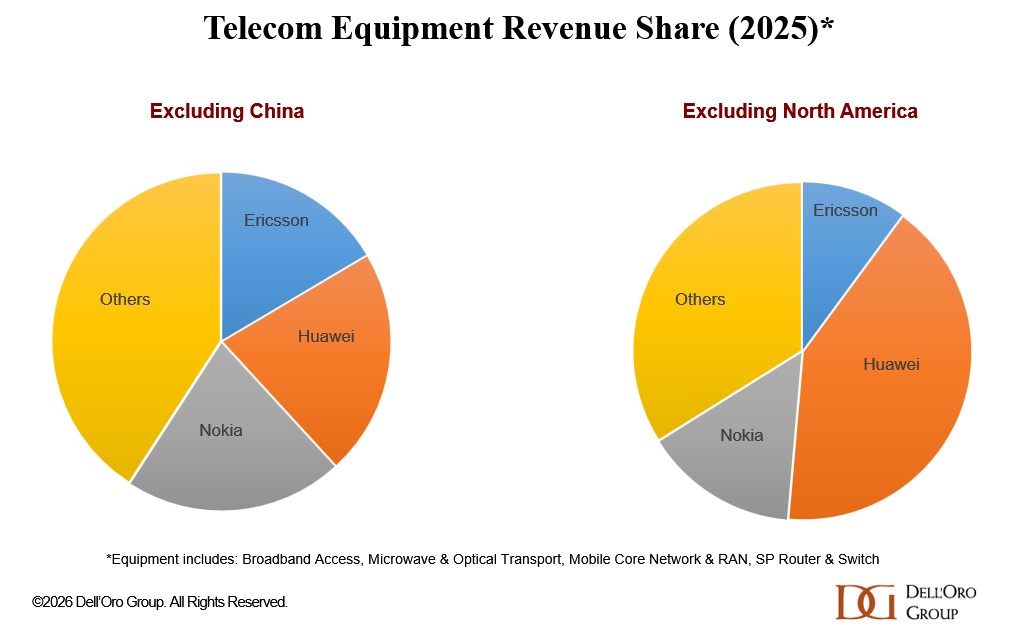
Global supplier rankings remained largely unchanged, although revenue shares shifted modestly. Nokia gained share, while Huawei and Ericsson remained broadly stable. Nokia’s share gains were partly driven by its acquisition of Infinera.

Regional dynamics vary significantly. Excluding China, the revenue distribution among the top three suppliers is more balanced. In contrast, excluding North America, Huawei’s overall revenue share reached a new high of 41% in 2025.

We attribute Huawei’s strong performance in markets where it is permitted to compete to three key factors:

  • First, a comprehensive telco strategy, with Huawei ranking as the #1 supplier by revenue across all six telco programs.
  • Second, technology leadership, supported by R&D investments that continue to exceed those of its competitors.
  • Third, footprint expansion, as Huawei has adapted to geopolitical constraints limiting its total TAM by focusing on share gains in markets where it can operate.

Looking ahead, the analyst team expects the positive momentum to extend into 2026. Global telecom equipment revenue across the six programs is projected to grow 2% to 4% in 2026, though the outlook for wireless infrastructure remains more muted.

[wp_tech_share]
The Broadband Battleground Is Moving Beyond Speed

In our previous blog titled “The 2026 Broadband Pivot: Why ‘Better’ Beats ‘Bigger,” we argued that the broadband industry’s competitive battleground is shifting from headline speeds to experiential quality — that the operators who win the next decade won’t be the ones who lit up the most fiber wavelengths or pushed the highest downstream speeds, but the ones who invested in intelligence, automation, and the operational architecture to actually deliver on their performance promises.

Obviously, the vendors who supply the equipment and components for their operator customers to make this shift must make adjustments themselves. We are beginning to see a consistent stream of product releases and partnership announcements highlighting this shift in focus away from faster speeds toward reliability and automation.


DOCSIS 4.0 Is Triggering a New Outside-Plant Investment Cycle

One such announcement hit the wires last week. ATX Networks and Harmonic announced an integration between ATX’s GigaXtend GMC Series 1.8GHz Amplifiers and Harmonic’s cOS Virtualized Broadband Platform. The timing is not surprising. As operators prepare their networks for DOCSIS 4.0, outside plant upgrades are entering a multi-year investment cycle. Dell’Oro Group previously projected that amplifier, node, and passive equipment upgrades will drive roughly $10 billion in cable outside plant spending through 2030.

On the surface, the release highlighted the companies’ partnership. But diving deeper, the focus is on the challenges operators are facing when rolling out DOCSIS 4.0 and how the two companies are working to solve those issues.

Specifically, as operators begin to upgrade their headend and outside plant systems with platforms that offer a much higher degree of intelligence, control, and automation, the management architecture required to take advantage of these network components becomes substantially more demanding than what operators have historically required.

Extended Spectrum DOCSIS and Full Duplex both require tighter, more precise control of the RF environment. Noise ingress that was tolerable —or at least manageable— in a DOCSIS 3.1 upstream becomes a hard impairment when you’re pushing FDX traffic into overlapping spectrum. Operators need faster detection, faster diagnosis, and faster resolution—and they need these capabilities at a scale and frequency that makes traditional manual troubleshooting workflows economically unsustainable.


The Limits of Legacy HFC Management Architectures

The inconvenient reality for most MSOs today is that their HFC management architecture was not designed for that operational model. Amplifier telemetry lives in one system. Node performance lives in another. The CCAP platform sits somewhere else. NOC technicians are left triangulating across multiple tools to assemble a picture of what’s happening in the plant —and by the time they have assembled it, a truck is already rolling to the amplifier or node believed to be the source of the ingress noise.

But that might not be the only source of trouble in the outside plant. Often, when is truck is rolled to address the specific ticket that has been generated, any other issues along the cascade can get missed. That is just one of the problems ATX and Harmonic are attempting to solve through their partnership.


Integrating Amplifier Telemetry Into the Virtualized Broadband Platform

ATX’s GigaXtend amplifiers now communicate natively with Harmonic’s cOS platform through embedded transponders. That means amplifier performance data —spectrum capture, ingress analysis, real-time diagnostics—flows directly into the same platform managing the vCMTS, RPDs, and cable modems, rather than feeding into a siloed element management system that operators have to query separately. Technicians can access amplifier settings and troubleshoot impairments through Harmonic’s Sonar cloud tool without context-switching between platforms.

The potential benefits include fewer truck rolls, faster root-cause identification, reduced mean time to repair, and an overall improvement in operational efficiency. In essence, the operator gets a better, more reliable network, but also a network that costs less to run.

Further, there is also an architectural benefit that is gained. When amplifier telemetry becomes a native data stream inside the vCMTS and its management plane, an operator is now one step closer to the network automation that many vendors and operators are talking about. Ingress noise can be detected, correlated to a node segment, and then isolated to a specific amplifier. From there, a resolution workflow can be created and applied without forcing technicians to connect the dots manually. More importantly, technicians can also ensure that a visit to repair the node segment or amplifier includes adjacent amplifiers along the cascade, so that one truck roll can take care of all possible sources of noise.

Though amplifiers with transponders and controller platforms designed to aggregate performance data from an entire system of amps—have been available and deployed for many years, the difference here is the use of the vCMTS container of the Virtualized Broadband Platform and its expanded telemetry capabilities to directly correlate amplifier and node performance with cable modem traffic in a single pane. This insight allows operators to detect, diagnose, and resolve ingress noise issues far faster than before. Also, the integration and correlation of these data streams will allow for more efficient and automated plant operations.


Intelligence and Automation Become the Competitive Advantage

We have argued before that the operators who recognize the shift from raw speed to experiential quality early —and invest in intelligence and automation accordingly— will build competitive advantages that are much harder to replicate than simply deploying more infrastructure. This partnership, as well as those expected to follow, is a concrete example of how operators and their vendor partners are working to improve the perceived quality and reliability of their broadband networks and services.

[wp_tech_share]

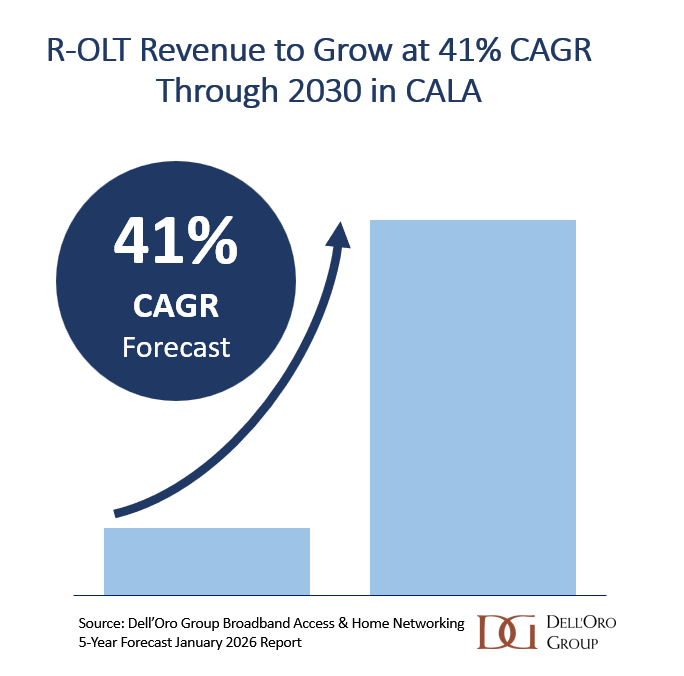
Last week, izzi, Mexico’s largest cable operator, announced that it was deploying Harmonic’s cOS virtualized broadband platform alongside its Pearl Remote Optical Line Termination (R-OLT) modules and Pearl outdoor node enclosures to extend its fiber network. The announcement is noteworthy because it is further evidence of the region’s cable operators continuing a wholesale shift away from DOCSIS and HFC to fiber. But it is also noteworthy in that it signals a shift towards more flexible R-OLT platforms as the fiber foundation for both cable operators and telcos in the region. Latin America is experiencing a fiber overbuild cycle that, in many markets, is more aggressive than anything North American cable operators have faced. Lower labor costs across the region have made greenfield fiber construction economically viable for a wide range of players — telcos, utilities, and new entrant ISPs — reshaping competitive dynamics almost city by city.

The specific benefits of R-OLTs are well matched to what izzi and other telco and cable operators in the region need to execute a large-scale fiber migration efficiently and competitively:

  • Reduced fiber feeder costs. Traditional centralized OLT deployments require operators to run long fiber feeder routes from a headend or hub site out to the access network. R-OLT platforms eliminate much of that feeder infrastructure by pushing the OLT function out to the node, dramatically shortening the fiber runs required to reach subscribers. In a market where izzi is deploying across a large and geographically diverse service territory, that reduction in feeder fiber translates directly into lower capital expenditure per home passed. Just as important as reduced capex is the faster time-to-market that an R-OLT architecture can provide.
  • Ability to leverage existing node infrastructure. One of the most underappreciated advantages of R-OLT platforms for cable operators is the ability to reuse what they already own. Izzi has an established outside plant with node locations distributed across its footprint — real estate, conduit, power feeds, and field infrastructure that took years and significant capital to build. Being able to drop into those existing locations rather than requiring new facility construction to keep overall deployment costs down and to get to market faster.
  • Right-sized port density and scalability. R-OLT modules are built for high PON port density within a compact form factor, which matters significantly when you’re trying to maximize the number of subscribers serviceable from a single field location. Higher port density means fewer node sites required to cover a given subscriber footprint, fewer truck rolls per unit of coverage, and a more scalable architecture as izzi expands its fiber deployment over time. It also provides a cleaner path to adding capacity incrementally as subscriber uptake grows, rather than requiring operators to over-provision upfront
  • Power and space savings. Traditional OLT cabinet deployments carry substantial power and space requirements — challenges that become acute when you’re trying to deploy at scale across a distributed field network rather than in a controlled headend environment. Optical node housings are designed for outdoor deployment with power consumption and thermal management designed for the field, not the headend. For izzi, those savings compound across hundreds of node sites over the course of a multi-year rollout, with meaningful implications for both capital and operating expenditures.


The Remote OLT Trend in Latin America

izzi’s decision is not happening in isolation. R-OLT as an architecture is gaining traction across Latin America largely because it aligns well with the region’s deployment realities. Unlike central office OLT deployments that require operators to run long fiber runs from a headend or hub site out to the field, a R-OLT pushes the OLT function closer to subscribers — reducing fiber costs, improving latency, and allowing operators to expand incrementally without massive upfront infrastructure investment.

The broader point is that Latin American cable operators looking at fiber migration are increasingly finding that R-OLTs strike a favorable balance of deployment cost, operational simplicity, and competitive positioning. The architecture doesn’t require operators to choose between upgrading their HFC plant and building fiber — it gives them a fiber-first path that can be executed in parallel with or as a replacement for legacy infrastructure, depending on the specific competitive and financial dynamics of a given market.

Harmonic certainly isn’t the only R-OLT supplier benefiting from this trend. Huawei and ZTE both have node-based OLT platforms they have been shipping into the CALA market for some time. Calix and Vecima have also found some traction for node-based OLT platforms in the region.


ONT Flexibility Just as Critical

One detail in the announcement that deserves more attention than it typically gets: izzi’s deployment integrates third-party ONTs through Harmonic’s Open ONT strategy. This is not a trivial design choice. CPE procurement is one of the larger ongoing cost variables in a multi-year fiber deployment, and vendor lock-in on ONTs has historically been a significant source of margin erosion for operators. By explicitly engineering an open ONT architecture into the deployment, izzi retains the flexibility to source CPE competitively as the deployment scales, rather than being captive to a single supplier’s pricing and roadmap.

For operators in Latin America where broadband ARPU is often significantly lower than in North American markets, total cost of ownership discipline in CPE is a necessity. It can be argued that ONT costs are a significant reason why Huawei, ZTE, Fiberhome, Humax, and Skyworth have found success in the region. Offering operators low-cost GPON ONTs has helped reduce the success-based capex budgets for operators in Brazil, Argentina, Mexico, and Uruguay, among others. For izzi, being able to mix-and-match ONTs will give them pricing leverage as they look to expand their fiber homes passed and connected.

[wp_tech_share]

Whenever OpenVault releases its quarterly OVBI (OpenVault Broadband Insights), there is always a lot of fascinating data regarding broadband usage to digest. The Q4 report is no different. In fact, the most recent iteration is the first one to provide an apples-to-apples comparison of upstream data consumption on DOCSIS and FTTH networks, quantifying one of the biggest gaps the industry has understood for some time.

According to the report, which is a sampling of usage metrics from across a select number of ISPs, FTTH subscribers provisioned at symmetrical speeds averaging 677 Mbps consumed 93.0 GB of upstream bandwidth in Q4 2025. Their DOCSIS counterparts at the same operator — provisioned at a much lower 17.3 Mbps upstream on average — consumed just 56.0 GB. That’s a 66% difference in upstream consumption. That gap isn’t driven by different subscribers with different habits. It’s the same operator, serving roughly the same markets. The only meaningful variable is how much upstream capacity each subscriber was given.

The implication, of course, is twofold: The first is that, given additional upstream bandwidth, subscribers will definitely use it and likely appreciate it; the second is that mid-split, high-split, and spectrum expansion efforts for DOCSIS networks can’t come soon enough.

The vast majority of cable operators are already well underway with both mid- and high-split upgrades, pushing their available upstream spectrum from 5-42 MHz to 85-204 MHz, which translates into upstream speed tiers moving from an average of 20 Mbps to 100 Mbps-200 Mbps. This is certainly an improvement and gets them into the conversation with comparable FTTH speed tiers.

One factor to keep in mind when parsing this data is that the OVBI notes that most FTTH subscribers are provisioned at the mid-range tiers of either 200-400 Mbps or 500-900 Mbps, rather than at the 1 Gbps tier. Meanwhile, roughly 34% of DOCSIS subscribers are provisioned at the 1 Gbps tier. The difference is due to the fact that, since they are offered symmetric services, FTTH subscribers don’t have to move up to faster downstream packages in order to access higher upstream speeds. On the other hand, for DOCSIS customers to access improved upstream speeds, they must move to the 1 Gbps downstream tiers, which typically offer upstream speeds of 100-200 Mbps.

What ultimately makes the FTTH vs. DOCSIS comparison so consequential is the broader upstream growth trend it sits on top of. According to the report, full-year 2025 upstream usage averaged 55.86 GB across fiber and DOCSIS platforms — a 21.7% year-over-year increase, and a 16.4% jump just from Q3 to Q4 alone. To put that in perspective, the quarter-over-quarter jump in upstream usage is nearly as large as the annual gains from just a couple years ago.

This isn’t a new trend, by any stretch. It is more of a continuation of a trend that was first seen during the pandemic, when residential broadband consumption—both upstream and downstream—skyrocketed. As students have returned to school and employees have returned to the office, the average growth in downstream consumption has moderated and stayed relatively modest. Upstream consumption, however, has continued to surge, with average annual growth rates ranging from 17-22% since 2022.

For cable operators, specifically, this sustained growth in upstream traffic accelerates the timeline for band-split upgrades in the short-term, followed by overall spectrum expansion in the medium term. Most cable operators have been managing upstream utilization rates on the assumption that demand growth was going to moderate, just as it has on the downstream side. Compounding things is the fact that, when comparing with FTTH, the report suggests that opening up more upstream spectrum won’t result in a gradual increase in upstream utilization; it will instead result in a fairly quick acceleration as the latent subscriber demand demonstrates. This is already evidenced by the fact that upstream usage on DOCSIS 3.1 networks is easily double what it is on DOCSIS 3.0 networks. Once again, if the bandwidth is available, subscribers will find a way to maximize it.

For cable operators, many of which are now seeing consistent quarterly broadband subscriber losses, whether the asymmetric design of their DOCSIS networks has truly become a weakness has to be one of the many questions they are asking themselves. Of course, with a large percentage of subscribers leaving for lower-cost FWA services, asymmetry takes a back seat to more immediate concerns around service bundling and pricing.

But when their DOCSIS subscriber base generates 66% less upstream traffic than FTTH subscribers, there has to be genuine concern that upstream constraints are pushing subscribers into the arms of fiber overbuilders offering symmetric speeds.