[wp_tech_share]

800 Gbps adoption rate expected to be faster than 400 Gbps, composing more than 25% of data center switch ports by 2025

Since the onset of COVID-19, we have predicted that the data center switch market will be for the most part resilient to the effects of the pandemic and that it will quickly recover from its low, single-digit revenue decline in 2020. We continue to believe that the Ethernet switch data center market will return to growth in 2021 and be able to exceed its 2019 pre-pandemic revenue level.

Following are key takeaways from the July 2021 Five-Year Ethernet Switch Data Center forecast:

    • Our interviews with end-users and system and component vendors suggest that the pandemic has amplified the importance of the network and accelerated multi-year digital transformation projects. These trends are expected to bring major changes to data center networks and potentially generate additional market revenue.
    • Despite our optimism, our interviews with major vendors revealed that a number of them are already operating at full manufacturing capacity and that supply challenges will continue through the remainder of the year with a potentially more pronounced impact on market performance and the pricing environment. If this is true, our forecast may prove to be too high, as it doesn’t currently take into consideration the impact of these various supply issues.
    • Through our latest interviews with the large Cloud service providers (SPs), we have learned of a number of changes that may impact network architectures when they migrate to next-generation speeds. These changes will be driven by a limited power budget and new AI/ML applications, which may require different network topologies. These hyperscalers will make different choices in terms of network chips, switch radix, number of network tiers, and –ultimately – network speeds. We expect this diversity to increase when Cloud SPs build next-generation networks, as some will focus more on latency improvements while others will focus on power. Ultimately, however, all SPs will focus on cost reduction. Additional discussion about these possible changes and their associated effects may be found in our forecast report.
    • Optics have always played an important role in enabling speed migration on data center switches. With the transition to 400 Gbps and beyond, however, the role played by optics will become even more crucial for a number of reasons. First, because of their increased price, optics for 400 Gbps speeds and higher are expected to compose about 60% to 70% of network spending (compared with less than 50% for speeds lower than 400 Gbps). For this reason, some switch vendors are planning to use the optics opportunity to capture a higher portion of network spending. Second, optics may displace some dense wavelength division multiplexing (DWDM) transport systems for certain Data Center Interconnect (DCI) use cases. Last, but not least, while pluggable (as opposed to embedded) optics are currently the form factor of choice, they may potentially exhibit some thermal and density issues as we approach speeds of 1.6 Tbps and higher. All of these possible changes in optics and their corresponding impact on the data center switch market are addressed in greater detail in our report.
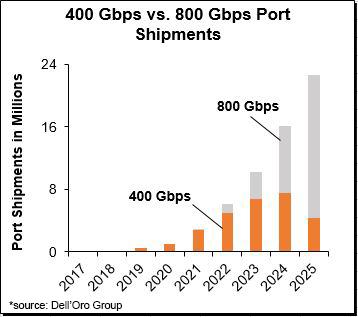
    • Data Center Switch market forecast - 400 Gbps vs 800 Gpbs Port Shipments - DellOroGroup.JPGWe predict that 800 Gbps adoption will be quick, surpassing 400 Gbps ports in 2024 (Figure). 800 Gbps deployments will be propelled by the availability of 100 Gbps SerDes and will not require 800 GE MAC. As a reminder, our forecast reflects port-switch capacity, regardless of how the port is configured. We expect early 800 Gbps ports to be used in breakout mode either as 8×100 Gbps or as 2×400 Gbps. (Breakout applications support many use cases, such as aggregation, shuffle, better fault tolerance, and bigger Radix.) The anticipated rapid adoption of 800 Gbps will be propelled by: 1) availability of 800 Gbps optics with a significantly lower cost per bit than two discrete 400 Gbps optics; and 2) lower cost per bit at a system level, as 800 Gbps will allow consuming 25.6 Tbps chips in a 1U form factor with 32 ports of 800 Gbps. These systems will have a better cost per bit than their equivalent 400 Gbps (which requires 2 U chassis to fit 64 ports). Since economics drive adoption, we believe that 800 Gbps will be more rapidly adopted than 400 Gbps.

To access the full report for details about revenue, units, pricing, speeds, regions, market segments, etc., please contact us at dgsales@delloro.com


About the Report

The Dell’Oro Group Ethernet Switch – Data Center Five Year Forecast Report provides a comprehensive overview of market trends, including tables covering manufacturers’ revenue, port shipments, and average-selling prices for modular, fixed, and managed and unmanaged by port speed. We report on 1000 Mbps and the following Gbps port speeds: 10, 25, 40, 50, 100, 200, 400, and 800. We also provide forecasts by region and market segment, including Top-4 U.S. Cloud SPs, Top-3 Chinese Cloud SPs, Telco SPs, Rest of Cloud, Large Enterprises, and Rest of Enterprises.

July 2021 5-Year Forecast DC Switch Market
[wp_tech_share]
[wp_tech_share]

We’ve just wrapped up the 4Q20 reporting period for Dell’Oro Group’s Enterprise Network Equipment programs, which include Campus Switches, Enterprise Data Center Switches, SD-WAN & Enterprise Routers, Network Security, and Wireless LAN. Enterprises include businesses of all sizes as well as government, education, and research entities. The equipment tracked in these programs can be used for wired or wireless data communication in private and secure networks.


2020 Market Performance

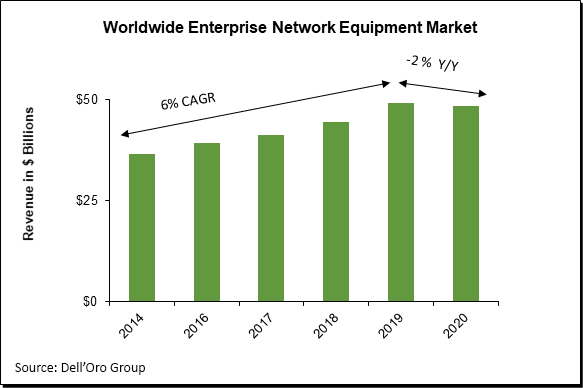
Our reports suggest that the overall Enterprise Network Equipment market declined 2% year over year (Y/Y) for full-year 2020 to $48.5 B as a result of the COVID-19 pandemic. This is a significant departure from the 6% CAGR achieved from 2014 to 2019.

The decline was driven mostly by campus and data center switches. In the meantime, enterprise spending was up on both routers and security and it was flat on Wireless LAN. What’s interesting is that growth in routers and security was actually driven by software and subscription-based products (SD-WAN and virtual and SaaS security). Even within Wireless LAN, we saw growth in controllers and licenses. In the meantime, spending declined on hardware products (access routers, physical firewall, Wireless LAN access points, and Ethernet switches).

The softness in the total Enterprise Network Equipment market was more pronounced in the first half of the year. However, starting in 3Q20, spending on network equipment began to recover, as enterprises showed confidence investing for the future. Government stimulus around the world was also a major factor. Additionally, what caught our attention is the spread across various technologies of this increase in spending. We calculated that enterprises increased their spending on network equipment by about $400 M in 2H20 (compared to 2H19), about 70% of which was allocated to Wireless LAN.


2020 Vendor Landscape


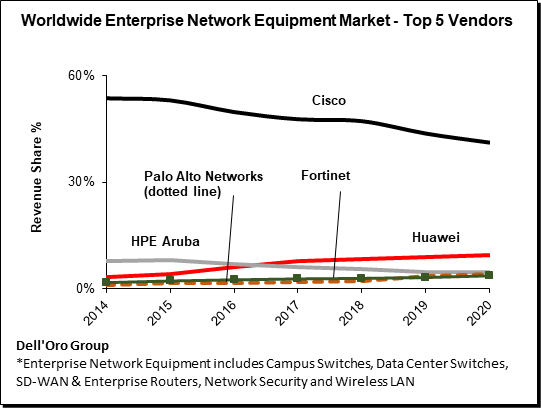
From a vendor perspective, Huawei and Cisco composed about 50% of the Enterprise Network Equipment market in 2020; they were the only two vendors with more than 10% revenue share in the Enterprise Network Equipment market.

Cisco remained the market leader in all segments. However, the company saw revenue-share loss in 2020 due to high exposure to hardware-based products and low exposure to China, which outgrew the market during the pandemic.

In the meantime, Fortinet climbed to fifth place, displacing H3C. Fortinet has high exposure to the security market, while H3C has high exposure to the switching market. Since security performed better than switching in 2020, it helped Fortinet gain share and improve its ranking in 2020.

Top 9 Vendors 2019 2020
CISCO 44% 41%
HUAWEI 9% 10%
HPE ARUBA 5% 5%
PALO ALTO NETWORKS 4% 4%
FORTINET 3% 4%
H3C 3% 4%
JUNIPER 2% 2%
CHECK POINT 2% 2%
SYMANTEC / BLUE COAT 2% 2%


2021 Market Outlook

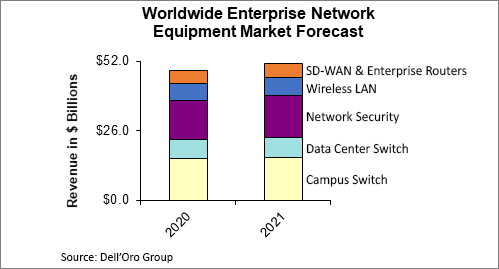
Dell’Oro analysts remain optimistic about the 2021 outlook and forecast 5% growth for the total Enterprise Network Equipment Market. This optimism is prompted by improving macro-economic conditions and business confidence as well as the ongoing government stimulus. Additionally, our interviews with end-users, system integrators, and value-added resellers (VARs) revealed that if a portion of the workforce returns to work by the end of 2021, spending on network infrastructure in preparation for such a development should start a few months in advance, perhaps as early as 2Q21 or 3Q21.

Dell’Oro Group Enterprise Network Equipment research programs consist of the following: Campus switches, Enterprise Data Center Switches, SD-WAN & Enterprise Routers, Network Security and Wireless LAN.

Related blogs for 5-year Forecast Jan 2021:

[wp_tech_share]


Campus switches are used for the purpose of connecting users and devices to the corporate Local Area Network (LAN). With the Work from Home or from Anywhere predicted to become a permanent aspect of the future of work, one of the fundamental questions is whether there is room for growth in the campus switch market. And if so- where will this growth come from?

We just published the latest edition of our 5-year forecast for the campus switch market. In the report, we discuss some of the negative impact from the pandemic such as the following:

    • Downward pressure on the number of campus switch ports needed to be installed: A more distributed workforce, working remotely either from home or from smaller distributed office spaces, will negatively impact the number of switch ports needed in those campuses. Initial data on commercial real estate, for example, suggests that prices are expected to fall significantly in 2020 and 2021 as demand for new office buildings is suppressed, which will in turn affect demand for campus switches.
    • Further cannibalization from WLAN: We expect WLAN to become more favorable for user connectivity than wired Ethernet, as it supports features and services that help businesses comply with re-opening guidelines, such as contact tracing, people counting, and other location-based services. Additionally, our interviews revealed that companies need to provide real mobility to the employees working from home. When these employees return to their offices, even in smaller numbers, their companies want to connect these users via Wi-Fi, as well, so as to maximize use of office space.

Despite the potential downside risk from COVID-19, we expect that the pandemic will also have some upside impact that will drive the market recovery, as detailed below:

    • Accelerated pace of digital transformation initiatives: Our interviews revealed that customers may be putting many budgets on hold, except for automation. We also learned that the timeline of some of these automation and digital transformation projects has been pulled in by about one to two years. Although the majority of IoT devices will be on wireless, some devices such as security cameras, industrial lighting or some sensors are expected to remain on wired Ethernet.
    • A greater portion of higher-priced PoE devices: We expect IoT devices to drive an increased portion of the higher-priced PoE ports. We expect this trend to help boost market average selling prices (ASPs).
    • Accelerated pace of the campus switch refresh cycle: We expect the adoption of digital transformation to accelerate the pace of the campus switch refresh cycle. In order to enable digital transformation, the network must undergo numerous changes. Automation, security, visibility, and analytics/intelligence are several added functionalities that IT managers need for the new digital era.
Any other impact from the pandemic on the campus switch market?

The pandemic is also expected to accelerate the adoption of Cloud-managed switches to accommodate the distributed workforce. Additionally, our interviews with end-users, system integrators, and VARs revealed an increased interest in Network as a Service (NaaS) during the pandemic, an interest that is expected to persist even after the pandemic ends.

If you need to access the full report to obtain revenue, units, pricing, relevant segmentation including regions and vertical markets, etc., please contact us at dgsales@delloro.com.


About the ReportDell'Oro Group Ethernet Campus Switch Report

The Dell’Oro Group Ethernet Switch – Campus 5-Year Forecast Report offers a complete overview of Ethernet switches built and optimized for deployment outside the data center, for the purpose of connecting users and things to the Local Area Networks. The report contains tables covering manufacturers’ revenue, average selling prices, and port/unit shipments by speed (Fast Ethernet, Gigabit Ethernet, 2.5 Gigabit Ethernet, 5/10/25/40/50/100 Gigabit Ethernet) plus regional breakouts, and Power Over Ethernet (PoE) Forecast.

[wp_tech_share]

400 Gbps and 800 Gbps adoption is expected to accelerate and drive nearly half of the revenue in the market by 2025

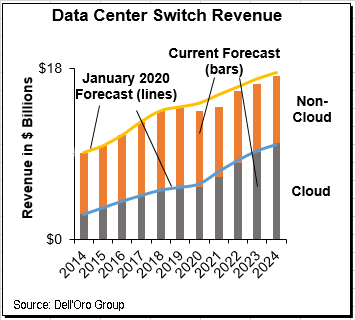
We just published the latest edition of our 5-year forecast for the data center switch market.  Six months ago, when we published our July 5-Year forecast, we predicted that the data center switch market will be for the most part resilient to the pandemic. We also explained that most of the downward adjustment relative to our January 2020 Pre-pandemic forecast was driven by the non-Cloud segments, which include enterprises as well as Telco Service Providers (SPs). In the meantime, our July 2020 forecast for the Cloud segment showed only a slight downward revision relative to our pre-pandemic January forecast.

We are now pleased to announce that we hold to our prior view that the pandemic won’t significantly depress the growth in the data center switch market (Chart). We even had to raise our forecast slightly compared to our prior July report, as certain segments of the market, namely Tier 2/3 Cloud SPs and large enterprises, have been performing better than expected.

Ethernet Data Center Switch market Dell'Oro Group

Our current forecast shows that the Ethernet switch data center market will decline only for one year (in 2020), at a low single-digit rate (-2%). We expect the market will return to growth in 2021 and will be able to exceed its 2019 pre-pandemic revenue level.

Other takeaways from the January 2021 5-Year Ethernet Switch Data Center Forecast Report include the following:
  • The 200/400 Gbps adoption has been so far driven mostly by Google (starting 4Q18) and Amazon (starting 4Q19). We expect the 200 Gbps adoption by Facebook to accelerate in early 2021, and the 400 Gbps adoption by Microsoft to accelerate in the second half of 2021.
  • We expect early 800 Gbps deployment to start in 2022, driven by the availability of 100 G SerDes. However, initial 800 Gbps deployments will not be based on native 800 G Ethernet MAC, but rather deployed as either 2×400 GE or 8×100 GE. In other words, 100 Gbps SerDes will allow building high-density, low-cost 400 Gbps or 100 Gbps systems. We expect early adoption to be propelled by Google and Amazon. We also expect Microsoft to adopt 800 Gbps (which will be deployed as 2×400 GE) by 2023.
  • 200 G SerDes may be available in the market by 2024. However, the availability of 200 G Lambda may lag 200 G SerDes. Given that connecting 200 G SerDes to 100 G Lambda requires Gearboxes which add complexity, cost, and power consumption, we expect 100 G SerDes with 100 G Lambda to dominate over the next five years.
  • Power is one of the major constraints for speeds beyond 400 Gbps. Future data center networks may require a combination of photonic innovation, such as co-packaged optics (CPO) and optimized network architectures.
  • Our current revenue forecast does not reflect an increased portion of optics sold by switch system vendors (For example, Cisco selling more optics with their switches). We plan to reflect that in separate tables to avoid inflating the market size.
  • We are assuming that CPO may start to ramp towards the end of our forecast period. However, the business model between chip suppliers and switch manufacturers is not yet clear to us (i.e who is going to carry the physical CPO inventory is not yet determined). Hence we elected to not reflect additional revenue associated with CPO in our current forecast until we have a better view of the business model.

If you need to access the full report to obtain revenue, units, pricing, relevant details including speeds, regions, market segments, etc., please contact us at dgsales@delloro.com.


Dell'Oro Group Ethernet Data Center Switch 5-Year Forecast ReportAbout the Report

The Dell’Oro Group Ethernet Switch – Data Center Five Year Forecast Report provides a comprehensive overview of market trends and includes tables covering manufacturers’ revenue, port shipments, and average selling price forecasts for various technologies: Modular and Fixed by Port Speed; Fixed Managed and Unmanaged by Port Speed. We forecast the following port speeds: 1000 Mbps; 10 Gbps; 25 Gbps; 40 Gbps; 50 Gbps; 100 Gbps; 200 Gbps; 400 Gbps, 800 Gbps. We also provide Regional Forecast as well as forecast by different market segments (Top 4 U.S. Cloud SPs, Top 3 Chinese Cloud SPs, Telco SPs, Rest of Cloud, Large Enterprises, Rest of Enterprises).