[wp_tech_share]

We just published our 3Q20 reports where we looked at how the market performed during the three-month period from July to September.

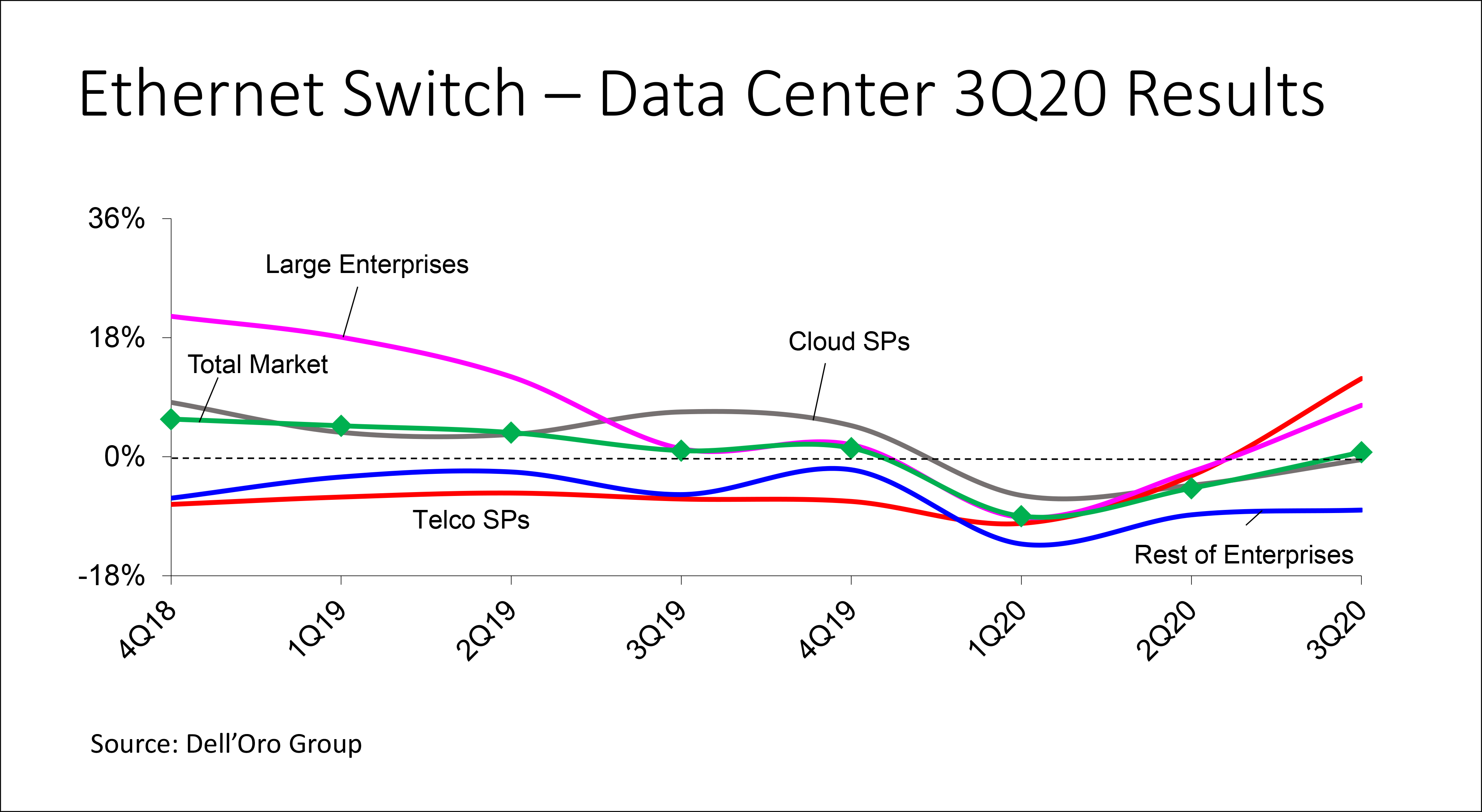
During the third quarter, revenue was up 1% Y/Y, in contrast with our prior forecast of a 7% decline. The upside surprise was driven mostly by the non-Cloud segment (which includes Telco Service Providers (SPs) Large Enterprises, and Rest of the Enterprises). In the meantime, the Cloud segment was flat, in line with our expectations but showing uneven performance across various Tier 1 and Tier 2/3 Cloud SPs.

The recovery in the non-Cloud segment was propelled by increased demand from large enterprises (which include Fortune 2000 companies and comprise about half of the sales of the non-Cloud segment). We have been predicting this segment’s return to growth, as it is more economical for these enterprises with large scale to build and manage their own private data centers than to use the Public Cloud. However, to our surprise, the recovery occurred ahead of our predictions, as a result of improvement in macroeconomic conditions, easing of lookdown measures, and injection of government funding—which helped certain verticals, mainly in the public sector.

Additionally, we saw a recovery in the Telco SPs segment in the third quarter, driven by some 5G related projects, most notably in APAC regions. We also saw some growth in Telco SPs in Europe and North America (NA) as vendors such as Arista were finally able to add features to their products to tie back to legacy networks. Nevertheless, we expect demand from Telco SPs to remain lumpy. As for the Rest of Enterprise segment, we continued to see a decline, which is a trend that we do not expect to reverse due to ongoing migration to the Public Cloud.
Ongoing improvement expected for the remainder of the 2020 year

Looking at 4Q20, we expect the underlying growth drivers that helped the 3Q20 recovery in the Large Enterprise segment, will continue through 4Q20. However, we may have underestimated the benefit from backlog fulfillment that may have artificially boosted the performance of the Large Enterprise segment in 3Q20. Some of the manufacturers we interviewed confirmed benefiting from backlog fulfillment during the third quarter as supply challenges improved. Those benefits from backlog fulfillment may not repeat themselves to serve as a tailwind in 4Q20. If that’s the case, our 4Q20 forecast may be too high.

As for the Cloud segment, we expect to continue to see mixed performance among Tier 1 and Tier 2/3 Cloud SPs in 4Q20. In line with the 3Q20 performance, we expect network spending from some of the U.S.-based Tier 1 (for instance Facebook and Microsoft) as well as some Tier 2/3 Cloud SPs to remain soft through the remainder of the year, for reasons explained in more details in our report. We expect some of that softness to be offset by ongoing strength in spending from Chinese Cloud SPs, stimulated by an accelerated pace of digital transformation and untapped potential in the Chinese Cloud market.

For the full year of 2020, we now predict the market to decline only low-single-digit, compared to our prior forecast of mid-single-digit decline. We expect the Cloud segment to grow at a low single-digit rate, in line with our prior predictions. However, we adjusted our forecast for the non-Cloud segment from high single-digit to mid-single-digit decline, as the anticipated recovery in 2H2020 will offset some of the weakness in the first half of the year (The non-Cloud segment was down 8% Y/Y in 1H2020).

Data Center switch revenue forecast to grow high single-digit in 2021

Looking at 2021, we expect sales of data center switches to grow high single-digit. We expect the ongoing recovery in the non-Cloud segment, most of which is driven by large enterprises, will be propelled by improvement in macro-economic conditions. Recent GDP reports indicate that economists at world-leading banks are forecasting positive GDP growth in 2021, compared to negative growth in 2020. Additionally, the availability of a vaccine will boost business confidence, all helping to abate the uncertainty in the market. As for the Cloud segment, we predict a double-digit growth in network spending which will be triggered by an accelerated pace of 200/400 Gbps adoption outside of just Google and Amazon.

200/400 Gbps refresh cycle expected to accelerate in 2021

Most of the 400 Gbps adoption in the market has been so far driven by Google and Amazon. The availability of high-volume low-cost 400 Gbps optics has been the major constraint for the adoption. Additionally, adequate switch chips with the right density, power, and buffer size were needed for specific use cases at some of these large Cloud SPs to enable this transition. According to our interviews with the major chip suppliers as well as the optical transceiver vendors, we predict the 200/400 Gbps refresh cycle to start to materialize at Facebook in early 2021 and at Microsoft in the second half of 2021.

Despite our optimism, a lot of uncertainty remains in the market

Despite our optimistic outlook, we wouldn’t be surprised if the market continues to show some volatility next year. The level of uncertainty in the market remains relatively high due to elevated levels of unemployment rates and bankruptcy, which may impact business confidence and suppress network spending from large enterprises and even some Tier 2/3 Cloud SPs.

Additionally, it bears mentioning that at the time of this writing, the rate of COVID-19 infections is accelerating, prompting many countries to slow business reopening, while invoking curfews and lockdowns. This may potentially suppress market growth but we believe that the impact will not be as significant as what the market has experienced with the first wave of infections and lockdowns. We believe that many vendors, as well as their customers, have figured out ways of doing business during the unusual circumstances in these unprecedented times.

All that said, although we believe the worst of the pandemic is behind us, we are all watching how fast and smooth the distribution of the vaccine will be. Until then, and until the vast majority of the population is vaccinated and builds immunity to the virus, a lot remains uncertain about the outcome of this pandemic.
[wp_tech_share]

We just published our 3Q20 reports where we looked at how the market performed during the three-month period from July to September.

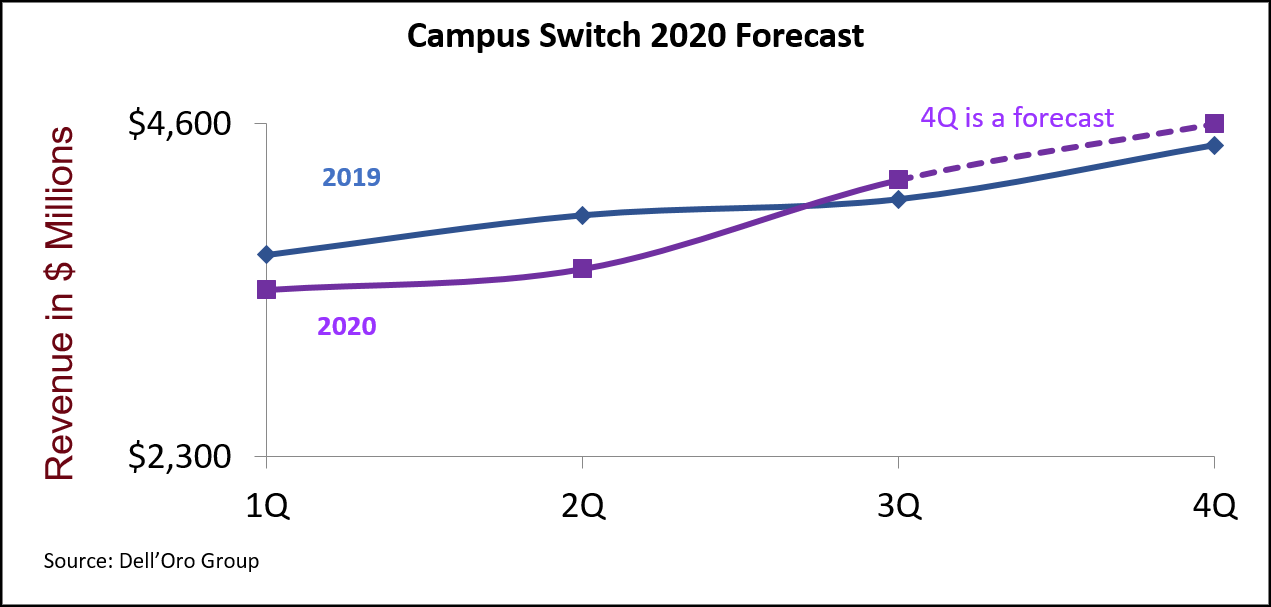
Surprisingly, the campus switch market performed well above our predictions in 3Q20. Revenue was up 3% Y/Y, compared to our prior forecast of a 12% decline, which would have been in line with prior recessions and in correlation with prior GDP forecasts.

The upside surprise was driven mainly by a stronger performance in North America as a result of strong government funding (CARES Act and E-Rate). Some of the manufacturers we interviewed expect government funding, mostly related to E-Rate, to flow into the next couple of quarters.

For 4Q20, we predict the market to grow at 3% Y/Y in 4Q20, in line with the 3Q20 performance.


We believe that the underlying growth drivers that helped the 3Q20 recovery will continue through the remainder of the year. We believe ongoing government funding, as well as improving macroeconomic conditions—namely in the U.S. and APAC—will encourage the large and even some mid-size enterprises in those regions to resume spending on infrastructure.

We would like to caution, however, that we may have underestimated the benefit from backlog fulfillment that may have artificially boosted the market performance in 3Q20. Some of the manufacturers we interviewed confirmed benefiting from backlog fulfillment during the third quarter as supply challenges improved. Those benefits from backlog fulfillment may not repeat themselves to serve as a tailwind in 4Q20. If that’s the case, our 4Q20 forecast may be too high.

For the full year of 2020, we currently predict the market to decline only 2%, as the anticipated recovery in 2H2020 will offset some of the weakness in the first half of the year (1H2020 was down 8% Y/Y).


Campus switch revenue forecast to return to growth in 2021

Looking at 2021, we predict the positive momentum to continue and drive 2% growth in the market.  This projected growth will be propelled by improvement in macro-economic conditions as recent GDP reports indicate that economists at world-leading banks are forecasting positive GDP growth in 2021, compared to negative growth in 2020. Additionally, the availability of a vaccine will help abate the uncertainty in the market and boost business confidence.


This pandemic-induced recession looking better than the two prior ones

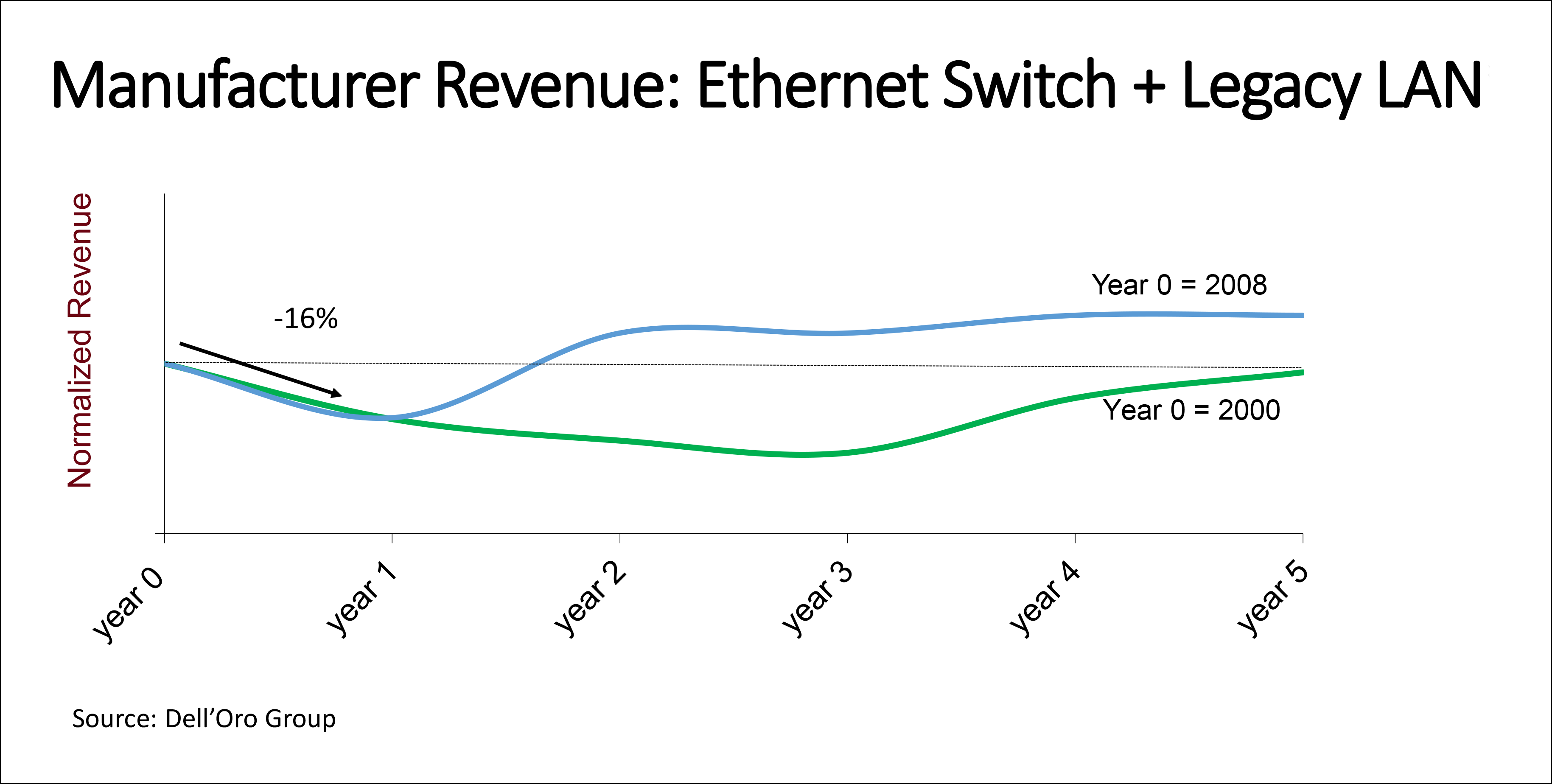
The question now is how this projected performance in the market compares with the performance during the two prior recessions (in 2000 and 2008). In the 2000 recession, sales of enterprise switches declined in the mid-teens in the first year of the recession and it took the market three years before returning to growth. In the 2008 recession, the market declined in the mid-teens in 2009 as well, but returned to growth in the following year, thanks to deep government stimulus.  We believe a few major tailwinds would help the market perform better during this pandemic-induced recession.


First, government spending and stimulus helped not only the government sector but also the lower-education vertical and even manufacturing as governments in some regions of the world, such as Asia Pacific, provided incentives to manufacturers to modernize their processes.

Second, China, which recovered relatively fast and has been providing some uplift to the market since 2Q20, is now a significant portion of the total sales. (China was less than 10% of the market in 2008 and prior vs. about 20% in 2019).

Third and more importantly, this pandemic has actually amplified the importance of the network and is accelerating the digital transformation and network upgrade cycles. Our interviews with end-users as well as system integrators revealed that some of the digital transformation projects have been pulled in by about one to two years. This accelerated pace of digital transformation is offsetting some of the impact from work from home and cannibalization from WLAN, which we are planning to discuss in more details in our upcoming five-year forecast report.

Despite our optimism, a lot of uncertainty remains in the market

Despite our optimistic outlook, we wouldn’t be surprised if the market continues to show some volatility next year. We believe the level of uncertainty in the market remains relatively high due to elevated levels of unemployment rate and bankruptcy. Additionally, our interviews as well as commercial real estate reports are showing decreased demand and high level of excess capacity which may potentially impact demand for network equipment. We question whether the true level of private demand is currently camouflaged by massive government funding.

Finally, it bears mentioning that at the time of this writing, the rate of infections is accelerating, prompting many countries to slow business reopening, while invoking curfews and lockdowns. This may potentially suppress market growth but we believe that the impact will not be as significant as what the market has experienced with the first wave of infections and lockdowns. We believe that many vendors, as well as their customers, have figured out ways of doing business during the unusual circumstances in these unprecedented times.

All that said, although we believe the worst of the pandemic is behind us, we are all watching how fast and smooth the distribution of the vaccine will be. Until then, and until the vast majority of the population is vaccinated, a lot remains uncertain about the outcome of this pandemic.
[wp_tech_share]


Last week, Marvell announced another giant deal with the acquisition of Inphi. We had an opportunity to talk with members of Marvell’s executive team to garner insights on the acquisition, which we share in this blog.

We view this acquisition as strategic and complementary, rather than opportunistic, given Inphi’s strong positioning in electro-optics interconnect both inside data centers as well as connecting data centers. Inphi also has a strong and growing position in 5G backhaul, mid-haul, and front-haul. Its technology and addressable market complement Marvell’s storage, networking, processor, and security portfolio and accelerate its growth in Cloud and 5G infrastructure. Note that more than 70% of Inphi’s fiscal 2020 year-to-date revenue is derived from Cloud and 5G. Marvell’s executive team expects this acquisition to help expand its footprint with large Cloud Service Provider (SP) customers. Four additional networking Cloud customers with greater than $100 M in annual revenue will be created by the combined company.

While the pandemic may have slowed investments in some areas of the network, we have highlighted in our reports that spending on Cloud data center infrastructure as well as 5G networks will remain robust and may even accelerate because of the pandemic.

Our Data Center Capex five-year forecast projects spending on Cloud data center infrastructure to grow at 11% CAGR, reaching $140 B by 2024. Additionally, Dell’Oro Group’s 5-Year RAN Forecast shows that 5G NR investments are anticipated to advance five to ten fold over the next five years.

Nevertheless, although growth in Cloud SPs as well as 5G networks presents attractive opportunities for many suppliers, it also carries margin challenges, technology challenges, and the rising need for custom solutions:

Margin challenges:

It is widely known that Cloud SPs have a relentless need to lower the cost of deploying and operating their data centers. Incremental savings on each piece of purchased equipment translates into significant improvement in their return on investment (RoI) as well as other profitability metrics. This is because of the scale at which they operate data centers with hundreds of thousands of server installed base. Our interviews with players throughout the supply chain revealed how vigorously suppliers are struggling to win Cloud SPs business (viewed as strategic) without taking a margin hit. This low-margin business is driving small companies to get acquired and large companies to try to grow even larger as scale is the only way to remain competitive. There are tremendous synergies when you can sell more products to a single customer. There are also synergies when you can partner with the same manufacturers. Additionally, the development costs of some advanced—and, in some cases, custom—products required by Cloud SPs is so high that they can be offset only through scale. Marvell’s executive team expects both Marvell and Inphi to benefit from the larger scale in R&D—in particular, in process technology. Note that Marvell recently announced its 5 nm platform and started its research in 3 nm. This will help Inphi drive higher performance, lower power, and potentially more custom products.

Technology challenges:

The transition to a digital world with artificial intelligence (AI), mobility, and distributed computing at the edge has accelerated the explosion of traffic and data movement inside Cloud SP networks, across data centers and at the edge. This means that networks must become faster to satisfy the insatiable demand for bandwidth. Our data center switch five-year forecast report shows that about 30% of data center switch ports shipped by 2024 will be at 400 Gbps speeds and higher. However, as network speeds continue to increase, they will create challenges. For example, pluggable optics (currently the form factor of choice for network connectivity inside the data center) will hit density and power issues. When this occurs, the industry will be forced to adopt alternative technologies, such as co-packaged optics (CPO), with optics co-packed and integrated on the switch chip. We expect this trend to favor vertically integrated companies, at least in the early stages of adoption, due to the lack of a standardization level that would allow for a more diverse ecosystem. I mentioned this trend at the beginning of the year in my blog (Ethernet data center switch trends in 2020 and beyond) and predicted that CPO will drive numerous acquisitions, consolidations, and partnerships among switch chip vendors, switch system vendors, and optical transceiver vendors. Note that Marvell has a switch chip business, which may be bolstered by Inphi’s strong optics technology.

Rising need for custom solutions:

The data and compute intensity of modern AI and machine learning workloads is putting tremendous pressure on the performance of Cloud data centers. While computing demand continues to surge, CPU performance improvements are slowing down, as Moore’s law is reaching its limits. We expect this to drive new ways to design modern data centers to become giant compute engines with hundreds of thousands of compute nodes. This, in turn, will drive innovations to interconnect the different nodes without compromising latency and performance. As Cloud SPs will try to differentiate themselves through these architectural innovations, their need for custom—and sometimes proprietary—solutions will increase, potentially forcing their suppliers to own different pieces of technologies that they can integrate. Additionally, this differentiation will require a large scale to drive synergies, while developing custom-made solutions.

Marvell’s acquisition of Inphi was the chip sector’s second acquisition last week, following Advanced Micro Devices’ acquisition of Xilinx. The deal followed on the heels of an already active year of giant tech acquisitions with Nvidia’s acquisition of ARM and Analog Devices’ acquisition of Maxim Integrated. We expect more acquisitions to follow as the only way to survive in this highly competitive market is to join forces and get “stronger and better together.”

[wp_tech_share]

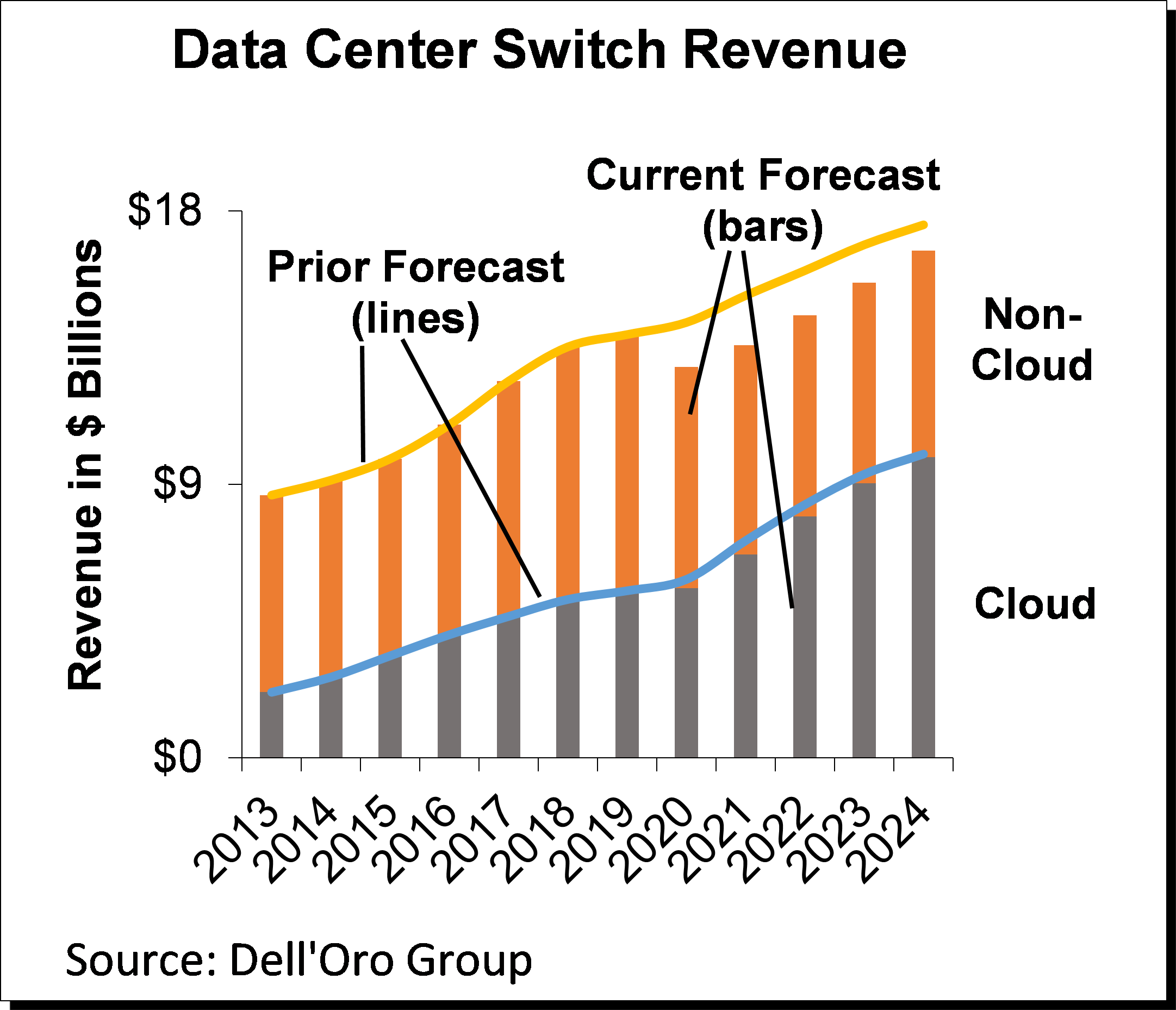
Dell’Oro Group published an update to its Data Center switch market five-year forecast report. The report shows that the data center switch market is expected to grow at a 4% CAGR from 2019 to 2024, approaching $17 B by the end of our forecast period. Despite the COVID-19 pandemic, our revised forecast of 4% CAGR shows only a slight downward adjustment from our prior January forecast of 5%.

Most of the downward adjustment was driven by the non-Cloud segment, which includes enterprises as well as Telco Service Providers (SPs). The non-Cloud segment comprises about 60% of the total data center switch revenue and accounted for more than 70% of the downward adjustment for every year during our forecast period. In the meantime, our current forecast for the Cloud segment shows only a slight downward revision, relative to our prior January report  as shown in the chart. Our Cloud segment includes the Top 4 U.S Cloud SPs (Google, Amazon, Microsoft, and Facebook), The Top 3 Chinese Cloud SPs (Alibaba, Tencent and Baidu), and other Tier 2/3 Cloud SPs that are mostly Content Cloud providers.

Within the non-Cloud segment, we have lowered our forecast for large enterprises, as well as for small and medium enterprises. However, while we project the “Large Enterprise” segment (which includes Fortune 2000 companies) to return to growth and surpass its 2019 pre-COVID revenue level in 2021, we predict that small and medium enterprises will continue to decline during our forecast period—never to return to growth, for reasons explained in more details in our Ethernet Data Center Switch Five-Year Forecast Report.

Within the Cloud segment, we essentially maintained our projections for the Top 4 U.S. Cloud SPs, as well as the Top 3 Chinese Cloud SPs, as our underlying assumptions for the growth in those segments have remained unchanged. These assumptions are mostly driven by the timing of the 200/400 Gbps adoption as well as the consumption/digestion cycles. However, we have lowered our forecast for the “Rest of Cloud” segment, as macroeconomic headwinds may affect the ability of these Tier 2/3 Cloud SPs to grow revenue, consequently impacting their ability to expand their data center infrastructure to support their business. We believe that some of these Tier 2/3 Cloud SPs may rely on Tier 1 Public Cloud providers to expand capacity during and after the pandemic. Leveraging Public Cloud SPs is an opex alternative that allows them to scale up and down capacity according to the demand.

Other highlights from the report

  • 400 Gbps adoption in 2020 will continue to be driven mainly by Google and Amazon, and benefit mostly white box switch vendors. In the meantime, we don’t expect the adoption of 200/400 Gbps by Facebook and Microsoft to materialize until 2021. Facebook and Microsoft still deploy a fair amount of branded switches but we do expect a potential change in the vendor landscape in tandem with the 200/400 speed transition at these accounts.
  • We predict Google, followed shortly by Amazon, will spearhead the adoption of 800 Gbps in 2023/2024. 800 Gbps will be driven by the availability of 100 G SerDes technology which will allow to build dense 100 Gbps or dense 400 Gbps systems in 1 U form factor (i.e., each 800 Gbps port can be used as 2×400 Gbps or 8×100 Gbps). 100 G SerDes will also allow to match the electrical lanes with the optical lanes.
  • With the transition to 400 Gbps and higher speeds, the role played by optics will become even more crucial for several reasons including increased optics prices, the possibility to displace DWDM systems in the data center interconnect (DCI) and the potential migration to co-packaged optics at high speeds. For these reasons, some switch vendors are increasing their offerings of optical transceivers. In the report, we explain if/when we will include optical transceivers in our data center switch revenues. We also expect to see many consolidations and acquisitions in the market in order for switch, chip, and optics vendors to position themselves during this transition.
  • The adoption of disaggregated switch systems will continue to increase during our forecast period, although at a slower rate than in the prior years. Early adoption of disaggregated systems has been driven mainly by large Tier 1 Cloud SPs and has greatly affected the market given their scale (involving a server-installed base of well over one million). However, the next wave of adoption will be driven either by Tier 2 Cloud SPs (which are significantly smaller in size than the Tier 1) or by some large enterprises.

If you need to access the full report to obtain revenue, units, pricing, relevant details including speeds, regions, market segments, etc., please contact us at dgsales@delloro.com

About the Report

The Dell’Oro Group Ethernet Switch – Data Center Five Year Forecast Report provides a comprehensive overview of market trends and includes tables covering manufacturers’ revenue, port shipments, and average selling price forecasts for various technologies: Modular and Fixed by Port Speed; Fixed Managed and Unmanaged by Port Speed. We forecast the following port speeds: 1000 Mbps; 10 Gbps; 25 Gbps; 40 Gbps; 50 Gbps; 100 Gbps; 200 Gbps; 400 Gbps. We also provide Regional Forecast as well as forecast by different market segments (Top 4 U.S. Cloud SPs, Top 3 Chinese Cloud SPs, Telco SPs, Rest of Cloud, Large Enterprises, Rest of Enterprises).

[wp_tech_share]

Dell’Oro Group published an update to its Campus switch market five-year forecast report. The report shows that the campus switch market is expected to be profoundly impacted by the COVID19- pandemic and to decline at 1% CAGR from 2019 to 2024, compared to our prior January forecast of + 3% CAGR.

Analysis of market performance during the prior two recessions was a fundamental part of our forecast process, as we assessed the impact of the COVID-19 pandemic. However, it is very important to recognize how this pandemic-induced recession may differ from the prior two recessions, not only at a macro level but also from a technology perspective. COVID-19 will bring many changes to our lives and will impact the adoption of technology in different ways. Some of these changes may be short-term, but we believe a number of them will remain with us for the long term. In the report, we detail our view on the potential impact of the COVID-19 pandemic on the market, in terms of both upside and downside. We also explain how and why this recession may differ from the prior two recessions. Our view is the result of numerous interviews over the last three to four months with end-users, system integrators, VARs, and manufacturers. Below are some highlights:

Downside Impact from the COVID-19 Pandemic

  • Although GDP outlooks are reflecting anticipation of a rebound in 2021, we expect the actual rebound in campus switch revenue to lag behind GDP recovery. This is the result of high exposure to verticals that are heavily impacted by the pandemic and may take years to recover (such as Healthcare, Higher Education, Hospitality, Logistics, Retail).
  • Our interviews revealed consistent expectations among end-users, distributors, system integrators, and vendors that the portion of the remote workforce will increase following COVID19. However, it is still anyone’s guess as to what the degree will be and what the new normal will look like. Our models assume a 20% to 45% increase in the portion of remote workforce post-COVID.
  • A more distributed workforce, working remotely either from home or from smaller distributed office spaces, will negatively impact the number as well as the type of switch ports needed in those campuses.
  • Wireless LAN will become more favorable for user connectivity than wired Ethernet, as it supports features and services that help businesses comply with re-opening guidelines such as contact tracing, people counting, and other location-based services.

Upside Impact from the COVID-19 Pandemic

  • The digital transformation is accelerating as businesses try to adapt and evolve. This, in turn, will expedite the pace of the campus switch refresh cycle. Automation, security, visibility, and analytics/intelligence are several added functionalities that IT managers need for the new digital era. We expect campus switch vendors to try to monetize those features, which may boost market average selling prices (ASPs) and help the market recover faster than currently projected.
  • We forecast the higher-priced PoE ports to comprise about a third of the total campus switch ports by 2024. The increased portion of IoT devices connected to the network will drive an increased portion of the PoE ports.
  • Adoption of subscription-based consumption models will become a theme during and after the pandemic. The conversion from Capex to Opex makes it much easier for companies to scale their costs down or up, according to the demand.

If you need to access the full report to obtain revenue, units, pricing, relevant segmentation including regions and vertical markets, etc., please contact us at dgsales@delloro.com


About the Report

The Dell’Oro Group Ethernet Switch – Campus 5-Year Forecast Report offers a complete overview of Ethernet switches built and optimized for deployment outside the data center, for the purpose of connecting users and things to the Local Area Networks. The report contains tables covering manufacturers’ revenue, average selling prices, and port/unit shipments by speed (Fast Ethernet, Gigabit Ethernet, 2.5 Gigabit Ethernet, 5.0 Gigabit Ethernet, 25 Gigabit Ethernet, 10 Gigabit Ethernet, 40 Gigabit Ethernet, 50 Gigabit Ethernet, 100 Gigabit Ethernet) plus regional breakouts.