[wp_tech_share]

We’ve just wrapped up the 4Q21 reporting period for Dell’Oro Group’s enterprise network equipment programs, which include campus switches, enterprise data center switches, SD-WAN & enterprise routers, network security, and Wireless LAN. Enterprises include businesses of all sizes as well as government, education, and research entities. The equipment tracked in these programs can be used for wired or wireless data communication in private and secure networks.

Sales Hit Record Level in 2021

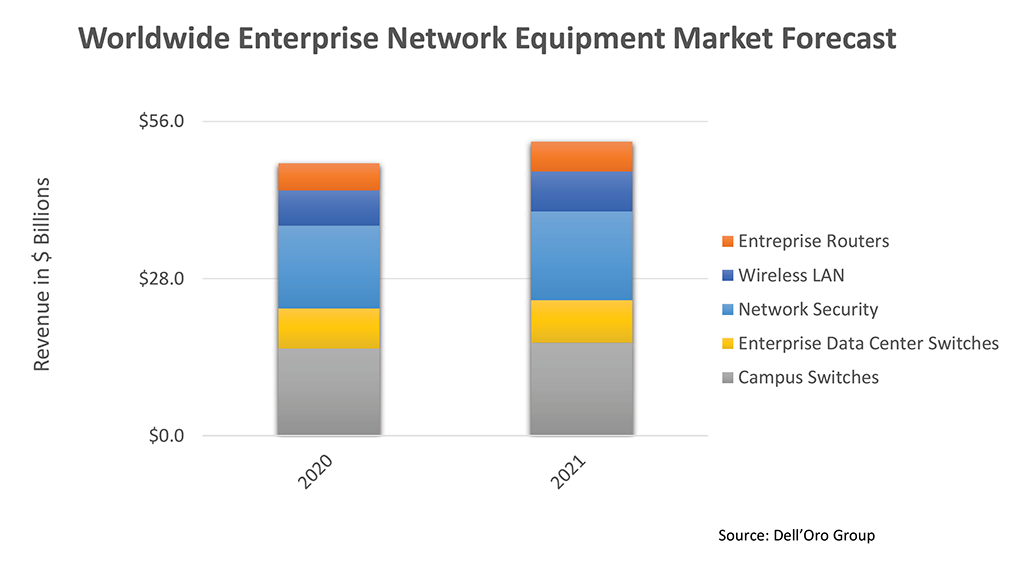
Despite a macro-economic environment that continues to be defined by supply constraints, our reports showed a strong rebound in the overall Enterprise Network Equipment market in 2021, following some stagnation in the prior year. Sales jumped 12% year-over-year (Y/Y), propelling the market to a record- level in 2021.

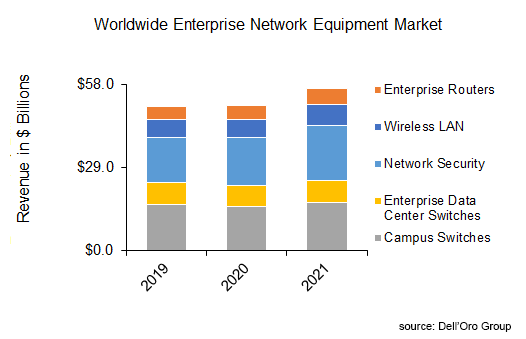
The strong performance was broad-based across all technology segments. Enterprise Routers, Wireless LAN, and Network Security were all up double-digits. In the meantime, Campus and Enterprise Data Center Switches were up mid-to-high single digits. All technology segments hit record-revenue level in 2021.
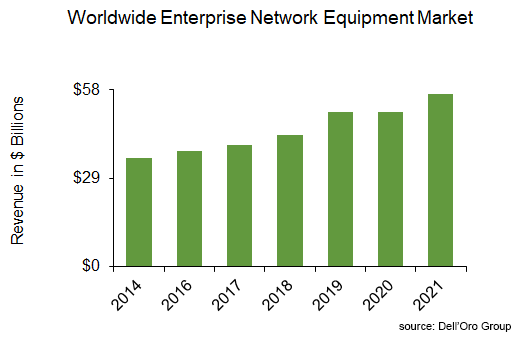
 

2021 Worldwide Enterprise Network Equipment Market


We have calculated that spending on enterprise network equipment rose by nearly $6.0 B in 2021.  Security accounted for 40% of the increase in spending, while campus switches accounted for a quarter of the increase.
We attribute this broad-based recovery to the following:

  • Continuing improvement in macro-economic conditions.
  • Continuing government spending and stimulus around the world.
  • Network upgrades in preparation for workers returning to the office full or part-time.
  • Digital transformation initiatives, accelerated by the pandemic, are driving new network requirements and putting pressure on IT managers to upgrade their networks and add different security layers.
  • Orders pulled in from future quarters, to mitigate ongoing supply challenges that are adversely affecting product availability, lead times, and prices.

The 2021 robust performance in the Enterprise Network Equipment market was broad-based across all regions, except the Caribbean and Latin America, which was flattish (although showing a significant improvement from the high-single-digit decline registered last year).
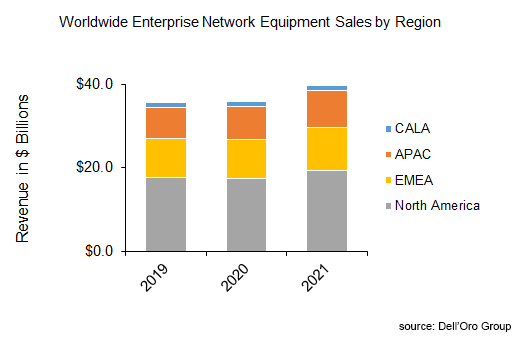
2021 Worldwide Enterprise Network Equipment Market by Regions

Cisco Loses Some Ground — Still Leads the Enterprise Network Equipment Market

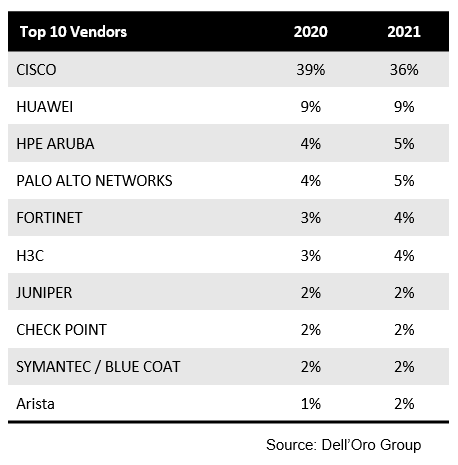
The analysis shared in our reports showed no major change in vendors’ ranking. Cisco remains the only vendor with more than 10% share in the market, although the firm lost three points of revenue share in 2021. This share loss was broad-based across all technology segments, except WLAN. In the meantime, HPE Aruba, Palo Alto Networks, Fortinet, H3C, and Arista, gained one point of revenue share, each.

Nevertheless, we would like to note that the vendor landscape continues to be defined by a challenging supply environment and that some of the share shifts witnessed in 2021 may not be necessarily reflective of competitive displacement, but rather the timing of order fulfillment.


Robust Market Outlook for 2022

Despite a challenging supply environment that is expected to persist through most of 2022, Dell’Oro analysts are projecting strong double-digit revenue growth in the Enterprise Network Equipment market in 2022. This optimism is underpinned by healthy outlooks provided by most vendors as a result of increased visibility and robust backlogs. Additionally, ongoing supply challenges will continue to encourage customers to place advance orders, which will have a positive effect on bookings first, then a few months later, on revenues, depending on lead times.

Dell’Oro Group Enterprise Network Equipment research programs consist of the following: Campus switches, Enterprise Data Center Switches, SD-WAN & Enterprise Routers, Network Security, and Wireless LAN.
[wp_tech_share]


At the beginning of each year, we analysts like to look backward and reflect on our predictions for the prior year to review what we got right and what we got wrong, and then look forward in order to predict how the new year may unfold and what technology trends may shape our forecast.

In reviewing my 2021 predictions, published a year ago, I’m delighted to report that the 2021 data center switch market unfolded pretty much in line with my expectations, with sales up high single-digit-to-double digits.  Growth was broad-based across the Cloud segment (up by double digits) as well as the non-Cloud segment (up in the mid-single digits). Note that the growth in the non-Cloud segment was mostly driven by large enterprises (comprised mainly of the Fortune 2000 companies).


The Data Center Switch Market Spotlight Will Continue to Shine in 2022 if Supply Permits

We are currently projecting that the data center switch market will grow by double digits in 2022, with the Cloud segment growing almost at twice the rate of the non-Cloud. Although the panic purchasing behavior fueled by ongoing supply challenges is one of the major drivers for such a robust market forecast, there are also some fundamental catalysts behind the strong demand we expect to remain in the market. For the Cloud segment, we expect increased network spending propelled by the following:

  • accelerated adoption of 200/400 Gbps at Microsoft and Facebook, as explained later in this blog
  • expansion cycles at some of the large hyperscalers, further fueled by new AI (artificial intelligence) workloads
  • ongoing pent-up demand at Tier 2/3 Cloud Service Providers (SPs)

As for the non-Cloud segment, we expect the demand to be fueled by an accelerated pace of digital transformation.

Despite our optimism, supply constraints may continue to threaten market performance. As a reminder, despite the robust sales growth witnessed last year, supply fell short of demand. Based on our interviews with system and component vendors, as well as some of the Value Added Resellers (VARs) and System Integrators (SI), we do not expect the supply situation to improve until the second half of this year.


200/400 Gbps adoption to Accelerate Beyond Google and Amazon

Although 2021 market performance was pretty much in line with our predictions, 200/400 Gbps shipments fell short of our expectations. 200/400 Gbps shipments have been so far consumed mostly by Google and Amazon, and we have been predicting that deployment at Microsoft and Meta (Formerly known as Facebook) should start to accelerate in 2H21. However, while shipments were on track with our predictions, recognition of the revenues from some of those shipments has been deferred due to a pending qualification cycle. Hence, we did not reflect these 200/400 Gbps deployment at Microsoft and Meta in our reports. We expect revenue from these shipments to be recognized this year, and project the 200/400 Gbps ports to more than double in 2022.


800 Gbps Shipments May Debut at Google

While 200/400 Gbps shipments have barely started to take off at Microsoft and Meta, we expect Google to deploy 800-Gbps this year. 800-Gbps deployment will be propelled by the availability of 800-Gbps optics, which provide significantly lower cost per bit than two discrete 400-Gbps optics (about 25–30% lower cost). Additionally, 800 Gbps enables lower cost per bit at a system level. With the availability of 100 G SerDes technology, switch chip capacity will essentially double, from 12.8 Tbps to 25.6 Tbps. 800 Gbps ports will allow those chips to be configured in 1 U fixed factor as 32 ports of 800 Gbps (with each port potentially configured as 2×400 Gbps or as 8×100 Gbps).


Silicon Diversity Will Become More Pronounced

Silicon diversity at large Cloud SPs’ networks has been a theme over the past few years, fueled by the need to put pressure on Broadcom, which has dominated the merchant silicon space to date. We expect the increased number of viable merchant silicon suppliers such as Cisco and Marvell/Innovium—along with industry-wide supply constraints—to further accelerate this trend in 2022. As a reminder, in 2021, Marvell announced the acquisition of Innovium, giving the latter access to more engineering and financial resources, and at OCP 2021, Cisco announced that it will be supplying Meta with its Silicon One chips on the Wedge400C for Top of Rack applications.


AI-Driven Workloads to Continue to Shape Data Center Network Infrastructure

Dell’Oro Group projects that the spending on accelerated compute servers targeted to AI workloads will reach double-digit growth over the next five years, outpacing other data center infrastructure. However, AI applications are power- and bandwidth-hungry, and may require different ways to architect the network. We expect these requirements to drive faster adoption of high-speed networks and, in some cases, even some proprietary type of network architecture, which may not necessarily be Ethernet-based.

For more detailed view and insights on the data center switch market, please contact us at dgsales@delloro.com

[wp_tech_share]


Last week’s 2021 OCP (Open Compute Project) Global Summit marked its tenth anniversary. Fittingly, the vendor and partnership announcements were significant.

Meta (formerly known as Facebook) once again dominated the show’s headlines with product, architecture, and partnership announcements that will have a far-reaching impact on switch vendors and component suppliers. As the fourth-largest cloud service provider (SP), Meta accounts for a significant portion of total network and IT spend. Thus, the supplier ecosystem always pays close attention to upcoming changes in Meta’s data center architecture or procurement strategy.

Meta continues co-development efforts with Arista with the minipack 2 chassis design

Historically, Meta has mostly used white-box vendors in its Top of Rack (ToR) applications, running Meta’s home-grown Network Operating System (NOS) called the FBOSS, whereas in the leaf, spine, and data center Interconnect (DCI) layers, this cloud SP has mostly deployed Arista’s switches with Arista’ EOS. There has been, however, a recent concern that this relationship is in decline, as Meta’s spending with Arista has been weak in recent quarters. Some thought that white-box suppliers are muscling in on Arista’s share. However, based on multiple industry checks, we, at Dell’Oro Group, thought the softness in Meta’s contribution to Arista’s revenue was due to an interim pause in Meta’s data center capex spend.

Arista is expected to ship its recently announced 7388X5 switch to Meta in 2H21. This chassis is compliant with the minipack2 design and will support both Meta’s FBOSS and Arista’s EOS. We expect that Meta will run mostly the latter.

Meta partners with Cisco on Wedge400C for Top of Rack applications

In December 2019, Cisco announced its entry into the routing and switching merchant silicon market by allowing its latest Silicon One chips to be consumed both internally, in Cisco’s systems like Cisco 8000, and externally by customers who want to use the chip to build their own systems. The goal of this development is to help win a new footprint at the major cloud SPs, where Cisco has been losing share to white-box switch vendors. For some time, Cisco has alluded to its strong, early traction at the hyperscalers with its Silicon One chips. Yet this was the first major public announcement highlighting the new switch chip footprint at one of the top-four Cloud SPs—Meta.

Silicon diversity at large Cloud SPs networks has been a theme over the past few years, fueled by the need to put pressure on Broadcom, which has dominated the merchant silicon space to date. The increased number of viable merchant silicon suppliers—such as Cisco and Marvell/Innovium—along with industry-wide supply constraints—have further accelerated this trend.

The new Wedge400C switch is expected to be deployed in the ToR layer at Meta’s data center network, using Cisco’s Silicon One chips inside a white-box switch supplied mostly by Celestica and running Meta’s FBOSS.

How big is this opportunity for Cisco and what does it mean?

Based on our estimates as well as industry checks, we estimate the size of this opportunity will represent only less than $50 M in 2022. This move, however, will be very strategic for the firm, as we expect Cisco to penetrate other data center network tiers (leaf, spine, and DCI), where we anticipate expansion will accelerate when Meta starts to adopt some form of co-packaged optics. When this occurs, it will be crucial to dual-source network chips as well as optics. Optics represents a much greater opportunity for Cisco because it accounts for more than half of the networking spend at 200 Gbps speeds and higher.

For more details, insights on cloud service providers’ data center network design, and the list of suppliers, please contact us at dgsales@delloro.com

[wp_tech_share]
We’ve just wrapped up the 1H21 reporting period for Dell’Oro Group’s enterprise network equipment programs, which include campus switches, enterprise data center switches, enterprise routers, network security, and Wireless LAN. Enterprises include businesses of all sizes as well as government, education, and research entities. The equipment tracked in these programs can be used for wired or wireless data communication in private and secure networks.


1H21 Market Performance

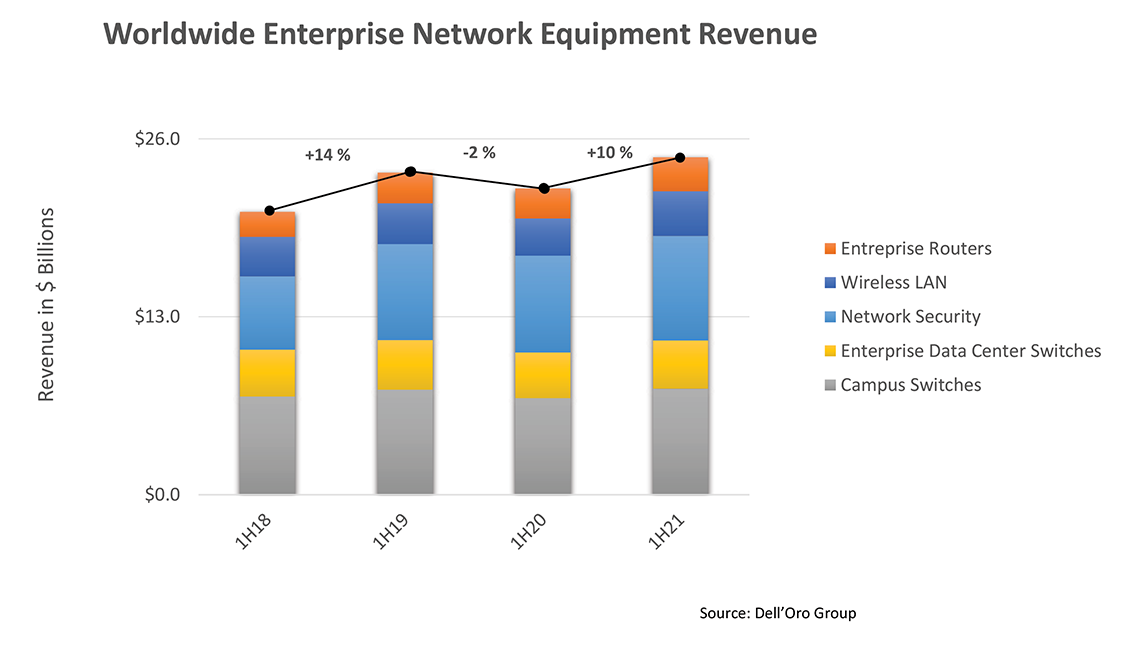
The overall Enterprise Network Equipment market was up 10% year-over-year (Y/Y) in 1H21. The growth was linear across the first and second quarters (up 10% and 11% Y/Y, respectively). Furthermore, the overall Enterprise Network Equipment market was able to exceed its 2019 pre-pandemic revenue level for the first half of the year.


The 1H21 growth was broad-based across all segments. Campus switching contributed about 30% of the increase in spending in the first half, followed by Network Security and WLAN at about 25%, each. Even the physical appliances segment of the Network Security market was able to turn the corner and go back to growth in 1H21. This broad-based recovery is encouraging given that last year was characterized by a significant decline in spending on hardware products, specifically campus switches, data center switches, access routers, physical firewalls, and Wireless Access Points (APs). In the meantime, 2020 spending on software and subscription-based products: SD-WAN and virtual and SaaS security, and the licenses portion of the WLAN segment, increased.

We attribute the 1H21 recovery to the following:

  • Improving macro-economic conditions and business confidence
  • Strong government stimulus around the world
  • Pent-up demand from verticals that have been hit hard by the pandemic such as the hospitality and retail sectors
  • Network upgrade activities in preparation for the back-to-work event planned for the second half of the year.

Despite the robust revenue growth recorded in the market in 1H21, major vendors reported that revenue would have been even stronger if they had not experienced supply constraints. In other words, demand outpaced supply. Although the gap between supply and demand impacted the different sectors within enterprise networking, it appears that the issues were more acute on the higher volume WLAN APs, where unit shipments declined Y/Y and Q/Q for some US-based manufacturers during a seasonally strong quarter.


1H21 Vendor Landscape

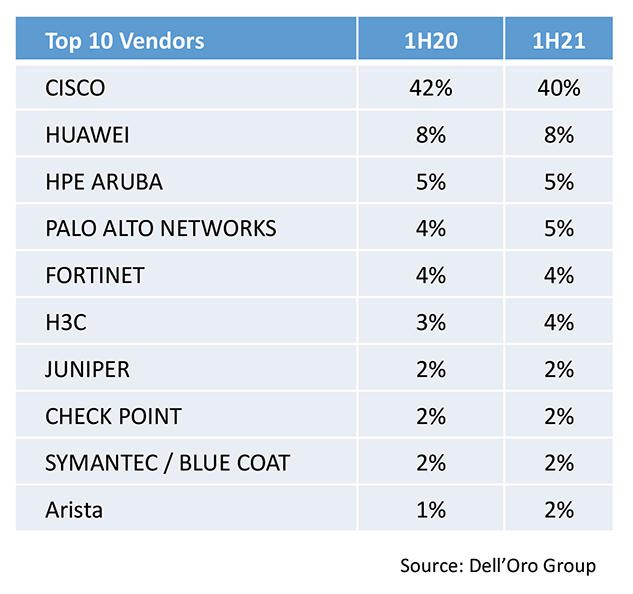
The analysis contained in these reports suggests the ranking and share of the top 10 vendors remain relatively stable, with the top two vendors, Cisco and Huawei, comprising nearly 50% of the Enterprise Network Equipment market in 1H21. We would like to note, however, that Cisco lost some shares between 1H20 and 1H21, while Palo Alto Networks, H3C and Arista, gained one point of revenue share, each.


2021 Market Outlook

Even with the unusual uncertainty surrounding the economy, the supply chains, and the pandemic, the Dell’Oro analyst team remains optimistic about the second half – the overall enterprise network equipment market is projected to advance 5% to 10% for the full-year 2021. However, we are expecting a slowdown in the second half, compared to the first half as supply constraints seem to be worsening which may hinder market performance.


Dell’Oro Group Enterprise Network Equipment research programs consist of the following: Campus switchesEnterprise Data Center SwitchesSD-WAN & Enterprise RoutersNetwork Security, and Wireless LAN.

[wp_tech_share]

Power-over-Ethernet ports are forecast to compose nearly 50% of campus switch ports by 2025

Since issuing our January 2021 five-year forecast report, we have published actual shipment and revenue data for 2020 and the first quarter of 2021. (Note that vendors did not report full-year 2020 financial results until after our January 2021 report was published.) 2020 revenue came in below the revenue forecast published in our January 2021 report. Nonetheless, we have raised our 2021 forecast from 2% growth to 3% growth.

Our more optimistic 2021 outlook is prompted by strong market performance that has so far exceeded our expectations. (1Q21 revenue was up 4% Y/Y in contrast with our flat-market forecast.) Although some of the growth in 1Q21 might have been reflective of pent-up demand, it came mostly from the public sector, while the private sector has not recovered yet, paving the way for more growth in the remainder of the year and potentially next year.  Funding around the world lifted public sector performance in 1Q21 and is expected to continue to stimulate market growth for many quarters – and possibly years – to come.

Last but not least, projected growth in 2021 will be propelled by ongoing improved macroeconomic outlooks. Recent GDP reports indicate that economists at the world’s leading banks have raised their growth projections for both 2021 and 2022.

Looking beyond, we expect the market to continue to grow in 2022, exceeding its 2019 pre-pandemic revenue level. In 2022, we expect growth to accelerate from 2021, due to pent-up demand from the verticals most greatly affected by the pandemic.

Despite the potential downside impact from COVID-19, such as work from home and further cannibalization from WLAN, we expect the pandemic to bring some upside impact, including:

  • Accelerated pace of digital transformation initiatives. Although the majority of IoT devices will be wireless, some devices – such as security cameras, industrial lighting, and some sensors – are expected to remain on wired Ethernet.
  • Greater share of higher-priced PoE devices. We expect IoT devices to drive an increased share of higher-priced PoE ports. We currently project PoE ports to compose nearly half of all ports by 2025. We expect this trend to help boost market average selling prices (ASPs).
  • Accelerated pace of the campus switch refresh cycle. We expect the adoption of digital transformation to accelerate the pace of the campus switch refresh cycle. In order to enable digital transformation, the network must undergo numerous changes. Automation, security, visibility, and analytics/intelligence are added functionalities that IT managers need for the new digital era.

In our campus switch five-year forecast report, we explore the methodology used to quantify the pandemic’s upside and downside risks. Additionally, our interviews with end-users, system integrators, and VARs revealed an increased interest in Network as a Service (NaaS) during the pandemic. We expect this interest will persist after the pandemic ends.

To access the full report for revenue, units, pricing, and relevant segmentation, including regions and vertical markets, please contact us at dgsales@delloro.com

About the Report

The Dell’Oro Group Ethernet Switch – Campus Five-Year Forecast Report offers a complete overview of Ethernet switches built and optimized for deployment outside the data center to connect users and things to Local Area Networks. The report provides tables covering manufacturers’ revenue, average selling prices, and port/unit shipments by Ethernet and Gigabit speed (Fast and 2.5, 5.0, 25, 10, 40, 50, and 100 Gigabit Ethernet). Regional breakouts and Power Over Ethernet (PoE) are also included.

Dell'Oro Group Ethernet Switch Campus market 5-Year Forecast July 2021