[wp_tech_share]
Industrial giants are reshaping their portfolios at speed. Some are shedding non-core businesses to become focused pure-plays. Others are buying their way deeper into the data center. Both moves answer the same call: the AI buildout has become the industrial economy’s defining megatrend—and capital markets reward those who focus.


The End of the Everything Company

For most of the last century, scale and breadth were the point. General Electric was the template: jet engines, light bulbs, locomotives, medical scanners, home appliances, and a vast finance arm—all under one roof. Diversification was designed to smooth the cycle and compound the advantage.

Then investors stopped buying it. The complexity of these sprawling portfolios made them opaque to value and unwieldy to run. As a result, the market started applying a conglomerate discount, pricing the whole below the sum of its parts. A focused operator commands a higher multiple than the same business buried inside a diversified holding company. Breadth, in other words, was leaving money on the table.

GE eventually drew the obvious conclusion and broke itself into three: GE HealthCare, GE Vernova, and GE Aerospace. The logic now echoes across the industrial landscape. Honeywell is splitting into separate aerospace and automation companies while spinning off its advanced materials business into a new company, Solstice. United Technologies had beaten them to it back in 2020, separating into Carrier, Otis, and Raytheon.


Carrier’s Performing-While-Transforming Act

Carrier, born from that breakup, wasted little time before going further. Few companies have rebuilt themselves as aggressively. The throughline is simple: double down on intelligent climate and energy, exit everything else.

On the buy side, Carrier acquired Viessmann Climate Solutions, the German heating and heat-pump champion, for roughly €12 billion, with the deal closing in January 2024. It was a clear bet on the electrification of heat and on Carrier’s European core.

The sell side was busier. In a tightly choreographed portfolio transformation, Carrier shed the businesses that no longer fit. It sold Global Access Solutions, its security arm with the LenelS2, Supra, and Onity brands, to Honeywell for an enterprise value of $4.95 billion, around 17x EBITDA. Next came Industrial Fire and its Det-Tronics, Marioff, Autronica, and Fireye brands, sold to Sentinel Capital Partners for $1.425 billion. Soon it was Commercial Refrigeration’s turn, going to Haier for $775 million. And it capped the program by selling its Commercial and Residential Fire business to an affiliate of Lone Star Funds for $3 billion. An earlier exit, the sale of Chubb fire and security to APi Group, had already set the tone in 2021.

This is harder than a slide deck makes it look. Each carve-out means separating shared systems, renegotiating supplier contracts, staffing data rooms, and absorbing restructuring charges. All while hitting quarterly numbers and paying down the debt taken on for Viessmann. Carrier’s own framing, “performing while transforming,” was less a slogan than a description of the grind. CEO David Gitlin has noted that the divestitures were all signed within about a year of announcement, for a combined value of over $10 billion at a mid-teens EBITDA multiple in aggregate. The reward for the pain is a cleaner story and, the company is betting, a better multiple.


Johnson Controls Goes Pure-Play

A parallel story is playing out at Johnson Controls, a leader in data center thermal management. In August 2025, JCI completed the sale of its Residential and Light Commercial HVAC business to Bosch for $8.1 billion, including its residential joint venture with Hitachi. The move leaves JCI as a pure-play provider of building solutions, with around $5 billion in net proceeds and a $5 billion accelerated buyback.

The Bosch deal is the latest chapter in a long unwinding. JCI spun off its automotive seating business, Adient, back in 2016, then sold its lead-acid battery business, now Clarios, in 2019. Each step steered the company toward commercial buildings, and increasingly toward the data center. While paring the edges, JCI has reinforced the center, picking up hyperscale cooling specialist Silent-Aire and, more recently, direct-to-chip components maker Alloy Enterprises. The portfolio is getting narrower and deeper at the same time.


Trim Cooling to the Core

The pattern is spreading to HVAC players with one foot in other industries, which are now sharpening their focus on thermal and the data center.

Modine offers a clean example. In January 2026, it agreed to spin off its Performance Technologies business and combine it with Gentherm, in a Reverse Morris Trust. Performance Technologies, the company’s vehicular and power-generation thermal arm, carries about $1.1 billion in revenue. The transaction is valued at roughly $1.0 billion, around 6.8x post-synergy EBITDA, with Modine taking a $210 million cash distribution and its shareholders ending up with about 40% of the combined company. What Modine keeps is the prize: its Climate Solutions segment, now a pure-play built around data center cooling and commercial HVAC. Management expects that business to keep compounding, with data center demand growing well into the double digits. Modine has fed it through acquisitions, too, from Airedale to Scott Springfield and the TMGcore immersion assets.

Munters is running a similar play. The Swedish climate specialist has organized itself around three segments, AirTech, FoodTech, and a fast-growing Data Center Technologies unit that now drives close to 40% of sales. Sharpening that focus, Munters has moved to offload its FoodTech business while continuing to build on the data center side, where its 2024 acquisition of chiller maker Geoclima added liquid-cooling and heat-rejection capacity. The direction of travel is unmistakable: less food and agriculture, more AI factory.

These portfolio moves are part of a wider wave. Many of these companies had already been steadily increasing their data center exposure for years before any spin-off; the breakups and divestitures only accelerate a shift that was well under way.
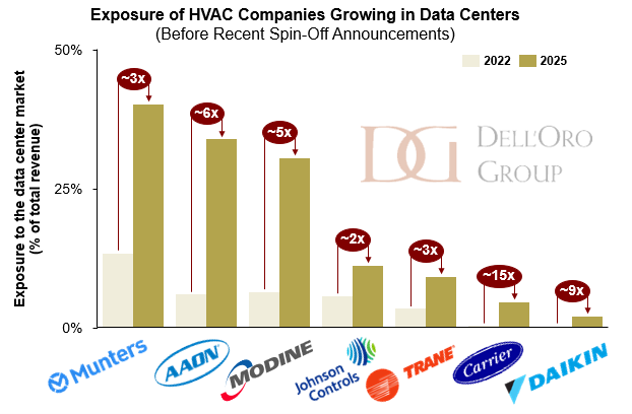
Dell'Oro's analysis - Exposure of HVAC Companies Growing in Data Center
Source: Company Filings, Dell’Oro Analysis


Crossing Over to the Electrical Side

The same realignment is reshaping the power half of the stack, and the marquee move belongs to Flex.

In May 2026, Flex announced it would spin off its Cloud and Power Infrastructure segment into a new, independent public company, provisionally called SpinCo. The new entity will be a grid-to-chip play, integrating power distribution, thermal management, and full infrastructure systems for AI data centers and mission-critical applications. The growth profile is the headline: Flex is targeting 65% to 75% revenue growth for the new company in fiscal 2027, accelerating beyond 80% the year after. Current Flex CEO Revathi Advaithi will lead SpinCo, signaling where the company sees its future. The remaining Flex stays an advanced manufacturing partner, and the split is expected to close in early 2027.

What makes the Flex story instructive is how the segment was built. Flex assembled it through M&A, adding critical-power specialist Anord Mardix, switchgear maker Crown Technical Systems, and direct-to-chip cooling startup JetCool. Buy the pieces, build the platform, then spin it out to let the market value it on its own terms. It is the conglomerate discount thesis run in reverse.

Flex is not alone on the electrical side. GEs split produced GE Vernova, a pure-play power and grid company. ABB agreed to hand its robotics division to SoftBank for $5.375 billion. nVent sold its thermal management business, the RAYCHEM and TRACER heat-tracing brands, to Brookfield for $1.7 billion, to concentrate on electrical connection and protection.
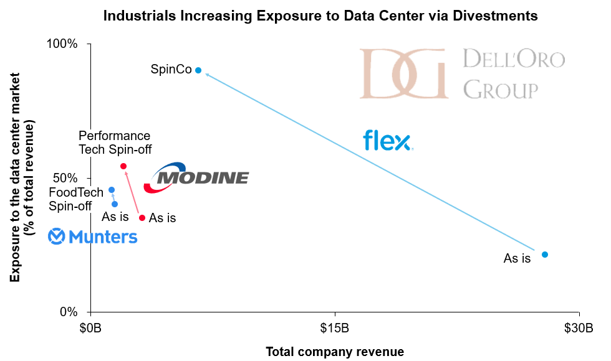
Dell'Oro analysis - Industrials Increasing Exposure to Data Center via Divestments
Source: Company Filings, Dell’Oro Analysis


No name, however, captures the realignment better than Eaton, which is also off-loading non-core assets. On June 2026, it agreed to separate its Mobility Group and combine it with Dana in a Reverse Morris Trust, valuing the vehicular business at about $5.1 billion and leaving Eaton shareholders with just over half of the combined company plus a $1.1 billion cash distribution. The spin-off sharpens its focus on electrical power.

But Eaton is not only shedding to refocus. It is also expanding inorganically. It added modular enclosure maker Fibrebond for $1.45 billion and solid-state transformer expertise through Resilient Power, building on earlier deals like Tripp Lite. The capstone is its $9.5 billion acquisition of Boyd Thermal, which vaults Eaton into liquid cooling at scale across CDUs, cold plates, and semiconductor thermal interface materials (TIMs), with the company guiding to roughly $1.5 billion in liquid-cooling revenue for 2026. With that cooling portfolio added to its electrical base, Eaton joins the ranks of vendors offering a full data center infrastructure stack.


The Full Stackers Get Fuller

While thermal and electrical specialists have reshaped their portfolios to raise their exposure to markets anchored in lasting high-growth fundamentals, the full stackers never had to. Already at the center of the digital infrastructure buildout, they have marched in a single direction: more power, more cooling, more of the stack.

Vertiv has been the most active. It strengthened white-space rack architectures by acquiring Great Lakes Data Racks & Cabinets for $200 million, around 11.5x EBITDA. It expanded its heat rejection and dry cooling offering with ThermoKey of Italy, adding EMEA manufacturing. And it reached up the thermal chain to the cold plate with Strategic Thermal Labs, adding server-side liquid-cooling design and validation. These sit alongside earlier moves into liquid cooling with CoolTera, into in-building power with E&I Engineering, and into commissioning and flushing services with PurgeRite. The strategy is end-to-end, grid-to-chip and across the lifecycle.
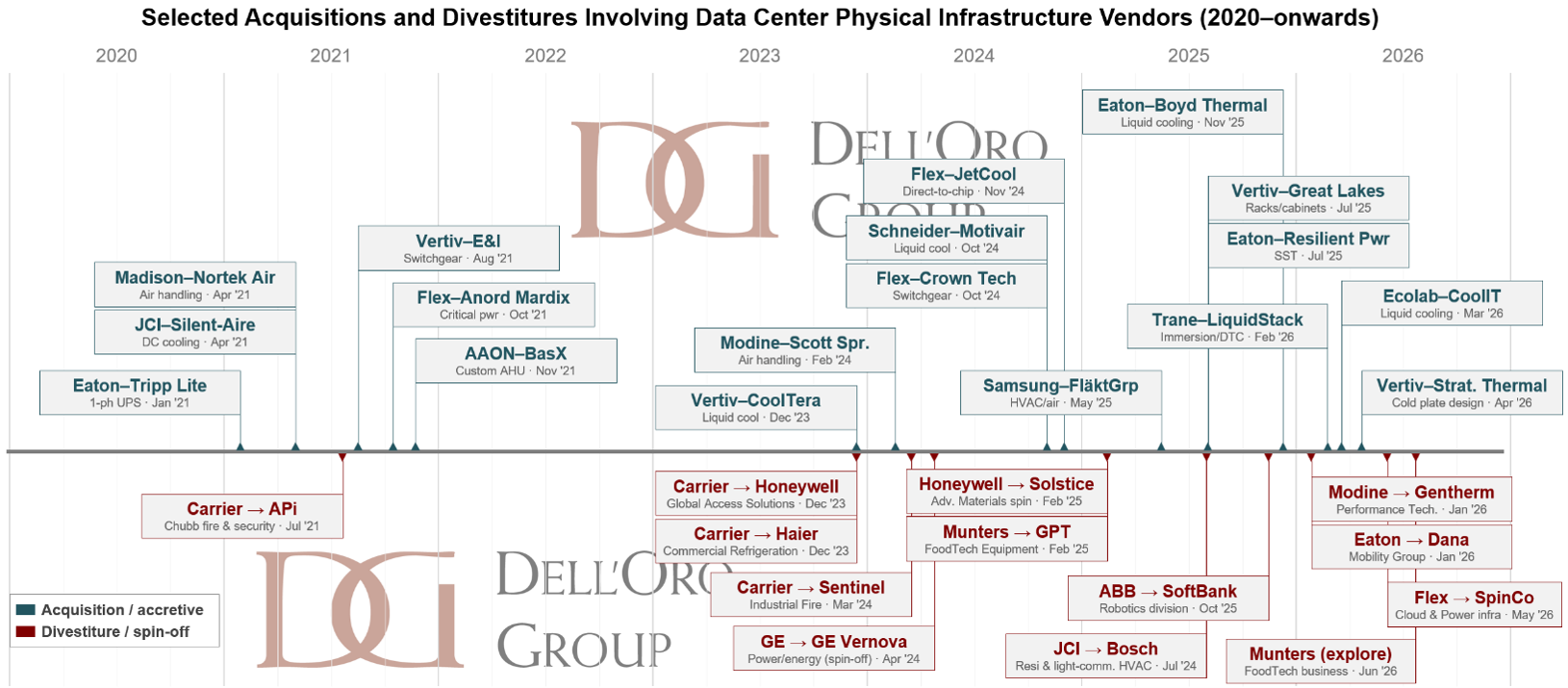
 

DellOro analysis - selected acquisitions and divestitures involving data center physical infrastructure vendors
Source: Company Filings, Dell’Oro Analysis


Schneider Electric has moved more selectively, favoring fewer but larger, high-conviction bets. In July 2025, it agreed to buy out Temasek’s remaining 35% stake in Schneider Electric India for €5.5 billion in cash, taking full ownership of one of its largest and fastest-growing markets. In cooling, it anchored its grid-to-chip ambitions with a 75% controlling stake in Motivair for $850 million. Motivair brings CDUs, cold plates, rear-door heat exchangers, and chillers, slotting directly into a portfolio that already spans power distribution and white space.

What unites them is a bet on breadth. Each is wagering that owning more of the stack will pay off, either by bundling additional products into the same deployment or by charging for the value of a coordinated, end-to-end design. The attach rate is never complete, and no vendor lands every power and thermal element in every project. But even a partial bundle, sold on the strength of a full-stack portfolio, can beat a point product standing alone.


New Entrants, Deep Pockets

If the incumbents are betting on breadth, another group is making a simpler bet: getting in at all. The most telling signal of this cycle is who is now arriving from outside the traditional infrastructure tent.

Ecolab, the water and hygiene giant, is the standout, and its move builds on a foundation laid years ago. Nalco Water, the treatment business it formed through the 2011 acquisition of Nalco for roughly $5.4 billion, already manages the cooling water that keeps data centers running. Moving from the facility loop to the fluid that cools the chip is the logical next step, and Ecolab took it by agreeing to acquire pure-play liquid-cooling specialist CoolIT Systems for $4.75 billion—a price 17 times what KKR and Mubadala paid only three years before. The premium is striking, but the opportunity behind it may be bigger still. As operators push warmer water through the technology cooling system (TCS) to chase efficiency, keeping that fluid clean and stable becomes a growing pain point, and few can answer it as completely as Ecolab, pairing CoolIT’s hardware with Nalco’s chemistry and the service to maintain both.

Others are crossing the same threshold. Samsung Electronics bought one of Europe’s largest HVAC makers, FläktGroup, for around €1.5 billion, planting a flag in data center precision cooling. Trane Technologies has built an end-to-end thermal stack with liquid cooling specialist LiquidStack and integrator Stellar Energy. Daikin Applied has reached into negative-pressure CDUs with Chilldyne and ultra-high-density cabinets with DDC Solutions. And on the electrical side, Legrand has run a near-continuous bolt-on campaign across busbars, racks, and power distribution, turning a steady stream of small deals into a serious data center franchise.


The New Megatrend

M&A in this sector is running hot, and there is little reason for it to cool down. We flagged as much in our 2026 predictions, where we expect still more deals to cross the $1 billion mark this year. As long as data center capex hovers around a trillion dollars, the business case for acquiring technical capability, manufacturing capacity, and customer relationships writes itself. No activist investor complains that a vendor is too exposed to the data center.

In an era of market exuberance, what makes this moment striking is the discipline. With capital abundant and investor appetite insatiable, an AI label on almost any acquisition would win expedited board approval. Yet the leading industrials are doing the opposite. Like a gardener pruning back the branches of a tree so it bears more succulent fruit, CEOs are reshaping the business for the AI age: offloading distraction, sharpening focus.

This is one of the AI buildout’s more unintended consequences. Industrial stocks have been among the market’s strongest performers in recent years. But the surging demand for electrical and mechanical equipment lifting their shares is only half the story. The bigger story is how AI is pushing these companies to remake themselves from within, unsettling the entire industrial ecosystem.

Industrial vendors have often coalesced around megatrends. For the past two decades, decarbonization and electrification set the agenda and shaped where capital flowed. Now, the AI buildout, and the next industrial revolution expected to ensue, is the dominant force—and the figures show how keen the industrials are to raise their exposure to it.

Are these industrial powerhouses making a mistake by tuning their portfolios to the AI buildout, or are they building a durable, long-term value-creation machine? Only time will tell. But unlike the software and internet companies that torched capital through the dot-com bubble, the industrials are taking a measured approach. And as they transform, they are emerging stronger, with leaner, more innovative portfolios better positioned to capture the opportunities that lie ahead.

###

This blog post shows only a reduced set of the data points behind our analysis. For deeper analysis with full charts, access our client-only version at Dell’Oro Client Portal or reach out to the Sales team to learn about becoming a subscriber.
[wp_tech_share]
What Market Share Says About Börje Ekholm’s Legacy

Leadership transitions often invite instant verdicts. But as the Wallenberg family noted during Ericsson’s previous leadership transition, turnarounds in the telecom space are measured in decades rather than quarters. As Ericsson enters a new chapter, it is still too early to fully assess the long-term impact of Börje Ekholm’s strategic decisions. What we can evaluate today, however, is how Ericsson’s competitive position in the telecom equipment and Radio Access Network (RAN) markets evolved during his tenure.

Market share is not a perfect measure of success. It says little about profitability, shareholder returns, or the quality of strategic investments. Still, it remains one of the clearest indicators of whether customers continued to choose Ericsson in an intensely competitive market.


From Decline to Stability

When Ekholm became CEO in early 2017, Ericsson was emerging from a challenging period. The company had experienced deteriorating profitability, multiple restructuring programs, and significant losses in its RAN revenue share.

We estimate that Ericsson lost approximately 10 percentage points (PPs) of global RAN revenue share between 2011 and 2016, in part due to an intensified competitive landscape. Reversing that trend would not be trivial.

While Ericsson did not dramatically increase its global market position over the next decade, it largely succeeded in reversing the negative momentum that characterized the years leading up to 2017.

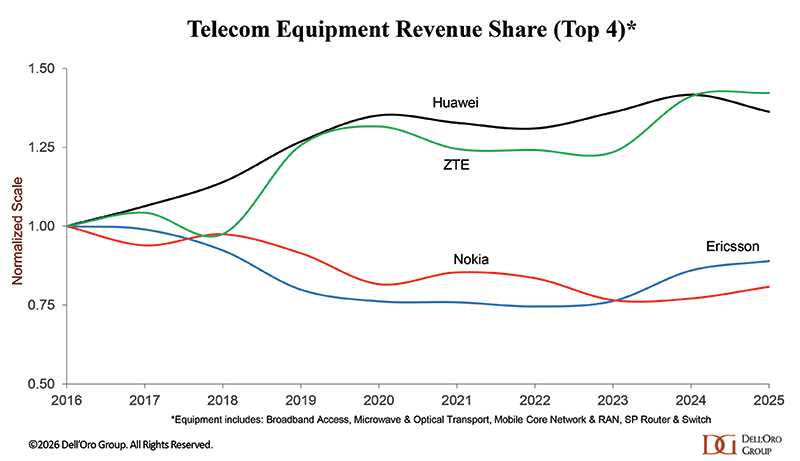
Our preliminary analysis suggests Ericsson’s overall telecom equipment revenue share declined by one to two percentage points between 2016 and 2025, settling at roughly 15% of the worldwide telecom equipment market in 2025. Considering the significant changes affecting the industry—including geopolitical shifts, supply chain disruptions, and the 5G investment cycle—this represents a fairly stable competitive position.

DellOro-Telecom Equipment Revenue Share Chart


Looking Beyond the Headlines

At first glance, Huawei appears to be the clear winner of the past decade. Among the largest suppliers, Huawei and ZTE posted the strongest relative market share gains, increasing their telecom equipment positions across the six telecom programs tracked by the Dell’Oro Group by roughly 40% between 2016 and 2025.

Ericsson’s trajectory looks different. Instead of pursuing aggressive share gains across the broader telecom equipment market, Ericsson largely defended its position. Ericsson’s wireless focus is key. Wireless infrastructure has consistently represented nearly half of the telecom equipment market, making leadership in RAN strategically more important than expanding into adjacent segments.


The RAN Picture is More Favorable

The picture becomes even more interesting when focusing specifically on RAN.

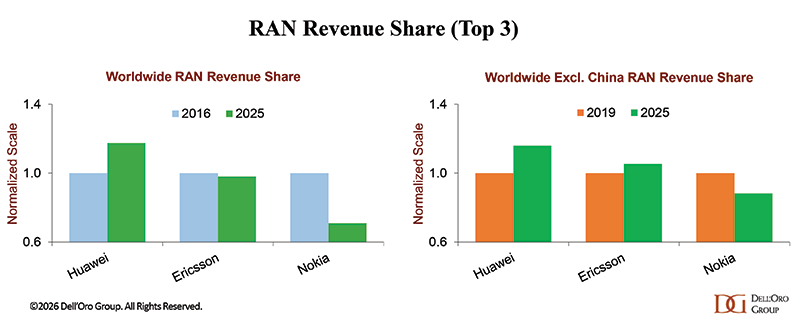
Globally, Ericsson’s RAN revenue share has remained relatively stable in the 25% to 30% range throughout most of Ekholm’s tenure. This stands in sharp contrast to the steep losses experienced between 2011 and 2016.

Meanwhile, Nokia experienced a more pronounced decline over the same period, while Huawei continued strengthening its global leadership position. Stability may not generate headlines, but in a mature infrastructure market dominated by a handful of global suppliers, maintaining share can be an important achievement.

DellOro - RAN Revenue Share Chart


The China Impact

Any assessment of Ericsson’s market position should also consider regional dynamics.

China has become increasingly difficult for foreign vendors, particularly amid geopolitical tensions and reciprocal restrictions affecting telecom infrastructure procurement—we estimate Ericsson and Nokia’s combined RAN revenue share in China has declined by 11 PPs between 2019 and 2025. As a result, global market share figures understate Ericsson’s competitive performance in many of its core markets.

Excluding China, Ericsson’s position actually improved between 2019 and 2025, gaining approximately four percentage points of RAN market share. Huawei also gained share outside China, while Nokia lost ground.

It is also worth noting that the US has played an outsized role in Ericsson’s RAN performance. In fact, if we normalize for both China and North America, Ericsson’s RAN share is stable while Huawei and Nokia are up.


Market Share Is Only One Part of the Story

Of course, market share does not provide the full picture.

Investors will also judge the period based on profitability, shareholder returns, and the success of strategic initiatives such as the enterprise expansion and the Vonage acquisition. Some of these initiatives remain works in progress, and their long-term value may not be fully understood for years.

Nevertheless, market share provides an objective scorecard. By that measure, Ericsson appears to have successfully halted a long-running decline, maintained its RAN leadership position, and strengthened its standing in some markets outside China.


Looking Ahead

The next CEO will inherit a company facing new challenges. Mobile data traffic growth is slowing, and operator capital spending is moderating. And within the capex mix, operators are shifting focus toward areas more closely tied to the data center wave, creating a double headwind for suppliers that remain more dependent on wireless infrastructure. AI is on the rise in network operations and in the RAN. And the role of SW is evolving. 6G is on the horizon, but cumulative 6G RAN revenue in the first six years of its cycle is projected to be 10% to 20% lower than the comparable period in the 5G cycle.

At the same time, Per Narvinger will inherit a company whose competitive foundation is considerably more stable than it was in 2017. While the industry appears to be changing faster today than it did when Börje took over, and some believe Ericsson has missed the data center wave, I get the impression that Ericsson is more confident in its position and prospects today than it was when Börje began.

That may ultimately become one of Börje Ekholm’s most long-lasting contributions. At the end of the day, he may be remembered less for any single metric—whether RAN market share, profitability, or shareholder returns—and more for restoring Ericsson’s competitiveness and preserving its position among the world’s leading telecom infrastructure suppliers.

[wp_tech_share]

If you want to amp up the pressure in your life, try getting up in front of twenty to thirty thousand people, some of whom influence whether or not you keep your job, and lay out a clear, concise strategy in a world full of upheaval.

That’s what Cisco and HPE’s leaders did this month, addressing customers, shareholders, employees, and analysts and making the case for why their respective IT brands are best suited to guide enterprises through the uncertainties of AI.

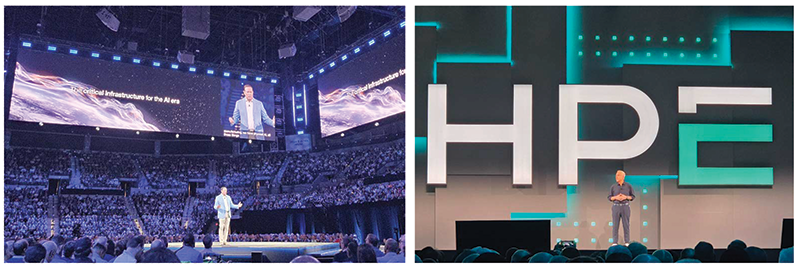
Cisco and HPE CEOs, Chuck Robbins and Antonio Neri, address stakeholders at their June 2026 annual conferences, Cisco Live and HPE Discover respectively. Both conferences were held in Las Vegas and had tens of thousands of attendees.
Cisco and HPE CEOs, Chuck Robbins and Antonio Neri, address stakeholders at their June 2026 annual conferences, Cisco Live and HPE Discover, respectively. Both conferences were held in Las Vegas and had tens of thousands of attendees.


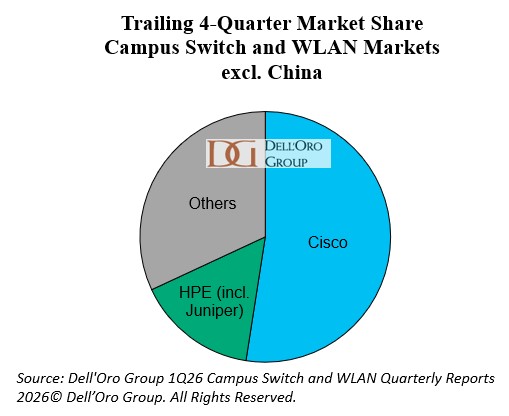
Together, these two vendors dominate more than two-thirds of the campus networking market outside China (see Figure). But while industry focus is on the jaw-dropping spending on GPUs and Data Center infrastructure, it’s a challenge for both Cisco and HPE to explain why campus networking remains relevant.  Executive quotes captured during the conferences reveal similarities and differences in these vendors’ messages—and provide insight into where they see opportunities to gain share.

DellOro-Trailing 4 Quarter market share campus switch and WLAN markets excl China chart


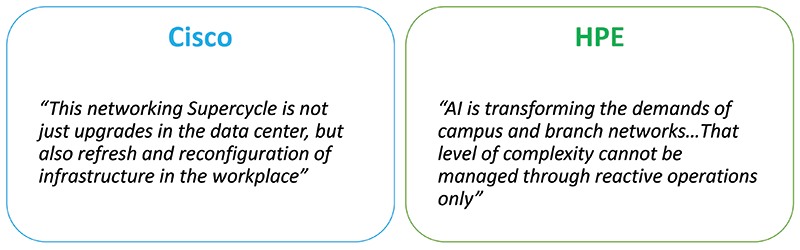
Theme 1 – The Enterprise AI Revolution

What the Leading Vendors are Saying about Campus Networking

Takeaway

Both vendors have tied the AI revolution to changes required in campus networks.  Cisco executives pointed to higher traffic levels extending bottlenecks from GPUs to networking, even to the campus, driving the need for refresh. To meet this new demand, Cisco announced the C9550, a 400G Fixed form factor switch for the Campus core.

HPE executives positioned the impending AI transformation first and foremost as an operations challenge, emphasizing Juniper’s advanced AI operations capabilities, such as a powerful set of AI Agents and skills, a Large Experience Model to prevent problems with Zoom, and a suite of autonomous actions that can be undertaken by Marvis.


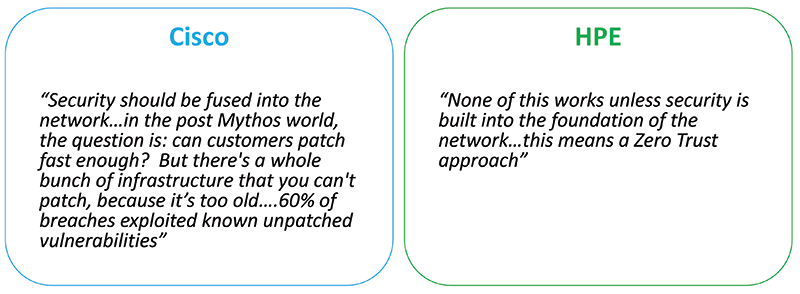
Theme 2 – Security and Networking
What the Leading Vendors are Saying about Campus Networking
Takeaway

Neither Cisco nor HPE has been able to challenge Palo Alto’s lead in the network security space, so arguments that leverage strengths in networking to advance security market share gain make sense.

Cisco brought a new angle on security at Cisco Live, dubbing the “Mythos Moment” as a wakeup call for enterprises with unsupported equipment.  They announced Live Protect on their new Campus Smart switches (GA September 2026), which will allow enterprises to track whether specific vulnerabilities are being exploited, and then apply compensating remediation, even before patches are available. Cisco also emphasized post-quantum security of their new switches.

HPE’s security focus was on converging SSE and SD-WAN, announcing HPE Networking EdgeConnect, which unifies the two products in an AI-native console. HPE executives underlined the importance of a universal ZTNA, covering universal policy as well as universal identity for humans, workflows, and agents. Identifying, securing, and putting up guardrails for AI Agents was seen as a critical step by both vendors.


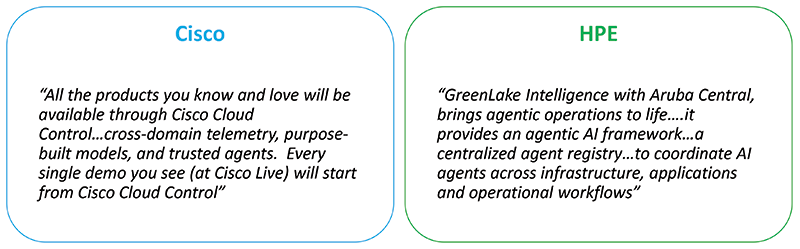
Theme  3 – Digital Complexity

What the Leading Vendors are Saying about Campus Networking

Takeaway

Both Cisco and Juniper addressed the increasing complexity of IT by presenting a single point of entry to their management ecosystems; to systems managing campus equipment as well as other domains such as compute, applications and workflows.

Through Cisco Cloud Control (which is in “controlled availability” in the US), enterprises can gain access to the Meraki Dashboard and, through the dashboard, access Catalyst Center.  Cisco executives hope that Cloud Control will be a breakthrough in addressing enterprises’ complaints about the complexity of Cisco’s deep feature list.  However, the coexistence of Meraki Dashboard, AI Canvas, and Cisco Cloud Control may also contribute to enterprises’ perception of complexity.

HPE emphasized the necessity of an agentic framework in hybrid deployments (across different clouds and on premises) and announced GreenLake Intelligence, which is being rolled out across 2026 and 2027.  While the HPE Discover keynote showed it interacting with Aruba Central, Mist is not available in GreenLake Intelligence today.


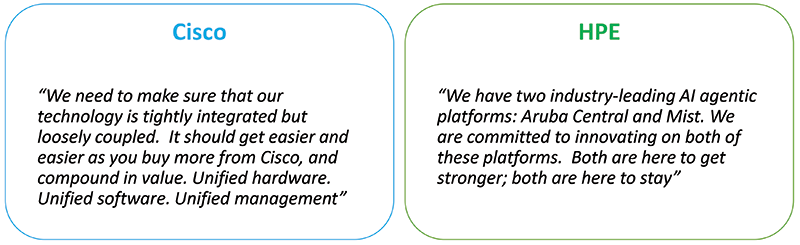
Theme 4 – Convergence

What the Leading Vendors are Saying about Campus Networking

Takeaway

It took Cisco about ten years to combine the Catalyst and Meraki product teams, something that HPE did (by combining Aruba and Mist development teams) in a few months. However, Cisco has now passed through the heavy lifting phase: their Wi-Fi 7 APs can be managed either through the cloud or by a controller, and at Cisco Live, the company completed its WLAN lineup by introducing the CW9177, an outdoor Wi-Fi 7 AP. The newer Catalyst switches can also be managed from the cloud. This has allowed Cisco to shift the focus onto convergence across their broader portfolio, with Cisco Cloud Control as a key piece of this strategy.

Meanwhile, less than a year after HPE acquired Juniper, the company announced that its first converged AP was generally available.  The hospitality AP (723H) can be deployed with Mist or Aruba Central, has the Aruba tessellated case design, and includes the dedicated scanning radio to provide the necessary telemetry for Mist.  HPE also announced that Aruba’s CX switches are now supported in Mist, although some variants will become available in the fall.

Over and above the hardware platforms, HPE has continued on its journey of cross-pollinating Aruba Central and Mist.  At HPE Discover, they announced that Marvis Actions would be available in Aruba Central.  The company’s consistent message about commitment to both cloud-managed platforms is reassuring to existing customers, but can confuse new, potential customers interested in a cloud-managed solution from HPE.


Is Campus Networking Relevant?

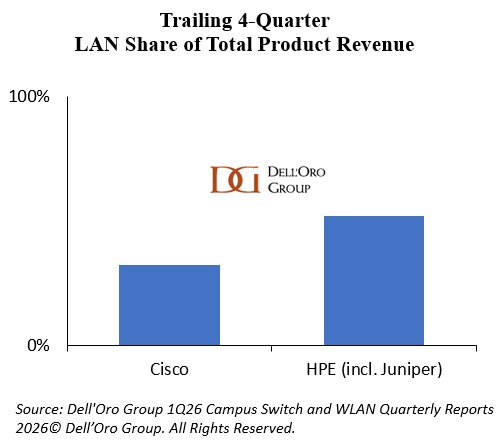
DellOro - Trailing 4 quarter LAN share of total product revenueWith enterprises increasingly distracted by AI projects, the emphasis on campus network security, operational simplicity, and automation by both Cisco and HPE was designed to refocus attention back to basics. Revenue from LAN equipment (WLAN and Campus Switches) represents a significant portion of both companies’ sales (see Figure).

In Cisco’s vision of the future, every worker manages a team of AI Agents, with these agents behaving more like unruly teenagers than fully formed humans. The vision is underpinned by an urgency to refresh campus equipment, both for security and to prepare for growing agentic traffic.

HPE, on the other hand, is focusing attention on reassuring its Aruba customer base as Juniper is brought into the fold.  AI is only as strong as the foundation beneath it, say HPE executives. Autonomous operations and AI-driven networking are prerequisites for scaling enterprise AI, and a solid foundation starts with a self-driving network.

[wp_tech_share]

Last week, I attended Cisco Live 2026 in Vegas. In a blog published last week, I discussed how Cisco Live 2026 framed AI as a catalyst for enterprise-wide infrastructure modernization, beyond just the data center. In this blog, I would like to double click on Cisco’ AI data center strategy as framed and communicated by Tom Gillis, Kevin Wollenweber, Will Eatherton and Murali Grandluru.

At Cisco Live 2026, the AI infrastructure story continued to move beyond the simple question of who can attach the most GPUs to the fastest network. The more interesting question, especially for non-hyperscale customers is now operational: how do customers design, deploy, secure, validate, and manage AI data centers at a pace that matches the market?

The strategy session with Kevin Wollenweber and Will Eatherton made clear that Cisco sees AI data center infrastructure as a multi-layered opportunity. The company is not only building faster switches or partnering around GPU platforms. It is assembling validated reference architectures, GPU vendor ecosystems, front-end and back-end fabrics, orchestration, observability, and segment-specific engagement models for neoclouds, and enterprises, driving the next wave of the AI adoption.


AI Network Cycles Are Compressing

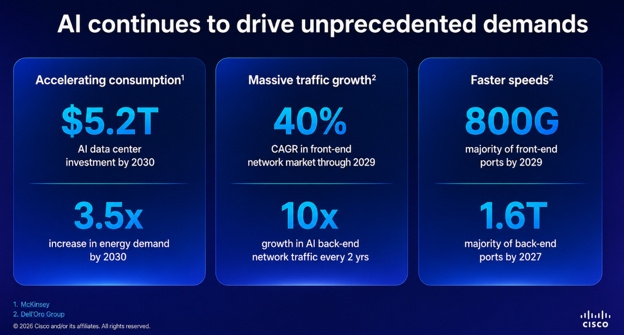
Traditional network refresh cycles that once stretched three to four years are now compressing toward 12 to 18 months. That is a major shift for data center planning, procurement, and architecture teams.

In front-end networks, the market is moving toward 800 Gbps connectivity over the next few years. In the back-end, fabrics are advancing toward 1.6 Tbps and 3.2 Tbps speeds at an unprecedented pace. These are not incremental changes. They reflect the pressure AI workloads are putting on every part of the network fabric.

The reason is straightforward: AI workloads are changing faster than traditional enterprise applications. Training clusters, inference systems, retrieval-augmented generation, and agentic workflows each stress the infrastructure differently. The network must adapt as workload patterns evolve, and customers want architectures that can absorb those shifts without forcing constant redesign.

Source: Cisco Live 2026


Different Customers Need Different AI Data Center Models

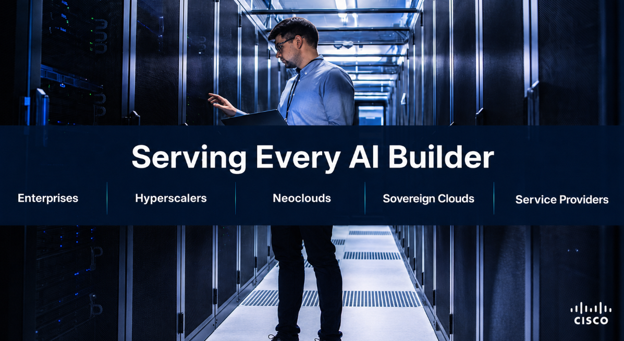
At Cisco Live 2026, it was clear that Cisco is not treating the AI data center market as one homogeneous segment. Hyperscalers, neoclouds, and enterprises are moving at different speeds and making different tradeoffs.

Hyperscalers are engaging through deep technical partnerships across multiple future generations. They want flexibility in silicon, software, accelerator choice, and custom algorithm development. Their architectures are becoming more nuanced than a simple scale-up versus scale-out distinction, and many are experimenting across multiple accelerator types.

Neocloud providers are different. They tend to move fast and put heavy emphasis on benchmarking, congestion handling, load balancing, and failure scenarios. They also need multi-tenancy, resource isolation, and shared infrastructure security using mechanisms such as network tags. Their deployment cycles are so compressed that the next cluster may be in planning before the current one is fully deployed.

Enterprises are different again. They generally want simplicity, vendor consolidation, integrated support, and familiar tools. Many are less interested in learning new controllers or stitching together bespoke systems. They want intent-driven automation from day 0 through day 1 operations, and they want AI infrastructure that can fit into existing data center operating models.

This segmentation is important because it suggests the AI data center market will not standardize around one universal architecture. The winning strategy will need to combine opinionated reference designs with enough flexibility to meet different customer operating models.

Source: Cisco Live 2026


Inference and Agentic AI Are Rewriting Data Center Assumptions

The first wave of AI infrastructure demand was dominated by large training environments. The next wave is increasingly about inference and agentic workflows. That shift changes the network conversation.

Historically, many AI designs assumed a much smaller front-end network relative to the scale-out back-end fabric. At Cisco Live, senior executives highlighted that the old 10-to-1 scale-out to front-end ratio no longer holds in all deployments. Some environments are moving closer to 1-to-1 ratios, driven by front-end traffic growth, cache initialization, offline processing, multi-tenant workloads, and new accelerator handoff patterns.

This is an important architectural signal. As AI becomes more distributed and application-facing, the front-end network becomes more strategic. It must handle high-bandwidth server-to-server traffic, connect users and applications to inference services, support multi-tenancy, enforce security policies, and deliver consistent performance under congestion and failure scenarios.

Agentic AI will likely intensify this trend. Agents introduce more workflow steps, more system-to-system communication, and more cut points across the architecture.


GPU Partnerships Are Becoming Architecture Partnerships

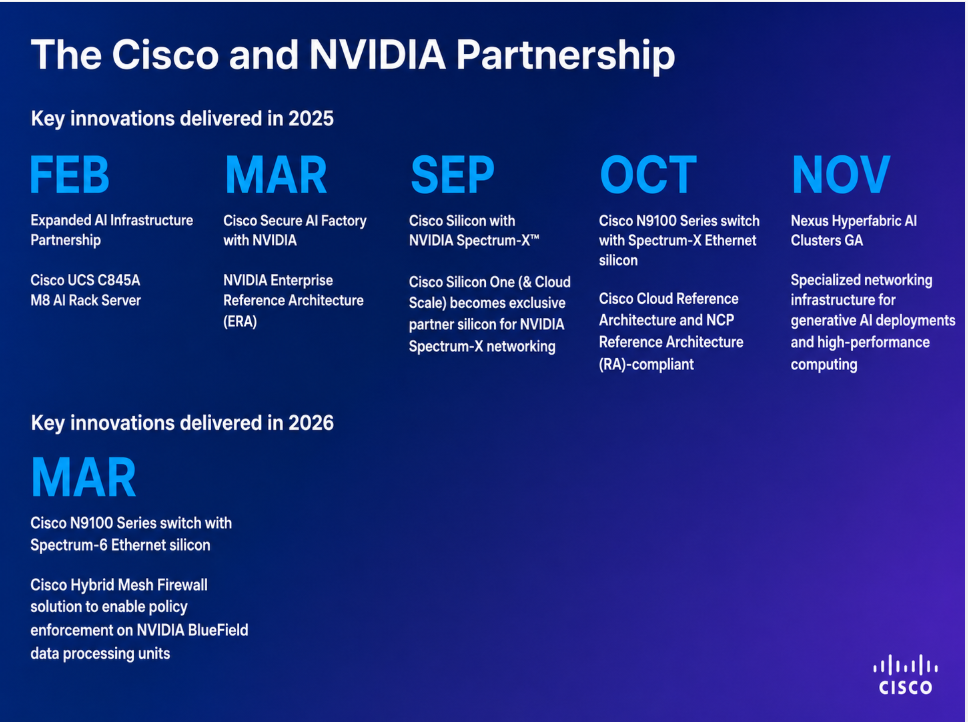
Cisco’s AI data center strategy is also increasingly defined by GPU vendor partnerships. The NVIDIA relationship has moved through several stages: enterprise reference architectures, Spectrum-X technology integration, Nexus 9100 platforms with Spectrum-X silicon, Nvidia certification, Nexus Dashboard management, and development work around BlueField NIC services for firewalling, micro-segmentation, and load balancing.

The significance is not only that Cisco is partnering with Nvidia. It is that the partnership is moving deeper into architecture, management, and services integration. AI data centers are becoming tightly coordinated systems, and the boundaries between accelerator, NIC, switch, controller, and security service are becoming more important.

Cisco is also validating AMD MI300 GPUs with Cisco networking infrastructure. The AMD ecosystem and benchmarking base may still be earlier than NVIDIA’s, but the direction matters. Customers want optionality, especially as AI infrastructure costs grow and accelerator roadmaps diversify.

Cisco Live 2026


Token Economics Are Pulling Some Workloads Back On-Premises

The session also touched on a practical driver that may become more important over time: token economics (or tokenomics). As customers gain experience with cloud-based AI services, they are starting to analyze the cost of token generation across model tiers and deployment options.

For some customers, especially those with large proprietary data sets and repeatable workloads, on-premises infrastructure can offer better cost control. Once customers understand their data, usage patterns, and model economics, they may choose to build dedicated infrastructure rather than consume everything through cloud APIs.

This does not mean the market is moving away from cloud. It means AI deployment decisions are becoming more workload-specific. Customers will evaluate performance, cost, data locality, governance, and operational control. That creates room for hybrid AI architectures and makes the data center relevant again for workloads that justify dedicated infrastructure.


Net-Net

The most important takeaway from Cisco Live 2026 is that AI data center infrastructure is becoming a systems problem. Faster silicon and faster switches are necessary, but they are not sufficient. Non-hyperscale customers increasingly need validated architectures that bring together compute, storage, networking, security, observability, orchestration, and operational tooling.

[wp_tech_share]

My colleague, Sameh Boujelbene, has already covered one of the bigger Cisco Live takeaways: Cisco wants the AI discussion to move beyond the data center and into the broader enterprise network. I am not going to retell that story here. What interested me more, coming out of Cisco Live, were the security and operational implications of the same argument. In other words, what happens after the entire enterprise network is “AI-ready”?

Faster networks, better silicon, and more capable fabrics matter. They will clearly be part of the AI infrastructure buildout. But once AI spans campuses, branches, clouds, applications, users, devices, and agents, the constraint begins to shift. The harder questions become: what assets do I have, what is exposed, where should enforcement happen, how long can I safely wait to patch, and which AI-generated recommendation can I trust enough to act on?

That is where Cisco’s message became more interesting to me. The company is not only trying to sell AI-ready infrastructure. It is trying to make the case for runtime-resilient operations. That’s the right problem to target. It is also a much harder problem than simply adding AI features to existing products.


AI Readiness Quickly Becomes an Operating-Model Question

The AgenticOps discussions were where Cisco’s AI message started to feel less like a feature roadmap and more like an operating-model bet. Cisco is clearly trying to move customers from siloed infrastructure management to a more unified operating layer that brings together topology, telemetry, identity, policy, exposure data, user experience, and remediation.

The product names matter less than the architecture. Whether it’s Cisco Cloud Control, AI Canvas, Agentic Actions, Digital Twin, ThousandEyes, Splunk, Cisco IQ, or Live Protect, all point in the same direction: customers need better context before they can safely automate more of their infrastructure operations.

Cisco has a real advantage here. It has a large installed base across enterprise networking, security, observability, collaboration, and support. That does not automatically make Cisco the operating layer for the AI-era enterprise, but it does give the company a credible starting point. Few vendors can look across as many infrastructure domains and claim the same degree of embedded operational context.

I also think Cisco is being realistic, at least in how it talks about customer adoption. The emphasis on explainability, confidence scoring, impact assessment, human approval, and digital-twin validation is important. Most enterprises are not ready to hand broad operational authority to AI agents. They may be ready, however, to use AI to improve inventory, accelerate troubleshooting, prioritize risk, recommend changes, and reduce the time spent stitching together data from too many tools.

That distinction matters for the adoption curve. The first phase of AgenticOps is unlikely to be full autonomy. It is more likely to be better evidence, better recommendations, and more supervised remediation. If Cisco can help customers get from fragmented visibility to trusted recommendations, that would still be meaningful.

Where I would be more careful is on timing. “Agentic” is an attractive concept, but enterprise operations teams have long memories. They know that configuration mistakes, poorly understood dependencies, and incomplete asset data can create real outages. The trust curve will be gradual. Cisco’s architecture is directionally constructive, but customers will decide where the handoff from human to machine actually happens.


Runtime Resilience May Be the More Immediate Security Opportunity

The security sessions reinforced a point that is easy to agree with but harder to operationalize: AI, particularly in the era that began with the recent unveiling of Anthropic Mythos, is compressing the response window. Vulnerabilities can be discovered, chained, tested, and weaponized faster than many enterprises can patch. That puts pressure on the familiar model of periodic scanning, manual prioritization, planned maintenance windows, and centralized enforcement. Cisco’s answer is not just “patch faster,” because that is not always realistic. The more interesting answer is runtime resilience.

To me, runtime resilience means four things: know what is exposed, understand which risks matter, apply compensating controls when immediate patching is not possible, and move enforcement closer to the workload when centralized inspection creates too much operational friction. A variety of Cisco products, including Cisco IQ, Splunk Exposure Analytics, Live Protect, Hypershield, AI Defense, Duo, Secure Access, and ThousandEyes, each touch part of that problem.

The session on a customer’s (Xifin) journey with Hypershield was useful because it moved the discussion out of the abstract. The customer story was not about AI branding. It was about simplifying east-west security operations and avoiding unnecessary hairpinning through external firewalls. Using Nexus Smart Switches with DPUs to enforce stateful policy closer to workloads is a tangible architectural shift. The reported reduction in rule complexity after converting ACLs into more intent-based policies was also a good reminder that the value proposition is as much operational as it is technical.

This is where I think Cisco has a strong argument. Security teams do not need more isolated control points. They need enforcement that fits how applications, users, and workloads actually move. If some portion of segmentation and east-west policy enforcement can move into the network fabric, customers may be able to reduce complexity while improving response time.

But this should not be oversold. Hypershield is not a universal firewall replacement, and fabric-based enforcement will not eliminate the need for dedicated firewalls, SSE, WAF, endpoint, identity, or cloud security controls. The more realistic implication is that the boundaries between switching, firewall, microsegmentation, and security software continue to blur. It is one of the reasons why my network security coverage now spans from the user-edge SASE solutions to cloud-centric application delivery and control solutions. The neat market silos that once existed are becoming a continuum.

Net/net, I view the blurring of the world as constructive for Cisco. It gives the company a differentiated way to connect markets that have historically been viewed separately but are increasingly being consumed together. However, for the customer (and, by extension, even for folks like me in the analyst community or folks in the investor community), it also complicates taxonomy. Is the customer buying switching, firewall, microsegmentation, or security software? In many cases, the answer may be a mix of all four in a single solution.


The Market Opportunity is Real, but Packaging Still Needs to Catch Up

The broader market read-through from Cisco Live 2026 was positive. AI traffic growth will be part of the story, but security-led and operations-led modernization will be equally important for enterprise infrastructure spending.

Customers are not going to refresh networks only because AI produces more traffic. They will refresh when the current architecture cannot support the operating model they need. That could mean poor visibility into assets. It could mean aging hardware and software tied to lifecycle risk. It could mean branch architectures that are too complex to secure. It could mean too much dependence on manual policy management. It could mean east-west traffic patterns that were never designed for today’s segmentation requirements.

Cisco is trying to connect those dots. Cisco IQ can turn asset posture, lifecycle state, vulnerability context, and support data into a conversation about modernization. ThousandEyes can extend the discussion from device health to digital experience. Splunk gives Cisco a broader data and exposure story. Secure Access ties policy, users, and access into the same broader security architecture. Hypershield gives Cisco a way to talk about enforcement inside the fabric, not only around it.

That is a good strategic setup. The challenge is that customer buying motions do not always line up neatly with vendor architecture. Many Cisco products, including Cloud Control, Cisco IQ, Live Protect, Hypershield, AI Defense, ThousandEyes, Splunk, Secure Access, and professional services, may all contribute to the same outcome. Still, they will not necessarily be bought by the same team, funded by the same budget, or measured in the same way. Budget pressure is the other constraint. Customers may agree with Cisco’s direction and still struggle to fund every part of the vision at once.

The strongest opportunities will be where Cisco can connect the architecture to measurable outcomes: lower downtime, faster vulnerability response, less rule complexity, better user experience, reduced patch-window pressure, or fewer operational escalations. That is the right way to sell this. Runtime resilience cannot remain a conceptual platform story. It has to become an operational and economic argument.


Conclusion

My view coming out of Cisco Live 2026 is that Cisco is aiming at the right problem. The AI-ready enterprise will need more than connectivity. It will need visibility, policy, enforcement, identity, observability, and remediation to keep pace with a faster, less predictable operating environment.

The positives outweigh the concerns. Cisco has breadth, installed-base reach, telemetry, security assets, observability assets, and customer relationships that give it a credible position.

However, the concerns are still worth watching. Multi-vendor coverage will be essential. Customer trust in autonomy will take time. Runtime protection cannot become an excuse for weak patch discipline. And packaging needs to become clearer if customers are going to understand what they need to buy.

Still, these are better problems to have than trying to convince customers that AI is only a data center bandwidth story. Cisco’s more compelling argument is that AI changes how infrastructure has to be operated and defended. If the company can translate that argument into repeatable customer outcomes, runtime resilience could become one of the more important enterprise infrastructure themes to emerge from Cisco Live 2026.