Nokia’s latest AI-RAN announcement is more about increased confidence and improved messaging than a fundamental change in strategy. The AI-RAN roadmap and timeline remain largely unchanged, but Nokia has refined its migration story, sharpened its focus on software-driven innovation, and provided additional insight into how it views AI-RAN’s role in addressing operator challenges and strengthening its competitive position in the evolving RAN market.
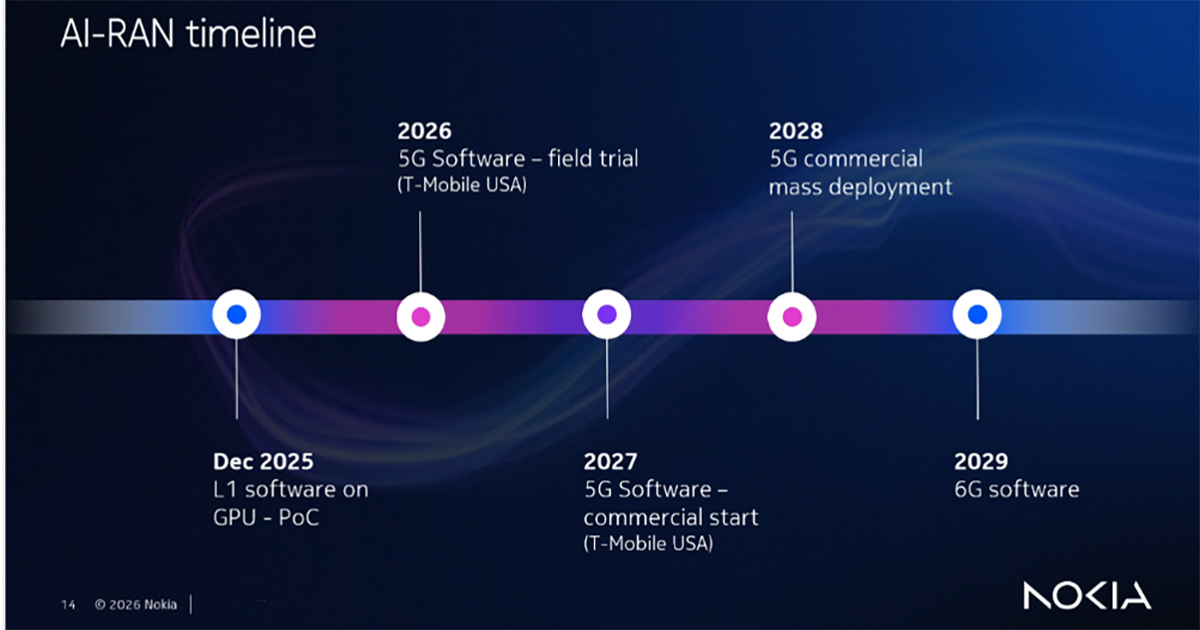
Nokia’s AI-RAN roadmap and timeline remain broadly unchanged. The AI-RAN roadmap and timeline are largely unchanged from what the company shared with analysts and investors over the past year, suggesting Nokia is executing against an existing strategy rather than introducing a new one.
The migration path has been refined and simplified. Compared with last year’s Nokia-NVIDIA framework—which highlighted purpose-built D-RAN, D-RAN vRAN, and C-RAN vRAN—the company has simplified the way it presents deployment options. Nokia is now placing less emphasis on specific vRAN architectures and more emphasis on deployment flexibility and performance profiles (installed-base leverage, high-capacity AI-RAN, and cloud-native AI-RAN). Broadly speaking, the migration strategy remains intact, with the changes reflecting refinements in packaging and messaging rather than a fundamental shift in direction.
Nokia is becoming more confident in its merchant silicon/GPU-based AI-RAN strategy. The most notable changes are in messaging and conviction. There was more hedging at MWC Barcelona when analysts pressed them on their 6G R&D efforts between custom and merchant silicon. Now, Nokia appears increasingly confident in its merchant silicon/GPU-based approach and is positioning AI-RAN as a software-defined platform strategy rather than a hardware story. While the company continues to support multiple hardware options, management indicated that most future software innovation and feature development will target the merchant silicon track.
AI-on-RAN is also becoming more tangible. Beyond AI-for-RAN use cases, Nokia is now highlighting sensing, positioning/location services, and third-party software applications that could run on the platform. Importantly, these are being positioned as complementary software-ecosystem opportunities rather than as the primary justification for the architecture.
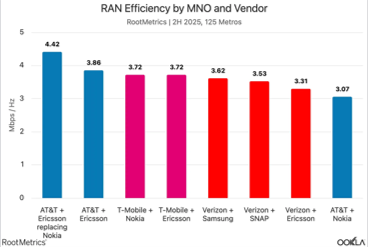
The 2x spectral efficiency claim is compelling but requires more context.The headline claim of up to 2x spectral efficiency improvements is compelling, especially since the gains appear to exceed those highlighted in other AI-RAN announcements. At the same time, it should be viewed with some caution until there is greater clarity around the underlying assumptions, benchmarks, and how it compares with competing approaches from Huawei, Ericsson, and others in actual deployments. Spectral efficiency remains highly dependent on deployment scenarios and starting points, making cross-vendor comparisons difficult. Hopefully, Ookla can update this RAN efficiency chart by 2028.
The announcement supports Dell’Oro’s AI-RAN and GPU-RAN forecasts. More broadly, the announcement is consistent with our recently published $35 B AI-RAN forecast and our upward revision to the GPU-RAN outlook, which now exceeds $1 B by 2030. Nokia’s emphasis on AI-for-RAN as the primary value proposition, combined with its growing confidence in merchant silicon-based deployments, is consistent with our view that AI-for-RAN adoption is accelerating as operators prepare for more software-centric and AI-native RAN architectures.
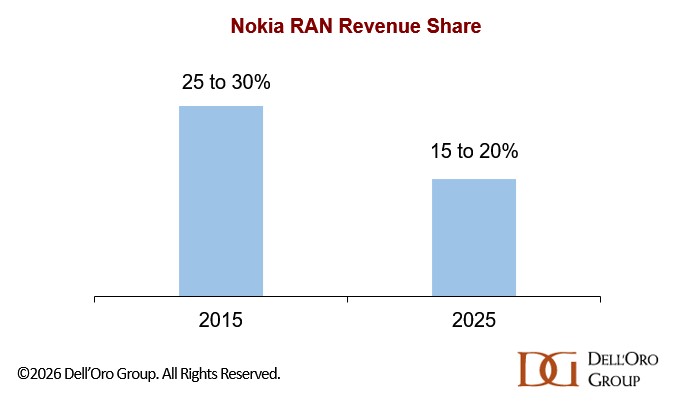
AI-RAN is strategically important to Nokia’s broader RAN turnaround efforts. Finally, Nokia’s AI-RAN strategy should be viewed in the context of its broader RAN turnaround efforts. Having lost approximately 10 percentage points of RAN market share over the past decade, Nokia is well aware of the importance of maintaining sufficient scale in the highly concentrated RAN market. AI RAN is therefore more than a technology roadmap—it represents a strategic bet that software-driven innovation, flexible deployment options and AI-native capabilities can help strengthen Nokia’s competitive position over the long term. The latest announcement signals that Nokia is becoming increasingly confident that AI-native RAN will play a central role in its efforts to improve its competitive standing in the RAN market.