

The positive momentum that shaped the telecom equipment market in 2025 extended into the first half of 2026. Preliminary findings suggest that aggregate worldwide telecom equipment revenues across the six programs tracked by the Dell’Oro Group—Broadband Access, Microwave & Optical Transport, Mobile Core Network (MCN), Radio Access Network (RAN), and High End Routing & Aggregation—increased 5% year-over-year (Y/Y) in 1H26, marking a sixth consecutive quarter of Y/Y growth. This follows the 4% increase recorded in 2025, when the market returned to growth following a 14% revenue decline between 2022 and 2024. While the 2025 recovery reflected a combination of inventory normalization, easier comparisons, improving wireless and wireline demand, and increased cloud investment, the composition of growth shifted in 1H26 toward markets with greater exposure to AI and data center infrastructure.
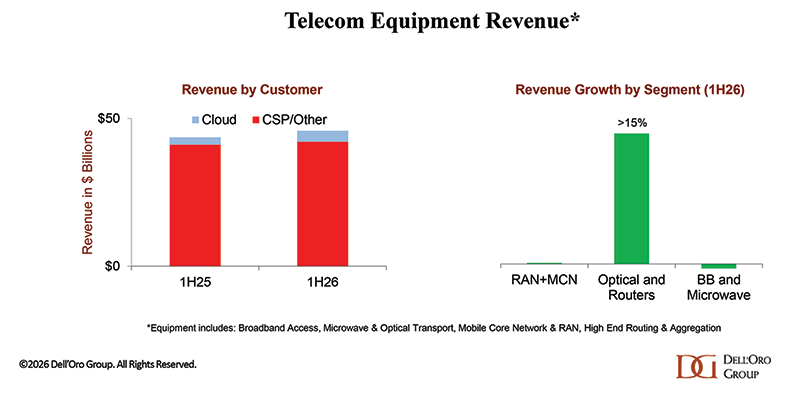
While traditional communication service providers (CSPs) continue to account for the vast majority of telecom equipment revenues (>90%), cloud providers are playing an increasingly important role in driving incremental growth. We estimate that cloud providers accounted for 55% of the revenue growth in 1H26, reflecting continued investment in AI and data center infrastructure and the connectivity required to support it.
The impact of this investment wave varies significantly by technology. Our analysis shows that 1H26 growth was concentrated in Optical Transport and High End Routers, the two segments most directly exposed to cloud and data center infrastructure investments. Optical Transport revenue increased at a double-digit pace, supported by strong demand for data center interconnect, while the High End Routing & Aggregation market benefited from robust activity across both cloud providers and CSPs. In contrast, aggregate RAN and MCN revenues were relatively stable, as were Broadband Access and Microwave Transmission.
Regional dynamics were also favorable outside of China. North America, EMEA, CALA, and Asia Pacific excluding China all contributed to the 1H26 expansion, while conditions in China remained more challenging. North America continued to benefit disproportionately from AI and cloud-related infrastructure investments, including strong demand for optical transport, routing, and fiber access equipment. China, meanwhile, is tracking below our expectations as infrastructure spending continues to shift from traditional telecom networks toward compute infrastructure—the top 3 CSPs in China are collectively targeting 40% growth in computing capex in 2026, while traditional connectivity capex is expected to decline 24%.
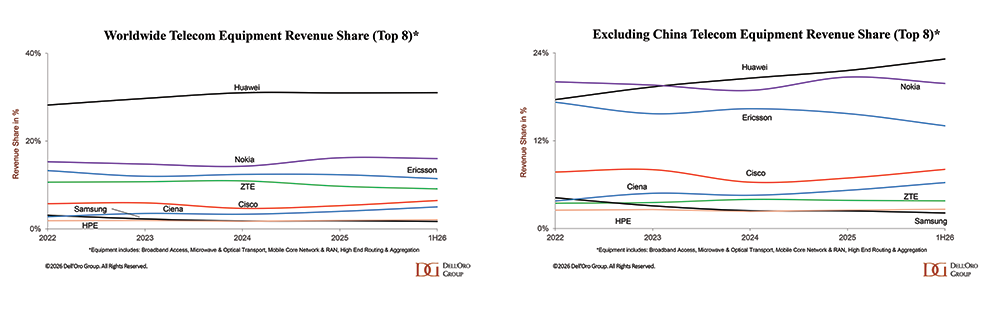
Global supplier dynamics remained relatively stable in the first half. Huawei was the largest telecom equipment supplier worldwide, followed by Nokia and Ericsson. Outside China, however, share movements were more notable. Huawei and Cisco gained share in 1H26 relative to 2025, while Ericsson and Nokia’s combined revenue share declined by about three percentage points. The shifts partly reflect differences in supplier exposure to the faster-growing optical and routing markets, as well as regional market dynamics.
Looking ahead, the analyst team remains positive about the market trajectory. Worldwide revenues across the six programs are projected to increase 3% to 5% in 2026, up from 2% to 4% in the previous update. Meanwhile, the risk profile has evolved somewhat. China is trending below full-year expectations, while rising memory and component costs have moved higher on the list of second-half concerns. These headwinds are being balanced by continued strength in cloud and AI-related infrastructure investment.
