[wp_tech_share]

OFC 2026 was held a couple of weeks ago, and since then, I have had a chance to reflect on what was shown and what I saw from the perspective of an Optical Transport industry analyst. The simple conclusion is that the next direction for optical networking is to scale up in density.

100 Gbps ZR/ZR+ is officially a market

I should clarify this headline. 100 Gbps ZR/ZR+ QSFP28 pluggable optics have been shipping for revenue since 4Q 2023, and shipments have ramped nicely. However, the only supplier of the DSP (Digital Signal Processor) was a co-developed product from Coherent Corp and Adtran. So, technically, it was only one supplier. This changed during OFC when two additional suppliers—Cisco Acacia and Arycs Technologies—announced plans to begin shipping their 100 Gbps ZR/ZR+ pluggable with in-house DSPs in mid-2026. Now there are three DSP suppliers, introducing competition and giving customers a choice. It “feels” more like a market. I should add that in the IPoDWDM and Disaggregated WDM report, we forecast that 100 Gbps ZR/ZR+ optical pluggable modules will grow steadily for many years to come.


1.6 Tbps ZR/ZR+ pluggable optics were announced… before 800 ZR/ZR+ volume shipments started

This is the environment we are in right now—things are moving fast, and development cycles are shortening. The good news is that Cisco Acacia announced it has ramped 800 Gbps ZR/ZR+ DSP production, shipping 25,000 DSPs to date, which is a lot compared to other 800 Gbps ZR/ZR+ suppliers. But to put this in perspective, the cumulative shipments for 400 Gbps ZR/ZR+ pluggable optics to date for the industry, per our ZR/ZR+ optical pluggable shipment tracker, are closer to 1.7 million (FYI Cisco Acacia has stated they shipped 750 thousand 400 Gbps DSPs to date, where most were used for ZR/ZR+ optics). So, 800 Gbps ZR/ZR+ is just starting to ramp in production.

The vendors that announced plans to sell 1.6 Tbps ZR/ZR+ optical plugs in an OSFP form factor based on DSPs using a 2 nm foundry process were 1Finity, Ciena, Marvell, and Nokia. The timeline was a little vague, but I believe 1.6 Tbps ZR/ZR+ plugs will be generally available before the end of 2027, with samples as early as 4Q 2026. A couple of items to point out: 1) 1Finity will use a 3rd party DSP, and 2) Cisco Acacia did not make any announcements about 1.6 Tbps optics at OFC. So, I am guessing the company is waiting until ECOC in September.


Nokia laid out its anywhere, anyplace, and anybody product strategy

“Anywhere, anyplace, and anybody” is my own interpretation of Nokia’s optical product strategy after listening to the company’s announcements. Nokia held an analyst event at OFC where the company presented all the new products it has in the pipeline. Personally, I liked seeing all the products it has in development, but it could be overwhelming to hear it all at once in under 60 minutes. Luckily, for me, the OFC analyst event was the fourth Nokia meeting I had with them, where they presented these product ideas, so I understood more of the details that the company executives didn’t have time to explain during the event. In summary, Nokia presented the following new products:

  • Four new coherent DSPs (Huron, Superior, Ontario, and Pacific) are planned. Not one or two, but four! The key here is that three of the four are being developed simultaneously, using the same 2 nm base structure and logic. In other words, the cost to develop two of them (Superior and Ontario) is a fraction of the cost to develop Huron. Nokia’s objective is to create cost and performance-optimized DSPs for applications that include 3.2 Tbps coherent-lite for campus, 1.6 Tbps ZR/ZR+ pluggable for metro and DCI, and 2.4 Tbps high-performance for long-haul and subsea. And while not explicitly stated, to meet the differing needs of their wide customer base (CSPs, cloud providers, enterprises/public). So, basically, DSPs for anywhere, anyplace, and anybody. There wasn’t much said about Pacific, but I believe it will be a high-performance, 3.2 Tbps-capable DSP operating at 400 Gbaud and will likely be productized later than the first three.
  • All the pluggable optics (QSFP and OSFP) and embedded line cards needed to house the new DSPs in different shapes and forms.
  • Double-sided pluggable transponder. The idea is simple: combine the client optical transceiver and the coherent optical transceiver into a single pluggable module. One use case for this is to convert CPO grey light to colored light.
  • Multi-rail in-line amplifier (ILA). It wasn’t clear what variations the company would offer, but they stated that the highest-density configuration would be 160 rails per rack. The system will begin sampling mid-2026.
  • A Full Band Transponder (also called a full spectrum transponder) that encloses all the client ports, coherent transponder components, and mux/demux into one line card module that fits in an existing GX chassis, delivering a single fiber output with multiple wavelengths. Nokia plans to offer variations of this module with different options and optical engines.


Ciena kept things at the system level

Ciena announced several products under development but kept much of the coherent DSP activity under wraps (probably to spread its announcements out between OFC and ECOC). The products included:

  • 1.6 Tbps ZR/ZR+ OSFP pluggable module for IPoDWDM. No comment was made on the DSP to enable it other than that it is a 2 nm DSP.
  • 3.2 Tbps coherent-lite plug for campus. This may leverage the same DSP developed for 1.6 Tbps ZR/ZR+ as Ciena did for its 1.6 Tbps coherent-lite plug.
  • RLS Hyper-Rail, which is a multi-rail ILA. The company plans to offer 300 mm and 600 mm versions, as well as a 5 RU size to fit in existing ILA huts.
  • Full Spectrum Transponder to house all the client ports, coherent transponder components, and mux/demux in a single unit that outputs all the wavelengths through a single fiber connector, enabling a rapid delivery for a full-fiber deployment.
  • Early work on xPO modules was shown. I was surprised since the MSA was just announced, but I guess the advantage of xPO is that companies can use existing components to fill in the xPO form factor, but in a tighter configuration, since the xPO has liquid cooling.


Optical line systems are REALLY important

As transponder technology approaches Shannon’s Limit, spectral efficiency improvements do little to increase fiber capacity. The realization is that to add more capacity, more fibers will be needed, and each fiber pair requires an ILA every 80 km. In addition, cloud providers are building massive AI data centers that now need to scale-across hundreds of kilometers between data centers to form a larger virtualized AI factory. My discussion at OFC with some folks pointed to a need for 20 Pbps of capacity to connect the back-end of a GPU data center to another. This would convert to 390 fiber pairs when connecting 800 ZR+ optics at each end. The answer to this is a multi-rail system. If a rack unit supports 128 rails, three racks of multi-rail ILAs will be needed at each site.

During OFC, four companies announced multi-rail products: Coherent Corp., Ciena, Cisco, and Nokia. Three other companies (Molex, Ribbon, and Smartoptics) plan to look into developing a multi-rail system. Based on the timing of availability, I think commercial shipments of multi-rail products could begin in 2027.


Density is the Next Dimension

For decades, the method for scaling optical transport networks was to increase wavelength speeds (Mbps to Tbps) and the usable spectrum in a fiber (C-band to Super C and L-band). However, as we saw at OFC 2026, the next dimension is density—increasing the number of transponders and ILAs that fit in a cubic meter of space. This is the reason for some of the new product announcements:

  • 1.6 Tbps ZR/ZR+ optics
  • xPO form factor pluggable module
  • Full Spectrum Transponder
  • Multi-rail ILA

You can imagine. Combining all four product features into an optical network will increase the density by around 4 times.

  • Put multiple 1.6 Tbps coherent optics inside a full-band/spectrum transponder unit. Use xPO modules for the client interface instead of 1.6 Tbps OSFP plugs, saving 75% of the front panel density.
  • Connect the fiber coming out of the full-band/spectrum transponder to a multi-rail ILA that is 75% smaller than a traditional ILA unit.

Following OFC 2026, I think the new metric for an optical transport system’s efficiency will be volumetric density (Gbps-per-cubic meter) rather than spectral efficiency (Gbps-per-hertz).
 

[wp_tech_share]

Very little is written about Huawei’s optical DWDM technology, but that doesn’t mean the company hasn’t made some big waves in the industry. We had the chance to sit down with the Huawei optical team, led by Gavin Gu, at MWC 2026 to learn about their latest coherent DWDM technology. This is what we learned.

Huawei has started shipping its next-generation high-performance coherent DSP in the first quarter of 2026 as an embedded assembly in a muxponder with two ports of 2.0 Tbps coherent wavelengths. The client ports in the module include a mix of 100 Gbps, 400 Gbps, and 800 Gbps. These muxponders are housed in the company’s DWDM systems, namely the OSN 9800 K12 and K36. And of course, Huawei’s new module delivers wavelengths across the entire Super C-band and Super L-band, which is increasingly important as wavelength channels get wider.

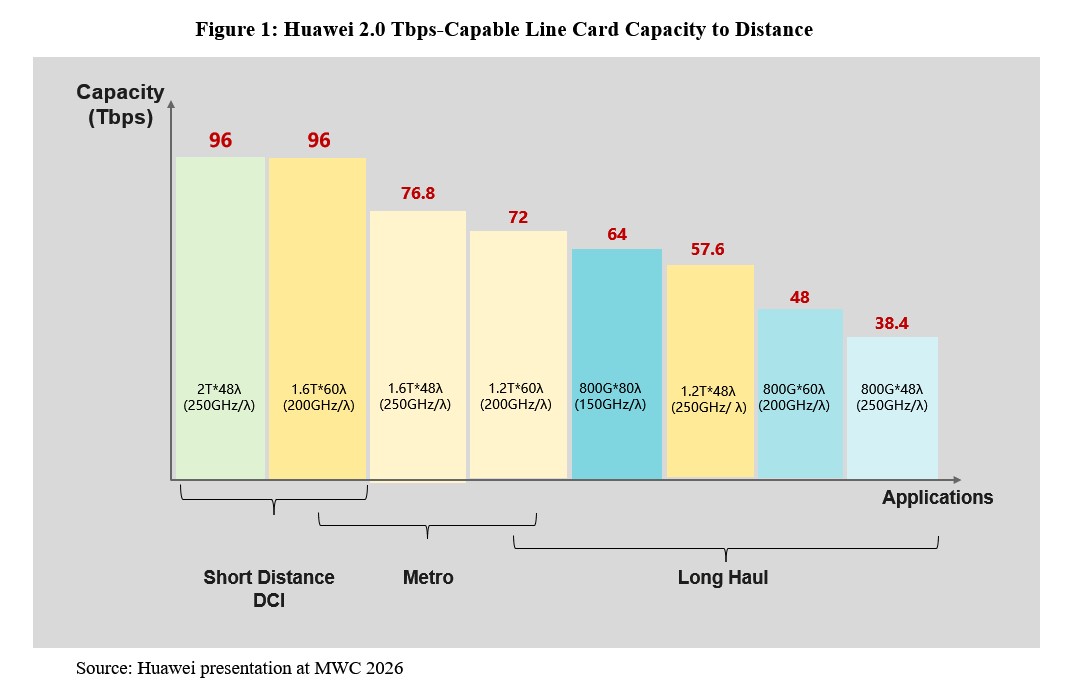
As is the situation in the industry, the highest wavelength speed used to identify the coherent technology is just that, the highest speed capable. One of the benefits of modern coherent line cards is that the symbol rate and modulation can be adjusted to deliver different wavelength speeds and performance. Huawei presented a few of those options in a chart (Figure 1) showing the unregenerated signal distance at different wavelength speeds. Maybe the most important speeds to look at are the 2.0 Tbps and 800 Gbps. We say this because the maximum distance at 2.0 Tbps gives us a good sense of the technology, and the maximum distance at 800 Gbps tells us if the muxponder will meet current customer requirements for unregenerated span lengths when they upgrade networks to 800 Gbps over the next few years.

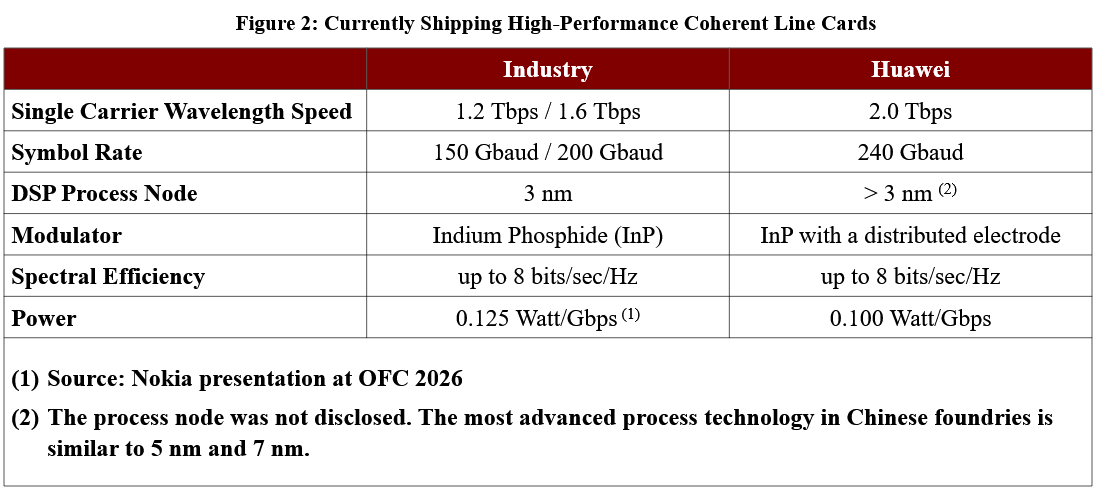
How does Huawei’s new coherent wavelength technology compare to the rest of the industry? We did a simple comparison between the industry and Huawei (Figure 2). Specifically, we looked at high-performance coherent muxponders that are generally available as of 1Q 2026. Of course, this doesn’t give a deep assessment of Huawei’s technology or even that of the industry. But at a high level, we think it gives a good sense of where the company is at.

Figure 2: Currently Shipping High-Performance Coherent Line Cards

Two key differences show up in this comparison. The first is that Huawei DSP uses a larger semiconductor process node, while the industry is at 3 nanometers (nm). This difference puts Huawei at a slight disadvantage at the ASIC level, but the company can still deliver 2.0 Tbps at 80 km, which was proven in a live demonstration. Usually, a DSP using a larger process node would also consume more power. However, in Huawei’s newest muxponder, power consumption is lower at 0.1 Watts/Gbps, compared to the industry average of 0.125 Watts/Gbps. We believe this power advantage is created by Huawei’s extensive in-house development of every component inside a coherent optical module (tunable laser, receiver, TIA, driver, modulator, and DSP), along with its expertise in photonic packaging and manufacturing processes (Huawei has its own state-of-the-art manufacturing, assembly, and test facility for optical modules that we once visited).

Also, using an advanced InP-based modulator with a distributed electrode, internally designed and developed to achieve 30% lower parasitic capacitance, could give the company a power-consumption advantage at the module level, compensating for the DSP’s higher power consumption. Then, at the system level, Huawei also internally develops and manufactures the major components of its optical line systems, including its pump lasers and WSS modules, giving the company greater control over technology performance and time-to-market. As a result, Huawei is constantly innovating its optical system design, from the chip level to the system level.

The 2 Tbps technology is now ready, with the first wave of deployments underway. During MWC 2026, Huawei highlighted six successful trials of its 2 Tbps-capable muxponders across Europe, Asia Pacific, the Middle East, and Latin America. The company also proudly announced that the first commercial deployment with a major European Tier-1 communication service provider (CSP) is currently in progress.

[wp_tech_share]

In the most recent 3Q25 market study, the Optical Transport market posted a 15% year-over-year (Y/Y) gain, moving us to raise our full-year outlook for 2025 and 2026.

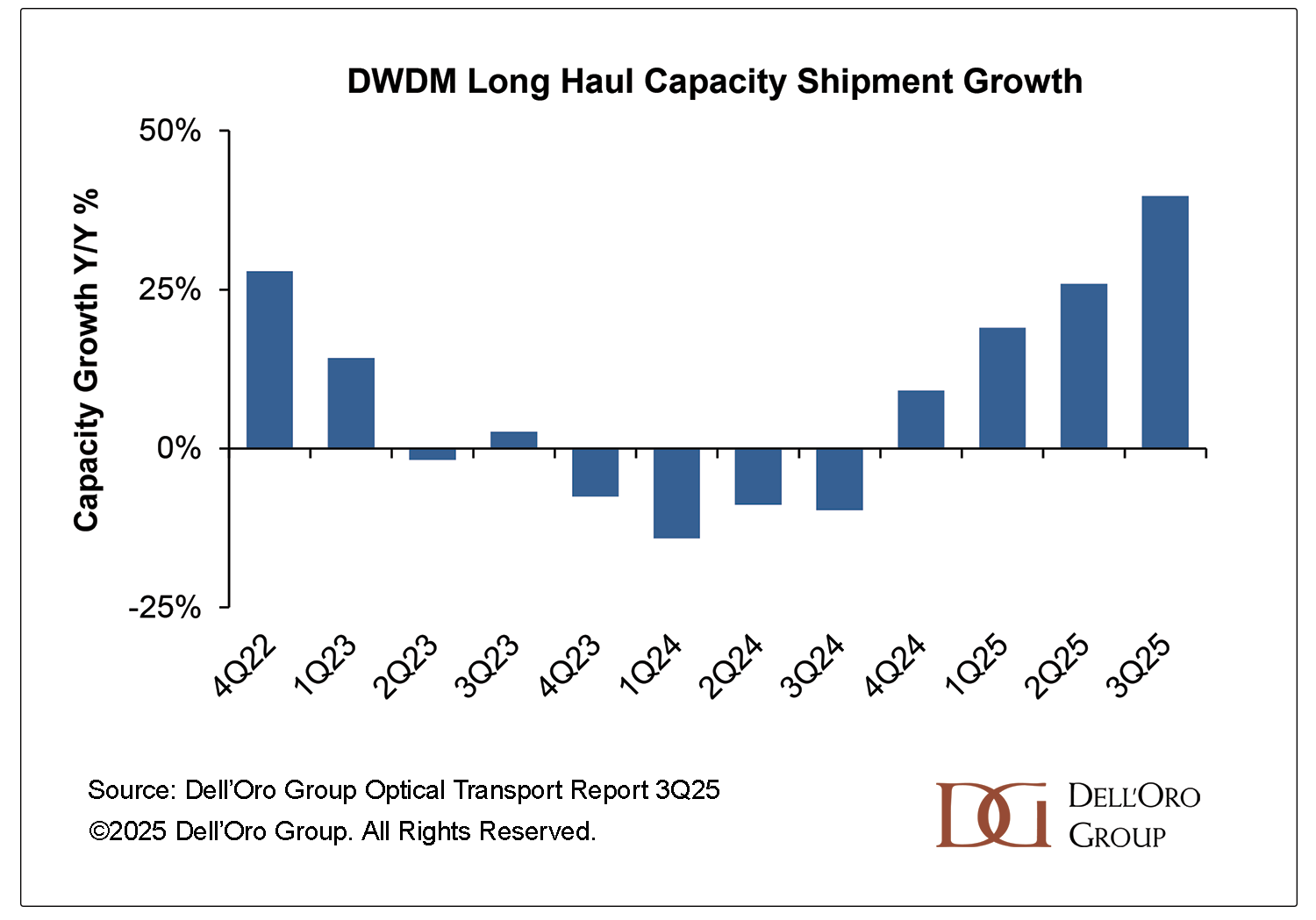
It was more than just the market’s growth rate that led us to raise our forecast; it was the bandwidth. What I mean is that network capacity demand or bandwidth was back on the rise after two years of stalling. Here is a chart on DWDM Long Haul capacity shipment growth on a Y/Y basis for the past 3 years. As shown, new installations on backbone networks grew at a rate below the historical average of 25% to 30% for 9 quarters. This changed in the middle of 2025, and growth rates are now back above 25%.

Data center interconnect (DCI) accounted for most of the bandwidth growth over the past year, driven by large deployments from cloud providers. This trend is expected to continue through 2026 and remain a key market driver. However, it will now expand beyond traditional DCI. The new outlook suggests that the largest cloud providers are nearing a performance ceiling in some geographies due to power grid limitations. The good news is that a solution exists: scaling across multiple data centers to create a larger virtual AI factory.

Hence, we believe that, beginning in 2026, cloud providers will expand their AI data centers across multiple buildings about 100 km apart, requiring 800 ZR+ optics and optical line systems (OLSs) to tap into different electricity grids to run their power-hungry GPU compute clusters.

The optical equipment of choice for building new DCI networks, including for scale-across, will likely remain Disaggregated WDM, which accounted for nearly 40% of total Optical Transport market revenue during the first nine months of 2025 (the other 60% of revenue was mainly from large integrated systems). Also, as many of you know, the idea of disaggregating the WDM network originated with cloud providers.

For those unfamiliar with what we call Disaggregated WDM, here is a description: Disaggregated WDM is a product and architecture that promotes the independence of the main elements in a WDM network—transponders and optical line systems. As transponder technology continuously improved and reduced in size, the natural progression was to sell these subsystems as optical pluggable modules for use in WDM systems, routers, and switches. Additional factors that characterize Disaggregated WDM include open interfaces to eliminate vendor lock-in and small form-factor chassis to better align with a pay-as-you-grow model. We track the Disaggregated WDM market in the following major categories:

  • Transponder Units: Compact form factor that mainly houses the embedded or pluggable WDM transponders and is used in long-haul and metro deployments.
  • Optical Line Systems: Small chassis that mainly houses the amplifier (EDFA and/or RAMAN), optical add/drop multiplexer (OADM), and mux/demux.
  • IPoDWDM ZR/ZR+: In an IPoDWDM architecture, the pluggable WDM transceiver is placed in a router or Ethernet switch rather than a Transponder Unit. We account for the ZR/ZR+ optical plug portion in Disaggregated WDM.

Alongside DCI, we expect the positive trend among communication service providers (CSPs) to continue into 2026. In the third quarter of 2025, non-DCI revenue for DWDM Long Haul rose 14% Y/Y, indicating that demand for network backbone capacity goes beyond just cloud providers and AI expansions. We believe this non-DCI growth is particularly significant because it suggests that CSPs’ inventory correction is complete and their network bandwidth is starting to grow again. This likely means that CSPs will purchase even more optical transport equipment in 2026.

We have an optimistic outlook for 2026 and believe that the Optical Transport market will build on the positive momentum in 2025. We are eagerly looking forward to witnessing this continued growth and development unfold in the coming months and years.

[wp_tech_share]

Looking back on 2025, we got a few things wrong and a few things right. One thing we got right is that 2024 was indeed the year that the Router market resets itself to a new baseline for future market growth. The part we got wrong was the steepness of the decline in 2024 and the speed of the market’s rebound in 2025, especially for Core Routers.

We expected the customer inventory surplus to conclude by the first half of 2024, which it did, but we did not expect that it would take another two quarters for new orders to flow through into revenue for the system houses. So, the market dropped nearly 20% in 2024 (more than we were expecting). Both communication service providers (CSPs) and cloud providers pulled down purchases through 2024, adding to the pain. But then came AI.

Right at the bottom, at the reset point for the Router market, cloud providers were accelerating their investments in building AI data centers, and companies were beginning to push out Agentic AI, autonomous artificial intelligence systems that adapt and learn to take over tasks that require reasoning. The result was an accelerated investment cycle in all things AI. But, more importantly for the router market, the need to interconnect or transport data outside the confines of the data center wall was beginning. This was evident in the numbers we captured in the 3Q25 survey process: Core Router revenues grew over 40% year-over-year (Y/Y) in the first nine months of 2025. It is becoming a V-shaped recovery, driven by the need for more wide area network (WAN) capacity and data center interconnect (DCI). So, this brings us to 2026.

Our preliminary view for 2026 is that growth rates will remain high, and the market momentum from 2025 will continue.

  • Cloud providers will continue building new AI data centers and connecting them to the WAN or neighboring data centers.
  • Since electricity is a scarce resource, cloud providers will build data centers in new geographic regions. And in many cases, we believe that cloud providers will leverage CSPs to help build their new routes and networks, increasing future spending by network operators.
  • Enterprises, in preparation for deploying AI Agents, will build AI-ready infrastructure to improve access speeds to cloud data centers, including adding more connections between their on-premises storage sites and cloud-based AI compute resources.

Building on this momentum, we believe there is a good chance that the 2026 results will surpass our expectations. But it depends on the answers to these questions:

  • Scale-Across DCI: Cloud providers are interconnecting their AI GPU data centers with massive amounts of bandwidth to form large virtual data centers using data center switches and ZR+ optics. However, we are not sure whether all of these scale-across DCI builds will use data center switches or whether some will use routers. Hence, the question is, will routers with deep buffers and WAN protocols be chosen for scale-across DCI when span lengths are too long for data center switches?
  • AI-Ready Infrastructure: We believe the early adopters are upgrading their infrastructure to be ready for Agentic AI. Will this become mainstream in 2026 or 2027?
  • Fronthaul: Fronthaul with routers had many false starts in the past decade. Hence, we are still cautious about its prospects before 6G. However, recently, there has been increased activity around eCPRI (enhanced Common Public Radio Interface) for fronthaul. So, will router fronthaul build-outs occur before 6G?
[wp_tech_share]

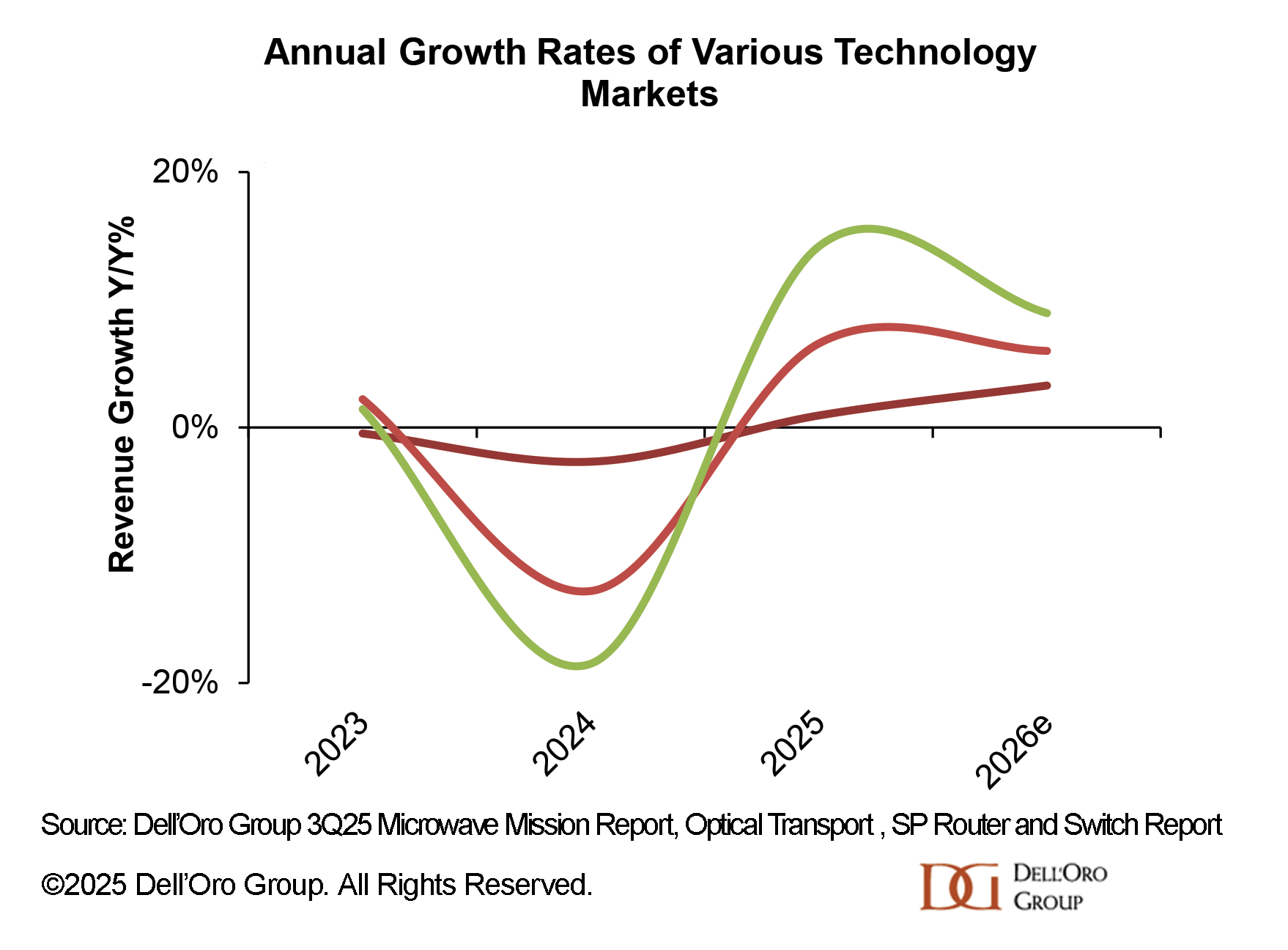
The Microwave Transmission market has gone through some ups and downs, but at a high level, it has been relatively stable and less volatile than the other network equipment markets I track.

Predictions 2026 - Microwave Transmission

Past: 2024

For the full year 2024, the Microwave Transmission market declined by only 3%. While this was a decline, it was minor compared to the double-digit declines in the other markets, where customers pulled back new orders as they digested the excess equipment purchased during the pandemic. In fact, the Microwave Transmission market decline in 2024 was slightly better than we anticipated at the start of the year. The reasons for the market contraction were as follows:

  • Sharp decline in E-band equipment purchases in India, following a massive deployment cycle the previous year.
  • Procurement delays and order flow disruptions that followed the acquisition of Siklu and NEC’s microwave business (Ceragon acquired Siklu, and Aviat acquired NEC’s microwave business).
  • Slowdown in rolling out 5G networks as operators began to question its return on investment (ROI).
  • Weaker macroeconomic conditions, including:
    • slower GDP growth in many countries
    • lower currency exchange rates against the U.S. dollar, and
    • higher borrowing costs.


Present: 2025

We just concluded data collection through 3Q25, and so far, the Microwave Transmission market is poised to post a very small increase driven by sales in emerging markets and a stable North American market. However, within the year, things were rocky: strong growth in the first half was followed by weakness in the second half, leading us to reevaluate the year repeatedly.

Two things are helping the market this year:

  • Mobile backhaul deployments in emerging markets are increasing. Although many operators are cautious about the ROI, they are still deploying 5G and mobile backhaul, albeit at a slower, steadier pace.
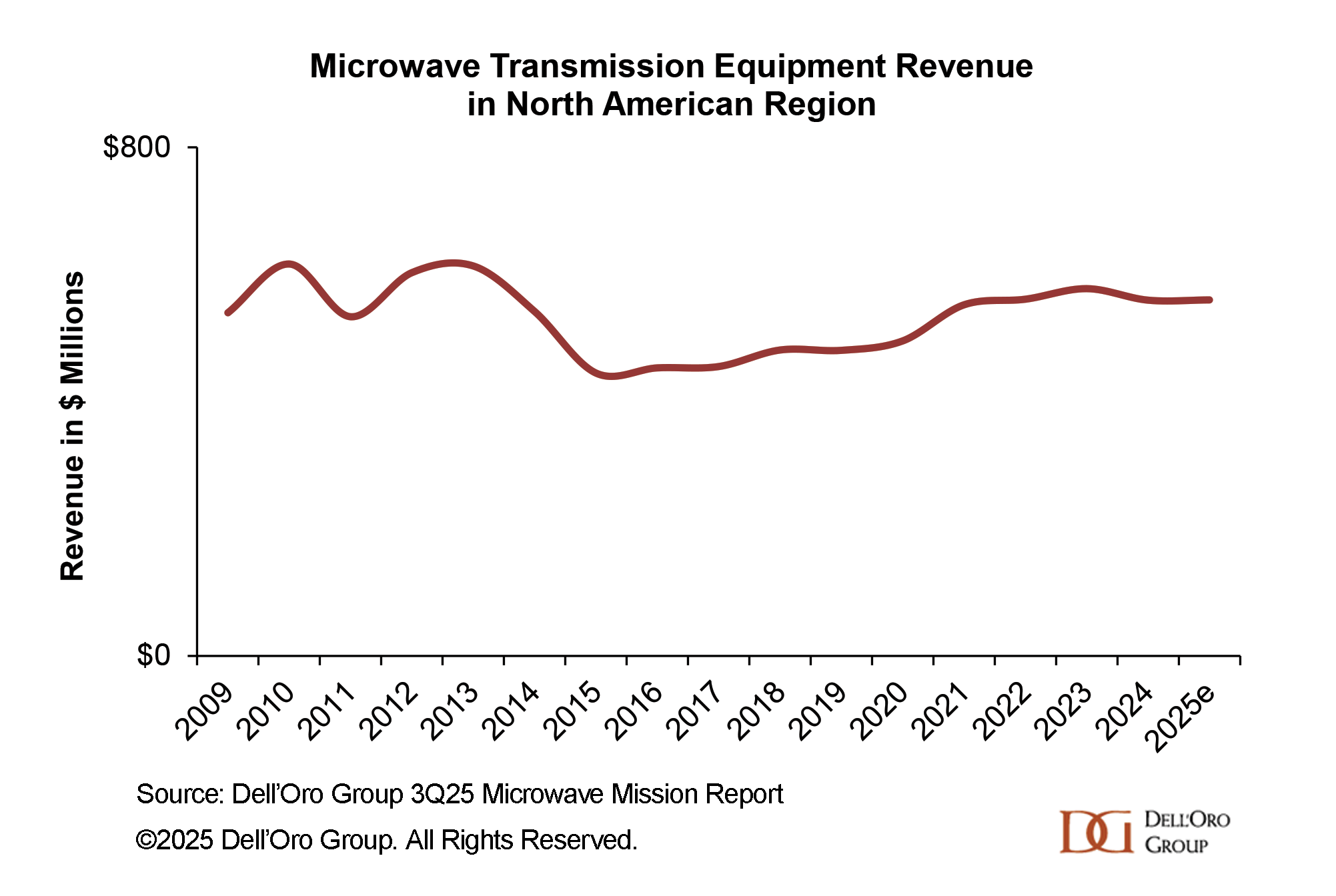
  • A stable level of demand in North America, which I had always thought would decline. It is actually one of the most fascinating things for me. I have tracked Microwave at Dell’Oro Group since 2008, and everyone (myself included) thought the revenue in this region would shrink with the shift to fiber. This chart shows the microwave revenue in North America between 2009 and 2025. I think the past 15 years have proved us all wrong about North America and that microwave backhaul use would decline.

Unfortunately, offsetting this growth is the weaker Verticals market, which we think is due to lower government funding and delays in project starts.

Predictions 2026 - Microwave Transmission


Future: 2026

We envision the Microwave Transmission market returning to a more normal state in 2026, driven by growth in both mobile backhaul and the Vertical markets.

One major assumption is that we expect demand for mobile network capacity to return to high double-digit growth rates. The demand for bandwidth slowed due to the pandemic, the shift to remote work, weak economic conditions, and reduced travel. However, this all reversed, and we expect network demand to revert to historical growth rates as the world pushes for normalcy. Additionally, integrating AI applications like ChatGPT on mobile devices may increase network usage more than before.

The Microwave Transmission market will not have the high growth rates of the other markets I track, but it won’t have the steep declines either. It is expected to have steady growth in 2026. Operators, especially those in emerging markets still expanding their 5G footprint, are expected to continue adding new cell sites and capacity to their backhaul networks for a few more years. We also believe the Vertical markets may return to growth in 2026, helped a little by rural broadband expansion, which is economically more feasible with wireless links that do not require months of trench digging to bury fiber.