[wp_tech_share]

It was a great year for the Microwave Transmission market in 2022 due to the growing demand for wireless mobile backhaul (MBH). In fact, following an 11% growth in microwave MBH revenue in 2021, the market is expected to grow an additional 8% in 2022, based on the data we have collected so far in the first nine months of the year. Unsurprisingly, this demand for microwave MBH equipment is being driven by 5G, since operators are either preparing their networks to deploy 5G or are actively installing a 5G network.

We believe 5G will continue to be a market driver in 2023 and, as a result, project another year of single-digit percent growth. However, we anticipate two significant changes in the Microwave Transmission market to occur this year.

The first is the return of the India market. India is one of the countries with the largest use of microwave equipment for MBH, making it a crucial element to the overall market size. During the peak 4G deployment cycle, more than 20% of all microwave radio transceivers were shipped to India. Since then, deployments have considerably shrunk with the declining installations of new 4G base stations. This, however, is expected to reverse because the country has just concluded the auction of 5G spectrum and will ramp microwave deployments for 5G MBH through 2023. Hence, we are expecting India to be a major contributor to the overall market once again.

The second change we are expecting to occur in 2023 is the use of E-band systems in India. Although a large share of MBH in India is achieved through wireless backhaul systems, E-band systems were never used since the spectrum was unavailable. This will change in 2023 since the E-band spectrum has been made available with the 5G spectrum auction, and the standard microwave frequencies such as 13 GHz and 15 GHz are congested due to the large number of 4G base stations using them. Therefore, we anticipate a very large use of E-band systems in India to begin this year, with a number of vendors having already been awarded E-band equipment contracts in the country.

2023 should be another great year for the Microwave Transmission market.
[wp_tech_share]

Knock on wood (if you are superstitious), but it seems like the worst is over for the Optical Transport market as we enter 2023. To recap…. in 2022, there was a pandemic with city-wide COVID lockdowns in China, war in Ukraine with economic sanctions placed on Russia, rampant inflation with spiking fuel prices, global economic slowdown, and component shortages. It was, in short, a tumultuous year.

While in most years the occurrence of one or two of these events would cause a sharp decline in the optical market, no such incident occurred this time. Through it all, the Optical Transport market at the global level held strong, and we are predicting it will decline at most by 1% in 2022. Things are, of course, different at the regional level, considering the war occurring in Europe and COVID lockdowns in China. Based on results for the first nine months of 2022, we believe Europe is on track to decline by roughly 15% and China by approximately 3%. We should note that most of the decline in Europe is due to a lower currency exchange rate compared to the US dollar. Therefore, on a constant currency basis, the market contraction in Europe was actually small. Offsetting much of the declines in these two regions is the higher revenue in North America, which we expect will grow at a double-digit rate.

For 2023, we remain somewhat optimistic that optical revenue will increase even as global macroeconomic conditions worsen. Specifically, we are expecting that component constraints will ease, and vendors will be able to fulfill customer orders that have been placed into their swelling backlog. Even in the Western European region, which is under a large amount of distress because of the war and high price of energy, there does not seem to be a significant slowdown in 2023. In fact, many optical vendors have stated that they do not see an impact from the eroding macroeconomic conditions in Western Europe at this time. Also recently, the rate of inflation is decreasing, and China has moved away from a zero-Covid policy, which should end the city-wide lockdowns that slowed the country’s economy and amplified certain supply issues.

Our biggest concern with 2023 is the uncertainty of vendor backlog. While backlog has grown and orders have exceeded revenue for the past few quarters, it is not clear to us what the duration of the backlog will extend to. That is, will customers begin to delay system delivery to a later period when their concerns of supply wane later this year?

In addition to having the worst of the conditions behind us, we are excited about the entry of a new higher-speed capable coherent DSP. Cisco, through its Acacia acquisition, is planning to have a single wavelength 1.2 Tbps-capable module available in early 2023. We have not heard what either Ciena or Infinera have planned for their next-generation coherent DSP, but we expect some news in early 2023—something to look forward to.

Although I am not superstitious, I am knocking on wood, to help ensure the worst is over.

[wp_tech_share]

Each year, I like to take the pulse of the vendor landscape in Optical Transport, and each year I am always impressed by the number of companies that compete in this market. This year is no different.

The good news is that the Optical Transport market, by most measures, is very healthy. The market revenue is just north of $15 billion and has grown at an average annual rate of 5 percent since 2003 (a year when the Optical Transport market was at its worst and network capacity was more aligned with demand). If we focus on WDM systems, this market has grown at an average annual rate of 12 percent. The profit margins here are not the highest among industries but also not the lowest. That said, when considering the type of technology these optical system companies produce, many (myself included) would argue the profit margin should be higher. This leads me to my annual review of the vendor landscape and assessment of vendor competition. The result of my assessment is unchanged—vendor competition is very high in the Optical Transport industry. However, as we all know, the higher the competition, the slimmer the profit margins.

The following are key findings of the vendor landscape that I find the most interesting:

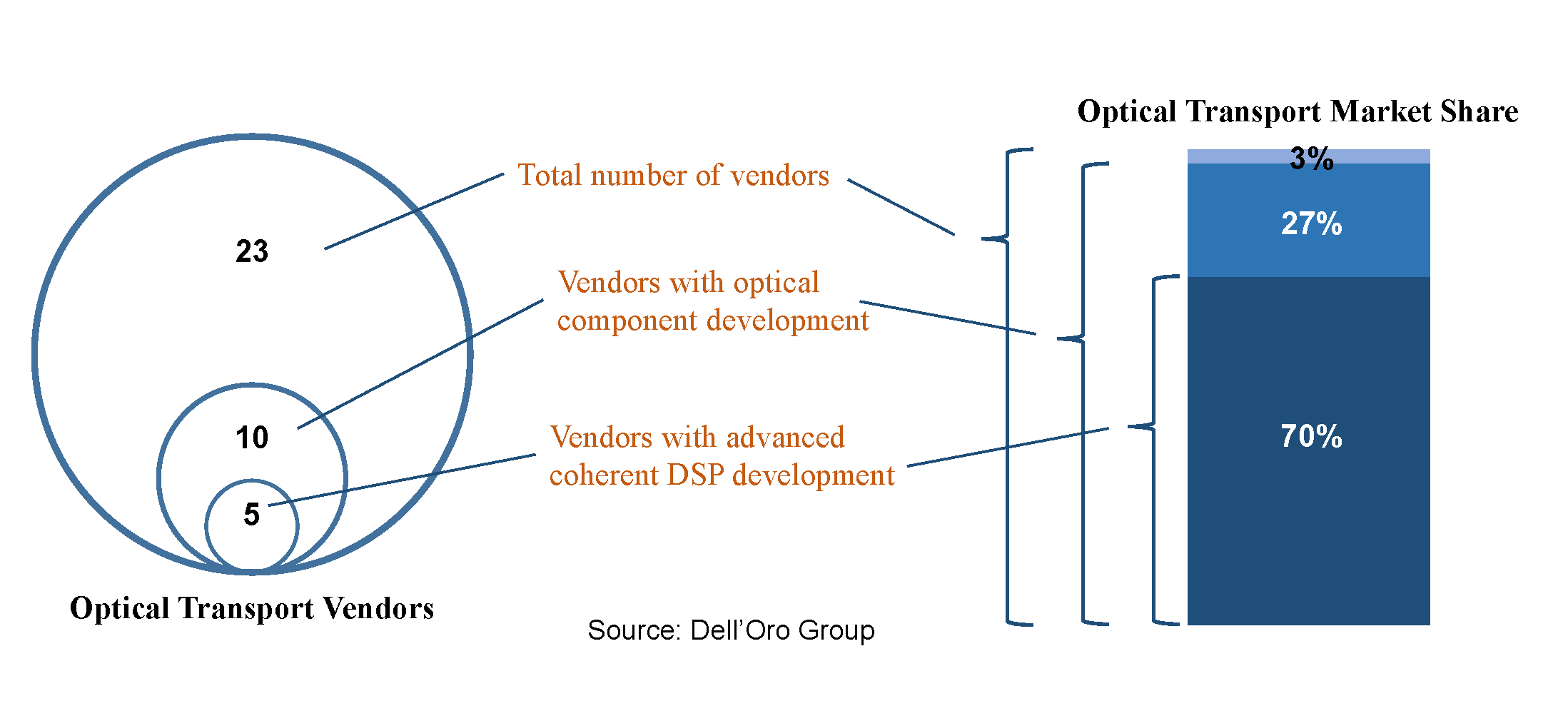
  • There are 23 vendors actively selling optical systems. Nine have headquarters in North America, seven in Europe/Middle East, six in Asia Pacific, and one in Latin America.
  • Of the 23 vendors, there are 10 that develop some optical components either in-house or through a sister company (subsidiary or part of a corporate group).
  • The 10 vendors that have optical component development are also the top 10 vendors in the Optical Transport industry with a combined market share of 97 percent.
  • Among the top 10 vendors, I find that 5 compete in technology. That is, 5 companies spend a larger amount on R&D to develop the latest coherent DSP and photonics to be first-to-market with the newest coherent wavelength technology.
  • The 5 vendors that compete in technology amass a combined market share of 70 percent. More importantly, these 5 companies have 90 percent share of the faster growing 400+ Gbps wavelength shipments and 90 percent of the business with Internet Content Providers.

Hence, while there are 23 optical system vendors in the industry, they are located in different regions of the world, giving them some advantage when selling to local customers. Also, among these 23 vendors, 10 capture the vast majority of the market with half of them competing for technology leadership.

So, what about the 13 vendors competing for 3 percent of the market? First, I am pretty sure each of them will state that they are striving to go after the entire $15 billion. However, considering that 70 percent of the market is held by technology leaders, I argue that the 13 vendors have a SAM (serviceable available market) closer to $4 billion. Second, the remaining companies are not all the same. I believe some are poised to grow and grab some market share while others are just holding on or close to exiting. My assessment of the remaining 13 companies are:

  • Four are growing
  • Four are sustaining
  • Five have stalled

This means that, in actuality, the total number of Optical Transport vendors competing each year is probably closer to 18.

As a point of reference, when I first did my assessment of the vendor landscape over a decade ago, I recall the number of vendors was closer to 30. It took over a decade to go from 30 vendors to 23. Perhaps, in another decade, the vendor count will be below 20.

[wp_tech_share]

OFC 2022 was held in San Diego, California with a large number of active participants at the show, filling the exhibit halls after two years of mostly virtual attendance. However, to accommodate those unable to attend in person, OFC held many virtual sessions. I was one of those remotely attending. Even though I attended OFC virtually, I think my experience, while different than attending in person, was really good. That is, I learned a lot. Here are four of the things I learned and found the most interesting at OFC 2022.

The top of my list was the announcement by EFFECT Photonics that the company was buying the coherent DSP and FEC technology from Viasat. This combination brings together the most valuable components in any coherent transponder: InP-based photonic integrated circuit that includes a high-performance tunable laser, modulator, amplifier, and receiver all on one chip along with the high-speed digital electronics. The only items that EFFECT Photonics will need to source are the TIA and Driver when producing coherent pluggable optics in the future. To put this in perspective, one of the key attributes for both Acacia’s and Inphi’s value was having all of these technologies in-house.

The second thing I learned during OFC was the volume of coherent DSPs shipped by Cisco (Acacia), but maybe more importantly, how fast the ramp of shipments is occurring for the company’s newest coherent DSP (Greylock) that are used for 400 Gbps pluggable optics. During OFC, Cisco announced that cumulative shipments of the company’s 600 Gbps-capable DSP (Pico) by port volume was 100k, which converts to 50k DSP chips since each DSP supports two ports. The Pico DSP is primarily used for metro and long haul spans that require the best-performing optics. Cisco, also, announced that the cumulative shipments of Greylock was at 50k with nearly half shipped in the most recent fiscal quarter and with most being sold in a 400ZR QSFP-DD; The remainder is used in 400 Gbps CFP2-DCO. This is a very fast ramp for Greylock, considering it was introduced over a year after Pico.

The third item of focus at OFC this year seemed to center around what comes after 400ZR. While there was talk about the progress of 400ZR and the possibility of 800ZR in a few years, I felt the discussions were more about 400ZR+. It seems 400ZR+ will continue to be a marketing term and not a standard. That is to say, companies were announcing better-performing 400ZR+ compared to competitors. And as you know, better performance, product differentiation usually translates to non-standard. However, one thing in common is that the vendors are producing 400ZR+ in a QSFP-DD plug. I had originally thought that 400ZR+ would generally be used in a CFP2 package due to thermal requirements, but many of these companies have solved that problem and can deliver better-performing 400 Gbps with just an extra watt or two of power. Of course, this makes me wonder (out loud), would operators be willing to forgo the standards-based 400ZR with a 120 km limit for a non-standard based 400ZR+ with span limits that could exceed 600 km if it is also a QSFP-DD and consumes only a couple watts more? I think we all know the direction Windstream chose with the partnership with II-VI (400 ZR+ in QSFP-DD to enable the use of a ROADM line system).

The last item I want to mention is the excellent tutorials and classes that OFC holds every year where people volunteer their time to share what they do and to present informational sessions. I wasn’t able to watch all of the sessions that OFC recorded and made available to virtual participants, but the ones I watched were all done well and the presenters did an excellent job. One, in particular, that stood out for me was a session by Alexander Nikolaidis of Meta (Facebook) called Building a Global Content Provider Network at Scale. He gave a really good overview and understanding of how the company thinks through building and scaling a large content delivery backbone. He walked the audience through the choices and trade-offs that are considered. Interestingly, many of these choices and trade-offs are similar to those made by the largest telecom operators. So, at the end of the day, the challenges and choices for scaling a large backbone network aren’t that different whether it’s a large Internet content provider or a tier-one communication service provider.

[wp_tech_share]

Dell’Oro Group published an update to the Microwave Transmission & Mobile Backhaul market 5-Year Forecast report in July 2021.


xHaul Systems Equipment in Demand

xHaul, a term referring to fronthaul, midhaul, and backhaul as well as transport and packet processing, is projected to grow through the forecast period, reaching nearly $9 billion by 2025. This multi-year growth is expected to be driven by 5G. In the xHaul forecast, we include both Mobile Transport (fronthaul and backhaul) and Routers & Switches. As would be expected, we believe the highest growth in xHaul will be from growing installations of Routers & Switches as more Layer 2 and 3 functions are required in the mobile network.

The Mobile Transport Layer Returns to Growth

The end of the 4G deployment ramp brought a slowdown in both mobile backhaul and fronthaul transport equipment sales. However, this trend seems to be in reverse as 5G rolls out globally. A small glimpse of this reversal, though restrained by the COVID-19 pandemic, was visible in 2020 when the Mobile Transport equipment market increased slightly. We believe the growth in 2020 was just the beginning, and predict that the Mobile Transport market, consisting of mobile backhaul and fronthaul, will grow for many more years and that the cumulative revenue for the next five years will approach $27 billion, a solid increase over the previous five-year period.

Microwave Transmission Important for 5G Backhaul

While much of the growth will be with fiber backhaul systems, we expect wireless backhaul systems such as Microwave Transmission equipment will be a critical component in an operator’s successful rollout of 5G for two simple reasons: fiber is not everywhere and time to market is critical to success.

Therefore, we anticipate that the demand for Microwave Transmission equipment will increase for a number of years and that much of the growth will be from rising sales of E-band radios. We forecast E-Band radio transceiver shipments to grow at a compounded annual growth rate (CAGR) of nearly 30 percent.

About the Report

The Dell’Oro Group Microwave Transmission & Mobile Backhaul 5-Year Forecast Report offers complete, in-depth coverage with tables covering manufacturers’ revenue, radio transceivers, and average selling prices. The report tracks mobile backhaul by cell type (macro and small cell) and technology (wireless and fiber/copper). The microwave transmission tables forecast point-to-point TDM, Packet and Hybrid Microwave as well as full indoor and full outdoor unit configurations. To purchase this report, please contact us at dgsales@delloro.com

Dell'Oro Group Microwave Transmission & Mobile Backhaul 5-Year Forecast Report July 2021