[wp_tech_share]

Dell’Oro Group published an update to the Optical Transport 5-Year Forecast report in July 2021.


Optical Transport Market Forecasted to Grow Through 2025

The Optical Transport market, largely driven by WDM equipment, is forecasted to increase in size annually for the next five years, reaching nearly $18 billion. This forecast update is unchanged from our previous forecast. That said, we did lower our outlook for WDM Metro since the coherent 400 Gbps ZR (400ZR) pluggable optics are now available and interest in using them in an IPoDWDM architecture seems high.

Coherent ZR Optical Pluggable Emerging

We are predicting coherent ZR optical pluggable demand to reach a material amount in 2022, starting with 400ZR. We project this pluggable optic will be in high demand among Internet content providers (ICPs), driving a very high percentage growth rate for the next few years. Following the success of 400ZR, we anticipate 800ZR will enter the market a few years later. We forecast the ZR pluggable optics market will surpass $500 million in annual sales by 2025.

1+ Tbps to Follow 800 Gbps

Demand for 800 Gbps-capable line cards, first introduced in early 2020, has rapidly increased, demonstrating a strong rate of adoption as well as the markets continued desire for higher performance DWDM transponder cards. As such, we believe the market is already preparing to release the next single carrier wavelength speed.

We predict the next wavelength speed following 800 Gbps will be 1200 Gbps (1.2 Tbps). Based on the timing of past coherent DSP introductions, we anticipate 1.2 Tbps-capable line cards could enter the market before the end of 2023.

We forecast that by 2025 about one-third of all coherent wavelength shipments will be from a line card capable of transmitting a signal at a speed of 800 Gbps or higher.

About the Report

The Dell’Oro Group Optical Transport 5-Year Forecast Report offers a complete overview of the Optical Transport industry with tables covering manufacturers’ revenue, average selling prices, unit shipments, wavelength shipments (by speed up to 1.2 Tbps). The report tracks DWDM long haul, WDM metro, multiservice multiplexers (SONET/SDH), optical switch, optical packet platforms, data center interconnect (metro and long haul), and disaggregated WDM. Click here to learn more about the report or contact us at dgsales@delloro.com.

Dell'Oro Group Optical Transport 5-Year Forecast Report July 2021
[wp_tech_share]
Optical Transport DWDM Market is Very Competitive

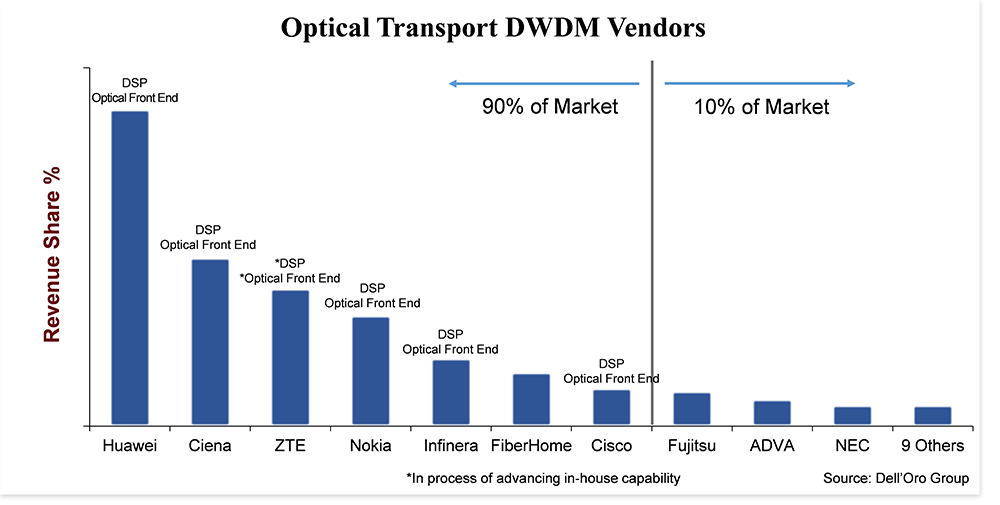
“Very competitive” is the best way to characterize the Optical Transport DWDM equipment market. While it is a sizeable market, weighing in at $15 billion, there are about 20 systems manufacturers that actively participate in selling DWDM equipment and aggressively vie for market share. That said, 90 percent of the market is held by only seven vendors, leaving 10 percent for the remaining vendors, and even among the top seven, the market share delta is large—25 percentage points between the largest and smallest vendor.

Company scale and investment is a key differentiator that seemingly divides the market, where among the top vendors, outside of FiberHome, all have invested in vertical integration on line-side components such as coherent DSP and optical front end. It doesn’t seem to matter whether the optical front end is based on Silicon Photonics (SiPh) or Indium Phosphide (InP) even though industry pundits continue to debate the two technologies. The deciding factor is that the company has developed an in-house technology that differentiates the products from others, lowers its product costs, and gives the company a better time to market. Furthermore, since it takes considerable scale and resources (money, people, and intellectual property) to develop these components, vertical integration creates a barrier to new (and even old) entrants.
 

Product Substitution is Available

Like most industries, an external force to the Optical Transport industry is product substitution. While product substitution was not a real threat in the decades past, due to the inherent benefits in performance and cost of DWDM technology along with the system-level constraints on incorporating DWDM technology in an adjacent platform, the tide is starting to turn a little with small form factor 400ZR pluggable optics. As a result of these new pluggable optics in a QSFP-DD form factor that can transmit 400 Gbps wavelengths up to 120 kilometers, we are anticipating a growing interest in IP-over-DWDM (IPoDWDM), which is a system architecture that incorporates DWDM optics in an Ethernet Switch or Router. This will, without saying, increase the level of competition in the DWDM equipment space as customers decide between using a traditional DWDM system from our 20 DWDM vendors or an IPoDWDM system from other switching vendors. (The top Ethernet Switch and Router vendors include Arista, Cisco, Juniper, and Nokia).

However, 400ZR will also benefit the optical DWDM vendors. One reason is that not all operators will want to change their network to IPoDWDM and will choose to use 400ZR pluggable optics on a DWDM system, keeping the network architecture somewhat unchanged while benefiting from the lower cost of 400ZR optics. But another reason is that 400ZR is a coherent technology and therefore the companies that have invested in this technology over the past decade are well positioned to address this new opportunity. Hence, the manufacturers of 400ZR pluggable optics are mostly comprised of companies that have a long history in the development of coherent DWDM systems, such as Ciena, Cisco, and Nokia. Huawei intended to develop a 400ZR as well, but we are unsure as to whether the US restrictions on the company will delay this endeavor.


Customers Prefer Local Suppliers When Available

In some ways this is neither old nor new, but it is important to reiterate that generally customers prefer to purchase equipment from a local supplier. In this chart, the global DWDM equipment market is sliced into major regions and the vendors that supply in a given region. The size of the box portrays the vendor share in that region, and the green shaded boxes are the vendors that are considered domestic to that region. It is not a surprise that in the two regions—North America and China—where there are a large number of domestic vendors, the vast amount of DWDM sales go to these domestic companies. Due to the high mix of companies in “others,” I did not shade those boxes, but in both North America and China the majority of “others” are domestic companies as well.
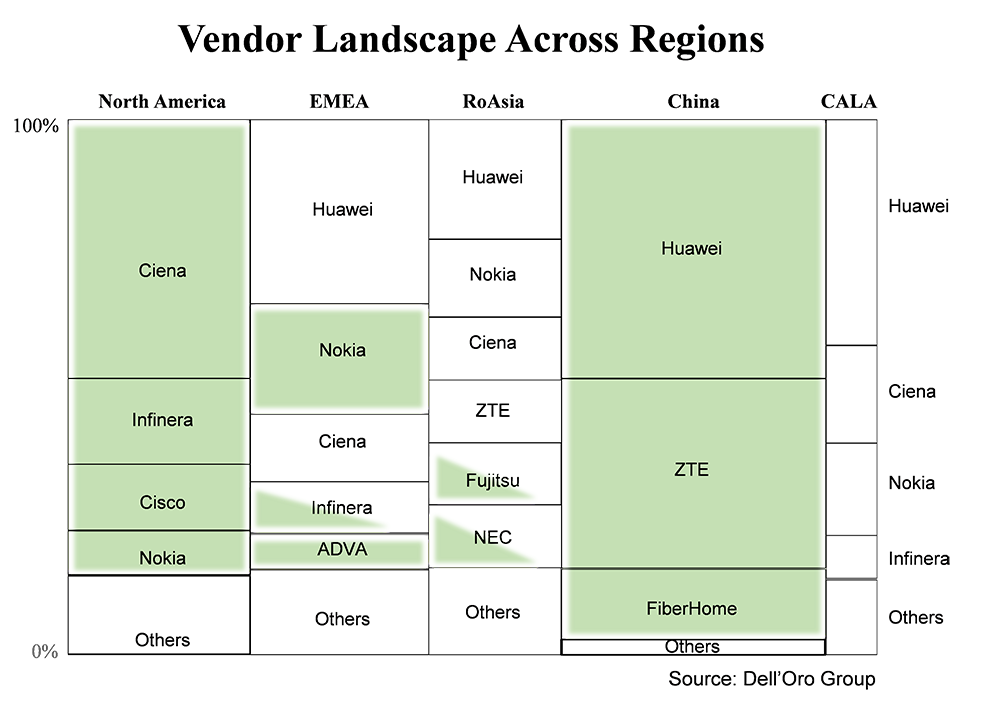
 

Dell'Oro Group Optical Transport Vendor Landscape Across Regions

What may be of interest is the non-shaded boxes. The reason is that after the U.S. placed restrictions on ZTE in 2018 and recently Huawei, service providers in the regions with a large number of non-shaded boxes (non-domestic vendors) are increasingly concerned with equipment supply. As a result, service providers are looking to de-risk by reducing dependence on any one supplier as well as increasing the consideration of local suppliers. In many ways, this will be good for the smaller companies that are based in the local regions such as Tejas in India, Padtec in CALA, and PacketLight in EMEA. However, in the vein of limiting risk, the largest service providers will likely continue to purchase most equipment from the larger DWDM manufacturers that have the scale and technology to support their future endeavors.


Dynamic State of the Industry

Perhaps the best way to describe the state of the optical WDM equipment industry this year is “dynamic.” I say this because unlike in the past when industry forces were relatively the same from year to year, new forces emerged in the optical industry this year that may dynamically reshape it. Specifically, the new forces I am referring to are the higher viability of product substitution with IPoDWDM enabled by 400ZR in a QSFP-DD plug and a change in customer behavior created by U.S. government actions on Chinese manufacturers that could alter the vendor landscape in certain regions over time.

[wp_tech_share]

New technology improves E-Band reach and performance

After attending Huawei’s 2021 virtual analyst summit, I started to wonder whether my forecast for E-band shipments was wrong.

Over the past decade, E-band has been steadily growing out of its early-era use as a technology for simple Ethernet bridges on a campus into the wider and more sophisticated world of mobile backhaul. In our market study at Dell’Oro Group, we estimate that E-band radio shipments that took place over a decade ago were used solely for enterprise campus interconnects, but now, about 80 percent of new E-band radios are purchased with the intent to use it for mobile backhaul. Of course, this change was not a coincidence; it was very much driven by the rising level of mobile broadband speeds enabled with 4G mobile radios that increased the requirements for mobile backhaul capacity.

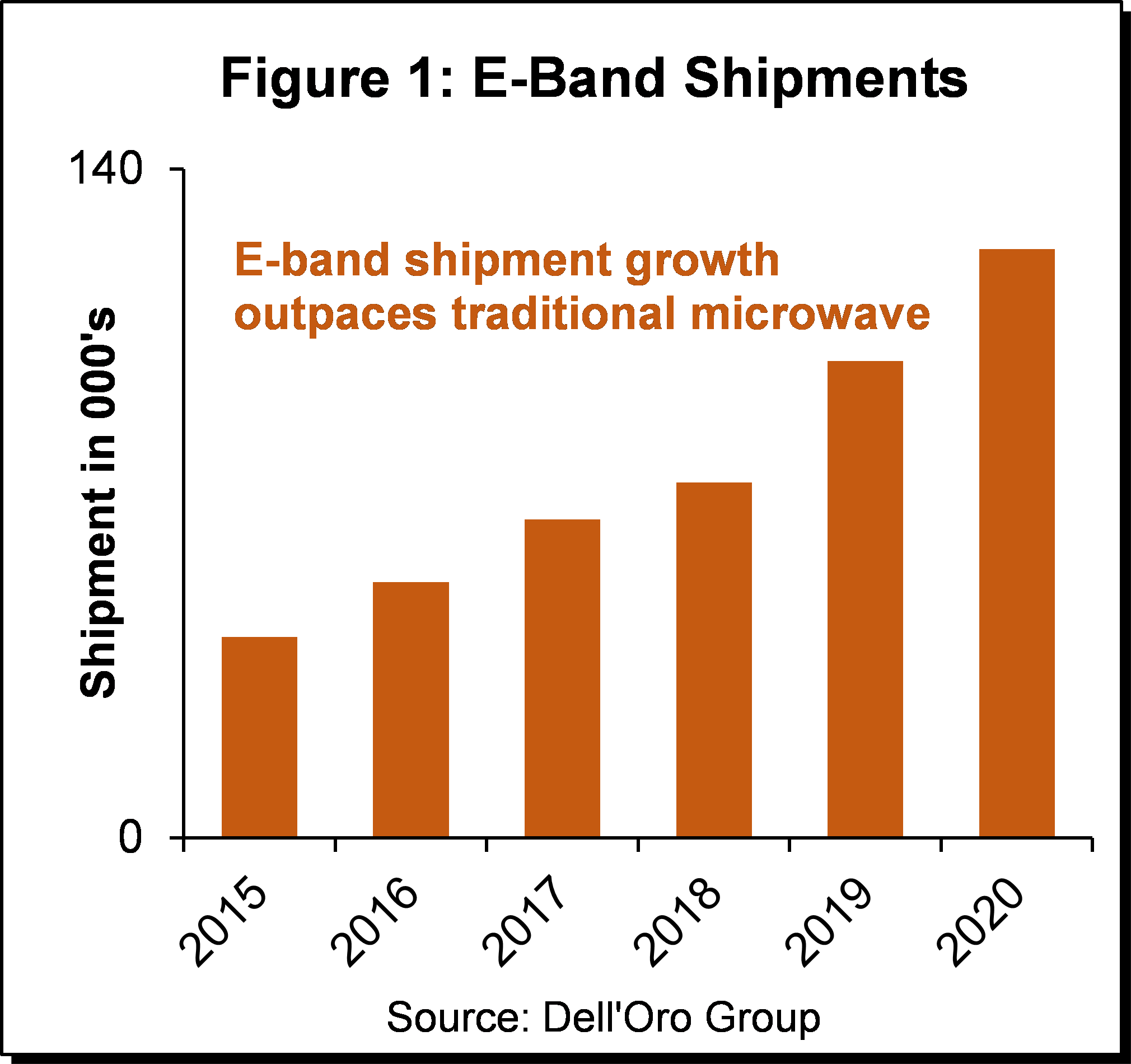
Furthermore, because of the increasing capacity requirements, operators needed a better solution for when fiber was not available. So for wireless backhaul, the question was whether to continue using traditional microwave bands that are designed for up to 500 Mbps of link capacity or future proof with E-band designed for 20 Gbps links (using XPIC). In many cases, the decision seemed to favor future-proofing with E-band, especially in regions where spectrum license fees for E-band was low. Looking back five years, while the shipment volume of traditional microwave systems declined at an average annual rate of 5 percent, the shipment volume of E-band radios increased at an annual rate of 24 percent (Figure 1).

E-band shipment chart

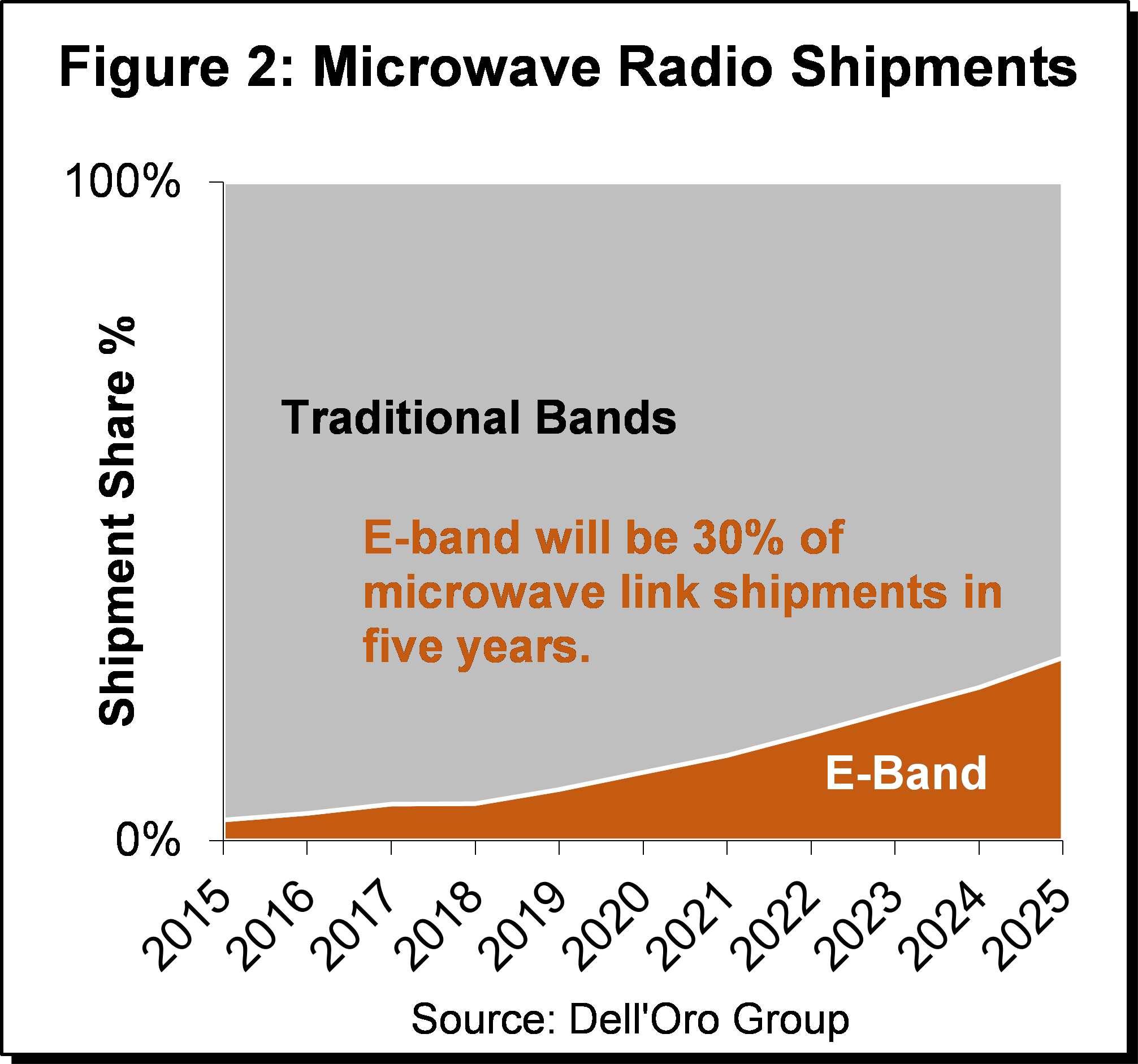
I do not think this trend will stop here. Rather, I think it will only grow as 5G mobile radio installations continue and backhaul capacity requirements increase further. There have already been very successful deployments of E-band radios for 5G backhaul in places like Saudi Arabia by major operators Saudi Telecom Company and Zain, strengthening the applicability of E-band technology for 5G backhaul. Hence in the January 2021 Microwave Transmission Five-Year forecast report, we projected E-Band radio shipments to grow at a 27 percent compounded annual growth rate (CAGR) and comprise nearly 30 percent of all microwave point-to-point radio shipments by 2025 (Figure 2). But can it be higher?

Microwave Radio Shipment Chart

In developing the five-year forecast, I already considered that 5G will require a much higher backhaul capacity that will favor a single E-band radio over multiple bands of traditional microwave links, especially when considering the cost of equipment, spectrum license fees, and operational expenses such as tower lease and power. I even, to a degree, accounted for smaller antennas that will benefit its use in urban areas, empowering operators to install E-band radios in a smaller form factor that can be closer to street level thereby easing the use of wireless backhaul for cell site densification initiatives. However, I always considered E-Band to be limited by a couple of its technical features (restrictions): span lengths below 2 kilometers and higher rain fade. So, what happens if these two features that are inherent in E-band radios can be overcome?

“How many more cell sites can use E-band radios if span lengths are increased to 5 kilometers or if E-band link availability can be increased in geographic areas with high rain fall?”

Those were some of the questions floating through my mind as Huawei presented a longer reach E-band solution that included a higher power E-band radio and larger active antenna with intelligent beam tracking (IBT) technology to ensure site-to-site alignment. (Note: one issue with a very small beam angle and longer span is that the microwave radio alignment can be easily disturbed by high winds and temperature if the microwave radio is not mounted on a very stable structure. Hence, active alignment widens the mounting options and number of deployable sites). Also, another dimension that adds to the greater usability of E-band is that with better radio performance, the link availability can be increased in short spans. Therefore, E-Band radios that were often not used when link spans exceeded 2 kilometers or when locations had historically high rain fall can now be considered.

While I have always had a positive outlook for E-band, claiming it to be the highest growth segment in the point-to-point Microwave Transmission market for many years to come, it is nearly impossible for me to not increase my optimism for this market when we consider the recent technology innovations that reinforce the future of E-band and further expand its market applicability:

  • Multiband systems that carry both traditional bands and millimeter bands over a single antenna, reducing footprint and increasing performance
  • Higher powered radios to extend reach and improve link availability
  • New small form factor antennas for urban densification
  • Larger antennas for use in longer reach applications
  • Active antennas for alignment to improve performance

In summary, E-band systems have come a long way from only providing short building-to-building links on a campus as the technology matured. As such, E-band has already proven it can meet the higher capacity and lower latency requirements of 5G mobile radios, and we believe the opportunity for E-band will only go in one direction from here—up and to the right—with new technologies that improve its reach and performance.

[wp_tech_share]

Dell’Oro Group published an update to the Optical Transport Five-Year Forecast report in January 2021

Although we continue to be concerned with the high level of uncertainties that exist due to the COVID-19 pandemic, we believe that the Optical Transport market will maintain its positive momentum for the next five years. This long term outlook is based, fundamentally, on the belief that bandwidth demand will continue to increase for many more years in the future as it has for the past decade—one that included the start of a pandemic.

This of course does not mean the Optical Transport market will grow unencumbered for the next five years. Because while bandwidth demand continues to grow, we anticipate the Optical Transport market will face challenges such as the three outlined here:

  • When WDM technology reaches Shannon’s Limit, it will be increasingly difficult to drive down the average price-per-bit of bandwidth by increasing spectral efficiency. Yet, we forecast the average price-per-bit will decline at the same rate in the next five years as it did in the past five years.
  • The entry of coherent 400 Gbps in a small form factor pluggable such as QSFP-DD opens the door for a change in architecture to IP-over-DWDM and away from traditional Optical Transport systems. Component manufacturers have already been trialing and sampling 400ZR pluggable optics in late 2020, and we think demand will be material by late 2021.
  • In the past five-year period, much of the Optical Transport market growth was due to a couple high growth markets—China and data center interconnect (DCI). However, as history has proven many times, markets do not stay at a high growth rate forever. Will this be the case for China and DCI as well?

But even with these market challenges, we are optimistic about the future of Optical Transport and believe that the market for optical gear will rise for many more years. In this latest January 2021 publication, we are forecasting that the cumulative Optical Transport market revenue will be nearly $85 billion for the years that include 2021 through 2025.

Our growth projections are driven by the anticipated need for WDM systems in both metro and long-haul applications, which combined is expected to comprise nearly 98 percent of the total Optical Transport equipment market.

Within the WDM market, we expect the continuous drive to higher wavelength speeds to occur. Hence, while 100 Gbps coherent wavelengths contributed the majority of revenue before, we forecast the largest contributor will be 200 Gbps in the near term period, and then 400 Gbps in the outer forecast period. In all, we are forecasting 200+ Gbps wavelength shipments to grow at a five-year CAGR of 30 percent.


About the Report

The Dell’Oro Group Optical Transport 5-Year Forecast Report offers a complete overview of the Optical Transport industry with tables covering manufacturers’ revenue, average selling prices, unit shipments, wavelength shipments (by speed up to 1.2 Tbps). The report tracks DWDM long haul, WDM metro, multiservice multiplexers (SONET/SDH), optical switch, optical packet platforms, data center interconnect (metro and long haul), and disaggregated WDM. Click here to learn more about the report or contact us at dgsales@delloro.com.

[wp_tech_share]

Dell’Oro Group published an update to the Microwave Transmission & Mobile Backhaul Transport Five-Year Forecast report in January 2021

The following are key takeaways from the newly released report:

    • We remain concerned about the COVID-19 pandemic, and believe it will continue to influence the mobile backhaul and microwave transmission markets this year, as it did throughout 2020. If additional lockdowns do occur, we expect that similar to last year supply-chain issues will cause a slowdown in deployments. Also, as a result of the pandemic’s damage on the 2020 world economy, we remain concerned that a second recession could occur in 2021 or 2022, depending on government economic policies this year. That said, we are optimistic that as COVID-19 vaccines are distributed, service providers will find the confidence to invest in their networks.
    • For the cumulative five-year forecast period that includes 2021 through 2025, we predict the Mobile Backhaul Transport market revenue, consisting of fiber/copper and wireless systems, to be $25 billion. During this period, the cumulative Microwave Transmission market revenue, driven mostly by mobile backhaul, is expected to be just over $16 billion.
    • We expect the rollout of 5G to be the main driver of market growth for both the Mobile Backhaul Transport and Microwave Transmission markets. We estimate that 67 percent of Mobile Backhaul Transport revenue and nearly half of Microwave Transmission revenue will be generated from equipment deployed in 5G networks by 2025. In addition to backhaul, we believe 5G will increase the use of Fronthaul.
    • With each generation of mobile radio technology, the use of Fiber/Copper Systems for Mobile Backhaul Transport has increased, and naturally, we predict this share will continue to rise with 5G deployments. Therefore, we forecast Fiber/Copper System shipments to exceed those of Wireless Systems throughout the forecast period. However, the increasing use of Fiber/Copper as a share of link shipments will likely plateau at approximately 70 percent since many operators will still rely on Wireless Systems such as point-to-point Microwave Transmission.
    • The Microwave Transmission market is forecast to grow at a low single-digit percentage rate for the next five years. We predict that Packet Microwave will be the only microwave transmission technology segment that grows over the next five years, driven by rising demand for full outdoor units and E/V Band systems. We forecast Packet Microwave revenue to grow at a 10 percent CAGR.
    • E/V Band system sales have been relatively modest but steadily rising in use. Due to higher capacity requirements for 5G and spectrum constraints on lower frequency bands, we expect growing demand for E/V Band systems. Therefore, we forecast annual E/V Band shipments to more than triple by 2025.
About the ReportDell'Oro Group Microwave Transmission and Mobile Backhaul 5-Year Forecast January 2021

The Dell’Oro Group Microwave Transmission and Mobile Backhaul 5-Year Forecast Report offers complete, in-depth coverage of the market with tables covering manufacturers’ revenue, ports/radio transceivers shipped, and average selling prices by capacities (low, high and E/V Band). The report tracks point-to-point TDM, Packet, Hybrid Microwave as well as full indoor and full outdoor unit configurations, Mobile fronthaul and backhaul, 5G backhaul, and Fiber/copper and wireless. To purchase this report, please contact dgsales@delloro.com.