[wp_tech_share]

Importance of Optical Transport

When asked to explain optical transport, people usually use automobiles and roads as an example. A person can reach their destination faster in a sports car than in a sedan since the former can travel at higher speeds. Adding more lanes reduces traffic or congestion, allowing vehicles to reach their destination on time without delay. These examples, using cars and roadways, are analogous to optical wavelength signal speed and dense wavelength-division multiplexing (DWDM). While this metaphor is a great way to explain the purpose of DWDM technology, it fails to capture the importance.

I like to use trees to illustrate the importance of optical transport. Beneath every tree lies roots that ferry resources to the branches and leaves and must scale proportionally. If the root system is inadequate, the branches won’t receive enough nutrients and will eventually break. In general, the bigger and more stable the roots, the stronger and healthier the tree, as realized by the many healthy branches and leaves that we see.

In a service provider network, the optical transport layer plays a crucial role. It serves as the roots of a tree that supports all the branches of services offered to customers. Just as tree roots provide the necessary nutrients for healthy growth, the optical transport layer ensures better connectivity to homes, mobile devices, enterprises, and data centers. It needs to be robust enough to support all the services that operators want to deliver. Otherwise, the branch will break. Stated another way—like a tree, the customers see the branches, but they experience the network beneath it through its beauty.

Therefore, like a tree, with each new generation of access technology, there is a need for a new generation of optical transport. I bring this to your attention because of the visible work by service providers to roll out next-generation services, such as Mobile 5G Advanced and Fixed 5G Advanced (F5G Advanced), and enterprise investments in developing new applications using artificial intelligence and machine learning (AI/ML). These buzzword access technologies will need a matching optical transport layer to support the resources they need.


Next-Generation Services

Access is moving to a new generation of services that deliver higher speeds, lower latency, and greater reliability. Some of these service offerings include 50 Gbps PON to homes, 5G-Advanced to devices, and ultra-high-speed connections between AI/ML data centers. In some cases, the bandwidth at the network edge will need to double, and in many cases, it will need to increase by over 10 times. For example, in residential broadband, the market is moving from the current technology (2.5 Gbps PON) to 10 Gbps and then 50 Gbps PON. This means the backhaul capacity may need to increase by as much as 20x.

In addition, the applications run by end users over their network will determine the speed and architecture required by the service provider to meet consumer expectations on quality and latency. Imagine a customer with a broadband service of 10 Gbps using the operator’s 50 Gbps PON network playing a virtual reality game with the same latency and service quality as before. Was the higher price for the 10 Gbps connection worth it? Will they keep it? The answer is “no” to both. And while we do not know what applications and services will emerge from AI/ML, we do know they will require more bandwidth, ultra-low latency, and much higher network quality. Additionally, due to the higher power consumption of AI/ML systems, data centers are required to be geographically distributed and interconnected (DCI) with a high-speed, high-availability optical network.

Therefore, beyond the new generation of access technology, the optical transport layer must also be upgraded to match it. The roots of the tree must grow to support the bigger branches.


Next-Generation Optical Transport

What are the requirements for the next-generation optical transport network? To answer this, we listed some key optical network technologies that are mapped to critical customer needs.
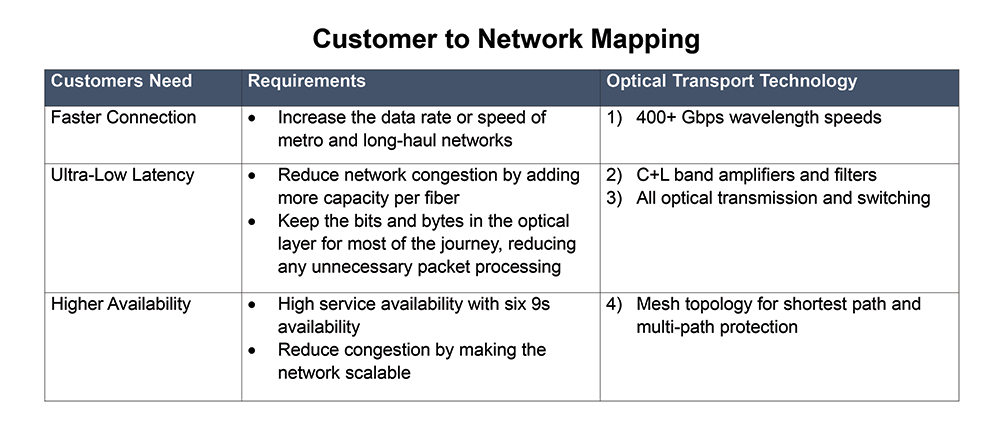
(1) 400+ Gbps wavelength speeds: End users want faster connections to their devices, using new broadband access technologies that require higher backhaul speeds. Therefore, the transceiver speed in the aggregation, metro, and long-haul network will need to increase beyond the installed base of 100/200 Gbps. The optical transport network will need to move to at least 400 Gbps wavelengths and, ultimately, 800 Gbps to support the higher load placed on the network. Additionally, there are many benefits to moving to 400+ Gbps wavelengths, including higher network efficiency, less rack space, lower power per bit, and lower cost per bit.

(2) C+L band amplifiers and filters: Two factors heighten the need to increase the capacity per fiber. The first is that demand for bandwidth has risen every year since the beginning of the Internet era, and it will continue to rise for many more years into the future. The second reason is that, because of Shannon’s Limit, every new generation of wavelength speeds utilizes higher baud rates, consuming more spectrum. As a result of these factors, operators need fiber strands to carry more capacity. Otherwise, they will need to add more strands of fiber, which may not be possible, causing network congestion along some routes. The solution is to add more usable spectrum in a fiber.

Originally, optical equipment was designed to operate in 4 THz (80 channels @ 50 GHz) of fiber spectrum located in the C-band. Over time, equipment manufacturers increased it to 4.8 THz (96 channels @ 50 GHz). The next generation of equipment will inevitably be designed to operate in 6.0 THz (120 channels @ 50 GHz) of spectrum, referred to as Super C-band. This action alone increases the amount of bandwidth-per-fiber by 25 percent. The spectrum can be nearly doubled by adding L-band, which supports 100 channels @ 50 GHz. Consequently, a fiber that had a maximum capacity of 38.4 Tbps (calculated using a spectral efficiency of eight) can now support 88.0 Tbps.

(3) All optical transmission and switching: The speed of transmission is important, but for some applications that require real-time response and feedback, latency is critical. We mentioned gaming as one application for consumers, but there are numerous additional applications in industries such as medical, power utility, automotive, and aerospace, where lower latency is a major requirement. One way to improve or lower latency is to remove any points along the signal’s route where it must be read, processed, buffered, or converted to electrical and then back to optical. Hence, the approach would be to use optical transmission and switching, such as reconfigurable optical add/drop multiplexers (ROADM) or optical cross-connect (OXC), as much as possible.

(4) Mesh topology for shortest path and multi-path protection: Mesh topology has many benefits: reduction of the number of hops between endpoints, improved path protection, and increased network scalability. More importantly, due to the exponentially higher number of paths a signal can take versus a ring topology to its destination, network quality is dramatically improved, moving the network towards six 9s availability.


“At the Root of It All”

Optical Transport is the network layer that delivers on the services and features that consumers want. Hence, any upgrades or addition of new services to end users will require changes in the optical layer. Using our tree analogy: there is no tree without the roots, and there is no network without optical transport. Therefore, to support all the next generation of services (5G Advanced, F5G Advanced, AI/ML applications, and DCI) that operators and cloud service providers are rolling out and ensure a high-quality of experience, the optical transport layer must also be upgraded.
[wp_tech_share]

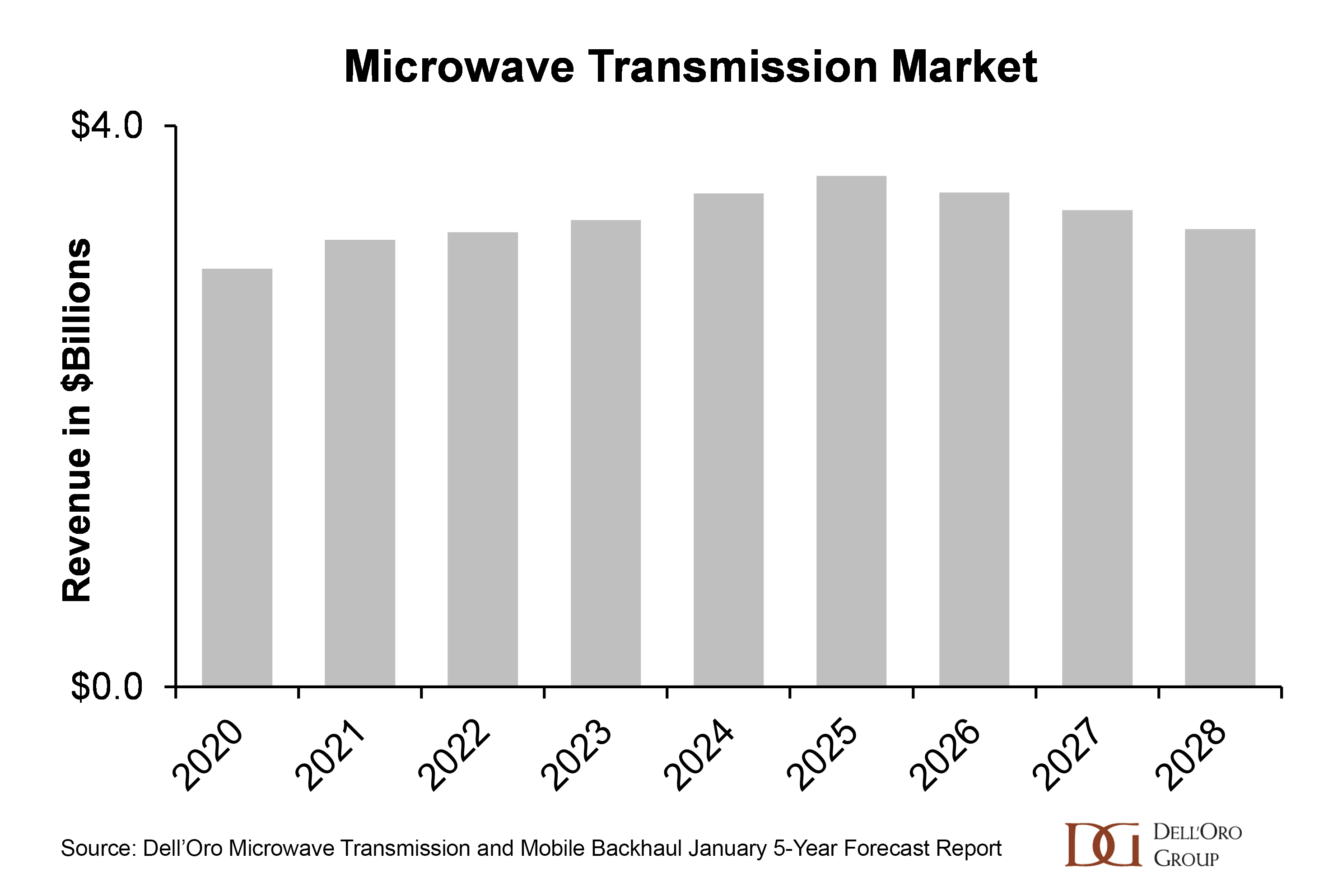
In Dell’Oro Group’s January 2024 update to the Microwave Transmission & Mobile Backhaul Transport Five-Year Forecast report (2023-2028), a mixed outlook emerges. Here are some good news and bad news. Let’s delve into the highlights of these contrasting trends:

Good News

The good news is that the microwave transmission market entered a growth cycle due to the expansive 5G buildouts in 2021 and has enjoyed a steady pace of growth. Furthermore, we expect that there will be at least two more years added to this growth cycle, culminating in five years of market expansion. During this period, the microwave transmission market’s annual revenue will increase 22% and the cumulative revenue for that period will be nearly $17 billion. Other factors contributing to the near-term growth projections include:

  • Overall demand for more bandwidth by customers is expected to continue for many more years, requiring higher link capacities. As a result, the adoption of E/V Band systems is expected to be much higher, and the number of carriers per cell site is also projected to increase.
  • Revenue in Europe is expected to recover following a significant decline in 2022 and 2023 that was caused by the Russia/Ukraine war, unfavorable currency exchange rates, and macroeconomic uncertainty.
  • India surprised us on the upside in 2023. We do have concerns that spending in 2024 will be lower after such a strong start to rolling out 5G, but based on our understanding, outside of one operator, the 5G roll out in the country has really just gotten started.
  • Worldwide government initiatives to expand broadband coverage into rural areas should stimulate additional demand for microwave systems beyond mobile backhaul.


Bad News

Now for the bad news. The bad news is that the Microwave Transmission market, like many others, is cyclical. Therefore, following these five years of expansion, we are predicting the market to decline or contract for a few years. Specifically, we believe the Microwave Transmission market revenues will trend lower until the next growth cycle is initiated by 6G. Also, similar to past mobile generations, we anticipate that operators will focus on installing new 6G sites at locations with fiber before advancing to sites that use wireless systems for backhaul. So, the next growth cycle for microwave may not occur until 2030, meaning the market contraction period may also be five years in length.

There is one silver lining. Although the broader microwave market will be in a multi-year decline, we believe demand for E-band systems will continue to increase. We are forecasting E/V Band radio transceiver shipments to grow through 2028 at a 13 percent CAGR.

[wp_tech_share]

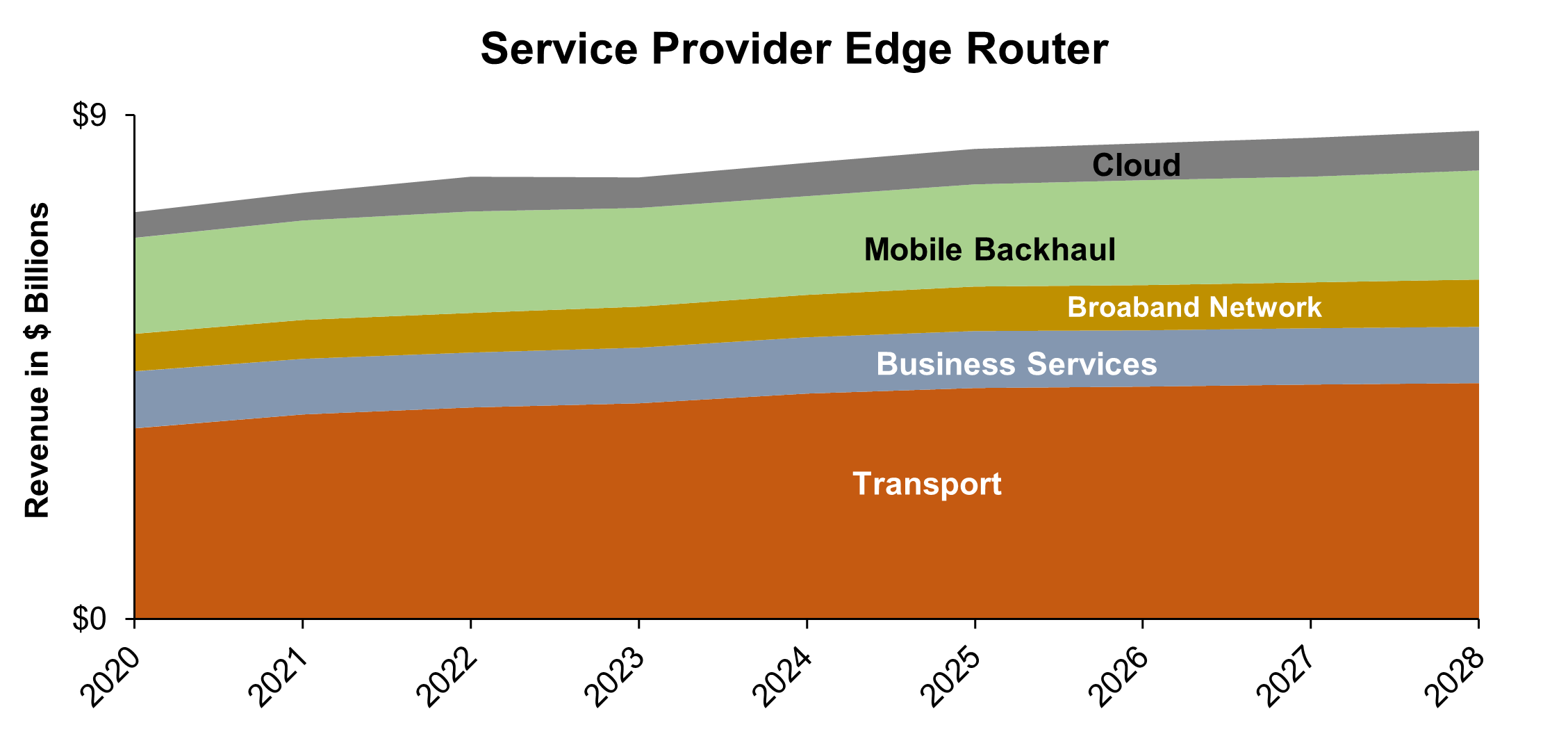
We just wrapped up our semi-annual Router Five Year Forecast report, refreshing our near-term and long-term market views. The following are some of the highlights of the January 2024 forecast report and key market trends for this year.

Near-Term Trends for 2024

  • The level of market uncertainty remains higher than normal this year due to the following factors: 1) supply and demand imbalance among North American service providers; 2) wars in both Eastern Europe and the Middle East; 3) concern about or fear of an impending economic recession; and 4) higher borrowing costs created by governments raising interest rates.
  • The component shortage that disrupted the industry is behind us. But, the residual effect of this long supply chain disruption is expected to have some adverse market effects in 2024, particularly in North America where service providers may be sitting on excess inventory.
  • Although the full year 2023 results are not in yet (4Q23 reports to be completed in February 2024), Core Router revenue looks poised to grow 12% in 2023. That said, some market softness should be expected in 2024 following such a strong year.

Long-Term Trends beyond 2024

  • The longer-term view of the routing market remains positive, especially for High End Routers since the need for routing capacity will trend higher for many more years to come. We forecast that the cumulative revenue of High End Routers for the next five years will be 15% higher than that of the previous five years at nearly $70 billion.
  • Based on the annual shipment capacity we are projecting for the next five-years, we estimate that the cumulative network capacity from High End Routers will grow at an average annual rate of nearly 30% with the highest share contribution from 400 Gbps Ethernet and higher port speeds.


All major applications should contribute to Edge Router market growth over the next five years. While network capacity/transport will remain the largest contributor to the market revenue, Cloud DCI and fixed broadband should drive more of the growth in the next five years.

[wp_tech_share]

A Problem to Solve

For the past couple of decades, the rising demand for optical network capacity has been counter-balanced by the declining price of a Gbps. It was one reason service providers could keep up with customer demand for bandwidth without exponentially growing their Capex spend. However, while bandwidth demand rose, the cost to lower the price-per-Gbps increased. Stated another way, optical companies had to perpetually invest more resources in research and development (R&D) to solve one key problem for their service provider customers: keeping the cost of bandwidth from growing exponentially.

Demand for Bandwidth Grows 30% Annually

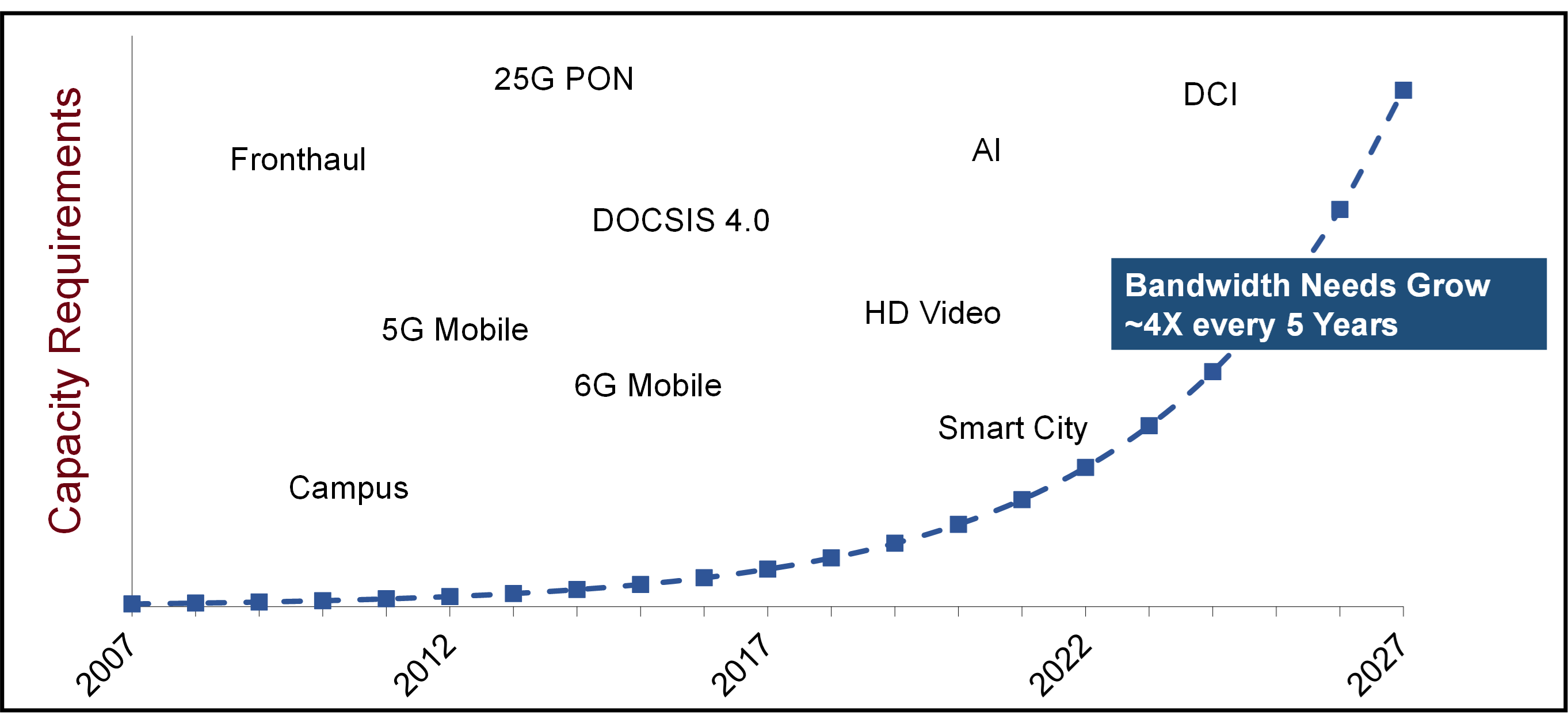
The demand for capacity in long distance networks has been growing at an average annual rate of 30% for the past decade and is expected to do the same for the next decade. This means that for every five-year period, the amount of installed network capacity on a Gbps basis needs to grow by roughly 4X. This increase in bandwidth is driven by an increase in applications that consume more capacity.

  • Access technology: The technology in the access layer increased the speed that end users were able to access the internet from Kbps to Gbps. The latest access technologies include 25G PON and 5G; the future includes 50G PON and 6G.
  • Densification: More places are being connected with fiber. Over time, fiber connections have moved from central offices to city blocks and now to homes. Smart cities are emerging that integrate communication technology with the infrastructure, further pushing up the number of connected devices, including those for safety and security.
  • Video: High definition (HD) video has moved beyond the television to handheld devices, surveillance cameras, and even doorbells.
  • Artificial Intelligence (AI): This is just the start of AI and machine learning (ML). We think ChatGPT was the first of many new applications leveraging AI and ML that will appear in the market. In fact, it is a possibility that AI/ML applications will drive annual bandwidth growth beyond 30% in the future.

Price of a Gbps Declined 20% Annually

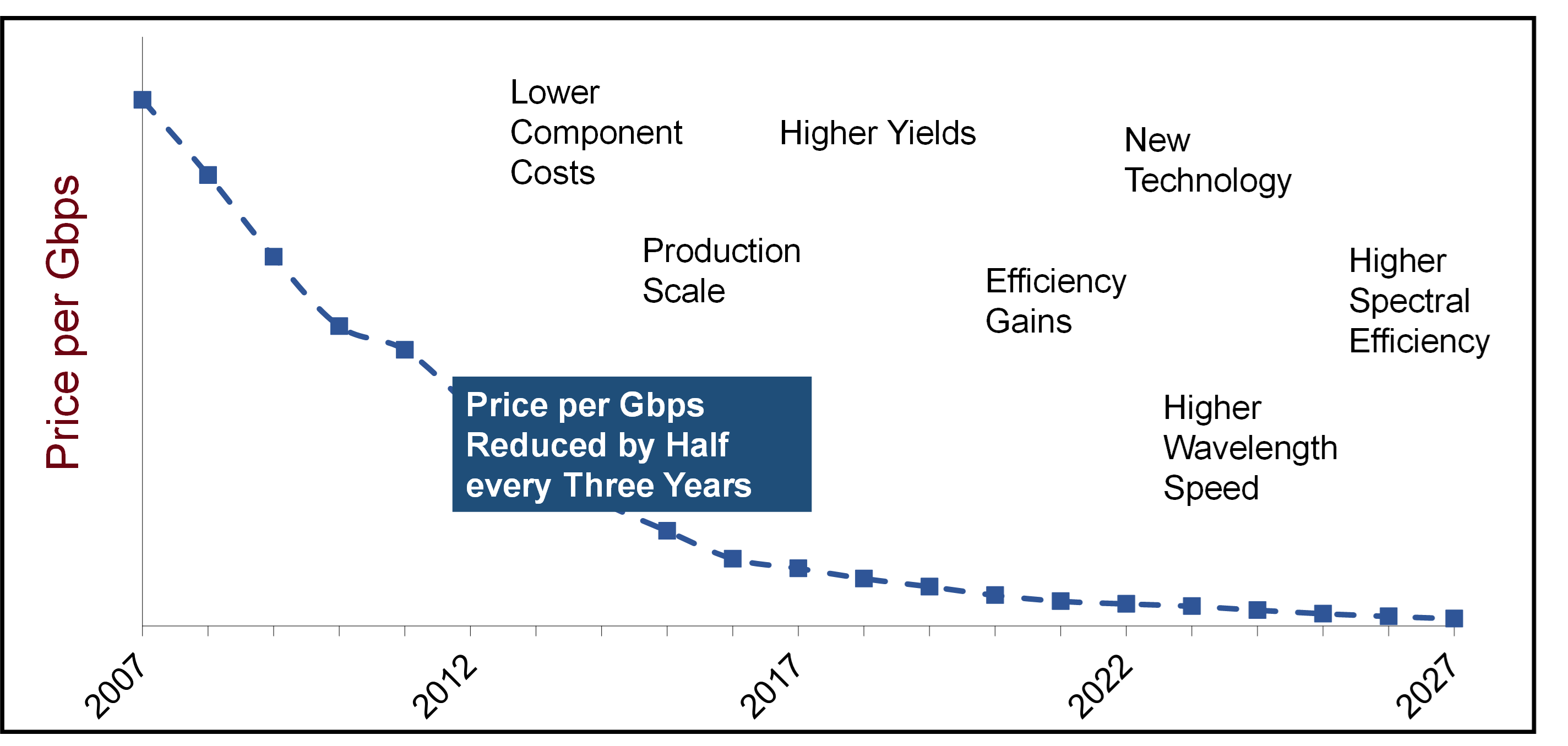
Although bandwidth requirements grew exponentially, service provider Capex grew linearly. This is because the price of DWDM equipment on a Gbps basis declined at 20% annually or by half every three years.

Price of a Gbps Declined 20% Annually

The 20% annual price decline is broadly achieved through the combination of two cost drivers:

  • Efficiency gains: We believe efficiency gains contribute approximately one-third of the annual price reduction. A few ways to improve efficiencies include improving manufacturing processes, achieving better product yield, and obtaining manufacturing scale.
  • Innovation: New technologies introduced into the market contribute the remainder of the 20% price reduction. These new technical innovations include coherent DSP and photonics to produce higher wavelength speeds that have better spectral efficiency (SE).

Spectral Efficiency Improvements Slowing

One of the main methods to lower the price-per-Gbps is to increase the SE of a wavelength. When sending more bits in the same amount of spectrum, the service provider amortizes the high cost of the optical line system (comprised of DWDM chassis, amps, ROADMs, and fiber) over more bandwidth. Thereby, lowering the price-per-bit of the network.

Coherent Technology

But, as we approach Shannon’s Limit, SE improvements are slowing and a problem is emerging.

  • Beginning in 2008, SE improvements accelerated higher due to the introduction of coherent technology. When a service provider moved from using a 10 Gbps wavelength to a coherent 100 Gbps wavelength, the SE increased 10X.
  • Although SE improved with the availability of new wavelength speeds, it was not at the same scale because the SE improvement of each generation is less than that of the previous generation as we advance towards Shannon’s Limit.
  • We believe the SE improvements in the next five years will only be 5%.

The Problem Statement

Increasing SE was the biggest lever to reducing the price-per-Gbps. However, due to Shannon’s Limit, future SE gains are harder to realize. Therefore, new technical innovations must be created. Otherwise, one day, service provider Capex will need to grow exponentially to keep up with user demand for bandwidth.

[wp_tech_share]

OFC 2023 was a great conference this year with the exhibit hall packed with people exchanging thoughts and ideas. One of the main technology themes at the show was around terabit-capable coherent wavelengths. Hence, my main takeaway from the conference was that we are now in the Terabit Era.

During the conference, practically every component and systems manufacturer showed off their plans for a 1.2 Tbps-capable coherent wavelength. The only exception was Ciena with an advanced 1.6 Tbps single carrier solution.

New High-Performance Coherent DSPs

The next generation of coherent DSPs was announced and displayed by several companies. Based on conversations at the show, the first significant quantity of shipments could begin as early as 2H 2023 with a ramp in production during 2024. The following is a list of announcements related to high-performance sixth-generation coherent DSPs.

  • Cisco/Acacia Jannu: 1.2 Tbps-capable DSP on a 5 nm node process operating at up to 136 Gbaud. General availability target is mid-2023.
  • NEL ExaSpeed GAIA: 1.2 Tbps-capable DSP on a 5 nm node process operating at up to 140 Gbaud. General availability target is mid-2023.
  • Nokia PSE 6s: 1.2 Tbps-capable DSP on a 5 nm node process operating at up to 130+ Gbaud. General availability target is end-2023.
  • Infinera ICE7: Customized 1.2 Tbps-capable DSP from a partner supplier on a 5 nm node process operating at up to 148 Gbaud. General availability target is mid-2024.
  • Ciena WaveLogic 6e: 1.6 Tbps-capable DSP on a 3 nm node process operating at up to 200 Gbaud. General availability target is mid-2024.

On a side note, Huawei was not at this conference. However, in separate meetings with the company, we understand they have plans to develop a 1.2 Tbps-capable DSP operating at up to 130+ Gbaud. The semiconductor process technology is unknown at this time, but it may be 7 nm if SMIC can produce it.

Among the vendors, Ciena is the only one launching a coherent DSP that can do a single carrier 1.6 Tbps wavelength. To accomplish this, the company is not only going with a more advanced semiconductor node process (3 nm rather than 5 nm), but is also developing advanced coherent drivers and receivers that can push the transponder to 200 Gbaud (no other company has 200 Gbaud drivers at this time). To remove any concerns about timing and progress of the WaveLogic 6e development, especially since it is using such an advanced semiconductor process node, Ciena took the time to detail out its development progress behind closed curtains.

Terabit Era Ready

There were a number of announcements by service providers confirming that 1.2 Tbps-capable devices are ready, and that they themselves were looking forward to these new high-performance transponders. Three of those announcements were as follows:

  • Windstream did a field trial in a live network to confirm technology readiness in a real world setting. The field trial used the Acacia CIM8 based on the Jannu DSP and showed that a 1 Tbps wavelength could be carried over at least 541 km with excess performance margin. The wavelength operated over SMF28 fiber with approximately 6 WSS filters along the way.
  • GlobalConnect did a field trial of Nokia’s PSE 6s in a live network. In this trial, GlobalConnect tested the 1.2 Tbps-capable DSP for a long haul route, operating at a wavelength speed of 800 Gbps. The route length achieved in this trial was 2,019 km.
  • China Mobile did a field trial of the Acacia CIM8 in an ultra-long-haul application, demonstrating that a 1.2 Tbps-capable transponder can transmit a 400 Gbps wavelength 5,616 km in their live all-optical network.

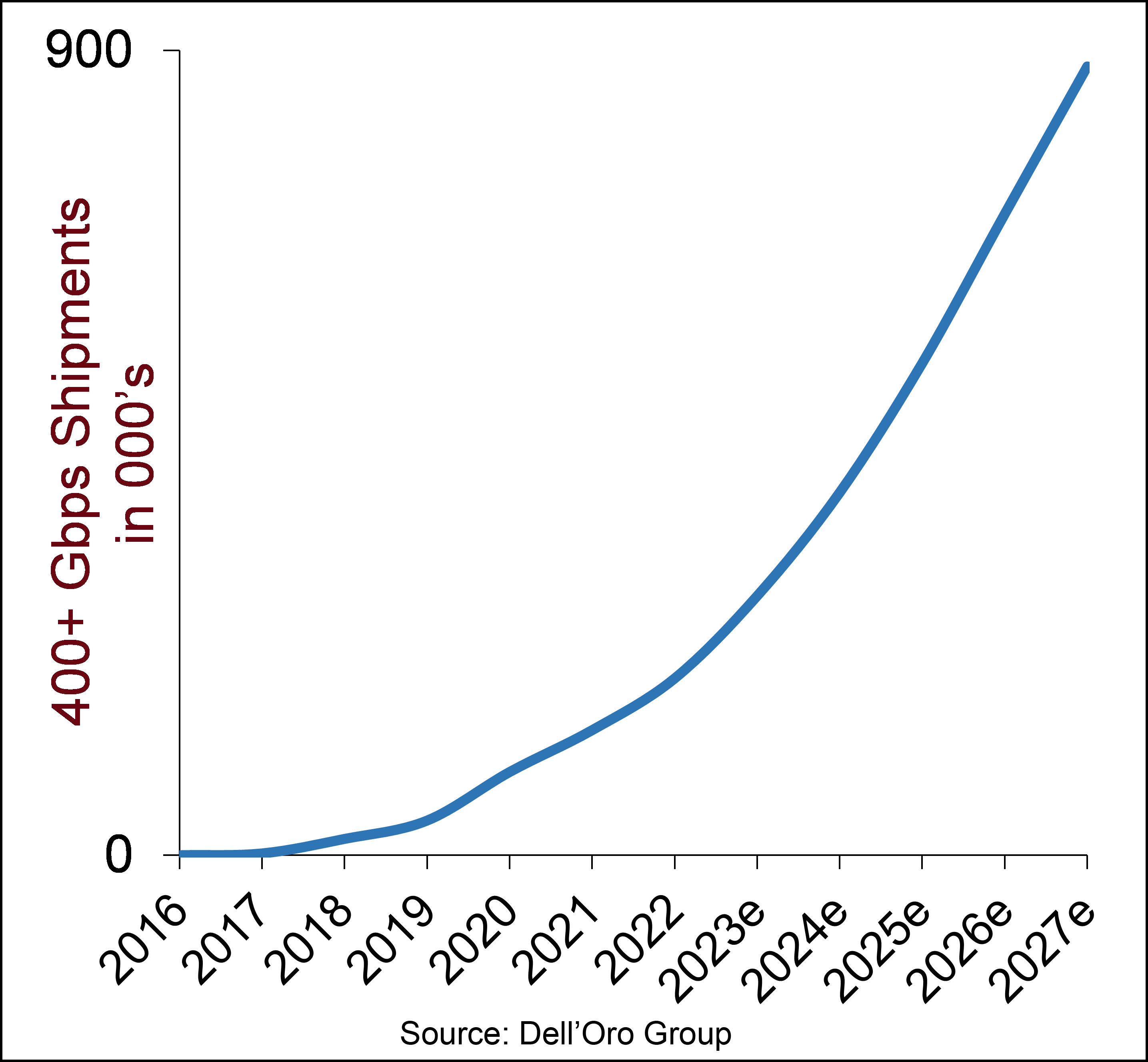
These field trials are a great demonstration of how the coherent 1.2+ Tbps-capable technology delivers on both higher capacity and longer spans. In the January 2023 Optical Transport five-year forecast report, we projected that demand for 400+ Gbps wavelength shipments will grow at a 40% CAGR, and that one of the key enablers for this growth will be these new sixth-generation coherent DSPs.