[wp_tech_share]

After spending a few days at OFC 2019, I sat down and read through the notes I took during each meeting at the conference and concluded that I have fewer pages of notes for this OFC than in the past two OFCs attended. Kidding aside…This lack of notes was in no way an indication of the meeting quality. They were great meetings with a lot of information exchange. It was, however, an indication that nothing was “really” new at this conference from the past two conferences. In fact, at times, I felt a sense of Déjà vu.

At the conference 600 Gbps and 800 Gbps coherent optical components, DSPs, and systems were re-affirmed with samples, demos, and timelines.  As I understand it, the timeline for system availabilities are as follows:

  • 600 Gbps capable coherent line cards
    • Cisco’s NCS 1004, Infinera’s Groove G30 using Acacia’s DSP will be available by the end of March 2019
    • Fujitsu’s 1Finity T600 using NEL’s DSP was available one week before OFC
    • Huawei’s OSN with an in-house DSP will be available by end of March 2019
    • Nokia’s 1830 PSI-M with an in-house DSP will be available in 3Q 2019
  • 800 Gbps capable coherent line cards
    • Ciena is targeting the end of 2019 (I’m guessing last month of 2019)
    • Huawei by end of 2020 (I’m guessing last month of 2020)
    • Infinera is targeting 2H20 (I’m guessing the first month of 4Q 2020)

Nearly everyone talked more about 400 Gbps ZR in a QSFP-DD or OSFP form factor this year. This was the same as last year. However, now both Ciena and Infinera have announced plans for developing and manufacturing 400G ZR. So, there are definitely more companies interested in making and selling 400G ZR. We should see 400G ZR products and demo in OFC 2020.

The most interesting item I saw at OFC this year was probably a new product that Fujitsu is developing that they call Trans Lambda. It sounded like the company needed a couple more years to develop the product, but the concept was quite unique. The premise is that as the optical world hits Shannon’s limit, the use of L-band will increase. So, Fujitsu is working on a box that can shift C-band signals to L-band without an optical-electrical-optical conversion.  I’m looking forward to hearing how this technology develops and fits into the optical market in the future.
[wp_tech_share]

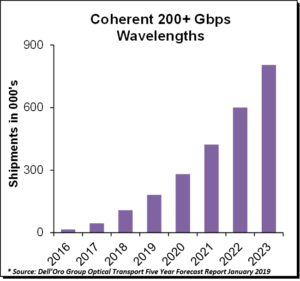
The latest Dell’Oro Group Optical Transport 5-Year forecast report claims that the cumulative Optical Transport equipment spend is projected to approach $80 billion over the next five years. The majority of the Optical Transport revenue will be driven by demand for coherent 200+ Gbps wavelengths.
“The market demand for 100 Gbps will continue to be large, but all future optical transport market growth will be driven by sales of higher wavelength speeds,” said Jimmy Yu, Vice President at Dell’Oro Group. “We believe service providers are still motivated to chase better spectral efficiencies to economically increase network capacity while maintaining their capital spend. Hence, the desire to migrate to higher wavelength speeds such as 200 Gbps and 400 Gbps. Fortunately, component and system manufacturers are striving to deliver better coherent solutions with each new product generation.  As a result, optical routes that once were only serviced by 100 Gbps wavelengths are now serviceable by 200 Gbps wavelengths and 400 Gbps in the future,” continued Yu.

Additional highlights from the Optical Transport 5-Year Forecast Report:

  • The cumulative spend on Optical Transport equipment during the next five years is projected to grow 16 percent.
  • Revenue from coherent 200+ Gbps DWDM shipments is forecast to grow at a 30 percent compounded annual growth rate.
  • Disaggregated WDM systems will be a larger share of the market.

About the report – The Dell’Oro Group Optical Transport 5-Year Forecast Report offers a complete overview of the Optical Transport industry with tables covering manufacturers’ revenue, average selling prices, unit shipments, Tributary/Line or Wavelength shipments (by speed up to 600 Gbps).  The report tracks DWDM long haul terrestrial, WDM metro, multiservice multiplexers, and optical switch equipment.

To access the report, please contact us by email at dgsales@delloro.com.

[wp_tech_share]

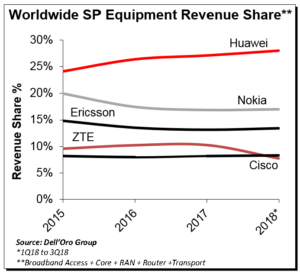
Huawei captured 28 percent share of the telecom equipment market, increasing its market share by 4 percentage points since 2015.

We just wrapped up the 3Q 2018 reporting period for all the Telecommunications Infrastructure programs.

For the first nine months of 2018, the top five equipment manufacturers were Huawei, Nokia, Ericsson, Cisco, and ZTE. Combined these five companies accounted for about 75% of the worldwide service provider equipment market revenue.

Additional key takeaways from the reports period include:

  • The overall telecom equipment market declined 2 percent year-over-year for the 1Q 2018 through 3Q18 period. Robust demand for Optical Transport and Microwave Transmission equipment was not enough to offset declining Core and Service Provider Router revenues.
  • Huawei’s revenue share continued to improve in 2018—up around four percentage points between 2015 and the first nine months of 2018. During this period, Ericsson’s and Nokia’s market share declined one and three percentage points, respectively.
  • Huawei’s telecom equipment revenue is nearly as large as Nokia and Ericsson combined.
  • Huawei’s revenue share gains over the past four years have been most pronounced in the Core, Router, and Optical Transport Markets.

Dell’Oro Group telecommunication infrastructure research programs consist of the following: Broadband Access, Carrier IP Telephony, Microwave Transmission & Mobile Backhaul, Mobile Radio Access Network, Optical Transport, Router & Carrier Ethernet Switch, Telecom Capex, Wide Area IoT, and Wireless Packet Core.

[wp_tech_share]

I just finished up three days of meetings at OFC 2018. I wanted to share a few of the key highlights from the show relating to Optical Transport.

First, I think the components market is gearing up nicely to enable optical system vendors to deliver better coherent line cards. What do I mean by better? With the help of a new generation of coherent DSPs and 64 Gbaud optics (transmit, receive, and drivers), 200 Gbps WDM wavelengths will be able to reach farther before a costly signal regeneration needs to take place, and fiber constrained buyers can opt to turn on higher speed wavelengths such as 400 Gbps, 500 Gbps, and 600 Gbps. However, for now, 600 Gbps span length will likely be under 200 km depending on conditions. This is really about producing better performing line cards capable of expanding the 200 Gbps and higher speeds into a broader market.

One of the critical items to enable higher wavelength speeds is a great coherent DSP, and there were a few announced at the show this year. Companies with new DSP announcements were Acacia, NEL, and Nokia. All three seemed to have a similar readiness timeline—available soon and in optical system vendor line cards ready for sale by the end of 2018. Among these three, Nokia’s new PSE3 seemed to be pushing the technology envelope (benefit of Bell Labs). Beyond the fancy name—probabilistic constellation shaping—what the new DSP does is improve optical performance by optimizing the modulation constellation; not by changing it from 64QAM, but by selecting the best points on the 64QAM constellation to use (I’m over simplifying what the PSE3 does, but I accepted the technology is beyond my grasp).

Also, among the three DSPs, Acacia and NEL’s development is really important to the optical ecosystem. The reason being that outside of the system vendors that design and make in-house DSPs, everyone else will be relying on these two vendors to allow them to compete against vendors such as Ciena and Huawei, companies that already have working 400 Gbps single wavelength solutions. This is really important in the very competitive and fast moving market for disaggregated systems. New 600 Gbps wavelength capable systems relying on these two DSP companies were announced by ADVA, Cisco, Coriant, Fujitsu, and PacketLight.

Second, I learned a few new things that I found interesting. As some of you may know, fast encryption has become an important requirement. In the past optical system vendors would add encryption on to their FPGAs, but it took time to license and get the IP (intellectual property) rights. What if there was an easier way? I spoke with Microsemi and learned that they have a new OTN chip called DIGI-G5 that not only performs 1.2 Tbps of OTN switching but also wire speed encryption, all in one ASIC. DIGI-G5 will also support 25 Gbps and 50 Gbps Ethernet as well as 400 Gbps Ethernet.

I also learned that adding optical DWDM optics onto switches and routers is back. It was just a little over 10 years ago that Cisco first added 40 Gbps DWDM optics to their large core router, and over time there have been a number of attempts to grow sales into this type of hardware convergence, but it never amounted to much. Well, the idea isn’t new, but there is a slight twist. Rather than add DWDM optics to large, core routers and switch, system houses are looking to add them to smaller access or edge routers and switches. This is what we saw from Ciena’s new 8180 and Juniper’s new ACX6360. Both platforms will have packet aggregation/switching and 200Gbps or higher DWDM optics. I think the opportunity for this type of platform could be better than the false starts in the past. The reason is that as you move closer to end-users, Ethernet traffic and switch/routing become more pervasive, and with Fiber Deep and 5G, the capacity requirements will also undoubtedly increase.

There were a lot of interesting things announced at OFC. Unfortunately, I’m not able to write about all of them here. Other announcements that were exciting include:

  • Infinera announced plans for two new optics engines: ICE5 for late 2018 and ICE6 for 2020.
  • Jabil will have a factory direct model for CFP2-ACO type 2 modules.
  • Huawei’s in-house CFP-DCO is now 200 Gbps capable.
  • NeoPhotonics developed a COSA (coherent optical subassembly) for 400 Gbps ZR that is meant for an OSFP pluggable.