[wp_tech_share]

Optical bandwidth is not limitless. I know we have all used the argument over the past few decades that by placing an optical fiber connection between two points you will have unlimited capacity. It is an argument we have all used when convincing the market that a fiber deployment future proofs the investment. Now, a few decades later, the reality of Shannon’s Limit hangs over service providers’ future like a dark cloud (an actual one, not the data center cloud kind).

Globally, service providers have always enjoyed the benefit of meeting customer requirements for higher network capacity at a lower per bit price by installing the latest optical DWDM transponders. It has been a tried-and-true method that leveraged the sunk costs related to fiber and amplifiers, often referred to as the fiber plant. Therefore, not only did a service provider benefit from the higher capacity and lower cost-per-bit inherent in each new generation of DWDM transponders, but they also benefited from installing these additional wavelengths in pre-existing fiber plants where much of the costs are either fixed (in the case of a leased fiber), depreciated (in the case of fiber ownership), or non-existent (in the case of fully depreciated fiber plants). The advantage of this is that for every bit added to a fiber, the cost of transporting the bits declines.

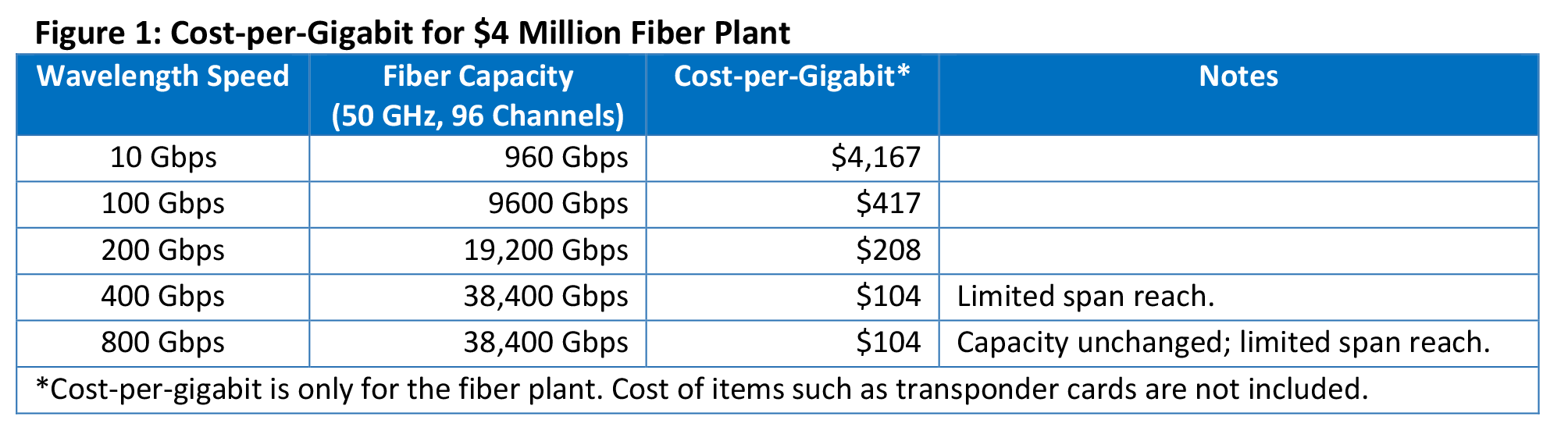
Even in the case of a green field deployment, the more a service provider can maximize the capacity of the fiber plant, the lower the cost of each bit transported. For example, if a fiber plant cost $4 million, the first gigabit may cost $4 million, but when 9,600 Gbps is installed, the cost-per-gigabit drops to $417 (Figure 1). It is a linear decline in cost. That is… until the capacity on a fiber can no longer increase due to Shannon’s Limit and spectrum availability.
Cost-per-Gigabit for $4 Million Fiber Plant
This constraint, brought about by the physical limitations of glass and light, brings to the forefront two challenges—extending the span length of higher wavelength speeds and increasing fiber capacity—and, fortunately for the industry, two solutions that will help service providers continue to reduce their cost-per-bit for at least another decade.

  1. 800 Gbps-capable transponders with probabilistic constellation shaping operating at around 96 Gbaud solves one of the challenges—extending the span length. Using these new transponders will help in a couple ways. For metro spans, service providers will immediately benefit from having a lower cost-per-bit by deploying one set of 800 Gbps line cards rather than two sets of 400 Gbps line cards. The second benefit is the extended reach. What was not shown in Figure 1 was that the un-regenerated span length of each wavelength speed diminishes as the wavelength speed goes up. However, with 800 Gbps-capable line cards, a 400 Gbps wavelength will be usable in many more fiber routes that extend in to the thousands of kilometers, reducing the need for costly regeneration sites. As a result, in both metro and long haul routes, 800 Gbps-capable line cards will reduce a service providers’ cost-per-bit.
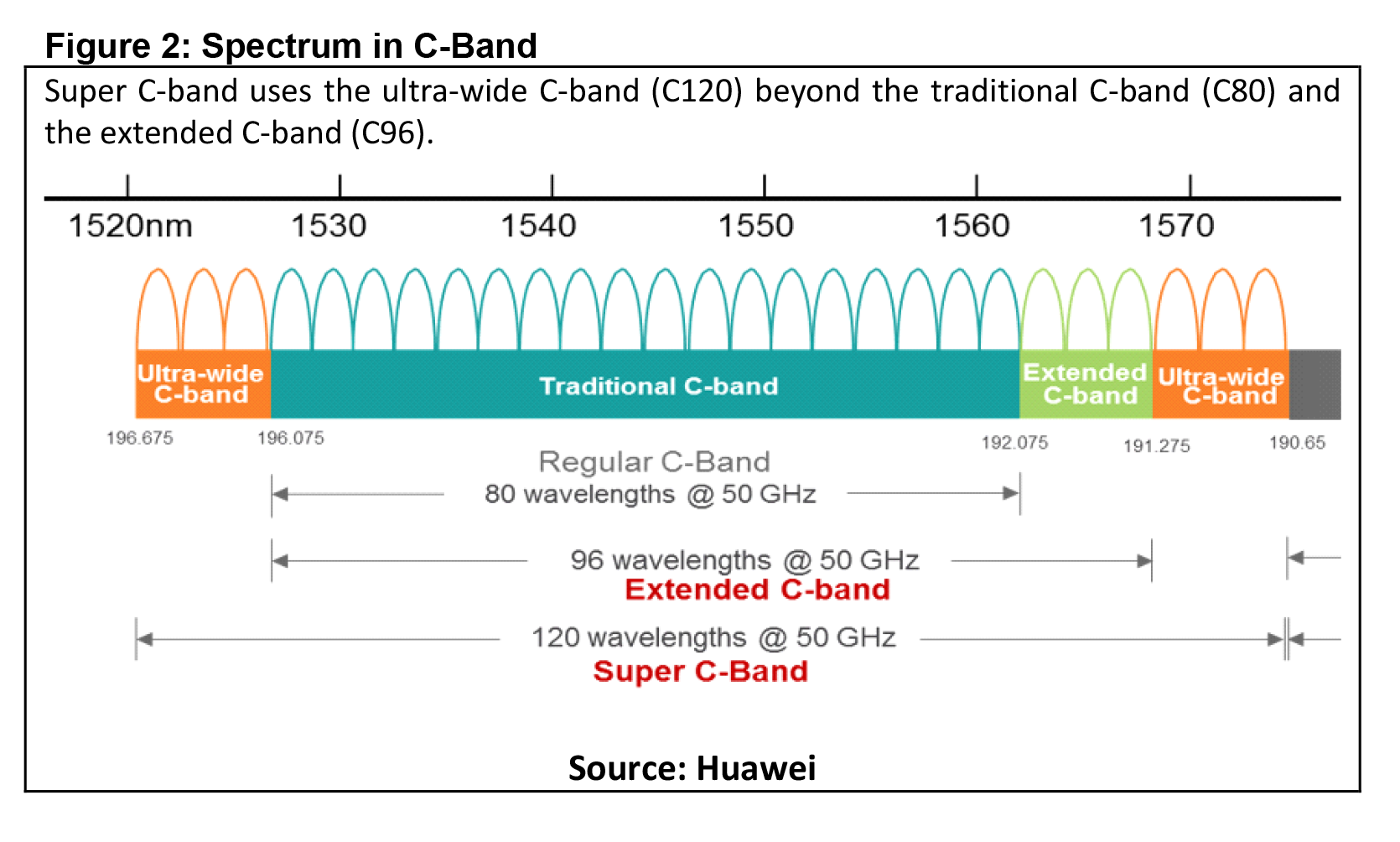
  2. Expanding the usable spectrum in a fiber will solve the second challenge—increasing fiber capacity. For the longest time, optical equipment was designed to operate in 4 THz (80 channels @ 50 GHz) of fiber spectrum located in the C-band (Figure 2). Over time, equipment manufacturers increased it to 4.8 THz (96 channels @ 50 GHz). The next generation of equipment will inevitably be designed to operate in 6.0 THz (120 channels @ 50 GHz) of spectrum, referred to as Super C-band by Huawei. This action alone increases the amount of bandwidth-per-fiber by 25 percent. As a result, a fiber that had a maximum capacity of 38.4 Tbps (at 400 Gbps per wavelength) can now support 48.0 Tbps. Using our $4 million example in Figure 1, the cost-per-gigabit will be further reduced from $104 to $78.
Huawei Spectrum in C-Band

We believe these new technologies will need to be adopted in the future to continue the cost-per-gigabit declines that the market has gotten accustomed to.
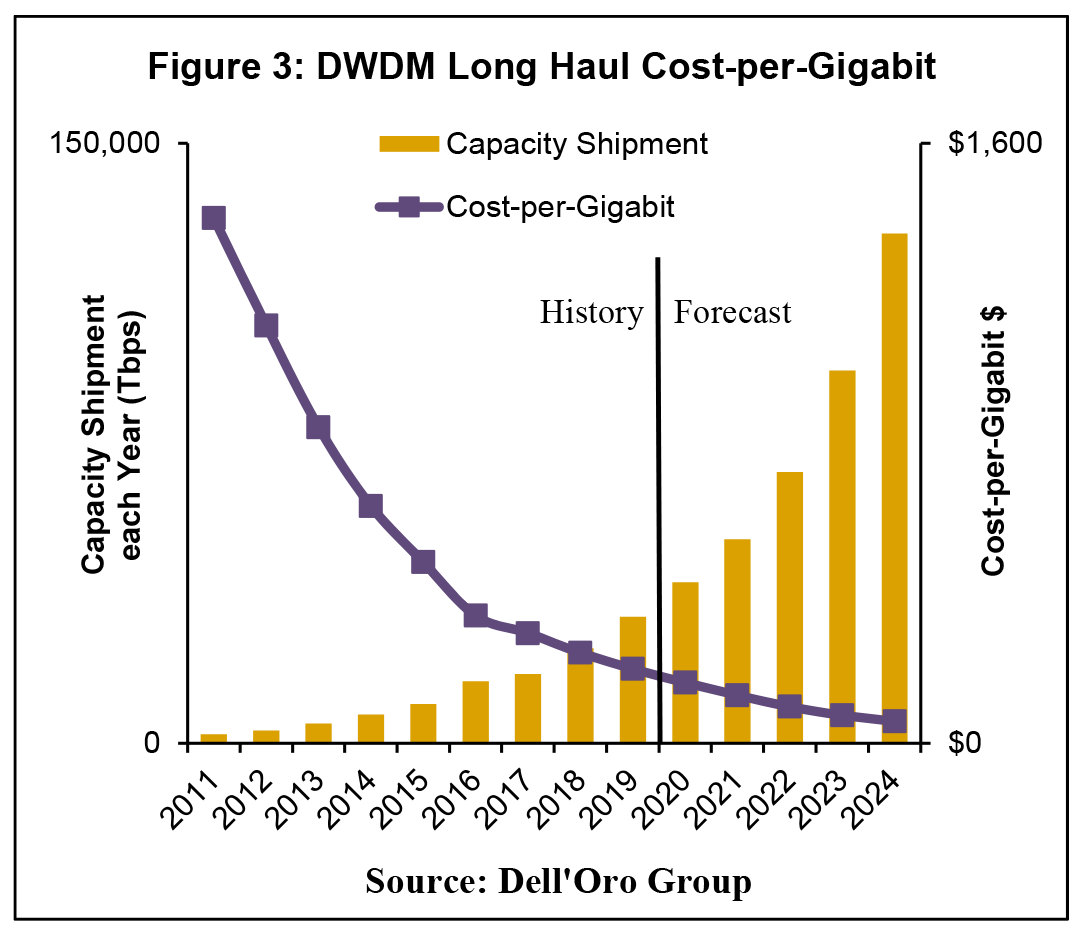
Dell'Oro DWDM Long Haul Cost per GigabitAs a point of reference, in the past decade, the average annual decline in cost-per-gigabit for DWDM Long Haul transport equipment was about 20 percent due to improving spectral efficiency gains brought on by deployment of newer, higher-speed wavelengths (Figure 3). It was a similar rate of decline for WDM Metro, as well.

It probably does not need to be said, but this decline in the cost of a gigabit was a critical element needed for service providers to profitably keep up with network demand, which grew at an average annual rate of approximately 35 percent. Also, as we see it, demand for bandwidth will only grow from here, placing additional strain on service providers to profitably increase their network capacity for many more years.

We believe that with the new technologies mentioned, this pace of declining costs can continue to benefit service providers for at least another decade.

In the face of Shannon’s Limit, installing systems that can extract higher value from installed fiber becomes critical. Two technologies entering the market will push out the concerns brought by Shannon’s Limit for at least another decade. Therefore, to all the service providers, take a moment, and breathe a sigh of relief because there are new solutions on the way to help you: 1) increase network capacity and 2) reduce your future cost of bandwidth.
[wp_tech_share]

We just published the 4Q19 update to the Microwave Transmission & Mobile Backhaul quarter report. Here are a few key findings for the quarter.Microwave Transmission top 3 vendors 4Q19

  • Microwave Transmission market declined in 2019 following a slight rebound the prior year. The decline in 2019 was due to a massive slowdown in India. We estimate sales to Indian operators declined over 50 percent in the year.
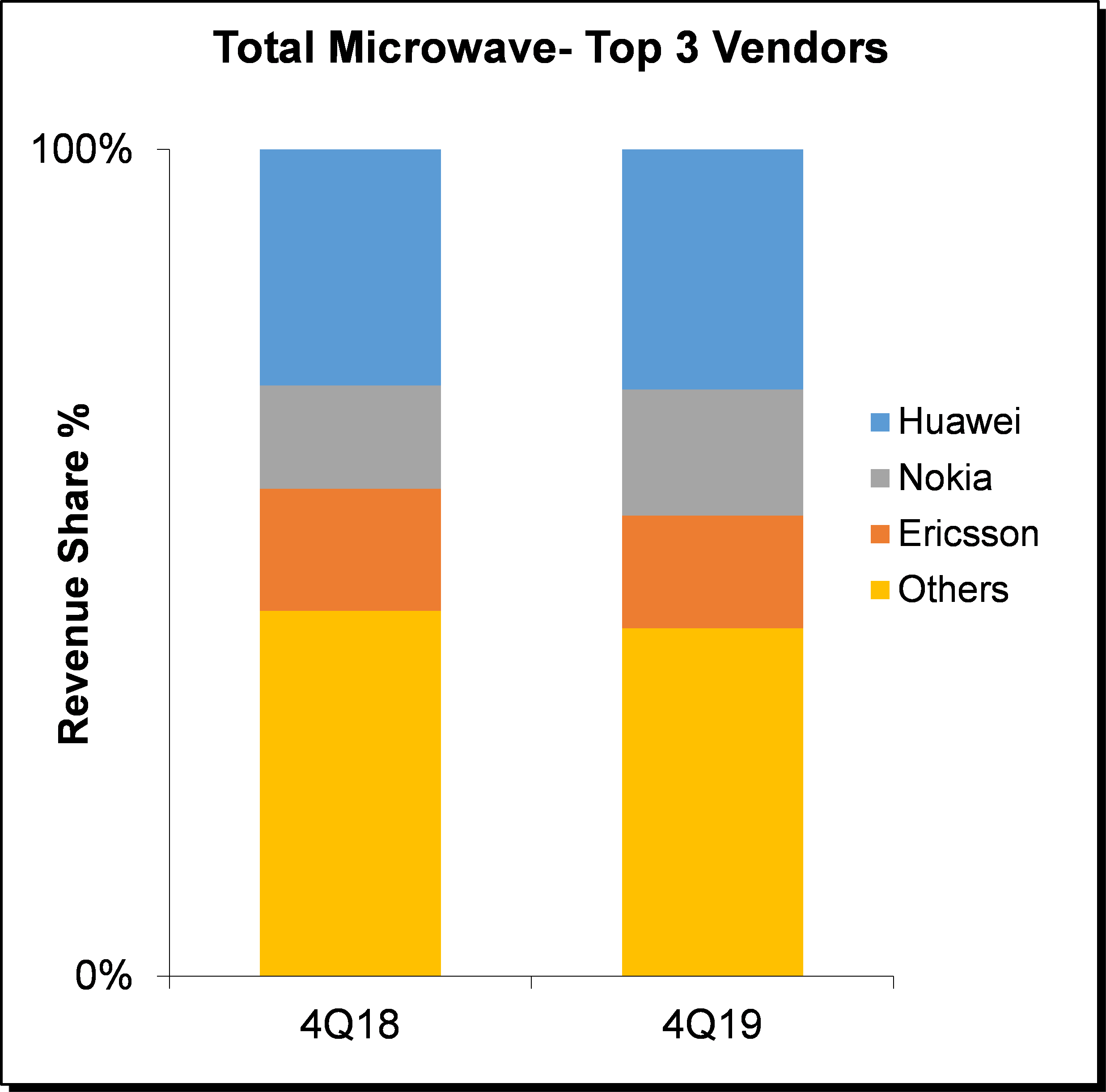
  • Huawei continued to hold the largest share of the Microwave Transmission market, garnering 29 percent share in 4Q19.
  • Vendor share was more fluid than usual in the quarter. Typically the top three vendors in this market consists of Ericsson, Huawei, and NEC. In 4Q19, Nokia overtook Ericsson for the first time and captured the second highest share.
  • E/V Band shipments outperformed in the quarter, helping to bring full year growth rates back up above 20 percent.
  • Among the microwave technology segments, we believe E/V Band systems have the greatest growth potential driven by its ultra-high capacity (10 Gbps), small footprint, and low spectrum license fees in certain countries. In addition to these advantages, demand for E-band systems in particular is projected to grow because of the availability of multi-band solutions that combine the benefits of both standard microwave frequencies with that of E-band.

About the Report

The Dell’Oro Group Microwave Transmission & Mobile Backhaul Quarterly Report offers complete, in-depth coverage of the market with tables covering manufacturers’ revenue, ports/radio transceivers shipped, and average selling prices by capacities (low, high and E/V Band).  The report tracks point-to-point TDM, Packet and Hybrid Microwave as well as full indoor and full outdoor unit configurations.  To purchase this report, please contact us at dgsales@delloro.com

[wp_tech_share]

Every generation of mobile radio technology creates renewed demand for mobile backhaul, and 5G is expected to do the same. So, it is not surprising that the major 2020 trends in mobile backhaul all relate to 5G, what the latest mobile technology means for backhaul transport equipment, and importantly, what we will need “more” of.

Trend #1: More Fiber Backhaul. Undoubtedly, the mobile network will require more network capacity with the roll out of 5G. One of the many benefits of 5G is the option to use a larger amount of spectrum and bump up the capacity for users. This is the reason so many people start a conversation about 5G and immediately shift to talking about what new applications they can run if given more throughput and lower latency on their devices.

Trend #2: More Wireless Backhaul. As in past mobile network upgrades (3G and 4G), operators balanced the use of fiber backhaul with wireless backhaul because installing fiber everywhere was never conceivable. In continuation with this trend, we believe that the mantra of “fiber first” will continue, driving the growing use of fiber backhaul, but eventually cell sites will need to be upgraded where fiber will either take too long to deploy, cost too much, or is infeasible. Therefore with 5G, wireless backhaul systems, such as point-to-point microwave, will play an equally important role for operators to deliver on their targeted network coverage and capacity as fiber systems.

Trend #3: More Carriers. Microwave systems continue to evolve to meet each new generational challenge. We believe one technology that operators will increasingly use in the future, and for 5G backhaul in particular, is combining multiple carriers in one microwave backhaul link. The two options are multicarrier—combining carriers in the same frequency band—and multiband—combining disparate frequency bands such as E-band and 18 GHz. The advantage of both options is higher link capacity with little change in tower footprint (keeping tower lease costs from going up). The additional advantage of multiband is the availability of much higher throughput (over 10 Gbps) at an economical price-per-bit compared to standard microwave frequency links.

Trend #4: More Ethernet. The shift to Ethernet began with 4G and will conclude with 5G. Therefore, the need for TDM-based systems and hybrid systems will continue to decline in favor of Ethernet-based systems (carrier Ethernet switch, routers, packet microwave, etc.) this year and into the future.

Trend #5: More Fronthaul Transport. 5G will likely bring about greater instances where the mobile baseband unit is centrally housed further away from the mobile radio unit (and tower) to obtain greater efficiency. To achieve these longer spans, operators will increasingly use fronthaul transport systems such as DWDM. While this architecture of pooling resources has always been available to operators, we believe the entrance of eCPRI will increase the adoption of centralizing baseband units since it reduces fronthaul capacity requirements.

[wp_tech_share]

The Optical Transport market has continuously evolved, giving consumers around the world one of the most precious assets—fast, affordable bandwidth. Whether it is 5G, home broadband, cloud services, or videos of cats, the one technology that enables the existence of these services is optical. So, it is no wonder that the one equipment that service providers (telecom, cable, cloud, etc.) need to continuously invest in and purchase is Optical Transport gear. Luckily for these buyers, market demand has grown at a rate fast enough for optical system and component manufacturers to continuously invest their R&D money towards developing better optical technology that transports more bits at an even better cost. What if this changes in the future?

Consider this: every generation of optical technology costs more to develop. Meanwhile, Shannon’s limit is around the corner, and fewer optical companies generate enough profit to maintain this pace of innovation. I won’t address this long-term concern here, but considering this, I have listed a few trends to watch in 2020.

  • Selective vertical integration will continue. System houses such as Ciena, Huawei, and Infinera will continue to invest in developing key component technologies to ensure they capture a significant share of the optical systems market and reduce the bill-of-materials (BOM) on highly advanced coherent line cards. When Cisco closes its acquisition of Acacia, the number of Optical Transport vendors that in-source high-end components (coherent DSP, TIA, drivers, and modulators) will increase. In 3Q19, these four vendors had approximately 60 percent share of the WDM market. If we also consider vendors that have in-house coherent DSPs, this share jumps to 70 percent and could potentially increase if additional vendors decide to “make” rather than “buy.”
  • Coherent 800 Gbps-capable line cards will enter the market. We know of three vendors—Ciena, Huawei, and Infinera—that will launch 800 Gbps-capable line cards by the end of 2020. Ciena will be first to market, closely followed by Infinera, and then Huawei. These new line cards will use the latest optical components (90+ Gbaud, photonic integration) and most powerful coherent DSPs with probabilistic constellation shaping that will bring the wavelength performance to near Shannon’s limit.
  • A faster shift away from 100 Gbps wavelengths to 200 Gbps and 400 Gbps wavelengths. The use of 200 Gbps wavelengths has already been rising to maintain a steady price-per-bit decline. With the availability of 800 Gbps-capable line cards, the market will increasingly deploy 400 Gbps wavelengths this year. That is, with 800 Gbps-capability, a line card can be employed at 400 Gbps across longer span lengths, making long haul 400 Gbps at an economical price point a reality.
  • Coherent 400 Gbps in a pluggable form factor is here. There is no denying that coherent optics will shrink into a pluggable form factor. Both Inphi and NeoPhotonics have announced tests and trials of 400G ZR in QSFP-DD and OSFP form factors as well as a 400G ZR+ version in a CFP2-DCO. It is still a little early in the year, but we believe systems using these pluggable 400 Gbps modules will enter the market by the end of 2020. However, significant sales volume may not occur until 1H21.
  • Adoption of IPoDWDM will increase. IPoDWDM isn’t a new concept. It has been available for over a decade, and Cisco has done quite well (relatively speaking) selling IPoDWDM systems. However, this architectural approach never really obtained wide-spread adoption. We think one of the many reasons behind this is that the target market was on core routers stationed in the long-haul network. A better opportunity for IPoDWDM, as evidenced by Inphi’s sales of ColorZ to Microsoft, lies in selling IPoDWDM in metro access applications such as data center interconnect. Therefore, with 400G ZR in a QSFP-DD form factor, we should see a wider adoption of IPoDWDM in metro applications such as data center interconnect and distributed access architecture (DAA).
  • System vendors will move into the components market. This may be a more “why not?” situation. If a system vendor develops a component, why not make it available for others to buy, since selling any components will help offset the company’s R&D costs? Also, at the end of the day, it is a good hedge against IPoDWDM. If you don’t win the system business, why not try to win the optical components portion?

Each of these listed trends are by no means revolutionary. In fact, each has been in the making for many years to sustain one goal—fast, affordable bandwidth.

[wp_tech_share]

Huawei Held Highest Worldwide Share; Ciena Leads Outside of China.

Optical Transport 2Q19 DWDM System Revenue

The market for DWDM systems significantly grew year-over-year (Y/Y) in the first half of 2019, in part because the comparative period, 1H 2018, includes much lower sales into China caused by the US ban on ZTE. Hence, taking a look at the optical market, excluding China, gives a much better view of the market’s health this period as well as vendor strength.

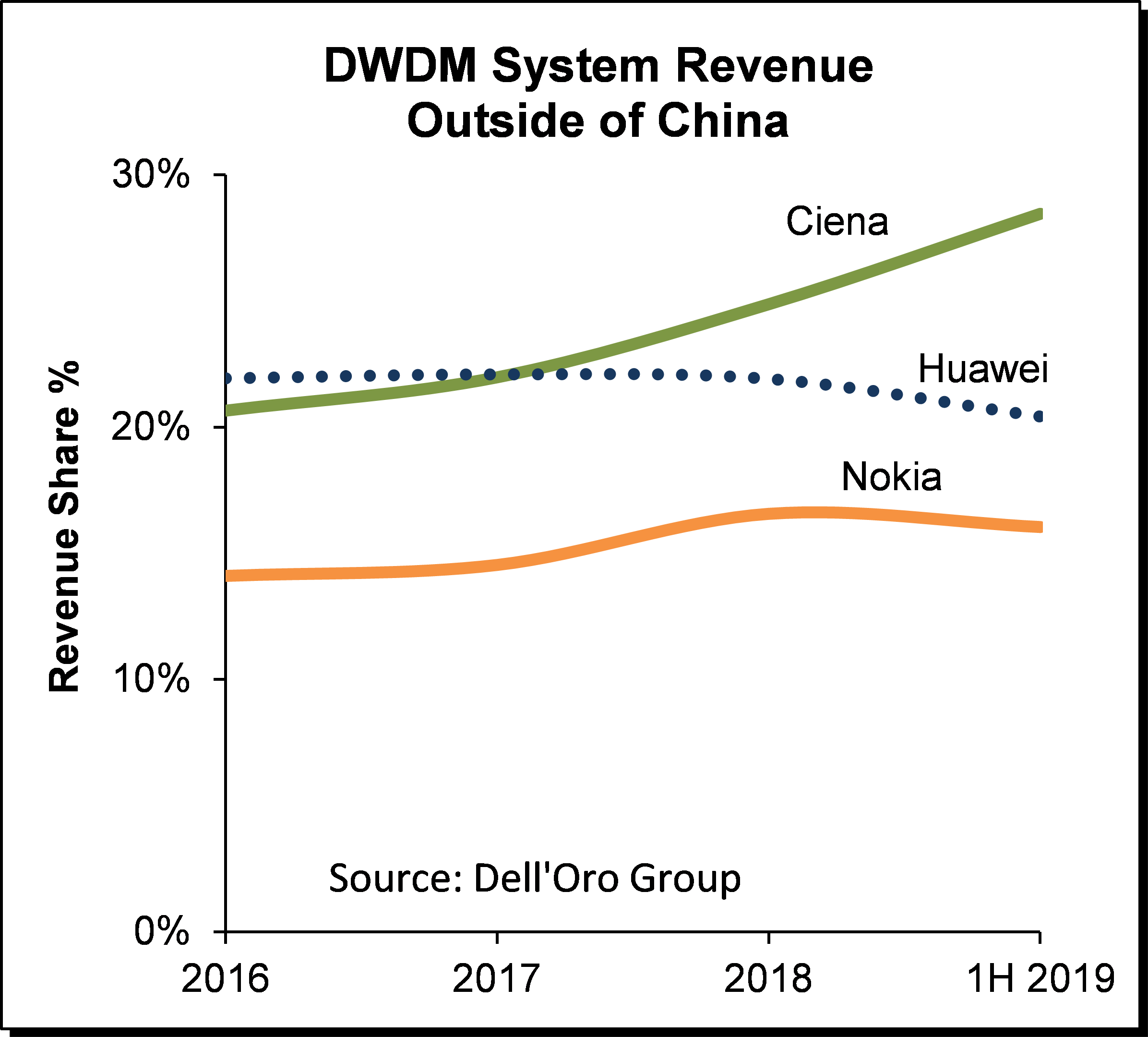
We estimate that DWDM systems revenue outside of China grew 5 percent Y/Y in 1H 2019. Not surprisingly, when we account for vendor share without China, Huawei, the worldwide market leader, drops considerably below Ciena’s lead share.

In 1H 2019, Ciena held nearly 30 percent share of the optical DWDM market outside of China due to the company’s dominance in North America and growing share in international markets. Ciena’s revenue grew over 20 percent Y/Y. During this period, Huawei held the second-highest share outside of China even though the company’s market share declined slightly from both full-year 2018 and 1H 2018. Nokia continued to hold the third-highest share outside of China with revenue growth in the period exceeding the market average percentage growth of 5 percent.

The Dell’Oro Group Optical Transport Quarterly Report offers complete, in-depth coverage of the market with tables covering manufacturers’ revenue, average selling prices, unit shipments (by speed including 100 Gbps, 200 Gbps, and 400 Gbps).  The report tracks DWDM long haul terrestrial, WDM metro, multiservice multiplexers (SONET/SDH), optical switch, optical packet platforms, and data center interconnect (metro and long haul).  To purchase this report, please contact us at dgsales@delloro.com.