[wp_tech_share]

Every market and industry has a cycle. In fact, some industries are comprised of many different cycles that, in combination, result in changes to the amplitude and direction of market growth. Among the different cycles that influence the Optical Transport market, I think the best cycle to highlight for 2021 is the Product Cycle.

As you know, the Optical Transport equipment market is a research and development (R&D) intensive industry that goes through a multi-year product cycle, consisting of idea formulation, development, introduction, and main stream deployment. Hence, grand ideas and proof of concepts announced years ago steadily build towards commercialization and main stream adoption over the course of a few years.

So, which phase are we predicting for 2021? I would say that we are moving from the product introduction to the main stream deployment phase in many areas of the Optical Transport market. Therefore, many of our market thoughts for 2021 revolve around the adoption of new products (many of which were first announced over two years ago). The following are a few of our expectations for product adoption in 2021:

Disaggregated WDM system sales will expand beyond data center interconnect (DCI) applications.

Open and disaggregated WDM systems may have been introduced years ago, but the main buyers were hyperscale companies for DCI. Recently, however, the use of these systems have started to expand beyond these Internet content providers (ICPs) and into a broader customer base that includes cable multiple-system operators (MSOs) and telecom operators.

600 Gbps and 800 Gbps-capable line cards will enter main stream adoption.

Although 600 Gbps-capable line cards entered the market over a year ago, the rate of adoption was low for various reasons that included the pandemic. However, we believe the adoption curve for 600 Gbps-capable line cards entered an inflection point and that it is positioned for rapid growth in 2021. At the same time, we believe 800 Gbps-capable line cards will also increase next year, considering the strong shipments so far with only one manufacturer. We anticipate one or two additional vendors will be shipping 800 Gbps-capable line cards in volume next year, increasing the pool of suppliers. All combined, we predict that shipment of 600 and 800 Gbps-capable line cards will more than triple in 2021 and drive much of the capacity expansion in the year.

400 Gbps everywhere.

Although we are projecting a large growth in 600 Gbps and 800 Gbps-capable line cards, we are expecting many (most likely the majority) of those line cards will be used to supply 400 Gbps wavelengths in metro, regional, and long haul networks. That is, we believe the use case for operating line cards at its highest modulation such as 64 QAM will be limited and that the higher usage will be at lower modulations such as 16 QAM and 32 QAM. This is since the lower modulations will offer better performance. In addition, 400ZR is entering the market for use in metro access applications such as DCI. We expect most of these will be in a QSFP-DD form factor in both optical and Ethernet systems. So, by the end of 2021, we predict that 400 Gbps wavelengths will be in heavy demand in all parts of the optical network.

In some ways, we have an optimistic outlook for the Optical Transport market in 2021. Partly, this is because we think it is a critical component in keeping the world connected. But also, we are hopeful that the pandemic that caused hardship in 2020 will be largely behind us in 2021 as COVID-19 vaccines become widely available. We are, of course, concerned that the timeline for returning the world economy to the pre-pandemic levels will take much longer than a year and that, depending on government initiatives, there is a small chance economic recovery in some countries could decelerate next year.

[wp_tech_share]

Originally, I anticipated that the Microwave Transmission market would enter a multi-year growth phase beginning in 2020 driven by the rollout of 5G. Instead, however, the market is on pace to decline 5 percent in the year due to precautions put in place to reduce the spread of COVID-19, slowing down the start of 5G in some countries and making it increasingly difficult to deliver and install microwave equipment in many others. Then in 3Q20, when many countries lifted their lockdowns or eased travel restrictions, the demand for Microwave Transmission equipment grew 7 percent year-over-year, recovering some of the lost market revenue in 1H20. We think this positive momentum will continue through the remainder of this year and the next. So, while the start of 2020 was painful and the middle of 2020 difficult, the end of 2020 brings some hope for a better 2021.

Of course, there will be a number of head winds in 2021—the biggest ones being additional lockdowns to control the spread of COVID-19 and the slow economic recovery. Both of these will negatively influence the revenue and confidence of mobile operators in spending capital on equipment.

That all said, we believe that COVID-19 has taught the world the critical importance of network connectivity. Whether it is fixed broadband or mobile broadband, there will be a need for “more”—more connections and more bandwidth. Therefore, while COVID-19 may have caused delays in starting new 5G roll outs in 2020, we find it difficult to believe there will be additional delays in 2021 since 5G is a crucial technology for the future.

Hence, we predict that the Microwave Transmission market will return to growth in 2021 (one year later than we had originally predicted). We believe 5G and preparation for 5G mobile radio installations will create a growing demand for Microwave equipment in 2021 and project the market to grow at a low single digit percentage rate. Furthermore, we think this is just the beginning of a multi-year growth cycle.

Since 5G will require more backhaul capacity, we expect the demand for E-band microwave systems (capable of up to 20 Gbps transmission) will accelerate, increasing more than 30 percent next year. While sales of E-band has been escalating for many years, largely driven by its use in Eastern European countries, we think that next year the level of interest and number of deployments will geographically widen across many other regions of the world.

Also, we think multiband systems and links combining E-band with at least one carrier frequency below 30 GHz will grow in importance. Demand for multiband systems using a mix of millimeter wave and lower microwave frequencies has already started in 2020, but we think usage will widen in 2021 along with 5G backhaul deployments. Not only will this solution provide more capacity per link, but it will also increase the link resiliency and performance with the same outdoor footprint (keeping tower lease costs unchanged). Therefore, we cannot help but think that the adoption of multiband links will be more mainstream than niche in the coming year.

Although we have a positive outlook for 2021, we do think the market will be more volatile. This is not to say that the demand for Microwave Transmission equipment will swing up and down quarter-to-quarter (which it might), but rather that the level of uncertainty in 2021 is still very high. And that while we are hopeful the worst of the pandemic is behind us and the COVID-19 vaccine will be widely distributed next year, it is still difficult for us to discern what will happen because when it comes to this pandemic (the first in my history of doing market research) we simply do not know what we do not know.

[wp_tech_share]


Dell’Oro Group published an update to its research on Network Equipment (NE) Services. The following are some of the key takeaways from the report.
Network Equipment Services Market Returning to Growth

Following five consecutive years of market contraction, the NE Services market began to reverse direction, growing slightly in 2019 due to positive developments with Network Rollout Services and Consulting Services offsetting reduced demand for Managed Services. We expect the improved market sentiment in 2019 will extend through the forecast period, resulting in the market registering $46 billion in 2024.

Near Term Challenges with Managed Services

Managed Services is expected to weigh on the market in the near term as vendors continue to exit contracts that are unprofitable and non-strategic. However, we are optimistic about the role of managed services in the future as networks continue to increase in complexity and vendors deliver a greater amount of automation to proactively maintain networks, reducing the number of costly alarms.

Network Equipment Services is Evolving

While “plan, build, operate, and maintain/transfer” remains a critical aspect of the services market, it is not expected to be the dominating driver for services in the future. The reason for this change in drivers is that the next network generation is not just about installing the newest hardware, expanding network coverage, or reducing the number of network layers. While these will still be part of the next network solution, we believe that network complexity will dramatically increase in the future as service providers strive to incorporate SDN/NFV, IoT, 5G real time services, along with exploring new architectures such as Open RAN. As a result, we believe Service offerings in the future will increase in sophistication often incorporating a higher amount of software and consulting.

Vendor Landscape is Stabilizing

Following five years of dynamic share shifts, the top three vendors—Huawei, Ericsson, and Nokia—have held their market share for the past three years. Together these three vendors accounted for about 75 percent of the NE Services market in 2019.

Click here to learn more about the report coverage or contact us for a sample report, please contact us at dgsales@delloro.com.


About the Network Equipment Service Advanced Research Report:

Dell’Oro Group’s Network Equipment Services report covers the service offerings by select network equipment manufacturers (vendors) that supply service providers. The network equipment we are referring to includes such equipment as broadband access, optical transport, routers, and mobile radio infrastructure. Network Equipment Services are reported in three segments: Rollout Service, Managed Service, and Consulting Service.

[wp_tech_share]

Optical Transport Market to Expand for many more Years, Reaching nearly $18 Billion

The world experienced a global pandemic in 2020 that ushered in a global economic recession. It is still unknown how much longer the coronavirus, COVID-19, will spread and cause economic disruptions, and at what rate the global economy will recover following massive shutdowns in the first half of the year. That being said, while in past macro-economic recessions the Optical Transport market would contract, we believe that in this recession, the demand for Optical Transport will increase as a large number of people shift to remote learning and working.

We believe the fundamental driver for the optical market—bandwidth—persists and that its value has been amplified by the recent pandemic. As a result, we forecast the Optical Transport market, largely comprised of DWDM systems, to expand in 2020 and for the next five years, reaching nearly $18 billion. However, there are near term challenges related to supply, distribution, and installation.

Shift to 800 Gbps-Capable Line Cards will be Rapid in DWDM

The first 800 Gbps-capable line cards started to ship in early 2020. We expect volumes to ramp during this year, as additional vendors introduce their products. We forecast that by 2024, nearly 30 percent of wavelength shipments will be from an 800 Gbps-capable line card. More than half of these line cards are expected to be used at 400 Gbps.

We predict the next wavelength speed following 800 Gbps will be 1200 Gbps (1.2 Tbps). Based on the timing of past coherent DSP introductions and first-line card shipments, we anticipate 1.2 Tbps-capable line cards to enter the market in the 2023-2024 time period (but more likely in 2024).

Other Market Trends

  • Demand for Optical Transport gear for data center interconnect (DCI) is expected to take a turn in the near future.
  • Disaggregated WDM transponder unit sales are a bright spot of growth, annually growing at a double-digit percentage rate.
  • 400ZR will moderate the market’s growth.
About the Report

The Dell’Oro Group Optical Transport 5-Year Forecast Report offers a complete overview of the Optical Transport industry with tables covering manufacturers’ revenue, average selling prices, unit shipments, wavelength shipments (by speed up to 1.2 Tbps). The report tracks DWDM long haul, WDM metro, multiservice multiplexers (SONET/SDH), optical switch, optical packet platforms, data center interconnect (metro and long haul), and disaggregated WDM. Click here to learn more about the report or contact us at dgsales@delloro.com.

[wp_tech_share]

Have you ever seen a caterpillar transform into a butterfly? Within weeks, the entire organism changes to prepare itself for its new mode of existence. This process is called metamorphosis, and it is the best way to describe the change in microwave transmission equipment over time.

For every new generation of communication technology, from long-distance fixed line to mobile, from 3G to 4G, microwave transmission equipment has transformed, filling a need, fulfilling a requirement, changing itself to fit a new mode of existence. This metamorphosis has continued with the emergence of 5G, changing microwave transmission equipment and wireless backhaul for the better.

But why does microwave equipment need to evolve to support 5G backhaul when fiber optics is the future? The answer is easy—operators need the right tool for the job.

Right Tool at the Right Time

Operators, like any other company in a competitive market, will increase its market share and revenue while enjoying higher profits if it is first to market and offers a superior product experience. This drove the rapid deployment of 4G and will drive the rapid deployment of 5G. Therefore, when operators begin to roll out 5G networks, each one will face the same challenge—obtaining full population coverage in the shortest time period to ensure a great customer experience—because, anything less would tarnish the operator’s brand.

To obtain the population and geographic coverage, operators need to deploy 5G in urban areas where people work, suburban areas where they live, and rural areas where customers depend on 5G for connectivity. In all of these areas, the biggest concern will be backhaul. Simply put, without good mobile backhaul, the mobile service will suffer. Luckily, for many operators, they can leverage the existing 4G networks they have built, and in many cases a fiber connection will have been installed over the past few years. Unfortunately, however, in many locations throughout the world, new sites will be needed where operators have yet to install fiber. So, operators need to choose whether to wait one to two years to build a fiber network at costs that can exceed hundreds of thousands of dollars, possibly millions, per site or install a microwave link in under a month at a fraction of the cost. Which is the right tool under this circumstance?

Time and again, microwave systems have proven to be the right tool at the right time. It is one of the many reasons that Microwave Transmission equipment was used in nearly half of all new mobile backhaul deployments for macro cells, globally, in 2019.

Metamorphosis of Microwave

Microwave transmission was used in communication networks as early as 1930 with an experimental connection across the English Channel. During this early stage the application for microwave was for the transport of voice across long distance, across difficult terrains. In time, operators installed microwave systems across continents to deliver tens of thousands of voice circuits to connect cities along one coast to those on the other.

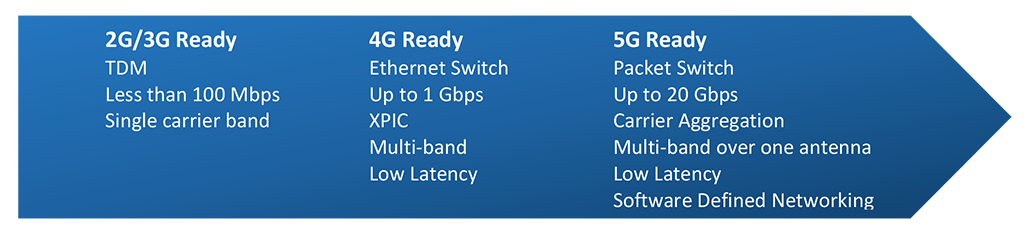
Since those early days, microwave transmission technology evolved, changing to meet the needs of every new generation. When cellular technology emerged, microwave transmission was used to transport hundreds of voice circuits; when 2G arrived, it was used to transmit kilobits of voice traffic; and with 4G, 100s of megabits of data. Over this period, networks shifted away from carrying lots of voice traffic towards transmitting an ever-increasing amount of data, requiring microwave equipment to grow from carrying only analog voice into carrying packets filled with a mixture of high definition voice and massive amounts of data.

When you look at a modern microwave transmission system, it no longer looks like the first system developed to carry a voice call across the English Channel. It has grown and evolved to meet the latest needs of operators, and it has continued to do so for 5G.

The latest Microwave Transmission equipment is more than able to meet the requirements of 5G backhaul with the newest features that include packet switching and up to 20 Gbps of throughput using spectrum in E-band. Other advancements that acclimate microwave to 5G backhaul include carrier aggregation and multi-band links over a single antenna—solutions that both increase the link capacity, improve the performance, and reduce the cost to operate.

2G 3G 4G 5G

And, the story of microwave will not stop here. Leading manufacturers continue to invest in this technology, developing new solutions and features that make microwave transmission more cost effective, simpler to use, and more reliable. Some of these new technologies include developing systems that operate in the D-band to deliver 100 Gbps throughput in a couple years, and others to reduce operational costs by improving the use of leased spectrum. Huawei presented two of these concepts during their 2020 global analyst conference. The first was 4×4 MIMO to quadruple the capacity without adding additional spectrum (deployment at a customer delivered 1 Gbps in 28 MHz), and the other solution that the company called SuperHUB was a novel concept that allows more microwave links at an aggregation site to use the same spectrum.

For the Better?

The answer is “yes.”

  Yes, microwave transmission equipment can be used to support 5G backhaul.

  Yes, microwave will be used in 5G networks around the world.

  Yes, it will save operators valuable time to market.

  Yes, it has already been used for 5G backhaul.

In Dell’Oro Group’s recent Microwave Transmission & Mobile Backhaul 5-year forecast, we studied the demand for 5G and its impact on the microwave transmission market. We concluded that microwave systems will be a significant part of 5G backhaul for many of the reasons mentioned above. As a result, we forecast 5G to drive about $3.5 billion of microwave transmission equipment over the next five years.

Also… Yes, 5G has changed wireless backhaul for the better.