[wp_tech_share]

Liquid cooling and high-density power dominated the data center physical infrastructure agenda at a sold-out summit. In a week when credit markets fretted, the show floor shrugged.


Standing Room Only

The 2026 Open Compute Project (OCP) Global Summit closed on Thursday, October 15, as the largest edition yet. The event sold out, drawing roughly 15,000 attendees to the San Jose McEnery Convention Center, with about 3,000 more left on a waitlist. A year earlier, the count was less than 11,000. Many sessions were packed to capacity, starting with AMD CEO Lisa Su’s opening keynote on Monday. Shut out of packed rooms, attendees followed along on their phones from the hallways.
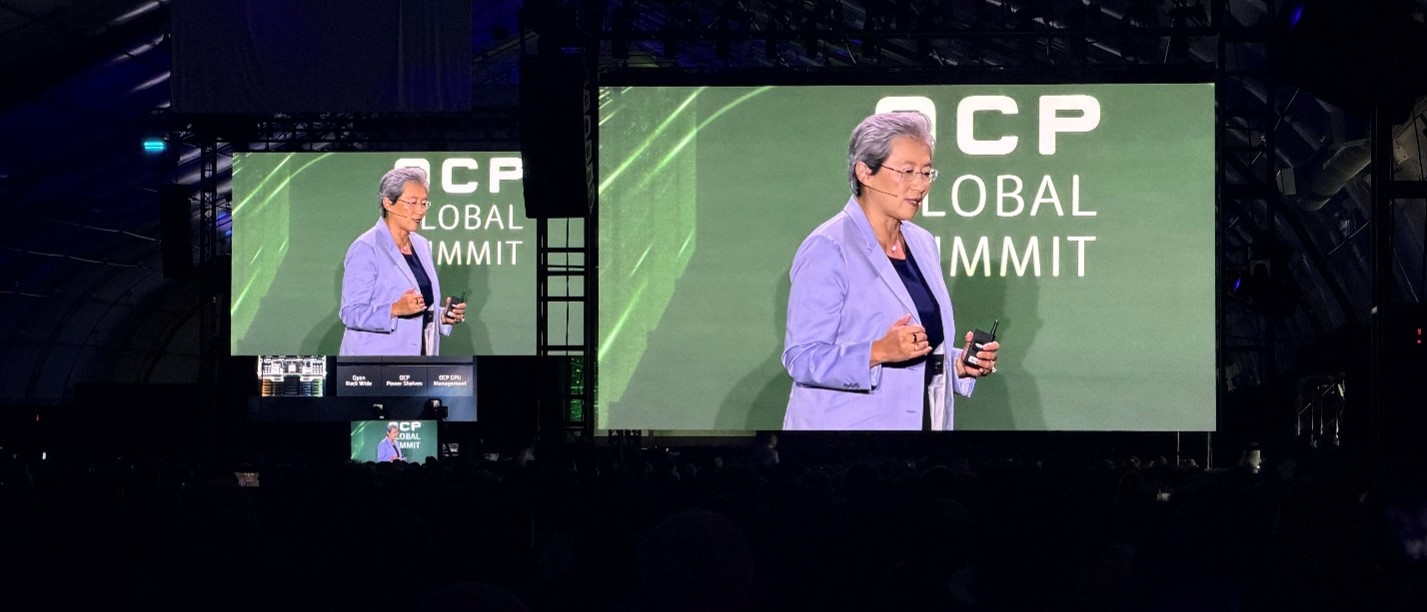
Lisa Su’s Keynote on October 12th, 2026


Relief is on the way. Next year, the summit moves to the Moscone Center in San Francisco, a substantially larger venue more in keeping with the stature OCP has gained in the AI economy. San Jose has been outgrown.


Pacing the Frontier, Racing the Buildout

On the floor, the mood matched the attendance. From concrete pourers to electrical engineers and thermal specialists, the people who build AI data centers have been working at breakneck speed for the past three years. Nothing on their order books suggests that is about to change.

Beyond the convention center, the backdrop was more uncertain. In September, Anthropic CEO Dario Amodei argued in “We Must Pace the Frontier” that AI developers should deliberately slow the advance of model capabilities, while stressing that pacing does not mean halting training. The frontier may be paced. The buildout is running at full throttle.

Credit markets fired a warning shot of their own. As the summit wrapped up, CoreWeave’s credit default swaps hit a record, pricing in more than 60% odds of default within five years. The topic came up in conversations, yet the crowd seemed unfazed. Sheer optimism prevailed, even if laced with a blasé disbelief at current growth rates.


Jensen’s Maths, Revised

On the IT side, optics stole the show. NVIDIA and Cisco introduced USFP, an optical module that fits four times the bandwidth into roughly the same space. Broadcom brought co-packaged optics, which sit right beside the switch chip to save power, and Wiwynn, Ayar Labs, and GUC showed the same approach on compute. Optical links are moving from the edge of the network toward the heart of the compute domain.

That migration changes what NVL576 means. At GTC 2025, NVIDIA unveiled Kyber as NVL576 by counting dies instead of GPUs: 144 GPUs with four dies each. Call it Jensen’s maths. NVIDIA has since dropped the die count, so Kyber got renamed NVL144. NVL576 has been repurposed. It now describes eight MGX racks of 72 Rubin Ultra GPUs each, joined into a single NVLink domain with copper inside each rack and optics between them. NVIDIA previewed the 576-GPU fabric again in San Jose—with NVL1152 expected to follow.
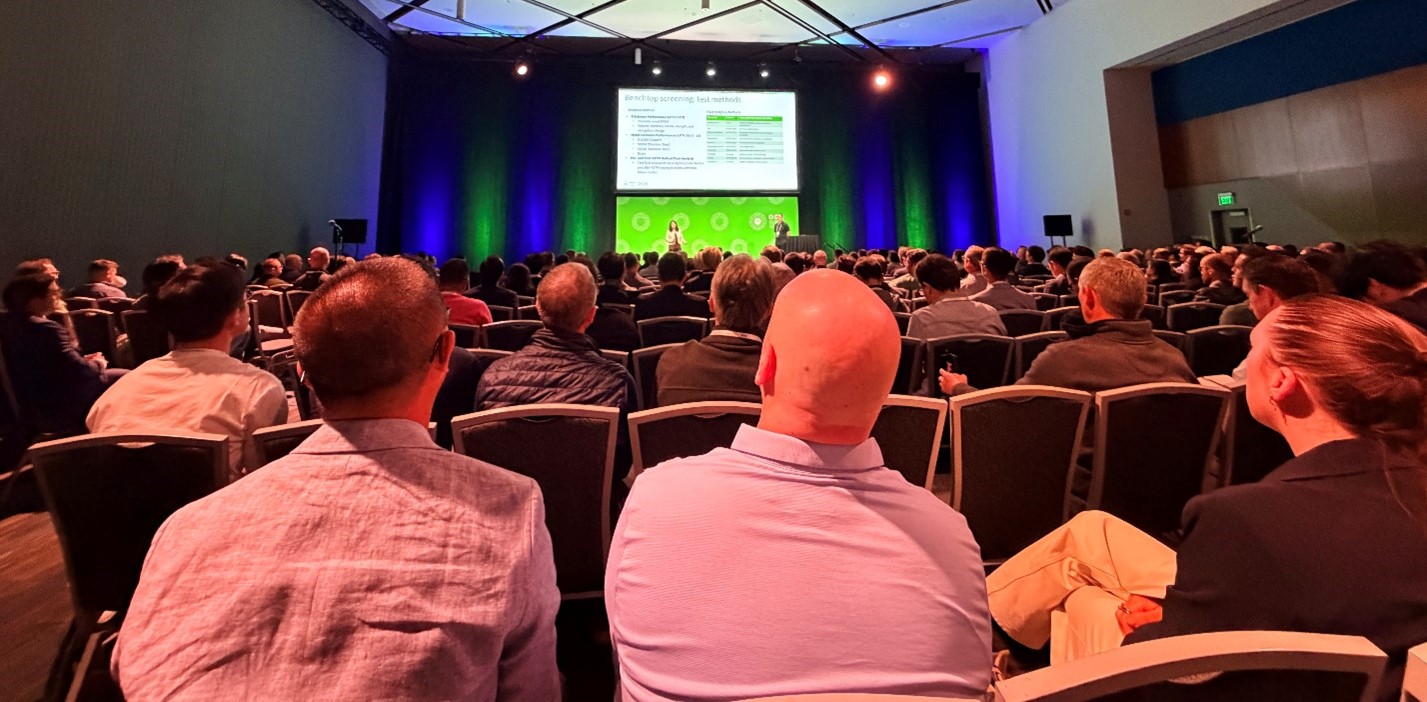
“Know Before You Flow — PG25 Mixing Thresholds for DLC” Session at OCP Global Summit 2026


For physical infrastructure, this is a subtle but consequential shift. Copper NVLink reaches only a few feet, which is why the scale-up domain has grown by packing more GPUs into a single cabinet. Optics loosen that constraint, blurring the line between scale-up and scale-out. If the domain can stretch across racks, the pressure to cram ever more silicon into one enclosure eases. Adding the migration of AI workloads from training to inference may cause the rack density trend to lose momentum.

But density is not going backward. NVIDIA’s MGX 1.2 specification supports racks up to 250 kW. Meanwhile, the OCP community sees a clear path to 1 MW racks—even if they arrive later and prove rarer than earlier roadmaps implied.


Plate Expectations

For the physical infrastructure community, the headline topics came as no surprise: liquid cooling and high-density power, the two pillars that make dense accelerated compute racks possible. Three shifts stood out on the floor. The cold plate took the spotlight from the coolant distribution unit (CDU). The 800 Vdc sidecar arrived in force. And solid-state transformers drew crowds well ahead of volume deployments.

At previous shows, the CDU took center stage. This year, it was all about the cold plate, the heart of direct-to-chip liquid cooling. This is not to suggest that CDUs were missing. CoolIT previewed its 3 MW CHx3000, integrated with Ecolab’s fluid monitoring suite, a sign that the acquisition is already bearing fruit. Cooler Master unveiled a 2.5 MW floor-mount unit, while Delta showed one of equal capacity running on 800 Vdc power. Rittal introduced an in-house CDU delivering more than a megawatt as part of its RiMatrix HPC architecture. Nidec, making its OCP debut, brought a 3.2 MW in-row prototype. Multi-megawatt is now table stakes.

The Project Deschutes design was also present, notably at the Envicool and Delta booths, the latter gearing up to mass-produce its Deschutes model in 1Q 2027. Yet it was eclipsed by the latest merchant designs. With the open specification at version 1.0 and a version 2.0 expected soon, some vendors may be holding fire. Others may see a design built around a single customer as not meriting the hefty investment of prime real estate on the show floor.
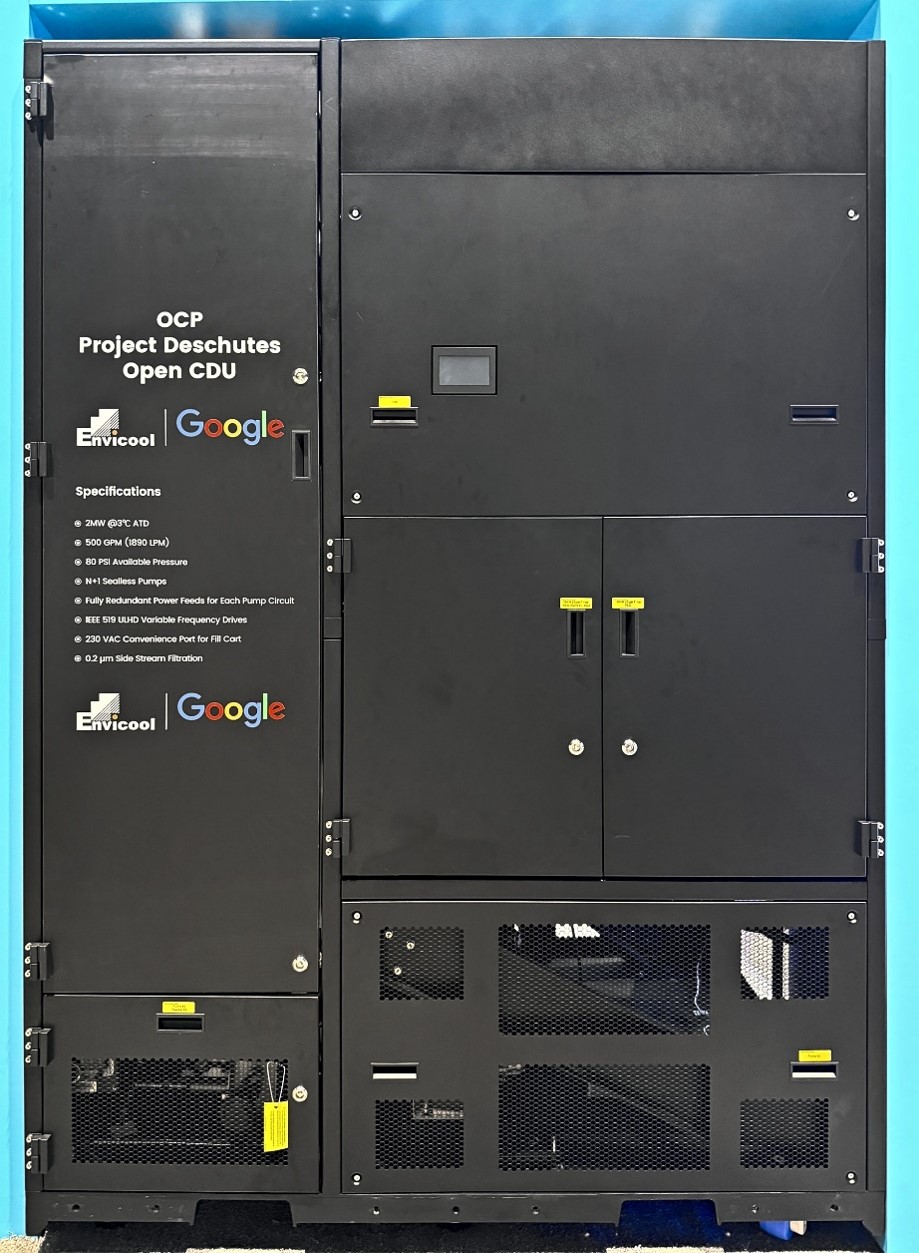
Deschutes CDU spotted at Envicool’s Booth


The real attention went to cold plates, where participation grew considerably. Established specialists such as Cooler Master and Auras continued to push the extension of direct liquid cooling beyond processors to memory, high-speed interfaces, and power delivery, while CoolIT unveiled its partnership with Stäubli on cold plates for pluggable optics. Jabil showcased the microchannel expertise it acquired with Mikros Technologies to handle more extreme heat fluxes. Start-up Frore Systems and IP specialist Adeia brought their own approaches, and xFusion presented diamond-copper composite cold plates. In the hallways and sessions, newcomers from adjacent industries, such as Conflux, were scouting their way into the data center.

As we detailed in our Data Center Liquid Cooling Advanced Research Report, every new silicon generation tests whether single-phase cold plates can keep up, turning a small component into a strategic asset. Large thermal management players have taken note. Earlier this year, Johnson Controls acquired Alloy Enterprises, whose stack forging process produces aluminum and copper cold plates, while Vertiv bought Strategic Thermal Labs, adding cold plate design and server-side validation. The show floor confirmed what the deal flow implied: value in liquid cooling is expanding beyond the CDU.


Phase Two: Two-Phase

If every new silicon generation puts single-phase to the test, two-phase direct-to-chip cooling is the contender waiting in the wings. The technology drew more interest in hallway conversations than in previous years, and both leading specialists came to make their case. ZutaCore demonstrated direct-to-die two-phase cooling on a running Blackwell GPU while MiTAC showed ZutaCore’s technology on its own servers. Accelsius answered with scale, expanding its Austin lab to multi-megawatt capacity for two-phase testing and teasing a 375 kW multi-rack unit. Beyond the specialists, Cooler Master previewed refrigerant-based cold plate loops still in development.

The OCP Foundation itself describes the transition to two-phase as looming, and a new OCP paper on thermal boundaries sets a threshold for single-phase cold plates that chip roadmaps may reach sooner rather than later. The interest likely reflects a growing sense of inevitability. Each year brings the two-phase era a little closer, but each year single-phase extends its runway a little further. Where one runway ends and the other takes off will constitute the battleground of the next few years.


Riding Sidecar

On the power side, the industry is coalescing around 800 Vdc, even if parts of the ecosystem, especially safety, protection, and insulation, still have ground to cover. OCP’s updated LVDC white paper now spans DC distribution up to 1,500 Vdc. Microsoft contributed new versions of its Mt Diablo power sidecar specification, which began life at ±400 Vdc. NVIDIA dedicated a session to protection and fault management, ABB and Eaton shared a keynote on the shift to DC distribution, and Vertiv explored how OCP could standardize the way solid-state circuit breakers behave and report faults.
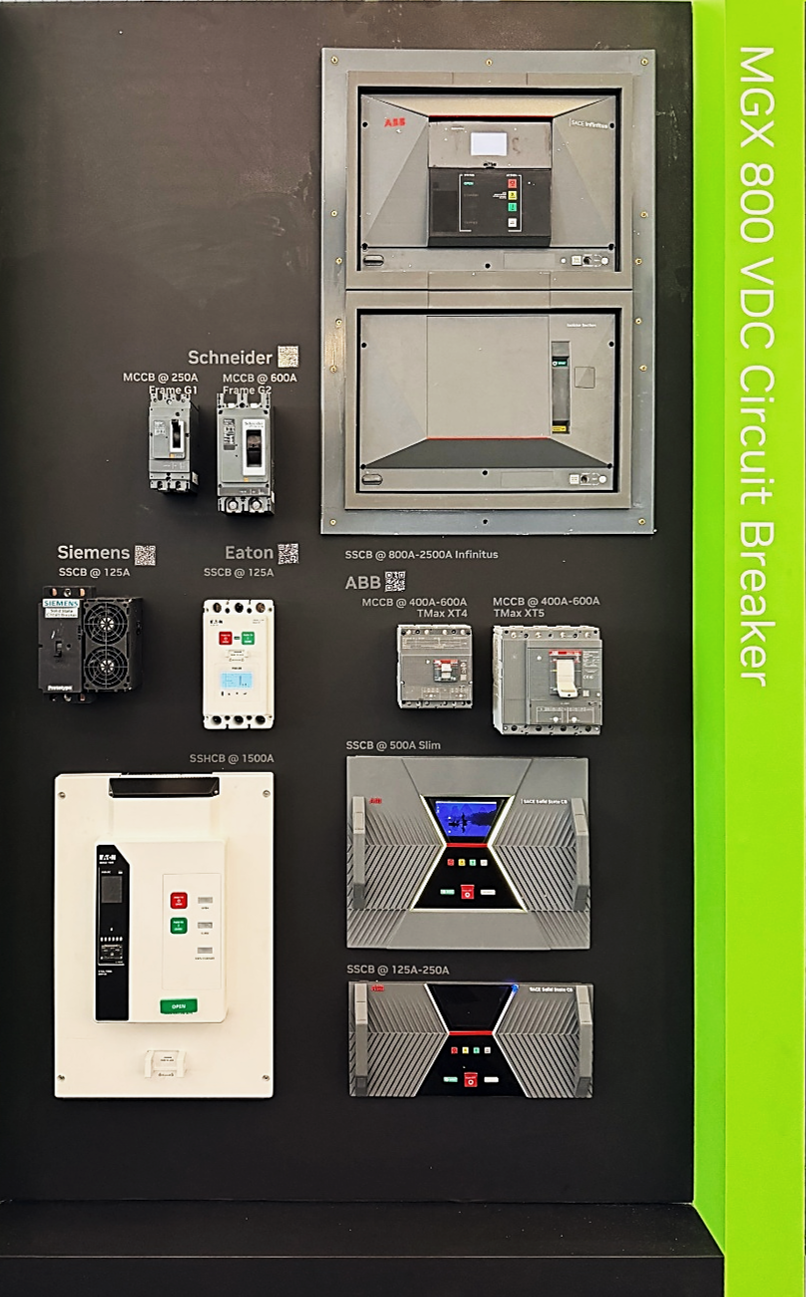
Solid-state circuit breakers in the MGX Wall


Solid-state circuit breakers, designed to clear faults within microseconds, are getting closer to market, with SolarEdge and Infineon deepening their collaboration on a silicon carbide-based design. Electrical heavyweights ABB, Schneider Electric, Siemens, and Eaton also brought their own 800 Vdc protection and power hardware to NVIDIA’s MGX wall. The full chain still needs work. The industry has yet to determine the appropriate balance between solid-state and thermal-magnetic breakers, the design of DC PDUs, and how much battery and capacitance to install across the system—and where. Operating at these voltages also raises questions about arc-flash mitigation and controlling fault currents shaped by system inductance.

Even so, while the upstream 800 Vdc architecture remains an object of engineering ambition and speculation, the sidecar is here. Sitting beside the IT rack, it converts AC power to 800 Vdc, while taking the power shelves and battery backup out of the server rack. It was the star of the show—no, make that a constellation.

Traditional power shelf suppliers came out in full force. Delta displayed a 660 kW in-row power rack with 480 kW of integrated battery backup, Lite-On brought 800 Vdc racks and supercapacitor backup units, and AcBel, Advanced Energy, Murata, and Flex (soon to be spun off as Axiom Solutions) all staked out 800 V roadmaps. Facility power leaders Eaton and Vertiv were in the mix, too.

Then came the new entrants. Shenzhen-based Megmeet put 800 Vdc front and center, xFusion showed a sidecar prototype scaling from 300 kW to 1.2 MW, and white-label UPS manufacturer Voltronic Power joined the race. Perhaps most telling, auto parts giant Bosch is supplying its EV-derived 800 V power electronics for a Rittal sidecar demonstrator designed to scale to 2 MW. When the automotive supply chain shows up, a market has arrived.
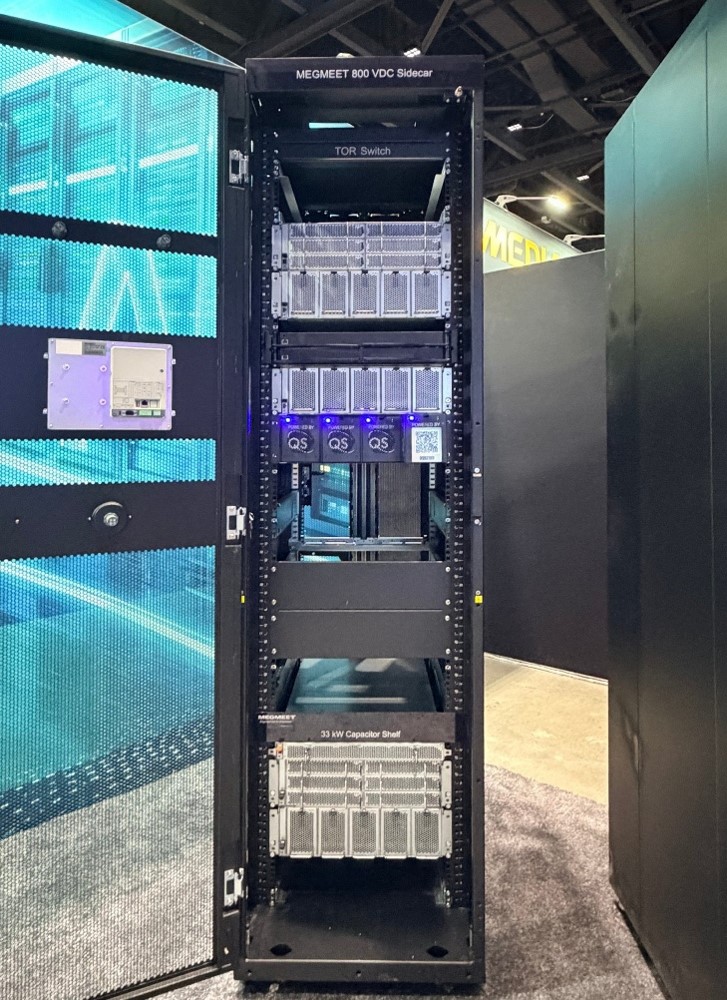
Megmeet’s 800 Vdc Power Sidecar


Solid-State of Play

Solid-state transformers (SSTs), meanwhile, remain the darlings of the industry. Specialists DG Matrix and Heron Power exhibited at the show for the first time, both flush with capital after raising $60 million and $140 million respectively earlier this year. DG Matrix launched Interport 360 Flex, a skid-mounted system built on its SST cell that takes up to 34.5 kV AC and delivers native 800 Vdc. Solar power companies joined them on the MGX wall. SolarEdge displayed an SST cell while its full system undergoes validation, Sungrow showed components of its EnerNeo SST, and Delta demonstrated direct conversion from medium-voltage AC to 800 Vdc.

The hype is understandable. By folding the transformer, rectifier, and much of the switchgear into power electronics, the SST promises a leaner path from grid to rack. OCP’s draft SST design specification already targets units of up to 10 MW, with at least 98% efficiency from half to full load. Yet volumes remain modest, field reliability is unproven at scale, and protection and grounding practices are still being written. The real test will come as 800 Vdc moves upstream, from the sidecar to the facility.


Good Grid Citizens

Energy extended well beyond the rack. Google, Meta, Microsoft, and NVIDIA jointly published an OCP Grid Resilience Specification that targets restoring near-full load within two seconds of a grid disturbance. OCP launched a new Energy Project covering generation and storage, issued requirements for energy storage systems, and formed an alliance with EPRI and Current/OS on how data centers interact with the grid. On the floor, battery backup units, supercapacitor shelves, and fuel-cell microgrids sat alongside the racks they serve. The data center is learning to behave like a grid asset rather than just a grid load.


Quieter on the Newswire

Physical infrastructure giants were notably quieter on the newswire than a year ago. At OCP 2025, Vertiv, Eaton, Schneider Electric, ABB, and others rallied around NVIDIA’s 800 Vdc architecture with a wave of product previews and reference designs. This year, the majors spoke from the stage and the booth rather than through product launches. With so many vendors closely tied to NVIDIA, the bigger names may be saving their news for GTC Berlin, which opens on October 20. Industrial AI tops the agenda, befitting the heart of Europe’s manufacturing economy, and Siemens, Schneider Electric, ABB, and Vertiv are expected to arrive in force, announcements in hand.


Next Stop, Non-Stop to Moscone

Disruption is no stranger to the data center, and the ecosystem continues to evolve at speed. Across the products showcased in San Jose, OCP is pointing to what comes next. Energy is the topic at hand: from 800 Vdc distribution and solid-state conversion to storage and grid interaction. All in all, a great show. We look forward to seeing it in even greater scale at Moscone in 2027. In the meantime, you’re invited to connect with us at Dell’Oro Group to discuss these trends.


Off the Wire
Date Company Category Press Release
Sep 28 Murata Power Murata Showcases “Powering AI Scalability” at the 2026 OCP Global Summit
Sep 29 Infineon and Eaton Power Infineon and Eaton leverage silicon carbide technology to advance solid-state transformers for 800 VDC AI data center power architectures
Oct 5 Airsys and Shell Thermal Airsys and Shell Showcase Spray Liquid Cooling for Data Centers at OCP Global Summit
Oct 5 Navitas and Microchip Power The Data Center Is Moving to 800V: Microchip and Navitas Are Enabling the Transition
Oct 7 Nidec Thermal Nidec Debut Appearance at “OCP Global Summit 2026”
Oct 8 AcBel Power Acbel to Showcase High-Density Power Solutions for AI Data Centers at OCP Global Summit 2026
Oct 8 Delta Electronics Power & Thermal Delta to Showcase Energy-Saving Grid-to-Chip Infrastructure Solutions for Sustainable AI at OCP Global Summit 2026
Oct 8 Infineon Power Infineon introduces 27 kW three-phase PSU solution for next-generation AI server power architectures
Oct 12 Accelsius Thermal Accelsius Expands Austin Lab to Multi-Megawatt Capacity for Two-Phase Liquid Cooling Testing of Next-Generation AI Racks
Oct 12 CoolIT Systems Thermal CoolIT and Stäubli Advance Direct-to-Plug Liquid Cooling with Next-Generation Optics
Oct 12 Cooler Master Thermal Cooler Master Expands End-to-End Cooling Solutions for AI Infrastructure
Oct 12 Flex Power & Thermal Flex Expands Prefabricated Modular Data Center Portfolio to Accelerate AI Factory Deployment
Oct 12 Infineon Power Infineon introduces XDP8HD40S-1 high-voltage hot-swap controller
Oct 12 Navitas Power Navitas Collaborates with NVIDIA on 800 V-to-12 V Power Delivery Board for Next-Generation AI Infrastructure
Oct 12 Rittal Power & Thermal Rittal at the OCP Global Summit 2026: New Architecture for Extreme Power Densities
Oct 12 Texas Instruments Power TI unveils new ADC to enable nanosecond-level telemetry and minimize downtime in AI data centers
Oct 13 nVent Thermal nVent and AMD Collaborate on Cooling for AMD Helios Rackscale Solution
Oct 13 SolarEdge Power SolarEdge Showcases MVAC-to-800 VDC AI Factory Power Technology at OCP Global Summit
Oct 14 LITEON Power & Thermal LITEON Showcases NVIDIA 800 VDC Architecture and Thermal Management Portfolio at OCP Global Summit 2026
Oct 14 Nidec Thermal Nidec Unveils “NIR3.0” Prototype: A 3.2MW, 800VDC-Compatible In-Row CDU
Oct 14 xFusion Power & Thermal xFusion at OCP 2026: When Cooling, Power, and Interconnect Converge for the Agentic Era
Oct 15 Clivet (Midea) Thermal Clivet Showcases Next-Gen Magnetic-Bearing Centrifugal Compressor at OCP Global Summit
Oct 15 Delta Electronics Power & Thermal Delta Highlights Collaboration with NVIDIA in Advancing Energy-efficient 800 VDC Power and Cooling Solutions for AI Data Centers at OCP Global Summit 2026
Oct 15 LITEON Power LITEON Showcases at NVIDIA MGX Ecosystem at OCP, Highlighting 800 VDC Power Technologies to Advance Next-Generation AI Infrastructure


[wp_tech_share]

I attended Mplify’s member summit in Boston several weeks ago, where I also served as a judge for its NaaS awards. One theme stood out: enterprise networking and security are becoming more integrated, yet delivering that integration across the broader communications service provider industry remains surprisingly difficult. Technology providers are combining capabilities enterprises historically bought separately, while communications service providers are working to make their networks and operational systems function as a coordinated ecosystem.

Both efforts are moving toward the same objective: making enterprise networking and security simpler to consume and operate. In my Distributed Cloud Networking (DCN) research at Dell’Oro Group, this tension is becoming increasingly important. The question is not whether Network-as-a-Service (NaaS) will evolve beyond connectivity. It already is. The more interesting question is whether the industry can deliver an integrated experience without forcing enterprises to rely on a single technology provider.

Four observations from Boston stand out.
The Networking and Security Stack Is Converging, but Innovation Is Far from Over

In my DCN research, I look at the enterprise WAN through three interconnected domains: the user/WAN edge, WAN middle mile, and cloud/application edge. Each has traditionally been served by different technologies and vendors. SASE and SD-WAN address secure user and branch connectivity, WAN-as-a-Service brings greater flexibility and programmability to the middle mile, and multi-cloud networking extends connectivity and security controls closer to distributed applications and workloads.

The boundaries between these domains are becoming less rigid. Convergence is happening horizontally as providers extend their capabilities across the three domains, and vertically as networking, security, observability, and automation become more tightly integrated. For some enterprises, this creates an opportunity to collapse a complicated networking and security stack into a more unified operating model, with fewer control planes, fewer integration points, and more consistent policy enforcement.

However, convergence should not be mistaken for the end of specialization. Significant innovation continues within each domain, and some of the more interesting developments are happening outside the traditional SASE conversation. The WAN middle mile, for example, is gaining renewed importance as enterprises look to dynamically connect private data centers, public clouds, AI factories, and emerging neocloud providers. At the cloud edge, application-aware networking and security continue to evolve, while SASE vendors are extending beyond traditional user-to-application traffic into broader infrastructure use cases.

AI is accelerating these developments, but it did not create the underlying challenges. Cloud adoption, distributed workforces, and application decentralization were already reshaping enterprise networking. AI adds urgency through more dynamic workloads, distributed inference, and new requirements for data governance and security. The important takeaway is that the market is still innovating within individual domains even as the broader technology stack converges.


Two Paths Toward a Simpler Enterprise Experience

One response to these market dynamics is technology convergence. Providers are extending their capabilities across traditional product boundaries to deliver more networking and security functions through a common platform. The appeal is understandable: enterprises increasingly want consistent policy, visibility, and operational control across users, branches, cloud environments, and applications. A more integrated provider can potentially reduce the complexity of making those pieces work together.

However, there is another path: a federated ecosystem of specialized technology and service providers. Not every enterprise wants to standardize on one vendor, nor will one vendor necessarily deliver the best capabilities across every domain. Existing investments, geographic requirements, specialized security needs, and heterogeneous application architectures will continue to create demand for best-of-breed solutions. The challenge is making those independent technologies behave like a coordinated service rather than a collection of individually managed products.

I do not see these approaches as mutually exclusive. Even highly integrated platforms depend on third-party connectivity and infrastructure to extend their reach. Likewise, a multi-provider ecosystem can offer customers a unified experience if the underlying integration is mature enough. This creates an interesting competitive dynamic: innovation within individual domains remains valuable, but the ability to integrate and operationalize those technologies becomes equally important.

In that sense, the real competition is not simply single-vendor versus multi-vendor. It is about which approach can deliver the required capabilities with the least operational friction, while preserving the flexibility enterprises need as their architectures evolve.


Boston Highlighted the Gap Between Federation and Execution

Federation was one of the strongest themes throughout Mplify’s Boston event. There was broad agreement that no single service provider can deliver every component of a global enterprise network, particularly as cloud and AI workloads become more geographically distributed. More importantly, several presentations showed that industry collaboration is moving beyond architecture diagrams into practical commercial workflows.

Bob Victor, Comcast Business’s Chief Product Officer and Mplify Board Chair, discussed efforts to connect Comcast and Colt’s automated workflows. Both companies have invested in internal automation, but transactions between them have historically involved spreadsheets and manual handoffs. Verizon described its use of Mplify’s Lifecycle Service Orchestration (LSO) Sonata APIs for wholesale transactions and its direction toward replacing legacy Access Service Request processes with standardized interfaces. Equinix and Comcast also discussed efforts to simplify service discovery and connectivity procurement through interconnected marketplaces.

These developments stand out because they show progress toward making independently operated networks function as a coordinated supply chain. However, the discussions also exposed a significant maturity gap between today’s implementations and the vision of fully automated, federated networking. Automating service discovery and quoting is not the same as automating end-to-end delivery. A provider may return a quote in seconds while installation, provisioning, troubleshooting, and performance assurance still depend on manual processes.

Legacy OSS/BSS environments, inconsistent operational data, and limited automation among smaller partners remain obstacles. There is also a commercial dimension that received welcome attention in Boston. Standardized interfaces do not automatically resolve contractual complexity, layers of reseller margin, service-level accountability, or ownership of the customer relationship. These are not secondary issues. They directly affect whether a multi-provider solution can compete with the simplicity an integrated platform promises.

This was one of my biggest takeaways from Boston. Federation requires business-model innovation alongside technical interoperability, and the industry still has considerable work to do on both fronts. The opportunity is significant, but getting multiple providers to communicate is only the first step toward making them operate as one.


Standardization Is Becoming More Important, Not Less

Having participated in standards efforts at the IETF and Trusted Computing Group, I appreciate the work required to build industry consensus and turn technical specifications into interoperable implementations. Standards do not eliminate competition or technological differentiation. Done well, they provide a common foundation on which companies can innovate without forcing customers into proprietary integration models.

This is why I view Mplify’s work as strategically important. The alliance has spent years developing Carrier Ethernet service definitions, LSO APIs, common product models, and certification programs. These assets are increasingly relevant as enterprises seek cloud-like consumption models across multiple communications service providers. Standardization also creates an opportunity for smaller and specialized providers to participate in larger ecosystems without having to build custom integrations for every commercial relationship.

Now Mplify is extending that work toward agentic automation and federation. Its LSO framework now supports the Model Context Protocol (MCP), and ongoing initiatives are developing reusable AI-agent capabilities, trusted provider discovery, and agent-to-agent coordination. The direction is promising because it builds on the existing service definitions, data models, and transaction workflows rather than assuming AI agents can independently solve the complexities of network operations.

In fact, AI may increase the importance of standardization. An agent that can discover and order connectivity is useful, but an agent that can reliably coordinate those actions across multiple providers while respecting commercial agreements, workflow sequencing, and security policies is far more valuable. Achieving that requires common definitions of services, authorization, operational states, and expected outcomes. It also requires mechanisms to verify that the agents and underlying systems behave as intended.

The industry is not there yet. The agentic federation vision remains ahead of broad production adoption, and considerable work remains on conventional service automation. Still, I see the effort as directionally constructive. The challenge for Mplify and its members will be translating the standards and architectural work into repeatable implementations that deliver measurable improvements in service delivery and operational efficiency.


What I Will Be Watching

The next phase of NaaS will be shaped by two related developments. First, how far can technology providers simplify enterprise networking through horizontal and vertical integration? Continued innovation across the user edge, middle mile, and cloud edge will create new possibilities, but comprehensive technology coverage does not automatically translate into a coherent operating model.

Second, how quickly can the broader service provider ecosystem close the interoperability gap? Mplify’s standards and certification work can help, but success ultimately depends on adoption, operational integration, and commercial execution. The strongest evidence of progress will not be another architectural framework or federation demonstration. It will be the ability to consistently discover, order, deliver, secure, and assure services across multiple providers without pushing the complexity back onto the enterprise.

For enterprises, the outcome matters more than the architecture. Integrated platforms can absorb more of the enterprise networking and security relationship, while specialized providers can preserve their differentiation by becoming easier to integrate and consume. I expect both models to remain relevant, with competitive advantage increasingly determined by how effectively providers turn their technology and partnerships into a simpler customer experience.

Boston reinforced my view that the future of NaaS is not solely about who can assemble the broadest networking and security stack. It is also about whether the industry can make a network assembled from multiple providers operate with the simplicity and accountability enterprises increasingly expect from a single platform. That is the opportunity Mplify is helping the industry pursue, and it is where much of the next chapter of enterprise WAN innovation remains to be written.

[wp_tech_share]
Musk, Satellites and the Future of the RAN

Elon Musk wants a bigger piece of the connectivity market. It is not clear how big a piece he wants, what the challenges are, or what his ambitions mean for mobile network operators (MNOs) and the terrestrial RAN market.

October 2026 Update: SpaceX’s agreement to acquire up to 14 MHz of 800 MHz spectrum strengthens its position in the terrestrial mobile market and reinforces its ambitions to compete more directly with incumbent operators. While the acquisition introduces additional possibilities for terrestrial RAN deployments, it does not materially change our five-year RAN market outlook. We have updated the analysis below to reflect the latest developments and clarify the potential direct and indirect implications for RAN equipment demand.

Recent commentary has become more ambitious. SpaceX estimates the addressable connectivity market opportunity is worth around $1.6 T, including $870 B for Starlink Broadband and $740 B for Starlink Mobile (consistent with the CSP revenue data published in the Dell’Oro capex report minus devices and China, or roughly $8 ARPU for nearly 8 B users).  More recently, SpaceX management has made clear that its goals extend beyond filling coverage gaps from space. In its 2Q earnings call, the company said it plans to build terrestrial infrastructure to complement its non-terrestrial network, potentially using large numbers of femto cells/small base stations deployed alongside Starlink terminals. The intention is not just to position for future growth opportunities but also to win more of the traditional carrier business – Starlink specifically called out the $0.6 T of revenue in the US.


Why would Elon Musk want to enter the CSP and MNO business in the first place?

Musk is widely considered one of the most successful entrepreneurs/visionaries of this era. He has already had three home runs with EVs, rockets, and satellites, with Physical AI and autonomous vehicles (AVs) among his next targets—all ultimately connected to his larger ambition of multiplanetary living. The traditional MNO market—with slow growth, high barriers to entry, enormous capital requirements, and roughly 10% net margins—does not look like a missing piece in this puzzle. How does connectivity fit into the bigger picture?

Understanding why SpaceX entered the satellite communications business in the first place is a good place to start.  After all, Starlink was not the first attempt to use satellites to disrupt terrestrial communications. The 1990s produced multiple LEO ventures, including Iridium, Globalstar, and Teledesic—the technology worked, but the economics did not. Investments turned into bankruptcies and abandoned broadband plans. The first LEO boom demonstrated that global coverage from space was technically possible. However, it did not demonstrate that it could be delivered economically at scale.

By controlling the rockets, SpaceX entered the game with a solid foundation. Falcon 9 and booster reuse changed the economics and ultimately allowed Starlink to build a constellation of 11K+ satellites with favorable capex relative to previous attempts, paving the way for Starlink becoming not just an important engineering pillar but also a vital economic engine­ for Musk’s bigger vision. Musk has previously stated that revenue from the satellite network could ultimately help finance a city on Mars.

That background may also help explain SpaceX’s growing ambitions in mobile. Becoming another conventional CSP or MNO is unlikely to be the primary objective. Musk has repeatedly moved vertically when an external dependency becomes strategically important or when controlling another layer changes the economics. Rockets enabled Starlink, Starlink extended SpaceX into global communications, and D2D is now extending that reach directly to the smartphone.

From a connectivity perspective, Starlink addresses the geographic limitations of terrestrial RAN. While 4G currently covers around 90% of the global population per Ericsson’s Mobility Report, some estimates suggest geographic coverage is around 15%. Terrestrial mobile networks are extremely efficient where people are concentrated, but the math becomes less favorable as population density falls. Satellites work the opposite way, providing coverage almost regardless of where people—or machines—happen to be. What may have started primarily as a way to connect the unconnected has consequently expanded from rural broadband to ships, aircraft, enterprises, and now the smartphone.

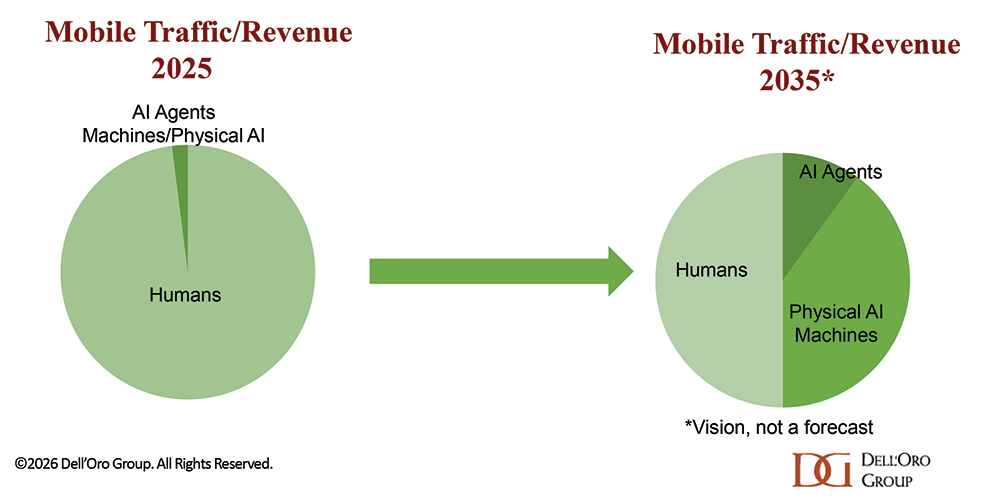
The strategic value of that capability could increase further in a world increasingly shaped by AI and physical AI. Today’s mobile network is designed and dimensioned for humans carrying smartphones, with most traffic and revenue ultimately generated by people consuming video, social media, and other applications. But in a world increasingly populated by AI agents, autonomous vehicles, robots, drones, and other forms of physical AI, human-driven traffic may eventually represent only one portion of the connectivity opportunity. Unlike humans, these machines might not remain concentrated within the existing cellular footprint. The traffic profile and ratios between indoor/outdoor, uplink/downlink, day/night, and dense/rural coverage could evolve if non-human-originated traffic comprises a larger share of overall mobile traffic, especially if Musk is right that these machines/robots will consume significantly more cellular traffic than humans using smartphones. Please note we don’t have a 2035 end-user forecast split for humans, AI agents, and machines—the illustration is more of a vision showing the three large buckets.

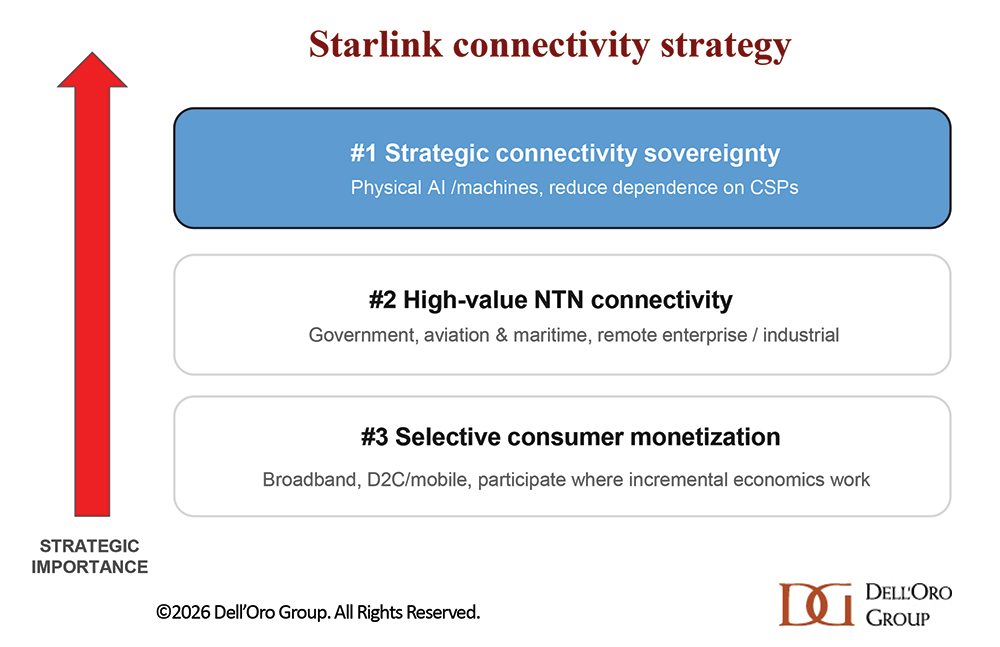
Viewed through that lens, Musk may care less about capturing another smartphone subscriber scrolling Instagram in Stockholm and much more about ensuring that a Tesla, Optimus robot, autonomous truck, drone, or some yet-to-be-invented AI-powered machine can remain connected wherever it operates. The recent push into D2D connectivity, mobile spectrum, and potentially terrestrial infrastructure therefore looks less like an attempt to build another conventional MNO and more like the gradual assembly of an end-to-end connectivity platform spanning terrestrial and non-terrestrial networks. Ubiquitous connectivity may simply be critical infrastructure for the AI and machine-driven world Musk is envisioning—and, as with rockets, batteries, charging, and AI, another strategic dependency he is increasingly unwilling to leave entirely in someone else’s hands.

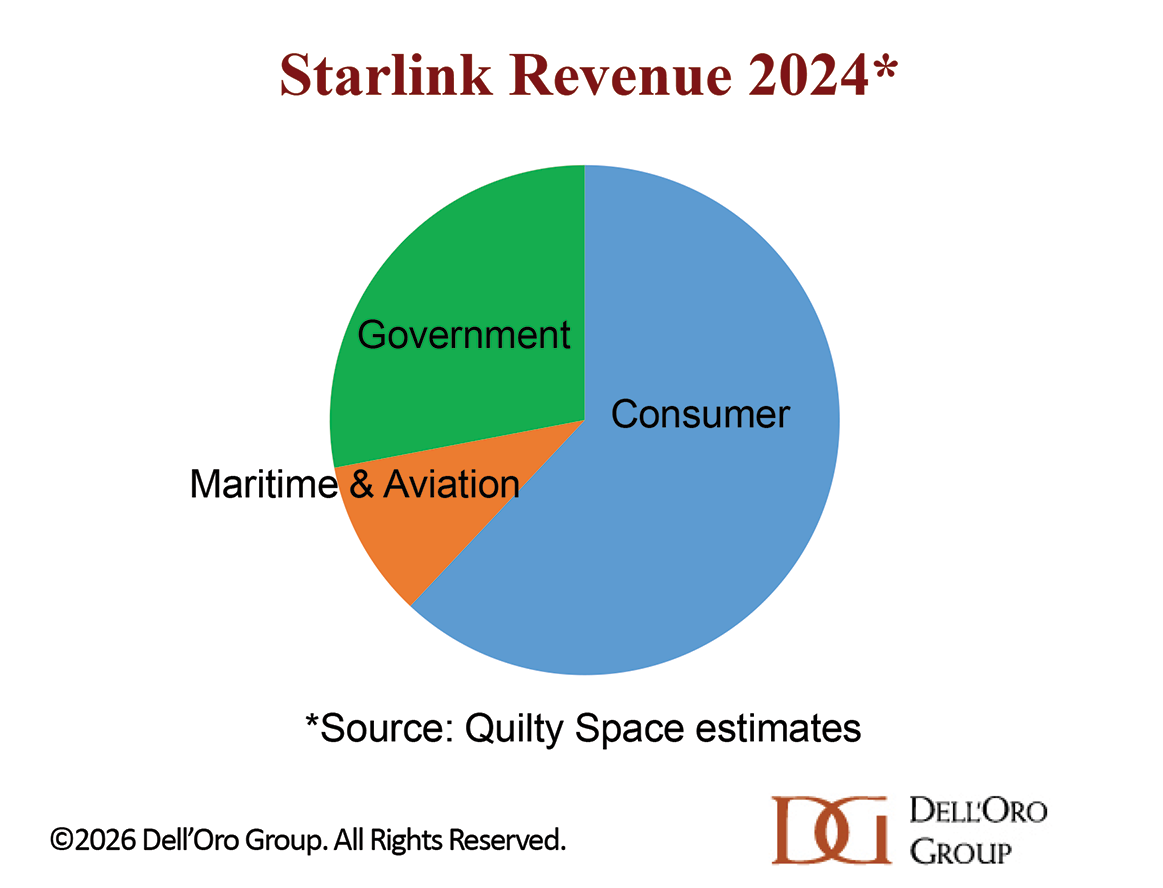
Strategic connectivity sovereignty does not mean SpaceX will ignore attractive commercial opportunities. The economics of satellite connectivity are already compelling in segments such as aviation, maritime, government, and remote enterprise/industrial, where terrestrial alternatives can be expensive or unavailable. And just as MNOs have learned to monetize excess mobile capacity with FWA, Starlink can selectively pursue consumer and enterprise opportunities where the incremental economics make sense.

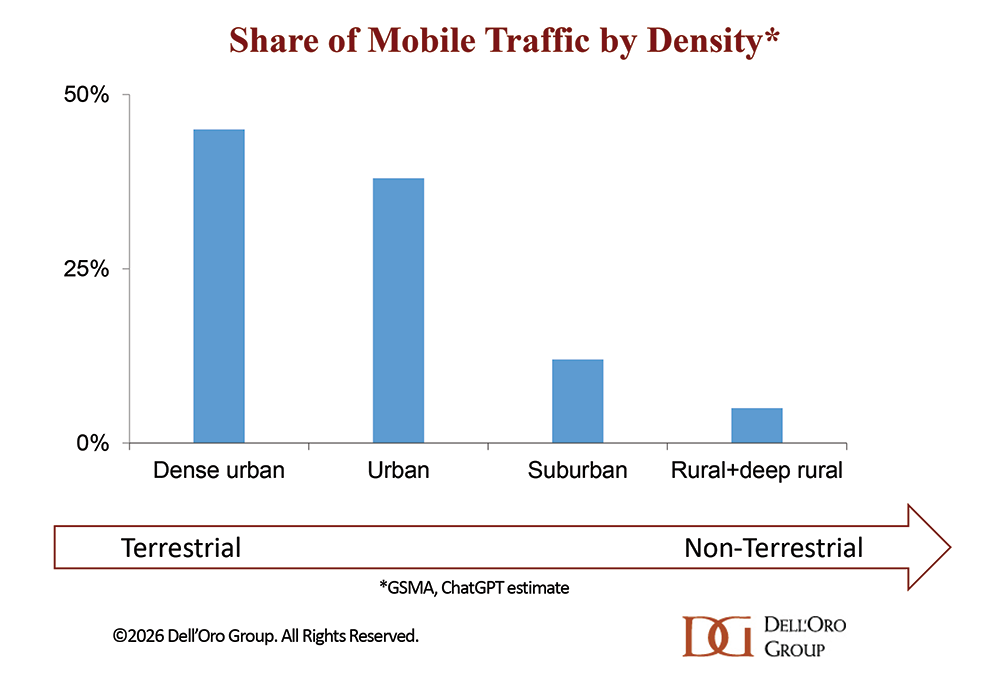
Ultimately, the addressable opportunity will vary enormously by density and geography: terrestrial optimizes capacity per km², while NTN optimizes geographic coverage.


What are the challenges?

If Musk’s ambition is to create a more ubiquitous connectivity platform spanning terrestrial and non-terrestrial networks, the fundamental question is – what are the big roadblocks? And the challenges are significant. At a high level, we can group them into three buckets: physics, assets, and ecosystem.

Physics is important. Even if Musk has an impressive track record of proving naysayers wrong and has already taken satellites much further than almost everyone thought possible, this can’t be overlooked in the world of wireless. Physics and the resulting economic challenges are the primary reason small cells and mmWave 5G did not live up to the initial hype.

Satellites are extraordinarily effective at solving the coverage problem — according to Sebastian Barros’ Telecom Newsletter, Starlink’s ~11 K operational satellites currently cover roughly 95% of the world’s landmass and maritime zones. But coverage and capacity are not the same. Terrestrial mobile networks achieve enormous capacity by dividing the network into increasingly smaller cells and repeatedly reusing the same spectrum.

A satellite beam covers a much larger geographic area, making the same degree of spectrum reuse difficult. This means the challenge is not aggregate capacity but capacity density. Satellite networks can spread enormous amounts of capacity across the globe, but mobile traffic is highly concentrated geographically. A terabit of unused capacity over sparsely populated areas cannot relieve a congested network in Tokyo or New York. Terrestrial RAN solves this problem through extreme spatial reuse, concentrating spectrum and capacity precisely where demand occurs. Satellites cannot replicate that density nearly as efficiently.

The link budget is also inherently asymmetric. SpaceX can put larger antennas and more power on its satellites, but it cannot change the antenna, transmit power, or battery constraints of an ordinary smartphone. Consequently, satellite connectivity can potentially eliminate many of the world’s remaining coverage gaps, but it is much harder to see satellites economically absorbing the enormous traffic generated in dense urban and suburban areas.

In other words, geographic coverage is SpaceX’s advantage while capacity density remains terrestrial RAN’s advantage. This is also why SpaceX’s terrestrial ambitions matter. If Musk wants more than coverage—if he ultimately wants a meaningful share of total mobile traffic, here defined to include humans and machines operating indoors and outdoors—he will undoubtedly need terrestrial radios as well.

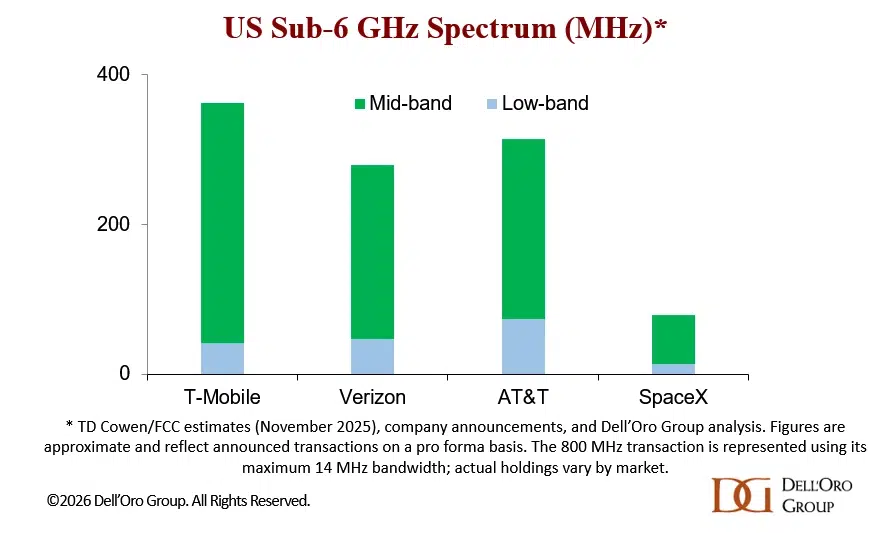
That leads to the second challenge: spectrum and terrestrial infrastructure. SpaceX’s spectrum acquisitions materially improve its position, but building a competitive mobile network requires more than owning some spectrum and small cells. The incumbent MNOs have spent decades accumulating spectrum across multiple bands and deploying hundreds of thousands of macro sites engineered around propagation, capacity, interference, mobility, and indoor coverage. SpaceX is exploring whether it can address this cost structure differently, potentially deploying large numbers of small base stations alongside existing Starlink terminals and using the Starlink network for backhaul.

The recent agreement to acquire 800 MHz spectrum is an important step toward addressing the spectrum challenge. Low-band spectrum offers favorable propagation characteristics and indoor penetration, making it well suited for providing broad geographic coverage and basic connectivity. However, the amount of spectrum involved is relatively limited and would not, on its own, provide sufficient capacity to support the traffic requirements of a nationwide mobile network at scale. While the acquisition strengthens SpaceX’s terrestrial ambitions, additional spectrum and infrastructure would be needed to compete more directly with established mobile operators, particularly in capacity-intensive markets.

Beyond spectrum, the proposed small-cell deployment model is interesting because it could complement existing macro networks and potentially improve coverage and capacity in selected locations. Leveraging its existing Starlink footprint could reduce some of the costs and complexity of building a terrestrial network. However, questions remain about the practical economics, coverage, and scalability of this approach. While it is early days and we haven’t had a chance to talk to Starlink about this concept yet, one challenge could be overlap—Starlink terminals are currently located where customers need satellite broadband, not necessarily where a mobile network needs capacity. In addition, they still need to figure out RF planning, indoor coverage, handovers, and interference—these steps don’t disappear just because the ratios between small cells and macros change. Spectrum itself remains scarce and heavily regulated. Ultimately, the deeper SpaceX moves into terrestrial mobile, the more it will face the same physical, regulatory, and economic constraints that have shaped the traditional mobile infrastructure market.

The ecosystem is another major challenge. Incumbent operators already have the spectrum, sites, fiber, customers, devices, distribution, roaming relationships, regulatory infrastructure, and operational experience to deliver mobile service at scale. They can also respond collectively, whether through standards, roaming arrangements, spectrum partnerships, or alliances with competing satellite providers. Mobile connectivity involves far more than transporting bits—authentication, seamless mobility, voice, emergency services, device certification, billing, customer support, and roaming all need to work reliably. Regulation could also impact Starlink’s ability to operate a mobile network in some countries.

None of these challenges suggests that SpaceX cannot become a meaningful force in mobile connectivity. But they do suggest that replacing the terrestrial mobile network is a very different proposition from complementing it. Satellites give SpaceX an enormous structural advantage in geographic coverage, while the terrestrial incumbents retain an equally important advantage in capacity density, spectrum depth, infrastructure, and ecosystem. The more interesting question, therefore, may not be whether SpaceX can replace the MNOs or terrestrial RAN. Ultimately, the key question is how far they can go with their existing assets and how much further they want to go – where is the sweet spot?


Impact on RAN

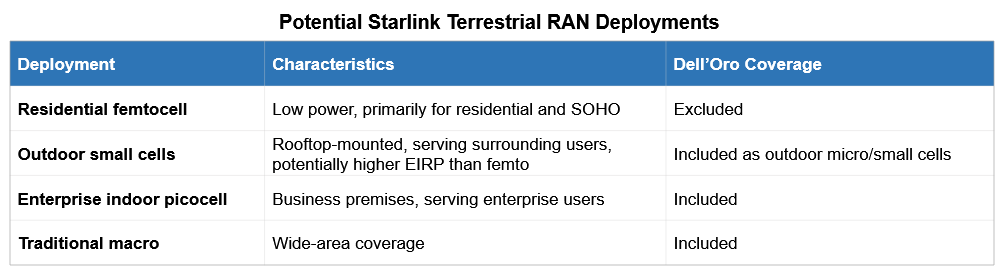
From a RAN equipment perspective, SpaceX’s growing terrestrial ambitions add another potential demand driver. However, the magnitude remains uncertain. SpaceX has discussed deploying large numbers of small base stations alongside Starlink terminals, while its recent 800 MHz acquisition raises the possibility of a broader terrestrial coverage network. Some of these deployments could fall within our RAN market estimates, which include outdoor microcells and enterprise and public-access picocells but exclude residential femtocells. Even if some Starlink radios qualify as outdoor small cells, the incremental equipment opportunity could remain relatively modest compared with the global RAN market. However, if SpaceX ultimately expands beyond small cells into a broader macro RAN deployment, this could introduce some upside to the North American RAN outlook toward the latter part of our five-year forecast period, though the impact on the global market would likely remain limited.

The potentially more significant impact could be indirect. SpaceX could capture a meaningful share of connectivity revenues without carrying a corresponding share of mobile traffic, particularly as it expands beyond satellite coverage into terrestrial mobile services. If this increases competitive pressure on incumbent mobile operators, it could also weigh on their revenues and capital spending over time. This remains a longer-term risk rather than a change to our current forecast assumptions. For now, we are maintaining our five-year RAN outlook, including our assumptions for the terrestrial and non-terrestrial traffic split. While SpaceX’s ambitions are becoming clearer, the scale, timing, and economics of its terrestrial deployments remain uncertain.

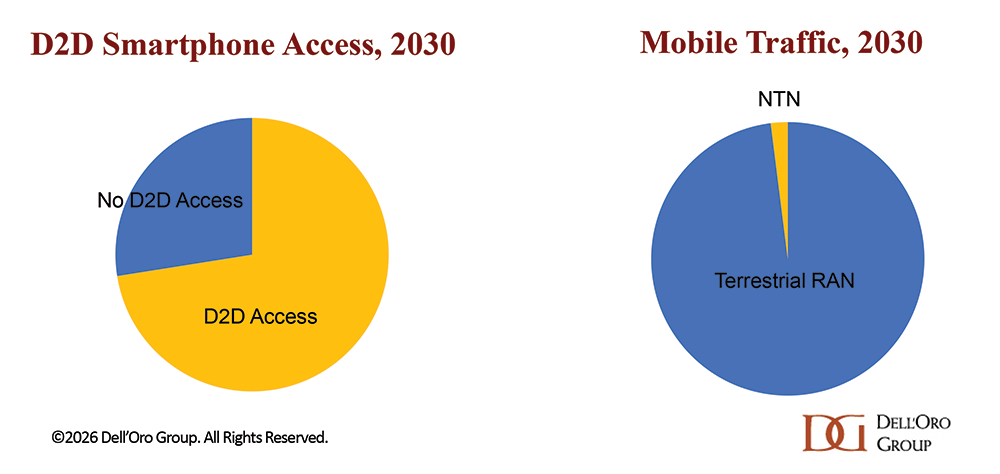
In other words, our long-term position remains unchanged—we continue to believe that NTNs are highly important complements to today’s terrestrial RAN networks and the future is hybrid. But we need to separate the “addressable D2D smartphone opportunity” from the “addressable mobile traffic share.” The base case is that D2D will scale rapidly and most smartphones outside of China will eventually have access to satellite D2D connectivity. At the same time, physics won’t change. And since the base case is that mobile traffic (human plus machine) will grow at a 17% CAGR over the next five years, with human-driven traffic still dominating (Ericsson Mobility Report), the mid-point scenario is for terrestrial RAN to carry more than 98% of the overall global mobile traffic by 2030.

There is also a question of time horizons. Our five-year RAN outlook is unlikely to capture the full implications of Musk’s connectivity ambitions, which appear to extend well beyond 2030. If autonomous vehicles, humanoid robots, and other forms of physical AI eventually scale as Musk envisions—he has discussed the potential for 10 billion humanoid robots by 2040—the connectivity requirements and economics could look very different. While the timing and magnitude remain highly uncertain, SpaceX’s longer-term ambitions could ultimately have a more significant impact on the mobile ecosystem than is reflected in our current five-year RAN outlook.

Alternative outcomes are likely, especially if we extend the forecast horizon. Two significant swing factors include the mobile traffic share of physical AI/machines in outdoor settings and the reach of Starlink’s terrestrial ambitions.

If physical AI accelerates faster than expected and traffic patterns/profiles are more conducive to satellite connectivity, the overall NTN share could surprise to the upside.  Similarly, if Physical AI develops more slowly than expected, the traffic split between terrestrial and NTN could differ.

The physics favor terrestrial RAN for capacity and NTN for geographic coverage, and that won’t change. But Musk has a history of changing the economics around the physics. The more consequential impact on RAN may ultimately come not from SpaceX’s equipment purchases, but from how its growing presence reshapes the economics of the operators investing in terrestrial networks.