[wp_tech_share]

At last month’s SCTE Tech Expo Event in Atlanta, two separate 3 GHz developments were announced, as cable operators and their equipment vendors look to define a future that continues to include HFC and DOCSIS in some capacity. First, CableLabs published Annex A to the DOCSIS 4.0 PHY spec, a year after announcing that an effort would begin to push existing HFC capacity to 25 Gbps. Second, AOI showed a live concept demonstration of a 3 GHz amplifier and published a corresponding whitepaper detailing some of the architectural options and challenges cable operators face when considering whether to evolve their outside plant to 3 GHz.

Although the updated CableLabs spec and AOI’s whitepaper tackle two different, but completely complementary, parts of the network, there are some interesting areas of alignment that emerge as well as some potential architectural differences, which is to be expected at these early stages of theorizing and development. It’s important to keep in mind that these technology cycles generally take many years before products are even introduced. The work on 1.8 GHz amplifiers and housings began in 2019, after 3 years of standards development, with final designs largely settled in 2025. If that holds true to form, then we are currently estimating 2033-2035 as the rough timeline for 3 GHz upgrades in current HFC networks.

In these early stages of conceptualization, the engineering questions often overshadow the business rationale. But in the case of 3 GHz, whether it makes sense from a financial and competitive standpoint is a very relevant question to ask, given the dynamic competitive landscape and given the fact that so few operators are even moving forward with DOCSIS 4.0 in the first place.

    • Will the effort required to bring 3 GHz to the market be worth it, considering that the number of operators deploying DOCSIS 4.0 remains limited to the largest North American tier 1 operators and a smattering of European operators?
    • By the time 3 GHz technologies are fully baked, delivering 25 Gbps of capacity, will the world have already passed those capacity levels by, effectively stranding the industry-wide R&D investment?

These are critical questions that absolutely have to be answered in order for 3 GHz to reach maturity and find a set of operators large enough to create the required component ecosystem. Even before the industry tries to answer those difficult questions, the technology has to work. Right now, vendors and operators alike are coming up with early technology options that will ultimately evolve with more testing and with the availability of silicon.


Outside Plant Remains the Overarching Challenge

The Annex A update to the DOCSIS 4.0 PHY spec lays out the requirements to support 3 GHz at the node and the modem, which is the scope of the PHY working group. The specification keeps the door wide open on architectural approaches in the outside plant, but notes that the target power amplifier technology at the node is 75 dBmV of total composite power (TCP) across 2304 MHz of available spectrum. That compares to current TCP levels of 66-70 dBmV at 1794 MHz. The specification states that the amplifier technology for 3 GHz at the node is still under development (and is “highly demanding”) and that a future iteration of the spec will include more detailed interface D requirements.

SCTE provides the standards for amplifiers, taps, and passives. While the organization has developed standards (ANSI.SCTE 264 and 265) that call for taps with 3 GHz-capable housings with 1.8 GHz faceplates, the amplifiers remain an open question thus far. That is where AOI and others are seeking to outline options for evolving the plant to 3000 MHz.

AOI’s whitepaper makes the clear point that attenuation rises with frequency. Pushing today’s amplifiers to 3 GHz raises TCP by more than 10 dB, or roughly 10x the RF power. This means that current network powering options will likely not be able to handle this additional power load. Also, whether current amplifier housings can dissipate the additional heat each amplifier creates is an open question.

The whitepaper proposes several alternatives and organizes them into distinct categories, each with its own set of trade-offs:

  • High-TCP wideband
  • Low-TCP wideband
  • Split-band
  • Channelized
  • Hybrid analog/digital

Each category provides a different combination of answers to two fundamental questions:

  1. Does the architecture concentrate gain in each amplifier using today’s spacing, or does it spread the gain across a larger number of smaller actives with shorter spacing?
  2. Does the architecture rely on amplifiers that are built to support a wideband path, a split-band pair, several channelized amps, or amps that support both analog RF and digital using a DSP?

Based on how each approach answers these two questions, we can boil things down to two architectural approaches. Let’s look at both.


Architecture One: Maintain Current Spacing and Make Each Amplifier Do More

In addition to AOI’s whitepaper, Richard Prodan, an Engineering Fellow at Comcast, published a technical paper for SCTE Tech Expo called “Evolving the DOCSIS 4.0 PHY to 3 GHz: Evaluating the Possibilities and Optimizing the Benefits.” In his paper, Prodan offers an option for keeping today’s amplifier spacing.

In one of his examples, Prodan starts with a node-plus-6 architecture with a 100-foot drop from the last tap after the amplifier furthest from the node, supporting up to 12 192 MHz OFDM channels anywhere from 108-258 MHz up to 3 GHz. The legacy power tilt is then extended to 3 GHz, which pushes the node and amplifier TCP to 84 dBmV, well above the 75 dBmV target identified in the CableLabs Annex A spec.

To bring the TCP down, Prodan suggests using step-downs in the power profile at higher frequencies. A single 9.5 dB step near 1 GHz reduces TCP to the 75 dBmV target while continuing to support 25 Gbps of channel rate using 2048-QAM.

From the perspective of maintaining RF signal quality and fidelity, the paper does demonstrate that cable operators could theoretically achieve their goal of 25 Gbps of capacity without having to put any additional active electronics in the field. The challenge that the paper doesn’t address and which AOI says is a deal-breaker for this high-TCP wideband option, is that maintaining 1.8 GHz amplifier spacing at 3 GHz would require “an incredible 50 times more power and dissipate more than a kilowatt of heat.”


Architecture Two: Add Gain Between Amplifiers

If a 50x increase in power is an excessive trade-off for not having to touch the installed amplifier base, then the next architectural option is to increase the number of actives in the plant and further distribute power amplification beyond what exists today. In other words, leave the legacy amplifiers in place but then add smaller booster amplifiers in the spans between them, using 2-3 booster amps per span. Additionally, booster amps can be located closer to taps or inside them as active hybrid taps. In the context of AOI’s whitepaper, this is the split-band option.

    • Technical trade-off: Overall loss is reduced, though at the cost of an increased number of actives in the plant, something most operators would desperately like to avoid;
    • Commercial trade-off: New hybrid amplifier and tap platform doesn’t exist yet, and there is no guarantee that the R&D effort required to build it would generate enough ROI, especially with so many operators looking at 50G PON as their possible fiber entry point.

Also, every split-band design sacrifices some amount of spectrum between the original amplifiers and the new booster amplifiers. According to the various papers presented, the range of loss is roughly 4-7%. This is precious capacity that, as of yet, can’t be reclaimed by any of the approaches suggested.


Why 3 GHz-Capable Tap Housings Matter Today

Though the papers disagree on the ideal approach for operators to upgrade their amplifier networks to support 3 GHz, there is alignment on the current need to deploy taps, nodes, and amplifier housings that can all be upgradeable to 3 GHz. For taps, start with deploying 3 GHz-capable housings, even with 1.8 GHz electronics inside.

Over time, and assuming alignment on the most cost-effective approach among operators, as well as the availability of silicon, deploy 3 GHz smart amplifiers and tap faceplates in those systems where the taps were already deployed within 3 GHz-capable housings.

In reality, however, operators upgrading to 1.8 GHz amplifiers aren’t universally pairing these upgrades with 3 GHz-capable tap housings.

Instead, operators appear to be installing 3 GHz-capable tap housings in select systems, rather than across the new 1.8 GHz amplifier footprint. This could be due simply to the original taps having ingress noise issues, or it could be part of a long-term strategy in those systems to help offload MVNO traffic.

But the fact that operators that are in the process of upgrading to 1.8 GHz DOCSIS 4.0 aren’t universally deploying 3 GHz tap housings at the same time could say something about their belief in 3 GHz as a realistic and cost-effective option to remain competitive in the 2030s and beyond.

What we believe will determine the viability of 3 GHz in the minds of operators is the success of DOCSIS 4.0 in slowing subscriber losses. Over the next 18 months, we should start seeing whether the systems that get upgraded to full DOCSIS 4.0 deliver better subscriber gains, more reliability, and higher NPS scores.

If they do, then 3 GHz remains on the table. If they don’t, then we believe there will be an effort to rethink the mix of fiber and HFC going forward.
[wp_tech_share]

As AI infrastructure scales, I believe evaluating server network adapters solely by port speed or PCIe generation no longer tells the full story. Three factors are becoming increasingly important in shaping network architectures: performance, programmability, and power efficiency. Performance determines how efficiently data moves; programmability determines which infrastructure functions can execute outside the host CPU; and power efficiency influences system cost, cooling requirements, and deployment density.

According to Dell’Oro Group’s latest Ethernet Adapter & Smart NIC market forecast, the market is projected to grow to $53.6 B by 2030. As AI infrastructure investment accelerates, the more important question is not simply how fast the market will grow, but how evolving networking architectures will influence demand and competitive positioning across different adapter segments.

The NIC Paradigm: Balancing Performance vs. Programmability

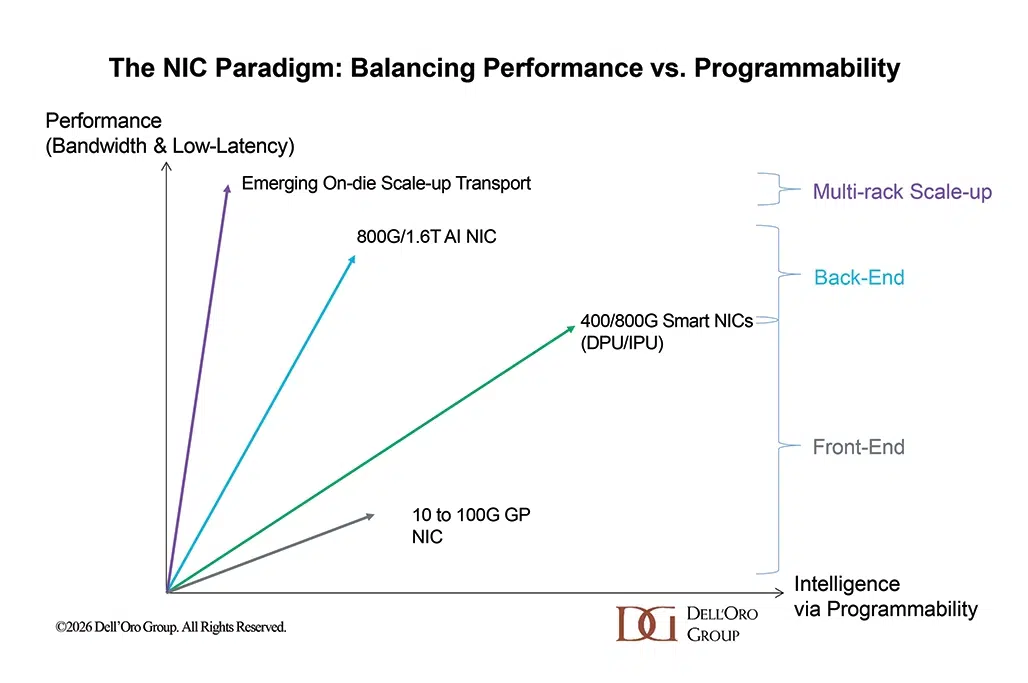
As illustrated in the accompanying chart, general-purpose (GP) NICs, Data Processing Units (DPUs) and Infrastructure Processing Units (IPUs), AI-optimized NICs, and emerging scale-up transport occupy different positions along the performance-programmability spectrum. These are conceptual distinctions, not a linear progression: actual capabilities overlap and depend on implementation.

The deeper market question is not simply which adapter is fastest. It is where networking functions should reside—and which capabilities customers will pay to accelerate, offload, or integrate within their power and thermal budgets.

Different Workloads, Different Value Propositions.


General-purpose NICs

Connectivity as the baseline. General-purpose NICs serve enterprise, cloud, and data center workloads requiring reliable connectivity, compatibility, and cost efficiency. Their capabilities vary in bandwidth and hardware offloads. Where conventional connectivity meets workload requirements, additional processing may not justify its incremental cost.

For vendors, opportunities remain in cost-effective, easy-to-deploy 10/25G and 100G general-purpose Ethernet adapters. According to our Ethernet Adapter & Smart NIC research, Ethernet adapters operating at 100 Gbps and below are projected to account for 86% of port shipments in 2030 across the front-end networks of enterprises, non-AI cloud providers, and telecom operators.


DPUs/IPUs

Programmable infrastructure offload. Data Processing Units (DPUs) and Infrastructure Processing Units (IPUs) are programmable processors designed to offload networking, security, storage, and other infrastructure functions from host CPUs. Depending on the implementation, they combine general-purpose processor cores with networking engines and dedicated hardware accelerators to support virtual switching, security, storage, and infrastructure management. In our Ethernet Adapter & Smart NIC research, DPUs and IPUs are categorized within the Smart NIC segment, and Smart NICs are projected to account for 83% of NIC port shipments in hyperscalers’ front-end networks by 2030. The hardware data path engine or packet pipeline of a DPU/IPU (Smart NIC) can be implemented using either fixed-function ASICs or reconfigurable Field Programmable Gate Arrays (FPGAs).

As agentic AI increases infrastructure complexity through multi-step reasoning, tool orchestration, memory access, and policy enforcement, DPUs/IPUs may offer new opportunities to offload selected networking, security, and infrastructure tasks. The key market question is whether these demands will drive broader DPU/IPU adoption beyond established cloud deployments, which customer segments will lead incremental demand, and whether programmable offload will expand the Smart NIC market or intensify competition with AI-optimized NICs.


AI-optimized NICs

Performance at scale. Distributed AI training and accelerator-intensive workloads require high effective bandwidth, efficient transport, congestion management, and predictable latency. Specialized adapters may accelerate RDMA, supported transport protocols, and selected collective-communication functions.

Power efficiency is equally important. Indicative profiles range from approximately 15–30 W for some 400G fixed-function adapters to 40–75 W for some 800G-and-higher designs. Actual consumption varies by implementation. As port speeds rise, SerDes and PHY circuitry can add to the power and cooling burden. The relevant metric is therefore not bandwidth alone, but effective networking performance per watt. Across large clusters, adapter power contributes to rack-level heat removal requirements and can constrain system design.

These categories differ in emphasis, not absolute capability. AI NICs can incorporate sophisticated acceleration, while DPUs/IPUs can also support high-throughput networking.


Scale-Up Networking: An Emerging Frontier for AI Infrastructure

The next architectural shift may extend beyond faster conventional adapters. Scale-out networking connects servers through a fabric. Scale-up networking extends high-performance communication across accelerators, potentially spanning multiple racks. Depending on the design, this can introduce requirements for accelerator-aware communication, memory semantics, and coordinated endpoint and transport behavior.

Open Compute Project initiatives, including Ethernet for Scale-Up Networking (ESUN) and Scale-Up Ethernet Transport (SUE-T), illustrate this direction.

If these architectures mature and achieve deployment at volume, networking functions could move closer to accelerator silicon or into tightly integrated packages. This could change the role of conventional adapters and redistribute value among accelerator vendors, network silicon suppliers, and system designers.

While on-die scale-up networking is not yet covered in our Ethernet Adapter & Smart NIC research, we are closely watching how these emerging architectures evolve. Interoperability, software maturity, manufacturing, and customer qualification will determine which approaches gain commercial traction. Integration may reduce some data-movement overheads, but system-level power savings must be demonstrated rather than assumed.


Three Market Developments Shaping Ethernet Adapters and Smart NICs
  1. System-level performance

Higher port speeds alone do not guarantee better workload performance. Improvements in accelerator utilization, job completion time, and total system cost provide stronger evidence of differentiation.

  1. Economics of programmable offload

DPUs/IPUs can consume substantially more power than fixed-function adapters because they incorporate general-purpose processing and additional acceleration logic. That cost may be justified when offloading infrastructure functions reduces host CPU demand or improves isolation. The right comparison is net system-level power and performance, not adapter power in isolation.

  1. Scale-up deployment at volume

Standards progress and product announcements matter, but interoperability, customer qualification, and repeatable deployments are stronger indicators of commercial adoption. Product leaders should also assess whether emerging architectures improve power efficiency and thermal density at the system level.


The Strategic Implication

The AI networking market is unlikely to converge on a single adapter architecture. General-purpose NICs, DPUs/IPUs, and AI-optimized adapters address different requirements, while emerging on-die scale-up designs may change where connectivity and transport functions reside.

The deeper shift is not simply toward faster networking, but toward a redistribution of networking functions across the computing system. For vendors and infrastructure providers, success will depend on identifying which functions warrant dedicated hardware, which require programmability, and which may be integrated into the accelerator or fabric. The winning designs will balance performance, programmability, and power efficiency to deliver measurable system-level value.

As these architectures evolve, understanding the adoption and market positioning of Ethernet Adapters and Smart NICs will become increasingly important.

[wp_tech_share]

Last week, I attended Cloudflare Connect 2026 in San Francisco as one of about 20 invited industry analysts. The most interesting story wasn’t an individual product announcement, but Cloudflare’s broader ambition to extend its global delivery and security network into infrastructure for AI agents that build, connect, and transact across the Internet. The opportunity is substantial because Cloudflare already operates at the intersection of several capabilities that could become increasingly important as machines assume a larger role in online activity.

Dell’Oro Group tracks Cloudflare across several security segments, including web application firewalls (WAF) and Security Service Edge (SSE). These security businesses remain important, but they may also provide the foundation for a broader developer and transaction platform.

Three observations from Connect illustrate both the strategic opportunity and the market implications worth watching.


The Internet’s Bodyguard Wants to Become Its Cashier

Matthew Prince, CEO of Cloudflare, highlighted a striking milestone during his keynote: Cloudflare data shows agentic AI traffic overtook human traffic in May 2026. That crossover arrived more than a year ahead of his original forecast, underscoring how quickly the Internet’s usage patterns are changing. Increasingly, the Internet serves two audiences: people who consume content and AI agents that retrieve information, interact with applications, and complete tasks on their behalf. This shift has implications that extend well beyond the volume of AI agent traffic.

AI agents place different demands on infrastructure because they can generate large numbers of requests, execute multistep workflows, and interact with services without direct human involvement. They also introduce questions about identity, authorization, and accountability, particularly when an agent acts on behalf of a person or organization. Cloudflare sees an opportunity at this intersection of networking, security, identity, and execution, building on a globally distributed network that already delivers applications and enforces security policies. Extending those capabilities into agent identity, execution, and payments could establish Cloudflare as an important infrastructure provider for the agentic Internet.

One particularly interesting opportunity involves the economics of agent-driven commerce. The Internet’s traditional business model has depended heavily on human visits, advertising, and referrals, but AI agents can consume content and computing resources without generating the traffic or revenue that previously supported content creators. Cloudflare’s Pay Per Use and Monetization Gateway initiatives seek to address this imbalance by enabling content and service providers to receive compensation when agents consume their resources. The direction is sensible, though it raises questions about how Cloudflare will set access, pricing, and payment terms as it increasingly mediates transactions between agents and content owners.

The opportunity extends beyond protecting existing business models and points toward a potentially significant category of machine-to-machine commerce. Cloudflare’s network reach naturally positions it to facilitate these interactions, while its existing security capabilities provide a strong foundation for building trust. However, interoperability, transparent policies, and customer control will be essential if these services are to become widely adopted Internet infrastructure. The Internet’s bodyguard is applying for a second job as its cashier, and the rules governing that role will matter.


The Developer Platform Is the Quiet Expansion Engine

The second observation is that developers, not solely enterprise security buyers, are increasingly pulling Cloudflare’s expansion. Workers, data services, and AI-related tooling allow developers to build and deploy applications without assembling conventional cloud infrastructure. Cloudflare OS extends that concept into an AI workspace that connects enterprise systems, selects models, and orchestrates workflows using Cloudflare’s underlying services. Together, these capabilities suggest Cloudflare wants to become an increasingly natural destination for AI-era applications.

The commercial logic is worth examining because the adoption model differs from traditional enterprise software. An open-source workspace does not necessarily generate direct licensing revenue, but applications built around it can increase consumption of compute, data, identity, security, and AI gateway services. A developer begins with a useful application, and the enterprise gradually inherits a broader infrastructure relationship as that application moves toward production. The opportunity is attractive for Cloudflare, although the durability of this consumption model will depend on how successfully experimental workloads become business-critical applications.

Two customer examples illustrated the potential. Block, the financial technology company behind Square and Cash App, described using Cloudflare to incubate employee-created applications without disrupting production systems, while consolidating workforce access under a consistent Zero Trust architecture. The developers at Block were instrumental in picking Cloudflare’s SSE/ZTNA solution. Montclair State University demonstrated another compelling use case: using AI to create connective tissue across disparate enrollment, housing, financial aid, academic, and campus systems. Instead of forcing students to navigate multiple portals and piece together information themselves, an AI-powered workspace can bring those systems together to answer questions, identify next steps, and help students complete tasks. Both examples show how AI can unlock value from existing enterprise systems without replacing them.

The major hyperscalers—Amazon Web Services (AWS), Google Cloud, and Microsoft Azure—are unlikely to lose their central role, especially where databases, long-running workloads, and compliance requirements create substantial inertia. Enterprises may nevertheless welcome Cloudflare for distributed execution, application integration, and security while retaining their core data and systems in hyperscaler or private clouds. However, infrastructure lock-in remains a concern, even when the application framework itself is open source, because operational dependencies can accumulate around the underlying infrastructure services. Cloudflare’s opportunity may be to win more of the work between clouds rather than displace them.


AI Makes Security More Important—and Changes Its Economics

The third observation matters for cybersecurity markets because AI is expanding the attack surface while improving security teams’ productivity. AI accelerates application development, increases API activity, and introduces autonomous agents that can take action, creating additional demand for security controls. At the same time, AI-assisted engineering, vulnerability discovery, investigation, and remediation could reduce the labor required to achieve security outcomes. The resulting dynamic is important: increasing cyber risk does not necessarily translate into proportionately higher spending across every security product category.

Application security provides a useful example because faster software development creates both advantages and difficulties. AI-assisted coding can boost development productivity and potentially reduce certain classes of vulnerabilities, but it also enables organizations to build more applications, APIs, and business logic that need protection. Even well-written code cannot prevent every inappropriate action, particularly when an AI agent executes a legitimate API request for a purpose its user never intended. Consequently, security increasingly needs to evaluate identity, authorization, application context, and permissible actions rather than relying exclusively on identifying known exploits or malicious requests.

This evolution plays to Cloudflare’s strengths in distributed enforcement because its network provides a common infrastructure for applying security policies close to applications and users. Combining these capabilities with agent identity, application execution, and AI governance could create meaningful differentiation as enterprises seek more coordinated security architectures. Customer presentations reinforced the practical importance of these capabilities: eBay described agentic tools supporting customer security operations and cybercrime intelligence, while Estonia demonstrated how centrally managed web and DDoS defenses can protect government services against sustained attacks. Neither example suggests that traditional security requirements are disappearing, but both illustrate how automation and shared enforcement infrastructure may change the economics of delivering security outcomes.

The broader implication is that AI could increase demand for security while also pressuring products whose primary differentiation rests on manual workflows, data aggregation, or basic orchestration. Vendors will increasingly need to demonstrate differentiated context, reliable enforcement, and operational accountability rather than simply adding an AI interface to existing products. For Cloudflare, this presents an opportunity to extend the value of its network and security capabilities into emerging AI workloads. For the cybersecurity market, it suggests that competitive advantage increasingly depends on how effectively vendors coordinate identity, application context, policy, and enforcement across distributed environments.


What I Will Be Watching

Cloudflare’s strategy now spans markets that enterprises have historically budgeted and managed separately, but the underlying capabilities increasingly reinforce one another. Its network provides global reach, security establishes trust, developer services generate workloads, and agent identity and payments introduce additional monetization opportunities. More developers create more applications, which generate traffic and require security, while growing agent activity increases the importance of authorization and transaction services. The strategic logic is compelling, although translating those relationships into sustained commercial growth will require continued execution.

I will be watching three developments as the strategy unfolds. First, can Cloudflare convert growing developer adoption into durable enterprise workloads that generate meaningful infrastructure consumption? Second, will agent identity, authorization, and payment capabilities mature into sufficiently open and interoperable services that enterprises can deploy them confidently? Third, can Cloudflare translate its expanding technology footprint into a coherent operating model that customers increasingly view as broader application and AI infrastructure rather than primarily security and delivery services?

For the cybersecurity industry, the implications reach beyond Cloudflare because AI is accelerating the convergence of networking, application delivery, security, and distributed computing. Vendors that can coordinate these capabilities will capture larger shares of enterprise infrastructure spending, although the economics of individual product categories could evolve considerably along the way. My takeaway from Connect is that Cloudflare is no longer simply asking how much more of the security stack it can address; it is asking how much of the agentic Internet it can help operate. Security may be the on-ramp, but what matters next is whether customers trust—and pay for—the road beyond it.

[wp_tech_share]

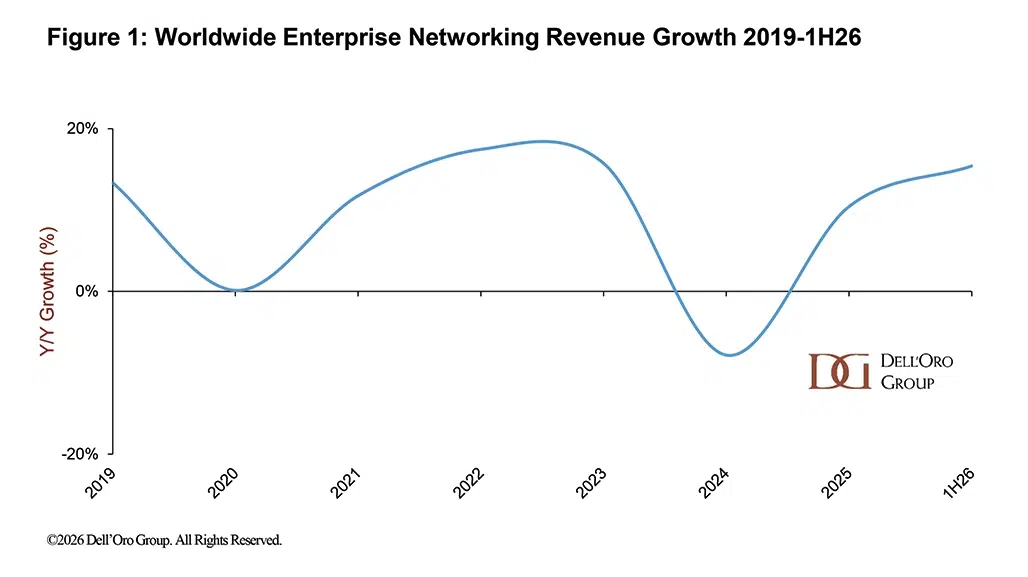
A year ago, we questioned whether the recovery in Enterprise Networking could sustain itself after several years of extraordinary market swings. The first half of 2026 has provided an encouraging answer. Worldwide Enterprise Networking revenue grew 15% year over year (Y/Y), with all five major segments—Network Security, Branch Routing, WLAN, Campus Switching, and Enterprise Data Center Switching—posting double-digit gains. Growth accelerated further in the second quarter.

Yet the headline figures conceal increasingly different market dynamics. Some segments are benefiting from rising equipment shipments, others from higher prices, and still others from changes in how enterprises connect and secure their infrastructure. Artificial intelligence (AI) is complicating the picture, generating new infrastructure requirements while also driving up the cost of traditional networking equipment. As the industry looks toward 2027, the central question is how much of the current expansion reflects durable investment demand and how much reflects pricing and purchase timing.


From Recovery to Expansion

The Enterprise Networking market has traveled a rocky road since the pandemic. Supply shortages and accumulated backlogs drove exceptional revenue growth in 2023, followed by a sharp correction as shipments normalized and enterprises worked through excess inventory. The market contracted in 2024 before returning to growth in 2025 (Figure 1). With the inventory digestion behind us, enterprise spending has entered a new investment cycle shaped by technology refreshes, security modernization, rising prices, and shifting infrastructure economics.

WW Enterprise Networking Revenue Growth 2019-1H26 Dell'Oro Group

WLAN led the five markets in growth during 1H26, while Network Security contributed the most incremental revenue. Campus Switching, Branch Routing, and Enterprise Data Center Switching also expanded at double-digit rates, but their underlying drivers were far from uniform. In 2026, renewed supply shortages and rising prices are intersecting with genuine deployment growth and technology migration. Those forces will not necessarily persist on the same timetable.


When Revenue Growth Outpaces Underlying Demand

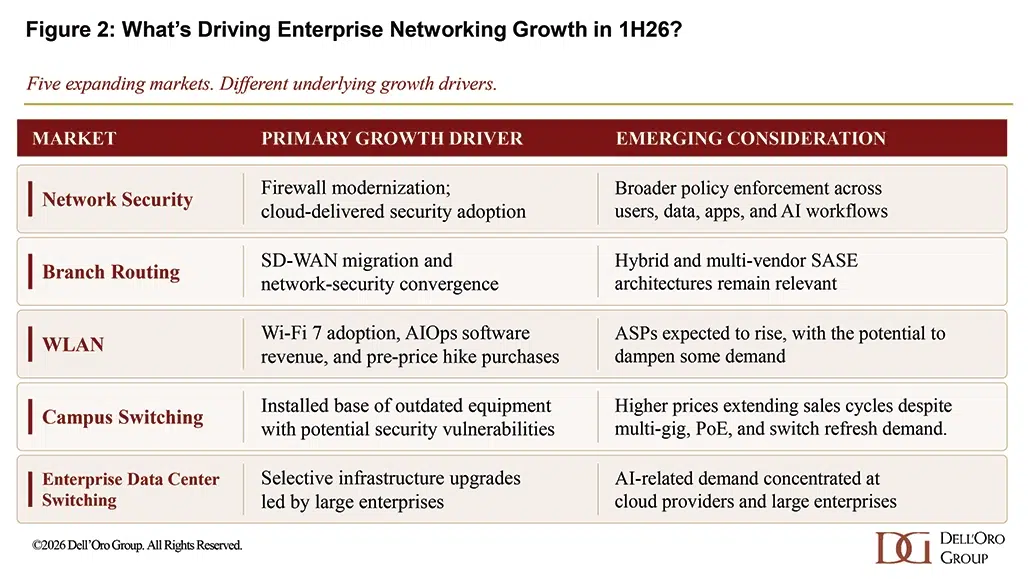
Campus Switching and WLAN illustrate the difference between stronger spending and stronger equipment demand (Figure 2). Campus Switching revenue grew at a double-digit rate in 1H26 even though port shipments were nearly flat following elevated shipment growth in 2025. Higher campus switch prices are now flowing through to vendor revenues; in 2Q26, port shipments fell 5% while ASPs surged 19%. Despite the large volume of end-of-support campus switches in the field, higher spending did not translate into a comparable increase in switch port shipments.

DDR4 memory shortages are a major source of pricing pressure, with memory costs escalating as AI infrastructure buildouts have tightened component supply. Enterprise IT vendors have raised prices, redesigned products, and sought alternative sources. Since enterprise equipment is often quoted well before delivery, these increases take time to appear in reported revenue. The latest Campus Switch results suggest that earlier price actions may be squeezing IT budgets and making some refresh projects harder to justify.

In 1H26, WLAN followed a different trajectory from Campus Switching, with revenue growth supported by higher access point shipments as Wi-Fi 7 adoption accelerated and enterprises ordered ahead of anticipated price increases. Wi-Fi 7 now accounts for most indoor access point revenue. Vendors are also contending with DDR4 memory shortages, which we expect will push WLAN equipment prices higher in 2H26. Meanwhile, recurring software licenses and advanced AIOps capabilities are becoming increasingly important revenue sources in a market historically dominated by hardware sales. Together, these developments are changing both the economics of WLAN deployments and how vendors monetize their installed bases.

Enterprise_Networking_Growth_Matrix_1H26-1

AI Is Both a Tailwind and a Headwind

AI infrastructure investment has been a strong catalyst for the broader Data Center Switching market, particularly among hyperscalers and specialized cloud providers building networks for training, inference, and agentic workloads. Enterprise demand is more measured. Growth in enterprise front-end Data Center Switching has been concentrated among large organizations, often as part of upgrades to networks supporting general-purpose servers rather than dedicated AI deployments. Smaller enterprise customers have continued to pull back on purchases.

Many enterprises are still deciding where AI workloads should run and whether the expected benefits justify new on-premises infrastructure. Public cloud services offer an alternative to owning compute and networking equipment. Meanwhile, the AI buildout is tightening supplies of components also used in campus and wireless networks. It can therefore lift traditional networking revenue through price increases even where AI is not generating incremental equipment demand. Higher costs could, in turn, encourage customers to extend product lifecycles or redirect budgets.

AI is also expanding security and operations requirements, from protecting sensitive data and governing AI applications to managing non-human access and defending against more capable attackers. Much of the near-term commercial opportunity is being captured through capabilities added to established platforms rather than entirely new product categories. For now, network modernization, risk reduction, and operational efficiency remain more tangible purchasing drivers than broad AI-led replacement cycles.


Cybersecurity Becomes a Modernization Catalyst

Network Security was the largest contributor to Enterprise Networking revenue growth in the first half, supported by targeted Firewall refreshes and continued adoption of cloud-delivered security. Within Security Service Edge (SSE), separately monetized Data Security and Digital Experience Management capabilities are expanding faster than foundational access and inspection. Enterprises are extending security policy across users, applications, data, and workloads, with AI introducing additional requirements rather than replacing existing ones.

Cybersecurity concerns are increasingly influencing spending beyond security products. Aging switches, routers, and wireless access points have always needed replacement as performance requirements rise or vendor support expires. Now, vulnerability exposure and concerns about AI-assisted cyberattacks are making those refresh decisions more urgent. Channel discussions suggest that security audits are identifying unsupported equipment and initiating replacement projects. Infrastructure modernization is becoming as much a resilience decision as a capacity decision.

The shift is especially visible in Branch Routing, where SD-WAN continues growing while traditional Access Router revenue contracts. Enterprises are using router refreshes to adopt software-defined connectivity and integrate networking with cloud-delivered security through Secure Access Service Edge (SASE). The result is not necessarily a single-vendor architecture: operational maturity, existing investments, and sovereignty requirements still favor hybrid or multi-vendor approaches in many environments. Network management is evolving similarly. Cloud-managed Campus Switching is outpacing the broader market, but premises-based and private-cloud WLANs remain important, reflecting the trade-offs among automation, recurring fees, and control.


Which Way Are We Headed?

We remain optimistic about Enterprise Networking, although growth is likely to moderate from the first-half pace. Wi-Fi 7, installed-base refreshes, security requirements, and SD-WAN adoption provide durable support. Countering those tailwinds are component shortages, higher equipment prices, and purchasing pull-forwards that may dampen subsequent shipments even if modernization plans remain intact.

As 2027 approaches, we will be watching whether equipment demand can withstand higher prices, whether AI investment spreads beyond cloud providers and the largest enterprises, and whether automation and cybersecurity investments deliver the operational benefits buyers expect. Sustaining market expansion will increasingly depend on the underlying need to modernize rather than on higher prices or shifts in purchase timing.

[wp_tech_share]

One of the biggest themes at OCP 2026 was the remarkable level of optical innovation and announcements—activity historically more associated with OFC. In my observation, the number of sessions dedicated to optics nearly doubled compared with last year.

This shift goes beyond the conference agenda. As AI networks demand more bandwidth, denser connectivity and increasingly distributed architectures, optics and switching silicon are becoming more tightly intertwined. Six developments stood out.

1. Co-Packaged Optics Moves Closer to Commercial Deployment

Co-packaged optics (CPO) reached an important milestone as NVIDIA moved its Spectrum-X Ethernet Photonics switches into production, with early customer adoption and deployments beginning. Celestica reinforced that momentum with its DS6005, a liquid-cooled 102.4 Tbps Ethernet switch based on Broadcom’s Tomahawk 6–Davisson CPO platform. It offers 64 × 1.6 Tbps ports in a compact 1.5OU form factor, using co-packaged optical engines and field-replaceable external lasers.

Near-packaged optics (NPO) also deserves attention. In its rack-scale architecture announcement, Arista identified open CPO/NPO alongside XPO as next-generation optical approaches for increasing network-rack density, citing a path from 1.6 Pb/s with current OSFP-based designs to 6.5 Pb/s per rack. This is an architectural density outlook—not evidence that NPO is already shipping in volume.


2. Pluggable Optics Fight Back with Higher Bandwidth Density

Even as CPO gains momentum, pluggable optics are far from standing still. NVIDIA and Cisco introduced plans for Ultra-Dense Small Form Factor Pluggable (USFP), a proposed 400 Gb/s-per-lane design with a path to as much as 12.8 Tbps of aggregate module capacity.

The companies are targeting four times the bandwidth density and approximately 1.3 times the power efficiency of 200 Gb/s-per-lane pluggable designs. That could connect more endpoints without adding network tiers while retaining familiar deployment flexibility and field serviceability. The story is not simply CPO versus pluggables: adoption will reflect density, power, reach, reliability, operating model and economics.

The significance is that optical integration is progressing from component roadmaps to complete systems and rack-level design choices. Customer qualification, serviceability, production yields and meaningful shipment volumes remain the metrics to watch. Early commercialization should not be confused with broad adoption.


3. The 100T Switch Era Is Here—and the Transition to 1.6T Is Underway

The 102.4 Tbps generation is taking shape across multiple silicon and systems ecosystems. Broadcom’s Tomahawk 6 underpins Arista’s 7060XE7 portfolio, which supports dense 1.6 Tbps connectivity with air- and liquid-cooled options. Celestica’s Tomahawk 6-based DS6000 and DS6001 are available to order, while the DS6005 extends the family into CPO.

Cisco’s OCP 2026 update reported initial customer shipments of G300-powered 102.4T systems and introduced the 51.2T Silicon One G302, with 200G SerDes and 1.6T connectivity for top-of-rack applications; G302 shipments were planned for before year-end 2026. NVIDIA is also advancing Spectrum-6, including Meta’s announced adoption for next-generation AI infrastructure.

The direction is clear: 100T-class switching and 1.6T ports are becoming building blocks of AI fabrics. But market readiness differs across announcements, orders, customer sampling and shipments. The next question is when 1.6T moves into a sustained volume ramp.


4. Scale-Up Is No Longer Confined to the Rack

One of the most consequential architectural disclosures during OCP was Microsoft’s Maia 300 scale-up domain, described as connecting 12,288 accelerators across 128 racks. It combines electrical links within racks with optical inter-rack connectivity and custom transport for accelerator-to-accelerator communication. The implication is that scale-up can be defined by workload communication requirements, not simply physical rack boundaries.

Additional announcements reinforce the breadth of this shift. Arista’s Etherlink SU-144 proposes open, Ethernet-based scale-up for as many as 144 accelerators in a single-hop domain and up to 1,024 across racks. Celestica and AMD’s Helios collaboration focuses on scale-up switches using Ultra Accelerator Link over Ethernet (UALoE) for AMD’s rack-scale AI platform. These are distinct architectures and development stages, but both point to Ethernet moving deeper into accelerator interconnects.

Meta’s Tahan scale-up switch offers another concrete example: a 51.2T, Broadcom Tomahawk 5-based Ethernet switch in the MTIA 300 system, using a lossless RoCE approach under FBOSS. Meta says Tahan is shipping and has outlined a future 72-accelerator-per-rack platform on 102.4T silicon, with a roadmap toward Ethernet for Scale-Up Networking (ESUN).

OpenAI and Broadcom’s Jalapeño announcement adds the accelerator-design perspective. Jalapeño is an inference-focused processor, not itself an Ethernet scale-up switch; nevertheless, its broader system platform incorporates Broadcom networking technologies, underscoring how chip architecture and fabric design are increasingly co-optimized.

Together, these developments challenge a hard rack boundary between scale-up and scale-out. They also create new opportunities for switching silicon, optics and open Ethernet fabrics, while raising questions around latency, transport semantics, congestion control and operational complexity.


5. Competition in Scale-Up Switching Silicon Is Heating Up

The emerging scale-up opportunity is drawing new suppliers and architectures. Upscale AI introduced its 115.2 Tbps SkyFabriX switching silicon as part of its standards-oriented Token Fabric portfolio. Astera Labs also unveiled its Orion rack-scale PCIe switching architecture, aimed at connecting multiple accelerators within a pod.

These announcements reinforce two trends: suppliers beyond incumbent networking-chip vendors are targeting the market, and no single interconnect is likely to fit every workload. Ethernet, PCIe, NVLink, UALink, and emerging open standards will be evaluated against bandwidth, latency, memory semantics, flexibility and cost. Scale-up is becoming a meaningful new battleground for silicon share.


6. Hyperscaler Customization and Open Networking Keep Advancing

Meta’s OCP 2026 networking disclosure illustrates a multi-vendor approach. Its IcePack liquid-cooled rack houses 102.4T IceCube scale-out switches offered in two silicon variants: Broadcom Tomahawk6C and NVIDIA Spectrum-6. Both use Meta’s FBOSS software and OCP Switch Abstraction Interface (SAI). NVIDIA separately detailed its Spectrum-6-based N-IceCube collaboration. Cisco Silicon One belongs in the broader open-switching competitive landscape at Meta, although Meta’s disclosed IceCube variants did not identify Cisco silicon. Arista’s earlier R4/HyperPort announcement provides another example of the scale-across dimension, although that product announcement preceded OCP 2026.

Cisco’s OCP announcement highlighted Silicon One deployments across hyperscale networks, including P200 systems in Microsoft and Alibaba environments. NVIDIA and Google also announced Falcon Transport support for future ConnectX-10 SuperNICs and BlueField DPUs, extending interoperability between transport software and networking hardware.

These examples show hyperscalers combining merchant silicon with their own software, protocols and system designs. Openness, multi sourcing and interoperability are strategic choices—not just implementation details—as AI factories grow larger and more specialized.


Looking Ahead

If one message emerged from OCP 2026, it is that AI networking is no longer simply about faster switches. Optics, switching silicon and network architecture are co-evolving. CPO is entering early commercialization; NPO and other optical integration paths are gaining visibility; pluggables are pushing density higher; 100T systems and 1.6T connectivity are taking shape; and Ethernet scale-up is extending from the rack into larger accelerator domains.

Optics is no longer a supporting technology at the edge of the switching conversation. It is becoming an essential enabler of how the industry scales the next generation of AI infrastructure.

We provide deeper analysis of vendor positioning, customer wins, hyperscaler architectural choices and market adoption timelines, in our Data Center Switch—AI Back-end Networks reports. To access the reports, please contact us at dgsales@delloro.com.