Memory has become an increasingly important factor in the cost of data center infrastructure, particularly as data center capex is projected to soar past $3 trillion by 2030. Strong demand for conventional DRAM, which is used across all server types, and high-bandwidth memory (HBM), which is used in AI accelerators such as GPUs, has driven memory prices sharply higher. Supply constraints have further intensified pricing pressures, increasing the cost of both general-purpose and AI-optimized servers.
DRAM Inflation Could Add Hundreds of Billions to Server Spending
DRAM pricing has risen significantly over the past year. Dell’Oro Group currently projects server DRAM average selling prices (ASPs) to reach approximately $10/GB in 2026, before gradually moderating toward the $5/GB range by 2030.
The impact on server spending is substantial. As a sensitivity analysis, if DRAM ASPs were instead held at approximately $3.50/GB from 2026 through 2030, roughly in line with pricing prior to the recent increase, higher DRAM pricing could add nearly 10% to cumulative server spending through 2030.
The impact will be most pronounced in 2026 and 2027, when we expect DRAM pricing to remain near its peak. Pricing should begin to moderate more meaningfully from 2028 onward as additional supply enters the market and the industry responds to the higher cost of memory.
Our outlook for the overall DRAM market has consequently increased significantly. The increase is not driven by pricing alone. We have also raised our forecast for DRAM bit demand alongside higher server unit shipments, supported by emerging agentic AI and storage-related workloads that are increasing demand for general-purpose servers in addition to AI-optimized systems.
However, we do not believe today’s elevated DRAM pricing can persist indefinitely without affecting the pace of infrastructure investment. Memory suppliers are expanding production capacity, including new capacity from China, while server and processor vendors are developing more efficient approaches to memory utilization. Together, these developments should help alleviate supply constraints and gradually normalize DRAM pricing over the forecast period.
HBM Faces a Different Cost Challenge
HBM represents an even more important consideration for AI infrastructure. Demand will continue to rise as high-end accelerators incorporate increasing amounts of memory to support larger models and more memory-intensive inference and reasoning workloads.
We project the average high-end accelerator to contain more than 500 GB of HBM by 2030. That estimate could prove conservative. AMD’s recently launched MI455X, for example, already incorporates 432 GB of HBM, illustrating how rapidly memory capacity per accelerator is increasing.
Unlike conventional DRAM, however, HBM may not benefit from the same long-term cost-per-bit declines. Increasing stack heights, density, bandwidth, and packaging complexity could keep the cost per bit elevated even as the technology advances. As a result, simply scaling today’s HBM architecture to ever-larger capacities could significantly increase the cost of future AI systems.
Continued advances in HBM manufacturing and advanced packaging will therefore be critical. Technologies such as hybrid bonding, higher-density HBM generations, improved yields, and eventually lower HBM ASPs could help offset some of the cost associated with rapidly increasing capacity per accelerator.
At the same time, the industry may need to reconsider how much HBM actually needs to reside directly alongside each accelerator. NVIDIA’s Rubin Ultra, for example, could ultimately incorporate less HBM than the approximately 1 TB originally envisioned. Improvements in model efficiency and memory management could reduce HBM requirements, while emerging technologies such as high-bandwidth flash (HBF) could complement HBM as a lower-cost, higher-capacity memory tier.
Memory Efficiency Will Become Increasingly Important
The AI infrastructure industry has so far focused heavily on increasing compute performance, but memory economics could become an equally important constraint on future system design.
For conventional servers, elevated DRAM pricing could add hundreds of billions of dollars to infrastructure spending over the next several years. For accelerated servers, rapidly increasing HBM capacity and complexity could place additional pressure on already-high system costs.
Memory suppliers also face an increasingly complex balancing act in allocating production capacity across conventional DRAM, HBM, and NAND flash. With demand rising across servers, AI accelerators, and storage, suppliers will need to prioritize capacity and investment across these markets. The recent increase in DRAM and NAND pricing could make capacity expansion in these markets more attractive, complicating suppliers’ decisions on how aggressively to prioritize HBM production.
The industry response will therefore need to come from both sides: more memory supply and lower manufacturing costs, but also more efficient use of memory within servers and AI systems. Improvements in memory architecture, packaging, software, and additional memory tiers could become increasingly important in determining how economically the industry can continue scaling AI infrastructure through the end of the decade.
[wp_tech_share]
Industrial giants are reshaping their portfolios at speed. Some are shedding non-core businesses to become focused pure-plays. Others are buying their way deeper into the data center. Both moves answer the same call: the AI buildout has become the industrial economy’s defining megatrend—and capital markets reward those who focus.
The End of the Everything Company
For most of the last century, scale and breadth were the point. General Electric was the template: jet engines, light bulbs, locomotives, medical scanners, home appliances, and a vast finance arm—all under one roof. Diversification was designed to smooth the cycle and compound the advantage.
Then investors stopped buying it. The complexity of these sprawling portfolios made them opaque to value and unwieldy to run. As a result, the market started applying a conglomerate discount, pricing the whole below the sum of its parts. A focused operator commands a higher multiple than the same business buried inside a diversified holding company. Breadth, in other words, was leaving money on the table.
GE eventually drew the obvious conclusion and broke itself into three: GE HealthCare, GE Vernova, and GE Aerospace. The logic now echoes across the industrial landscape. Honeywell is splitting into separate aerospace and automation companies while spinning off its advanced materials business into a new company, Solstice. United Technologies had beaten them to it back in 2020, separating into Carrier, Otis, and Raytheon.
Carrier’s Performing-While-Transforming Act
Carrier, born from that breakup, wasted little time before going further. Few companies have rebuilt themselves as aggressively. The throughline is simple: double down on intelligent climate and energy, exit everything else.
On the buy side, Carrier acquired Viessmann Climate Solutions, the German heating and heat-pump champion, for roughly €12 billion, with the deal closing in January 2024. It was a clear bet on the electrification of heat and on Carrier’s European core.
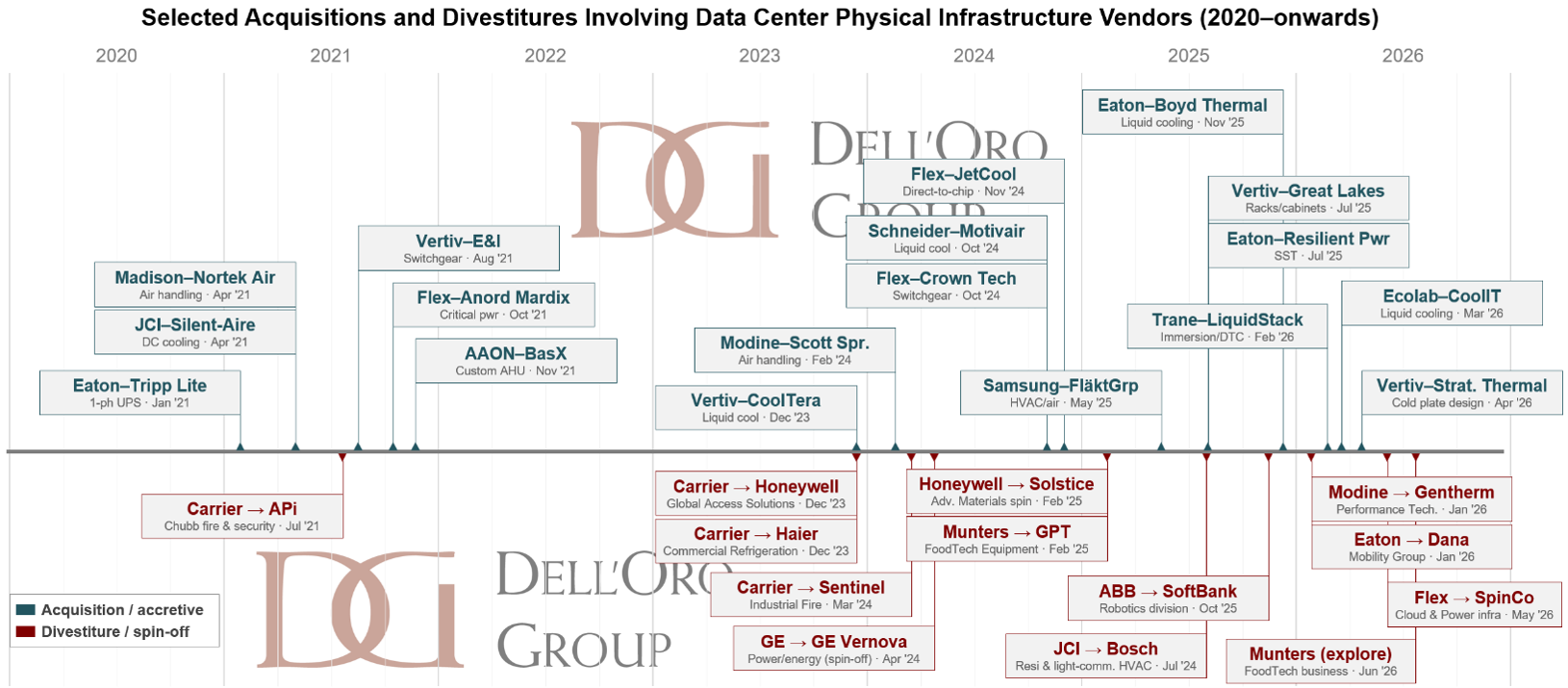
The sell side was busier. In a tightly choreographed portfolio transformation, Carrier shed the businesses that no longer fit. It sold Global Access Solutions, its security arm with the LenelS2, Supra, and Onity brands, to Honeywell for an enterprise value of $4.95 billion, around 17x EBITDA. Next came Industrial Fire and its Det-Tronics, Marioff, Autronica, and Fireye brands, sold to Sentinel Capital Partners for $1.425 billion. Soon it was Commercial Refrigeration’s turn, going to Haier for $775 million. And it capped the program by selling its Commercial and Residential Fire business to an affiliate of Lone Star Funds for $3 billion. An earlier exit, the sale of Chubb fire and security to APi Group, had already set the tone in 2021.
This is harder than a slide deck makes it look. Each carve-out means separating shared systems, renegotiating supplier contracts, staffing data rooms, and absorbing restructuring charges. All while hitting quarterly numbers and paying down the debt taken on for Viessmann. Carrier’s own framing, “performing while transforming,” was less a slogan than a description of the grind. CEO David Gitlin has noted that the divestitures were all signed within about a year of announcement, for a combined value of over $10 billion at a mid-teens EBITDA multiple in aggregate. The reward for the pain is a cleaner story and, the company is betting, a better multiple.
Johnson Controls Goes Pure-Play
A parallel story is playing out at Johnson Controls, a leader in data center thermal management. In August 2025, JCI completed the sale of its Residential and Light Commercial HVAC business to Bosch for $8.1 billion, including its residential joint venture with Hitachi. The move leaves JCI as a pure-play provider of building solutions, with around $5 billion in net proceeds and a $5 billion accelerated buyback.
The Bosch deal is the latest chapter in a long unwinding. JCI spun off its automotive seating business, Adient, back in 2016, then sold its lead-acid battery business, now Clarios, in 2019. Each step steered the company toward commercial buildings, and increasingly toward the data center. While paring the edges, JCI has reinforced the center, picking up hyperscale cooling specialist Silent-Aire and, more recently, direct-to-chip components maker Alloy Enterprises. The portfolio is getting narrower and deeper at the same time.
Trim Cooling to the Core
The pattern is spreading to HVAC players with one foot in other industries, which are now sharpening their focus on thermal and the data center.
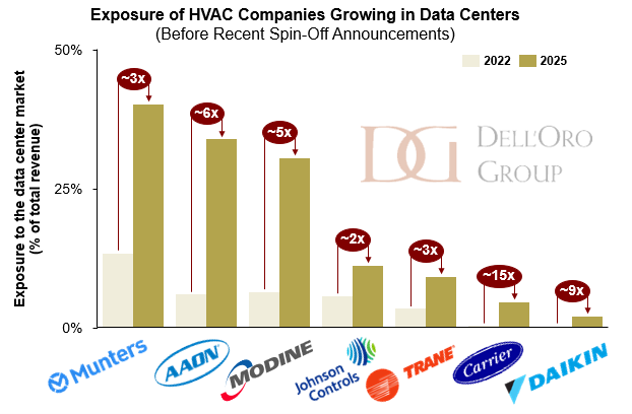
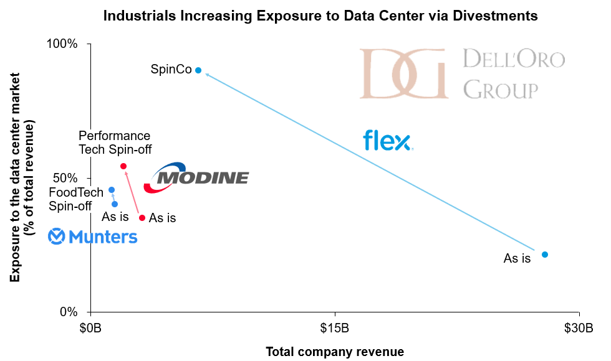
Modine offers a clean example. In January 2026, it agreed to spin off its Performance Technologies business and combine it with Gentherm, in a Reverse Morris Trust. Performance Technologies, the company’s vehicular and power-generation thermal arm, carries about $1.1 billion in revenue. The transaction is valued at roughly $1.0 billion, around 6.8x post-synergy EBITDA, with Modine taking a $210 million cash distribution and its shareholders ending up with about 40% of the combined company. What Modine keeps is the prize: its Climate Solutions segment, now a pure-play built around data center cooling and commercial HVAC. Management expects that business to keep compounding, with data center demand growing well into the double digits. Modine has fed it through acquisitions, too, from Airedale to Scott Springfield and the TMGcore immersion assets.
Munters is running a similar play. The Swedish climate specialist has organized itself around three segments, AirTech, FoodTech, and a fast-growing Data Center Technologies unit that now drives close to 40% of sales. Sharpening that focus, Munters has moved to offload its FoodTech business while continuing to build on the data center side, where its 2024 acquisition of chiller maker Geoclima added liquid-cooling and heat-rejection capacity. The direction of travel is unmistakable: less food and agriculture, more AI factory.
These portfolio moves are part of a wider wave. Many of these companies had already been steadily increasing their data center exposure for years before any spin-off; the breakups and divestitures only accelerate a shift that was well under way.
Source: Company Filings, Dell’Oro Analysis
Crossing Over to the Electrical Side
The same realignment is reshaping the power half of the stack, and the marquee move belongs to Flex.
In May 2026, Flex announced it would spin off its Cloud and Power Infrastructure segmentinto a new, independent public company, provisionally called SpinCo. The new entity will be a grid-to-chip play, integrating power distribution, thermal management, and full infrastructure systems for AI data centers and mission-critical applications. The growth profile is the headline: Flex is targeting 65% to 75% revenue growth for the new company in fiscal 2027, accelerating beyond 80% the year after. Current Flex CEO Revathi Advaithi will lead SpinCo, signaling where the company sees its future. The remaining Flex stays an advanced manufacturing partner, and the split is expected to close in early 2027.
What makes the Flex story instructive is how the segment was built. Flex assembled it through M&A, adding critical-power specialist Anord Mardix, switchgear maker Crown Technical Systems, and direct-to-chip cooling startup JetCool. Buy the pieces, build the platform, then spin it out to let the market value it on its own terms. It is the conglomerate discount thesis run in reverse.
Flex is not alone on the electrical side. GE’s split produced GE Vernova, a pure-play power and grid company. ABB agreed to hand its robotics division to SoftBank for $5.375 billion. nVent sold its thermal management business, the RAYCHEM and TRACER heat-tracing brands, to Brookfield for $1.7 billion, to concentrate on electrical connection and protection.
Source: Company Filings, Dell’Oro Analysis
No name, however, captures the realignment better than Eaton, which is also off-loading non-core assets. On June 2026, it agreed toseparate its Mobility Group and combine it with Dana in a Reverse Morris Trust, valuing the vehicular business at about $5.1 billion and leaving Eaton shareholders with just over half of the combined company plus a $1.1 billion cash distribution. The spin-off sharpens its focus on electrical power.
But Eaton is not only shedding to refocus. It is also expanding inorganically. It added modular enclosure maker Fibrebond for $1.45 billion and solid-state transformer expertise through Resilient Power, building on earlier deals like Tripp Lite. The capstone is its $9.5 billion acquisition of Boyd Thermal, which vaults Eaton into liquid cooling at scale across CDUs, cold plates, and semiconductor thermal interface materials (TIMs), with the company guiding to roughly $1.5 billion in liquid-cooling revenue for 2026. With that cooling portfolio added to its electrical base, Eaton joins the ranks of vendors offering a full data center infrastructure stack.
The Full Stackers Get Fuller
While thermal and electrical specialists have reshaped their portfolios to raise their exposure to markets anchored in lasting high-growth fundamentals, the full stackers never had to. Already at the center of the digital infrastructure buildout, they have marched in a single direction: more power, more cooling, more of the stack.
Vertiv has been the most active. It strengthened white-space rack architectures by acquiring Great Lakes Data Racks & Cabinets for $200 million, around 11.5x EBITDA. It expanded its heat rejection and dry cooling offering with ThermoKeyof Italy, adding EMEA manufacturing. And it reached up the thermal chain to the cold plate with Strategic Thermal Labs, adding server-side liquid-cooling design and validation. These sit alongside earlier moves into liquid cooling with CoolTera, into in-building power with E&I Engineering, and into commissioning and flushing services with PurgeRite. The strategy is end-to-end, grid-to-chip and across the lifecycle.
Source: Company Filings, Dell’Oro Analysis
Schneider Electric has moved more selectively, favoring fewer but larger, high-conviction bets. In July 2025, it agreed to buy out Temasek’s remaining 35% stake in Schneider Electric India for €5.5 billion in cash, taking full ownership of one of its largest and fastest-growing markets. In cooling, it anchored its grid-to-chip ambitions with a 75% controlling stake in Motivairfor $850 million. Motivair brings CDUs, cold plates, rear-door heat exchangers, and chillers, slotting directly into a portfolio that already spans power distribution and white space.
What unites them is a bet on breadth. Each is wagering that owning more of the stack will pay off, either by bundling additional products into the same deployment or by charging for the value of a coordinated, end-to-end design. The attach rate is never complete, and no vendor lands every power and thermal element in every project. But even a partial bundle, sold on the strength of a full-stack portfolio, can beat a point product standing alone.
New Entrants, Deep Pockets
If the incumbents are betting on breadth, another group is making a simpler bet: getting in at all. The most telling signal of this cycle is who is now arriving from outside the traditional infrastructure tent.
Ecolab, the water and hygiene giant, is the standout, and its move builds on a foundation laid years ago. Nalco Water, the treatment business it formed through the 2011 acquisition of Nalco for roughly $5.4 billion, already manages the cooling water that keeps data centers running. Moving from the facility loop to the fluid that cools the chip is the logical next step, and Ecolab took it by agreeing to acquire pure-play liquid-cooling specialist CoolIT Systems for $4.75 billion—a price 17 times what KKR and Mubadala paid only three years before. The premium is striking, but the opportunity behind it may be bigger still. As operators push warmer water through the technology cooling system (TCS) to chase efficiency, keeping that fluid clean and stable becomes a growing pain point, and few can answer it as completely as Ecolab, pairing CoolIT’s hardware with Nalco’s chemistry and the service to maintain both.
Others are crossing the same threshold. Samsung Electronics bought one of Europe’s largest HVAC makers, FläktGroup, for around €1.5 billion, planting a flag in data center precision cooling. Trane Technologies has built an end-to-end thermal stack with liquid cooling specialist LiquidStack and integrator Stellar Energy. Daikin Applied has reached into negative-pressure CDUs with Chilldyne and ultra-high-density cabinets with DDC Solutions. And on the electrical side, Legrand has run a near-continuous bolt-on campaign across busbars, racks, and power distribution, turning a steady stream of small deals into a serious data center franchise.
The New Megatrend
M&A in this sector is running hot, and there is little reason for it to cool down. We flagged as much in our 2026 predictions, where we expect still more deals to cross the $1 billion mark this year. As long as data center capex hovers around a trillion dollars, the business case for acquiring technical capability, manufacturing capacity, and customer relationships writes itself. No activist investor complains that a vendor is too exposed to the data center.
In an era of market exuberance, what makes this moment striking is the discipline. With capital abundant and investor appetite insatiable, an AI label on almost any acquisition would win expedited board approval. Yet the leading industrials are doing the opposite. Like a gardener pruning back the branches of a tree so it bears more succulent fruit, CEOs are reshaping the business for the AI age: offloading distraction, sharpening focus.
This is one of the AI buildout’s more unintended consequences. Industrial stocks have been among the market’s strongest performers in recent years. But the surging demand for electrical and mechanical equipment lifting their shares is only half the story. The bigger story is how AI is pushing these companies to remake themselves from within, unsettling the entire industrial ecosystem.
Industrial vendors have often coalesced around megatrends. For the past two decades, decarbonization and electrification set the agenda and shaped where capital flowed. Now, the AI buildout, and the next industrial revolution expected to ensue, is the dominant force—and the figures show how keen the industrials are to raise their exposure to it.
Are these industrial powerhouses making a mistake by tuning their portfolios to the AI buildout, or are they building a durable, long-term value-creation machine? Only time will tell. But unlike the software and internet companies that torched capital through the dot-com bubble, the industrials are taking a measured approach. And as they transform, they are emerging stronger, with leaner, more innovative portfolios better positioned to capture the opportunities that lie ahead.
###
This blog post shows only a reduced set of the data points behind our analysis. For deeper analysis with full charts, access our client-only version atDell’Oro Client Portal or reach out to the Sales teamto learn about becoming a subscriber.
[wp_tech_share]
Last week, I attended Cisco Live 2026 in Vegas. In ablog published last week, I discussed how Cisco Live 2026 framed AI as a catalyst for enterprise-wide infrastructure modernization, beyond just the data center. In this blog, I would like to double click on Cisco’ AI data center strategy as framed and communicated by Tom Gillis, Kevin Wollenweber, Will Eatherton and Murali Grandluru.
At Cisco Live 2026, the AI infrastructure story continued to move beyond the simple question of who can attach the most GPUs to the fastest network. The more interesting question, especially for non-hyperscale customers is now operational: how do customers design, deploy, secure, validate, and manage AI data centers at a pace that matches the market?
The strategy session with Kevin Wollenweber and Will Eatherton made clear that Cisco sees AI data center infrastructure as a multi-layered opportunity. The company is not only building faster switches or partnering around GPU platforms. It is assembling validated reference architectures, GPU vendor ecosystems, front-end and back-end fabrics, orchestration, observability, and segment-specific engagement models for neoclouds, and enterprises, driving the next wave of the AI adoption.
AI Network Cycles Are Compressing
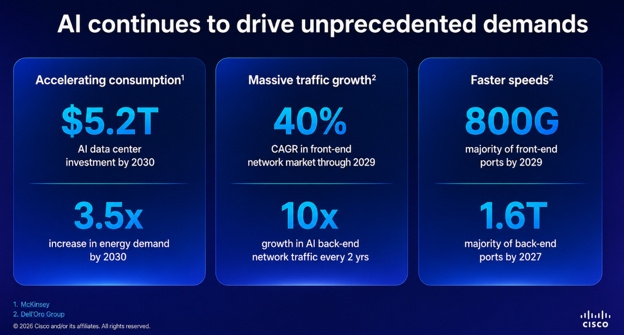
Traditional network refresh cycles that once stretched three to four years are now compressing toward 12 to 18 months. That is a major shift for data center planning, procurement, and architecture teams.
In front-end networks, the market is moving toward 800 Gbps connectivity over the next few years. In the back-end, fabrics are advancing toward 1.6 Tbps and 3.2 Tbps speeds at an unprecedented pace. These are not incremental changes. They reflect the pressure AI workloads are putting on every part of the network fabric.
The reason is straightforward: AI workloads are changing faster than traditional enterprise applications. Training clusters, inference systems, retrieval-augmented generation, and agentic workflows each stress the infrastructure differently. The network must adapt as workload patterns evolve, and customers want architectures that can absorb those shifts without forcing constant redesign.
Source: Cisco Live 2026
Different Customers Need Different AI Data Center Models
At Cisco Live 2026, it was clear that Cisco is not treating the AI data center market as one homogeneous segment. Hyperscalers, neoclouds, and enterprises are moving at different speeds and making different tradeoffs.
Hyperscalers are engaging through deep technical partnerships across multiple future generations. They want flexibility in silicon, software, accelerator choice, and custom algorithm development. Their architectures are becoming more nuanced than a simple scale-up versus scale-out distinction, and many are experimenting across multiple accelerator types.
Neocloud providers are different. They tend to move fast and put heavy emphasis on benchmarking, congestion handling, load balancing, and failure scenarios. They also need multi-tenancy, resource isolation, and shared infrastructure security using mechanisms such as network tags. Their deployment cycles are so compressed that the next cluster may be in planning before the current one is fully deployed.
Enterprises are different again. They generally want simplicity, vendor consolidation, integrated support, and familiar tools. Many are less interested in learning new controllers or stitching together bespoke systems. They want intent-driven automation from day 0 through day 1 operations, and they want AI infrastructure that can fit into existing data center operating models.
This segmentation is important because it suggests the AI data center market will not standardize around one universal architecture. The winning strategy will need to combine opinionated reference designs with enough flexibility to meet different customer operating models.
Source: Cisco Live 2026
Inference and Agentic AI Are Rewriting Data Center Assumptions
The first wave of AI infrastructure demand was dominated by large training environments. The next wave is increasingly about inference and agentic workflows. That shift changes the network conversation.
Historically, many AI designs assumed a much smaller front-end network relative to the scale-out back-end fabric. At Cisco Live, senior executives highlighted that the old 10-to-1 scale-out to front-end ratio no longer holds in all deployments. Some environments are moving closer to 1-to-1 ratios, driven by front-end traffic growth, cache initialization, offline processing, multi-tenant workloads, and new accelerator handoff patterns.
This is an important architectural signal. As AI becomes more distributed and application-facing, the front-end network becomes more strategic. It must handle high-bandwidth server-to-server traffic, connect users and applications to inference services, support multi-tenancy, enforce security policies, and deliver consistent performance under congestion and failure scenarios.
Agentic AI will likely intensify this trend. Agents introduce more workflow steps, more system-to-system communication, and more cut points across the architecture.
GPU Partnerships Are Becoming Architecture Partnerships
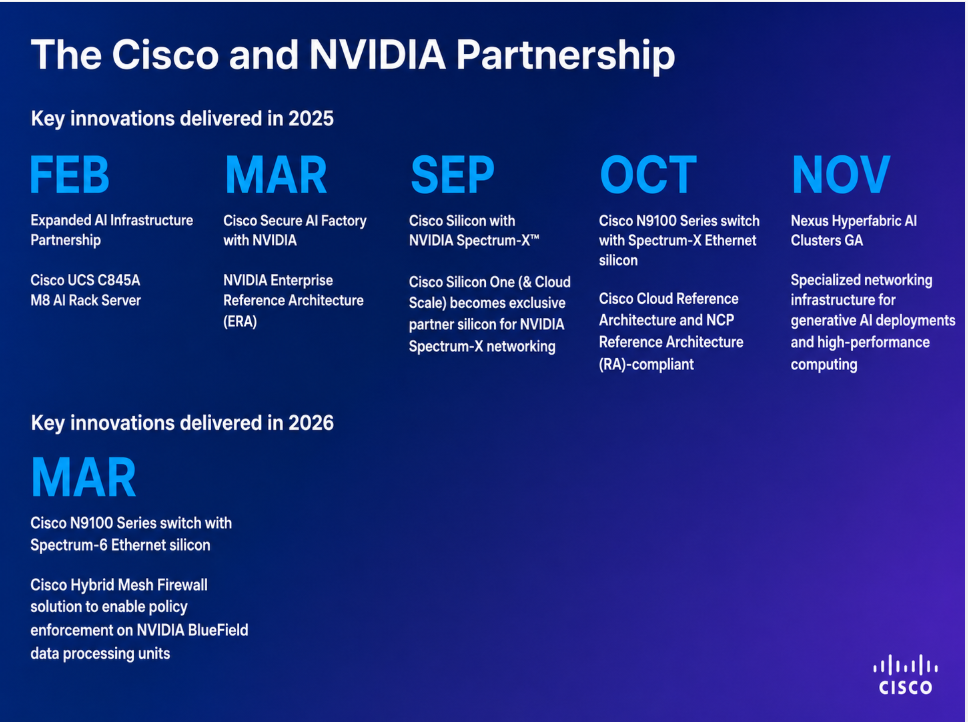
Cisco’s AI data center strategy is also increasingly defined by GPU vendor partnerships. The NVIDIA relationship has moved through several stages: enterprise reference architectures, Spectrum-X technology integration, Nexus 9100 platforms with Spectrum-X silicon, Nvidia certification, Nexus Dashboard management, and development work around BlueField NIC services for firewalling, micro-segmentation, and load balancing.
The significance is not only that Cisco is partnering with Nvidia. It is that the partnership is moving deeper into architecture, management, and services integration. AI data centers are becoming tightly coordinated systems, and the boundaries between accelerator, NIC, switch, controller, and security service are becoming more important.
Cisco is also validating AMD MI300 GPUs with Cisco networking infrastructure. The AMD ecosystem and benchmarking base may still be earlier than NVIDIA’s, but the direction matters. Customers want optionality, especially as AI infrastructure costs grow and accelerator roadmaps diversify.
Cisco Live 2026
Token Economics Are Pulling Some Workloads Back On-Premises
The session also touched on a practical driver that may become more important over time: token economics (or tokenomics). As customers gain experience with cloud-based AI services, they are starting to analyze the cost of token generation across model tiers and deployment options.
For some customers, especially those with large proprietary data sets and repeatable workloads, on-premises infrastructure can offer better cost control. Once customers understand their data, usage patterns, and model economics, they may choose to build dedicated infrastructure rather than consume everything through cloud APIs.
This does not mean the market is moving away from cloud. It means AI deployment decisions are becoming more workload-specific. Customers will evaluate performance, cost, data locality, governance, and operational control. That creates room for hybrid AI architectures and makes the data center relevant again for workloads that justify dedicated infrastructure.
Net-Net
The most important takeaway from Cisco Live 2026 is that AI data center infrastructure is becoming a systems problem. Faster silicon and faster switches are necessary, but they are not sufficient. Non-hyperscale customers increasingly need validated architectures that bring together compute, storage, networking, security, observability, orchestration, and operational tooling.
[wp_tech_share]
How Cisco Live 2026 framed AI as a catalyst for enterprise-wide infrastructure modernization
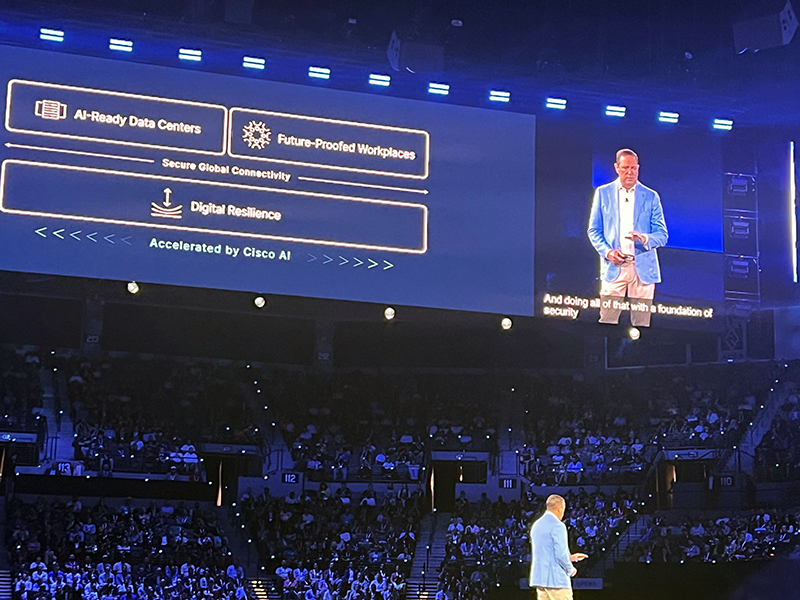
Photo: Cisco CEO Chuck Robbins speaking at Cisco Live 2026 in Las Vegas
At Cisco Live 2026, one message came through clearly: AI infrastructure is no longer just a data center conversation. The next phase of AI adoption will force enterprises to modernize across the full technology stack – from data center fabrics and campus networks to security, identity, observability, and edge operations.
At Cisco Live 2026, the firm’s executives framed Cisco’s opportunity around three outcomes: building AI-ready data centers, enabling future-proof workplaces, and delivering operational resilience. That structure is important because it shifts the discussion away from individual products and toward a broader platform strategy. Cisco is not positioning AI as a single workload or a single refresh cycle. It is positioning AI as a catalyst for infrastructure modernization across nearly every part of enterprise IT.
AI Infrastructure Is Spreading Beyond the Core
The first major theme was the expansion of AI demand beyond centralized compute environments. The early AI infrastructure discussion has been dominated by GPUs, data center capacity, power, and cooling. Those remain critical constraints. But Cisco’s view is that the next bottlenecks will emerge in the networks and systems that connect users, applications, devices, and AI agents.
That means AI readiness will increasingly extend into the campus, WAN, branch, and edge. As inference moves closer to where data is created and decisions are made, enterprises will need networks that can support higher performance, stronger identity controls, lower latency, and more automated operations.
This creates a natural modernization driver. The gap between today’s enterprise infrastructure and what AI-enabled operations will require is becoming clearer. Refresh cycles such as the Catalyst 9000 upgrade path are not just about replacing aging hardware; they are about preparing the enterprise edge for AI workloads, physical AI, stronger security enforcement, and more resilient operations.
Security Becomes an AI Infrastructure Requirement
The second theme was security. Cisco’s senior executives connected traditional infrastructure risk with new AI-specific threats. Known vulnerabilities, unpatched systems, zero-days, and operational complexity remain major challenges. But AI adds another layer: agent behavior, model drift, hallucinations, and non-human identities.
That last point may become one of the most important. As AI agents proliferate, identity is no longer limited to people, devices, and applications. Enterprises will need to govern and secure autonomous or semi-autonomous actors moving across systems. Cisco’s acquisition of Astrix Security fits into this broader need to manage non-human identities as part of the enterprise security model.
The implication is that AI security cannot be treated as a bolt-on. It has to be designed into the infrastructure, the development lifecycle, the observability layer, and the policy framework. This is where Cisco’s platform strategy becomes more relevant. The more AI touches every domain, the harder it becomes for customers to manage risk through disconnected tools.
Observability Must Expand from Infrastructure to AI Workflows
A third theme was observability. Traditional infrastructure monitoring tells enterprises whether the network, applications, and systems are performing as expected. AI introduces a different monitoring problem: are models, agents, and AI workflows behaving as expected?
That is where the Galileo acquisition becomes strategically relevant. By folding Galileo into Splunk Observability, Cisco is extending observability from infrastructure performance into AI workflow behavior, including issues such as hallucination detection and drift analysis.
This represents a meaningful shift. In the cloud era, enterprises needed new tools to secure and monitor cloud-native development. In the AI era, they will need a similar toolchain for AI development, deployment, and runtime governance. Infrastructure observability and AI observability will increasingly need to work together.
Sovereignty and Hybrid Deployment Become Strategic Advantages
Cisco’s senior executives also highlighted growing demand for sovereign and compliance-driven infrastructure. This is not just a regional issue. As governments and regulated industries place more emphasis on where data resides, how infrastructure is controlled, and who manages critical systems, sovereign cloud requirements are likely to influence a larger share of future technology spending.
Cisco’s advantage here is breadth. Its portfolio spans networking, security, observability, compute partnerships, and hybrid deployment models. That matters because sovereign strategies rarely fit neatly into one architecture. Some customers will need on-premises control. Others will need hybrid models. Others will want cloud-like operations with regional compliance.
This plays into Cisco’s broader positioning: global reach, local partner presence, and the ability to support customers across different operating models.
The Platform Is the Strategy
The common thread across Cisco Live was platform integration. Cisco Cloud Control was positioned as an umbrella management and policy layer across the portfolio. The goal is to reduce operational burden, accelerate time to value, and give customers a more integrated experience than they would get from managing multiple point products.
That does not mean Cisco is pursuing a closed strategy. Cisco’s senior executives emphasized open standards, APIs, ecosystem partnerships, and customer choice. The NVIDIA partnership is a good example. Cisco is working with NVIDIA on AI accelerators and Spectrum technology integration, while also signaling support for multiple AI accelerator partners across training and inference.
This balance matters. AI infrastructure will not be built by one vendor alone. But customers will still want simplified operations, unified management, and accountability across increasingly complex environments. Cisco’s bet is that openness and platform integration can coexist.
Net-Net
The most important takeaway from Cisco Live 2026 is that Cisco is using AI to reframe infrastructure modernization. The story is not only about AI-ready data centers. It is about AI-ready enterprises.
That means modernizing the data center, campus, WAN, edge, identity layer, security architecture, and observability stack together. It also means preparing for a world where AI agents become operational actors, sovereign requirements shape buying decisions, and resilience becomes a board-level priority.
Cisco’s strategy appears to be moving in a clear direction: use AI as the demand driver, platforms as the operating model, partnerships as the ecosystem lever, and security as the connective tissue. The winners in this next phase of infrastructure will not simply be the vendors with the best hardware. They will be the vendors that help customers turn complexity into an integrated, resilient, and AI-ready operating environment.
[wp_tech_share]
Networking Is Becoming a Strategic Layer of AI
OpenAI, alongside a consortium of major technology players, including AMD, Broadcom, Intel, Microsoft and NVIDIA have introduced a new networking protocol designed to prevent congestion and hardware failures from disrupting large-scale AI clusters—underscoring how networking is becoming just as strategic as the compute itself.
Large-scale AI training depends on thousands of GPUs working together in tight synchronization. When one part of the network slows down or fails, the impact can ripple across the entire training job. Multipath Reliable Connection (MRC) focuses on reducing that risk by improving performance, resilience, and predictability across very large XPU clusters.
Ethernet Is Moving into the AI Supercomputer Core
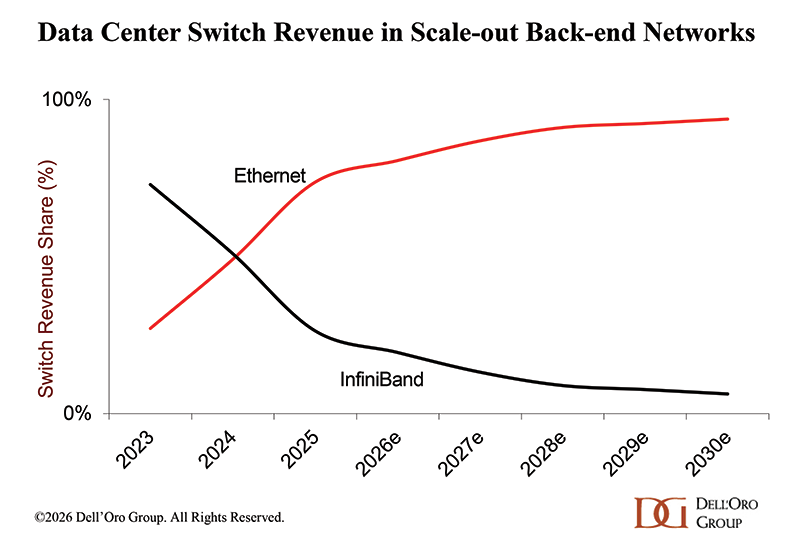
One of the most important signals from this announcement is the continued shift from InfiniBand toward Ethernet-based AI networking. InfiniBand has played a major role in high-performance computing and AI clusters, but Ethernet is becoming increasingly attractive because of its scale, openness, broad supplier base, and operational familiarity.
MRC extends RoCE, or RDMA over Converged Ethernet, and combines it with techniques such as multipath packet spraying and SRv6 source routing to make Ethernet more resilient for synchronous AI training workloads.
This does not mean InfiniBand disappears overnight. But it does show that Ethernet is rapidly evolving from a general-purpose data center technology into a serious foundation for the largest AI supercomputers. For the industry, that matters. A stronger Ethernet ecosystem could reduce dependency on a single networking approach, expand vendor participation, and give cloud providers and AI labs more flexibility in how they design infrastructure.
Open Standards Matter at AI Scale
The second major takeaway is the importance of openness and diversity. OpenAI’s decision to release the MRC specification through the Open Compute Project is significant because AI infrastructure is becoming too large and complex for closed, vertically isolated systems to scale efficiently.
Open standards can help align silicon vendors, cloud providers, system builders, and AI labs around common building blocks.
Diversity Is a Practical Requirement, Not Just a Principle
That diversity is not just philosophical. It is practical. The AI infrastructure market needs multiple suppliers for XPUs, NICs, switches, cloud platforms, and software layers. As demand for AI compute continues to rise, industry-wide collaboration can improve resilience, mitigate supply risk, reduce bottlenecks, and accelerate deployment.
From Specification to Real-World Deployment
The third major key takeaway is that MRC is not only a research concept; it is already being used in production. OpenAI says MRC is deployed across its largest NVIDIA GB200 supercomputers, including its site with Oracle Cloud Infrastructure in Abilene, Texas, and Microsoft’s Fairwater supercomputers. Both of these examples were deployed using NVIDIA’s SpectrumX switches.
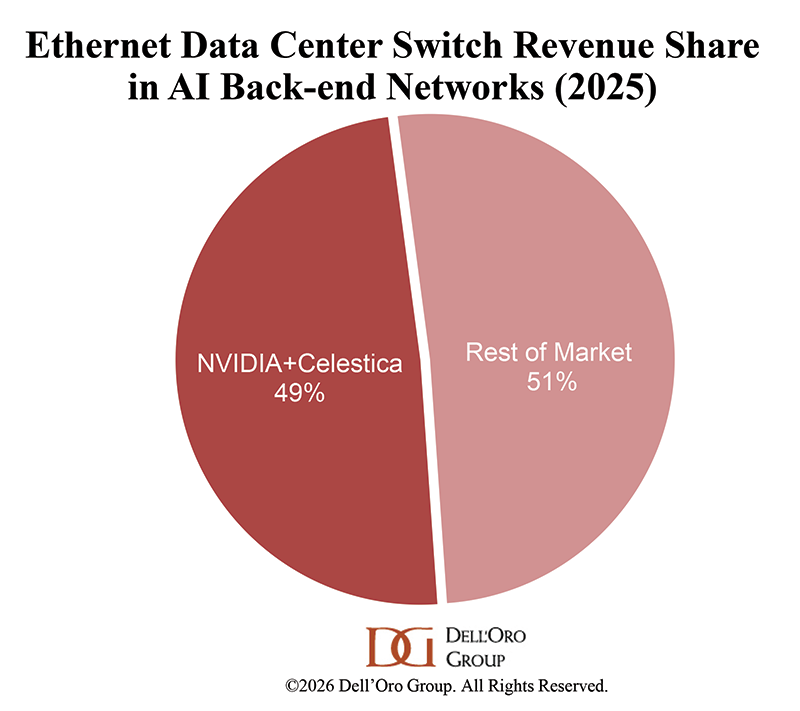
More broadly, these deployments validate the accelerating shift toward Ethernet in large-scale AI clusters. According to Dell’Oro Group’s Data Center Switch—AI Back-end Networks report, NVIDIA and Celestica captured 50% of AI back-end networks in 2025. Arista ranked third, despite a significant portion of its AI-related product revenue being deferred.
The Bigger Industry Message
For the broader industry, the message is clear: AI infrastructure is entering a new phase. The question is no longer only who has the most XPUs, but who can connect them efficiently, operate them reliably, and keep them productive at massive scale.